Battery Electric Vehicles and Emissions in India
Recent studies reveal vital information about the emissions of passenger vehicles in India. A collaboration between the Indian Institute of Technology (IIT) Roorkee and the International Council on Clean Transportation (ICCT) has shown that Battery Electric Vehicles (BEVs) emit up to 38 per cent less carbon dioxide equivalent (CO₂e) per kilometre compared to Internal Combustion Engine (ICE) vehicles. This research synthesises findings from six life-cycle greenhouse gas emission assessments.
Key Findings of the Study
The study marks three main factors that contribute to the variability in emissions – grid carbon intensity, laboratory test assumptions, and real-world driving conditions. Together, these factors account for nearly 75 per cent of the differences in emissions. The analysis indicates that emissions can vary based on grid mix and efficiency, with differences reaching up to 368 grams of CO₂e per kilometre.
Advantages of Battery Electric Vehicles
BEVs consistently outperform ICE and Hybrid Electric Vehicles (HEVs) in terms of life-cycle GHG emissions. Their efficiency is maximised when analyses reflect real-world performance rather than unrealistic energy consumption assumptions. The study warns against delaying BEV adoption in anticipation of a cleaner grid. Vehicles that are ICE will remain operational for 10 to 15 years, continually contributing to emissions.
Real-World Performance and Testing
The discrepancy between laboratory test cycles and real-world fuel use in HEVs is . Accurate emissions accounting requires the application of real-world correction factors. BEVs demonstrate the highest energy efficiency in practice, underscoring the need for stringent fuel efficiency standards. Real-world adjustments are essential, particularly for BEVs, where charging losses are often overlooked.
Importance of Land-Use Change in Assessments
Many assessments fail to consider land-use change, leading to an underestimation of emissions from biofuels. For example, diesel production emissions vary widely depending on land-use change considerations. This oversight can misrepresent the environmental impact of biofuels and needs to be addressed in future evaluations.
Policy Recommendations
https://www.gktoday.in/battery-electric-vehicles-and-emissions-in-india/

We came across a bullish thesis on Northern Dynasty Minerals Ltd. (NAK) on TripleS Special Situations’s Substack by Tiny Stock Ninja. In this article, we will summarize the bulls’ thesis on NAK. Northern Dynasty Minerals Ltd. (NAK)'s share was trading at $1.2 as of 4th June.
Is Southern Copper Corporation (SCCO) the Best Stock To Buy According to Marjorie Taylor Greene?
A large open-pit mining site, its machinery providing a long-term supply of copper.
Northern Dynasty Minerals (NAK) offers a uniquely asymmetric investment opportunity at the intersection of geopolitics, resource sovereignty, and severe market mispricing. The Pebble Project—one of the world’s largest undeveloped copper deposits—has long been stalled by regulatory hurdles, but the return of the Trump administration has radically altered its strategic outlook.
Recent executive orders prioritize domestic mineral independence and list copper and gold as critical to national security, with directives to expedite permitting. These policy shifts directly benefit dormant projects like Pebble, especially as the U.S. now imports over 45% of its copper.
Simultaneously, the global copper supply is entering a structural deficit, exacerbated by decades of underinvestment and geopolitical tensions, including tariffs cutting off U.S. access to Chinese rare earths. Legally, Northern Dynasty has advanced its position through persistent appeals and a well-documented challenge to both the EPA veto and Army Corps denial, citing contradictions with the Final Environmental Impact Statement, which found no measurable impact on local fisheries.
These appeals align with the administration’s deregulatory momentum, especially in Alaska, where a broad pro-development agenda is unfolding. The Pebble resource base is staggering, with measured and inferred deposits totaling tens of billions of pounds of copper and millions of ounces of gold, carrying a gross market value exceeding $400 billion.
At a current market cap of just $660 million, the upside is massive, with after-tax profits projected in the tens of billions. While regulatory and execution risks remain high, the strategic alignment of policy, resource needs, and valuation distortion sets the stage for potentially generational returns.
Previously, we have covered a bullish thesis on Harmony Gold Mining Company Limited (HMY) by Intelligent_Okra5374 on the Value Investing Subreddit in April 2025, which operates in the same industry as Northern Dynasty Minerals Ltd. (NAK). Harmony Gold is a profitable, cash-generative gold producer with diversified assets and a strong balance sheet, benefiting from macro tailwinds in precious metals and expanding into copper for long-term growth.
https://finance.yahoo.com/news/northern-dynasty-minerals-ltd-nak-154317032.html
COPPER smelters are paying unprecedented sums to process raw materials as China’s aggressive expansion of processing facilities creates a global market imbalance that threatens the viability of facilities worldwide, the Financial Times reported today.
Processing fees charged by smelters have turned negative for most of this year, hitting a record low of minus $45 per ton in May, said the newspaper, citing Fastmarkets data. This means smelters are effectively paying to process copper concentrate rather than earning their traditional margins, forcing many to operate at a loss simply to keep running.
“There is likely to be reduced copper smelter activity and potentially also some shutdowns in the Asian market,” Toralf Haag, CEO of copper producer Aurubis, told the FT.
The crisis stems from China’s strategic push to dominate base metals markets through massive capacity expansion, even as Western nations seek to reduce their dependence on Chinese processing. China has continued building new smelting facilities despite a shortage of the concentrate needed to feed them, the newspaper said.
Several facilities have already succumbed to market pressures. Glencore halted operations at its Pasar smelter in the Philippines in March, citing “increasingly challenging market conditions.” Analysis group CRU reported that continued commissioning of Chinese smelters is exacerbating downward pressure on processing fees.
The negative fees persist despite copper prices reaching near-record levels, with London copper trading at roughly £7,650 per ton on Monday. Global demand is expected to outstrip supply by 30% by 2035, according to the International Energy Agency.
Analysts warn that benchmark processing fees on long-term contracts between smelters and miners could turn negative for the first time, potentially forcing “meaningful smelting capacity reductions,” said Andrew Cole of Fastmarkets.
https://www.miningmx.com/trending/61417-copper-smelters-face-record-losses-amid-oversupply/
By Anushree Mukherjee and Kavya Balaraman
(Reuters) -Platinum and palladium prices have both rallied this month, notching a more than four-year and seven-month high respectively, but analysts say they remain more cautious about the outlook for palladium due to its narrower demand base.
Spot platinum was trading at $1,272.45 per ounce as of 1545 GMT on Wednesday, its highest level since February 2021, and has risen 41% this year on supply concerns, renewed investor interest following London Platinum Week in May, and increased jewellery demand as high gold prices drive consumers to cheaper alternatives, analysts say.
Spot palladium, meanwhile, was trading at $1,078.62/oz, its highest level since November 2024, and has gained 18% this year, but has struggled to reach the high of $1,244.75 hit in October 2024.
"The biggest factor is likely the wider appeal which platinum enjoys. Platinum’s uses are more diverse, spanning industrial applications, jewelry, and investor demand," said Zain Vawda, market analyst at MarketPulse by OANDA.
"This diversification shields platinum from the headwinds palladium faces, such as declining long-term demand from the traditional automotive market due to the EV transition."
Palladium is mainly used in catalytic converters for gasoline vehicles, while platinum has broader uses in diesel catalytic converters, jewellery, industrial applications, and emerging hydrogen technologies.
PALLADIUM PRICES LAGGING
Palladium could be considered a "one trick pony", with 90% of its demand coming from car manufacturers, Bank of America said in a note last week.
"China's rising EV penetration rates are particularly damaging because it means that palladium-intensive cars with a gasoline engine are now being quickly displaced," the note added.
The transition to EVs will also affect platinum in the medium term, but to a lesser extent, analysts told Reuters.
"Large commercial vehicles will likely use larger amounts of platinum (relative to palladium) and these vehicles will be slower to electrify. Over time, the hydrogen economy will also absorb some platinum, limiting the downside risk on platinum versus palladium," said Nitesh Shah, commodities strategist at WisdomTree.
Global sales of battery-electric vehicles and plug-in hybrids rose to 1.5 million in April. Sales in China were up 32% from the same month of 2024 to 0.9 million vehicles.
PLATINUM RALLIES
Platinum, meanwhile, is expected to be moderately supported over the next six to 12 months, although the upside may be capped without a clear rebound in auto demand or meaningful acceleration in hydrogen-related applications, said Alexander Zumpfe, a precious metals trader at Heraeus Metals Germany.
https://finance.yahoo.com/news/platinum-surges-palladium-lags-narrow-163815752.html
Wall Street's attention next week will be on further trade developments and key inflation data.
U.S. and Chinese officials, including U.S. Treasury Secretary Scott Bessent, Secretary of Commerce Howard Lutnick, Trade Representative Ambassador Jamieson Greer, and Chinese Vice Premier He Lifeng, are set to meet in London on Monday. Investors will be keeping a close eye on the talks. The last round of discussions had resulted in a surprise temporary trade truce, boosting market sentiment.
Turning to the economic calendar, traders will receive May readings for the consumer price index and the producer price index.
The earnings season next week is highlighted by video game retailer GameStop (GME), cloud software firm Oracle (ORCL) and Photoshop creator Adobe (ADBE).
Also grabbing the spotlight will be Apple's (AAPL) WWDC 2025, kicking off on Monday. The event is expected to feature major announcements and a first look at new updates for iOS, iPadOS, macOS, watchOS, tvOS, and visionOS.
Earnings spotlight: Monday, June 9: Casey's General Stores (CASY), Calavo Growers (CVGW), Lakeland Industries (LAKE). See the full earnings calendar.
Earnings spotlight: Tuesday, June 10: GameStop, J. M. Smucker (SJM), United Natural Foods (UNFI), GitLab (GTLB). See the full earnings calendar.
Earnings spotlight: Wednesday, June 11: Oracle, Chewy (CHWY), SailPoint (SAIL). See the full earnings calendar.
Earnings spotlight: Thursday, June 12: Adobe, Lovesac (LOVE). See the full earnings calendar.
https://seekingalpha.com/article/4793264-wall-street-week-ahead?source=feed
2 Picks For Monthly Distributions And Participating With Activists
Summary

Aleksandra Zhilenkova/iStock via Getty Images
Written by Nick Ackerman, co-produced by Stanford Chemist
Closed-end funds can offer opportunities to invest in assets at below their current valuation, which is through the discount/premium mechanic. That is the result of these funds not having a creation and redemption mechanism, such as is the case with their traditional open-ended mutual funds and exchange-traded funds counterparts. With that, they can present these potential opportunities, and there are activist groups that specifically target these types of opportunities.
Investing in them through activist funds can be an interesting way to participate in their expertise in this area, while also delivering substantial diversification. We're looking at two funds today that have a long history of delivering solid results through the generation of their high distributions paid monthly.
#1 Special Opportunities Fund (SPE)
SPE "employs an opportunistic investment philosophy with a particular emphasis on investing in discounted closed-end funds, undervalued operating companies, and other attractive special situations, including risk arbitrage and distressed securities."
This is a fund that is the result of Bulldog Investors taking over in 2009 as an activist target.
As another closed-end fund, there is a unique opportunity here to pick up a position that is at a discount itself, while it invests in a significant allocation of other discounted CEFs. Besides around half of its portfolio being invested in traditional CEFs, they also hold an allocation to business development companies. These are also a pool of assets, usually mostly senior loan investments. Otherwise, the fund also has a rather high allocation to special purpose acquisition vehicles and common stocks.
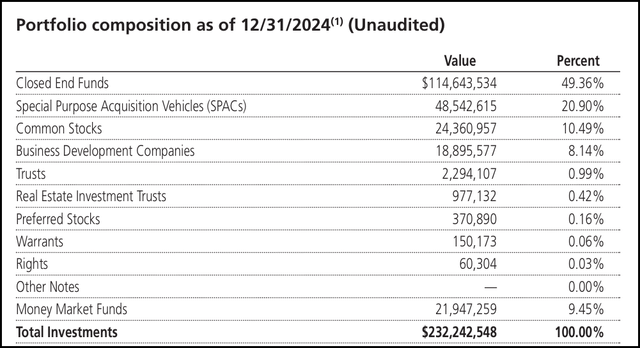
SPE Portfolio Composition (Bulldog Investors)
The top positions of the fund tend to be heavily discounted CEFs, with SRH Total Return (STEW) and General American Investors (GAM) being the top two. This is then followed by BDC CION Investment (CION) and then back to a traditional CEF Central Securities Corp. (CET). STEW, GAM and CET all trade at wide discounts, and have tended to do so for quite a significant period of time.
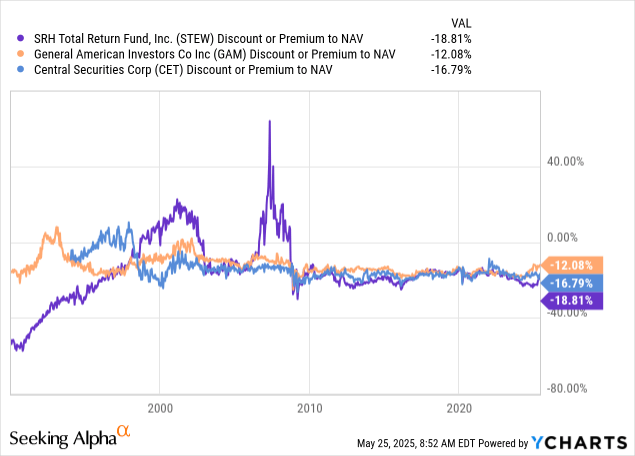
They've also been regular positions in SPE's portfolio, so these three appear to be more core types of positions for the fund.
Similar to CEFs, BDCs can also trade at discounts, and as of the last reported NAV, CION is pushing near a 33% discount.
SPE provides a monthly distribution that is based on a managed 8% NAV distribution rate calculated at the end of the year. They pay monthly, which is another potentially attractive feature of SPE. CET and GAM pay semi-annual distributions, with CION and STEW paying quarterly. In a way, that makes SPE convert these into more regular monthly payers.
The distribution policy went into place several years ago, as SPE was a rather irregular payer too. Then, prior to 2009, it was a muni fund.
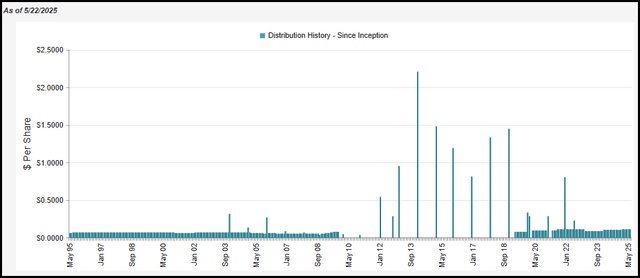
SPE Distribution History (CEFConnect)
They report NAV weekly, and they also include a diluted NAV due to their leverage coming via a convertible preferred offering, the Special Opportunities Fund 2.75% Convertible Preferred Series C (SPE.PR.C). This is an enviable leverage rate when you consider that most other funds are borrowing through a credit facility, paying closer to 5% these days.
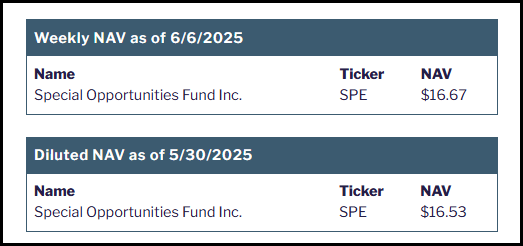
SPE Weekly NAV (Bulldog Investors)
Worth noting is that SPE is being leveraged and holding other CEFs that are also leveraged; you can get leverage on leverage, which could make SPE even more volatile. In that same line of thinking, that also comes with fees on fees, so being able to pick up SPE at a meaningful discount can be important.
At this time, I believe that SPE is presenting a fairly attractive time to consider investing in this fund. Our buy target is at around a 10% discount, and we are quite close to that, but technically just under, based on the latest weekly NAV. If calculating it based on the diluted NAV reported a week earlier, then we are at an 11% discount.
#2 Saba Closed-End Funds ETF (CEFS)
CEFS' investment objective and investment strategy are to "generate high income by investing in closed-end funds trading discounted to net asset value, and hedging the portfolio's exposure to rising interest rates."
CEFS is an exchange-traded fund, which doesn't provide a "discount on discount" opportunity due to the ETF creation and redemption mechanism that keeps the NAV per share reasonably close to the share price. That said, as a Saba Capital managed fund, they are much more active when it comes to targeting CEFs.
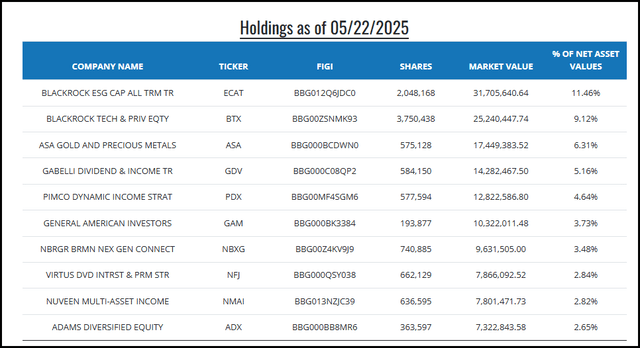
CEFS Top Ten Holdings (Saba Capital)
The average discount to NAV of the underlying holdings was listed at nearly 9% across 97 holdings. The fund also utilizes leverage, but they've been reducing the leverage they're using. Keeping in mind, some of CEFS' portfolio holdings are also leveraged.
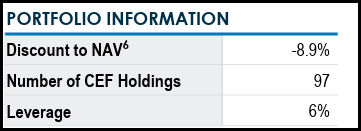
CEFS Portfolio Info (Saba Capital)
Unlike CEFs, ETFs have to report the acquired fund fees and other expenses, which are expenses of the underlying portfolio. Therefore, we get a good idea of what the fees on fees add up to with CEFS, which we don't get for SPE, as it isn't provided.
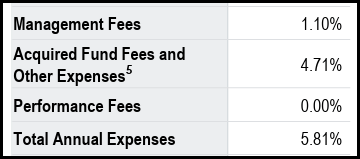
CEFS Expense Ratio (Saba Capital)
These are hefty expenses, but the fund's performance has been able to put up a solid track record of stronger long-term results, nonetheless, which is usually what counts.
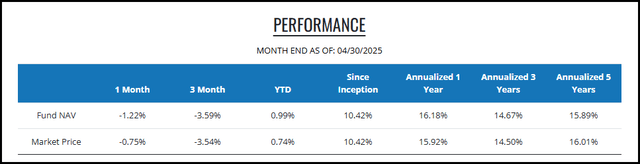
CEFS Annualized Performance (Saba Capital)
What else counts for investors in this fund is likely the distribution that is paid out monthly. Unlike most ETFs, they pay a level distribution, providing a predictable monthly payout for extended periods of time. Most other ETFs pay out whatever income/gains they'd have generated during the period. At this time, they pay $0.14 a month as the regular distribution and then pay out a year-end special as required.
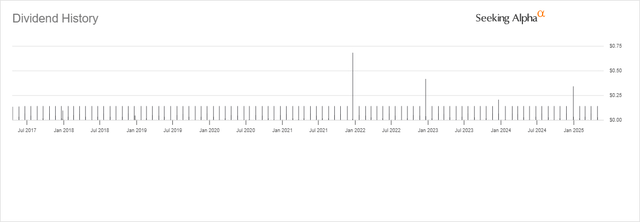
CEFS Distribution History (Seeking Alpha)
Conclusion
SPE and CEFS provide significant diversification wrapped up into one package through investing in underlying CEFs. Both of these funds are run by activists, though Saba Capital tends to be much more aggressive relative to Bulldog. For SPE, one has the opportunity of investing in a discounted fund that is also trading at a discount to its NAV. For CEFS, it may not have a meaningful discount, but being more active can tend to drive discount narrowing within the underlying portfolio of holdings.
At the CEF/ETF Income Laboratory, we manage closed-end fund (CEF) and exchange-traded fund (ETF) portfolios targeting safe and reliable ~8% yields to make income investing easy for you. Check out what our members have to say about our service.
Russia said on Sunday that its forces had launched cluster sticks against multiple military targets of Ukraine, while Ukraine, on the same day, reported downing a Russian Su-35 fighter jet.
The Russian military conducted cluster strikes using long-range precision weapons and drones against targets in Ukraine in the past 24 hours. The strikes targeted enterprises of Ukraine's military-industrial complex, including workshops assembling attack drones, facilities for the maintenance and repair of weapons and military equipment, and ammunition depots, the Russian Ministry of Defense said.
The objective of the strikes has been achieved, with all designated targets being hit, the ministry said.
It also said that the Russian air defense systems shot down a total of 311 Ukrainian fixed-wing drones, among which 140 were located outside the special military operation area, and the Russian army also destroyed four Ukrainian unmanned boats in the Black Sea.
On the same day, the General Staff of the Ukrainian Armed Forces reported over 100 combat clashes with Russian forces on the front lines over the past day, with the most intense fighting occurring in the directions of Pokrovsk and Krasnyi Lyman (Red Lyman).
The Ukrainian Air Force said that it shot down a Russian Su-35 fighter jet in the direction of Kursk on Saturday.
The Ukrainian side also said that on Friday, the Ukrainian military, in coordination with the Defense Intelligence of Ukraine, carried out strikes on multiple Russian military targets, including facilities within the territory of Russia.
Meanwhile, Ihor Terekhov, mayor of Ukraine's second-largest city of Kharkiv, said the city came under the "most intense" Russian attack early on Saturday since the outbreak of the conflict between the two countries.
On Saturday, Andriy Kovalenko, head of the Center for Countering Disinformation at Ukraine's National Security and Defense Council, said that a refinery owned by Russian company Lukoil had caught fire that day.
Kovalenko said that Lukoil is a key asset in Russia's energy sector, primarily providing aviation, armored vehicle, and logistical fuel for the Russian military.
There has been no response from the Russian side regarding this incident.
Russia strikes Ukrainian military targets, while Ukraine downs Russian fighter jet
President Trump and Chinese leader Xi Jinping spoke on Thursday, with tariff and trade talks set to resume next week.
Trump said Treasury Secretary Scott Bessent, Commerce Secretary Howard Lutnick, and US Trade Representative Jamieson Greer would meet with Chinese counterparts in London on Monday.
"The meeting should go very well," he said.
Trump's call with Xi, which both leaders framed as positive, came after weeks of Trump publicly pushing for the talk. US-China tensions have risen in the aftermath of the countries' trade truce reached in mid-May in Geneva, with both countries have accused the other of breaching that truce while ratcheting up pressure on other issues.
The US and China are also now using their control over certain key materials to gain control in the trade war. Bloomberg reported on Friday that the US dominates in ethane, a gas used to make plastics, and China buys nearly all of it. Washington is now tightening control by requiring export licenses. China's curbs on exports of rare earth minerals, crucial for autos and more, have drawn Washington's ire.
Read more: What Trump's tariffs mean for the economy and your wallet
The US-China talks come as Trump pushes countries to speed up negotiations. The US sent a letter to partners as a "friendly reminder" that Trump's self-imposed 90-day pause on sweeping "reciprocal" tariffs is set to expire in early July.
White House advisers have for weeks promised trade deals in the "not-too-distant future," with the only announced agreement so far coming with the United Kingdom. US and Indian officials held trade talks this week and agreed to extend those discussions on Monday and Tuesday ahead of the July 9 deadline.
Also effective Wednesday, June 4, Trump doubled tariffs on steel and aluminum from 25% to 50%
Meanwhile, Trump's most sweeping tariffs face legal uncertainty after a federal appeals court allowed the tariffs to temporarily stay in effect, a day after the US Court of International Trade blocked their implementation, deeming the method used to enact them "unlawful."
Here are the latest updates as the policy reverberates around the world.
LIVE
1110 updates

The U.K. Treasury has run out of road for delaying nuclear decisions, according to Whitehall and industry insiders.
LONDON — Philip Hunt, the unassuming Labour peer put in charge of rejuvenating U.K. nuclear energy, has a favorite joke about how slowly the industry moves.
Hunt — who was first an energy minister from 2008-2010 and retired from his second stint in government just last month — liked to roll out the gag at Westminster receptions, according to one industry figure who saw him in action.
“I came back after 14 years,” the minister would say, “and everything was exactly as I left it.”
It was a way to bash the Conservatives’ decade-and-a-half in power, but also an admission of the glacial pace of the nuclear world.
That is about to change. Ministers are prepping a series of high-profile nuclear announcements in the lead-up to the government-wide spending review on June 11.
The government is expected to unveil, after months of delay, the winner of a multi-billion pound contract to build next-generation small modular reactors (SMRs), known as “mini nukes.” A long-awaited financial decision on the mega nuclear plant Sizewell C in Suffolk is on its way. Meanwhile, U.K. officials are discussing buying up nuclear sites from private ownership to bring the industry under greater state control.
It would trigger more activity on nuclear over a handful of weeks than there has been in a generation.
This flurry of action is coming, insiders say, not because of astute maneuvering by Hunt or his political bosses but because the Treasury — long skeptical about nuclear — has run out of road for ignoring the problem.
The looming spending review, the last chance in this parliament to commit cash to the U.K.’s neglected nuclear energy system, “has forced the government’s hand,” said a second energy figure, granted anonymity, like others in this piece, to speak candidly about government planning.
Worried about the splurge
Bringing more low-carbon nuclear power online is crucial to two of Prime Minister Keir Starmer’s “missions” in government — galvanizing sluggish economic growth and ending the U.K.’s reliance on high-polluting fossil fuels.
Backing more nuclear power in a speech in February, Starmer said he was taking on “the blockers who have strangled our chances of cheaper energy, growth and jobs for far too long.”
The industry has its vocal supporters on Labour’s benches, too. “We urgently need new nuclear in this country, not just for the energy security but for the jobs and the growth opportunities, too,” said Charlotte Nichols, MP for the red wall seat Warrington North. Tom Greatrex, an ex-Labour MP who now heads the Nuclear Industry Association lobby group, said: “The time for talking is over. We need to see decisions being made.”
https://www.politico.eu/article/nuclear-power-will-spending-reviews-big-winner-philip-hunt/
By Metal Miner - Jun 07, 2025, 4:00 PM CDT
The Rare Earths MMI (Monthly Metals Index) found more price stability month-over-month. As a result, it moved sideways, with only a 0.81% increase. Despite this, the short-term outlook for rare earths remains uncertain. Chinese export restrictions jolted prices in H1 of 2025 and fractured long-running supply lines. Shortly after, global automakers warned that Beijing’s April curbs on alloys and magnet exports “could cause production delays” without fast relief.
China’s Rare Earths Shockwaves Continue to Jolt Global Markets
Chinese market data show how wild things got in May. According to China Tungsten Industry charts, Chinese rare earth prices jumped sharply in early May before easing later in the month. For example, after a brief rally, neodymium-praseodymium metal was about $4,176.53/ton higher. Overall, May’s closing prices were slightly above April levels.
China’s policy shock continues to be felt worldwide. The export bans target medium-heavy rare earths used in EV motors, wind turbines and high-tech weapons. One industry report said the restrictions “triggered a ripple effect” through global EV and clean-energy supply chains.
According to Reuters, the country still mines roughly 60% of the world’s rare earths and refines ~90% of them, making it the undisputed supply giant. MP Materials, the U.S.’s only large rare-earth miner, warned the situation is “broken,” and that China’s moves will force a laser focus on American supply security.
Trade Truce or Temporary Fix?
Throughout 2025, U.S. buyers have scrambled for solutions. After a G7 trade “truce” in mid-May, Washington pressed Beijing to ease restrictions, and Reuters sources say China may now fast-track export licenses for U.S. customers. Still, complete relief isn’t assured. Meanwhile, suppliers are sounding the alarm, warning that electric vehicles, defense and renewable energy are all in the crosshairs.
Permanent magnets are vital in EV motors. In fact, a single electric car can require several kilograms of neodymium and dysprosium. In aerospace and military manufacturing, the stakes are even higher. For instance, the F-35 fighter consumes roughly 900 pounds of rare-earth magnets, while a Virginia-class submarine requires over 9,200 pounds. Wind turbines and satellite systems also rely heavily on these materials.
Prices on Edge: U.S. Buyers Brace for a Volatile Summer
Rare earth element prices will likely experience continued instability over the next few months due to persistent supply challenges and rising geopolitical friction. China’s tightening of export controls on crucial materials like neodymium and praseodymium has caused significant ripples throughout global supply chains. These disruptions are hitting U.S. sectors especially hard, particularly those tied to electric vehicles, wind energy and national defense.
For U.S procurement teams, this landscape highlights the need to both diversify supply channels and support the development of domestic production. Rare earth companies are expanding output, but that effort won’t solve short-term shortages. In the meantime, decision-makers should stay alert to evolving market conditions and consider building up inventory as a buffer against future shocks. Regularly consulting trustworthy market data and industry insights will be essential to making informed sourcing decisions during this volatile period.
Many procurement teams have shifted strategies overnight. Manufacturers are diversifying suppliers, boosting recycling of old magnets and even redesigning products to use fewer heavy rare earths. For example, EU firms are planning magnet recovery from scrap batteries and turbines, while the EU government recently identified 13 new mining projects outside China to shore up supply.
Summary
We have three strategic asset-allocation models, based on risk-tolerance levels: Conservative, Growth, and Aggressive. We make tactical adjustments to the models on a regular basis, based on our outlooks for the various segments of the capital markets. In terms of performance through May, stocks and bonds are neck-and-neck, both with sub-par returns of 1% year to date. Looking ahead from an asset-allocation standpoint, our Stock-Bond Barometer model still slightly favors bonds over stocks for long-term portfolio positioning. In other words, these asset classes should be near their target weights in diversified portfolios, with a slight tilt toward bonds. We are over-weight on large-caps at this stage of the market cycle. We favor large-caps for growth exposure and financial strength, amidst volatility. Our recommended exposure to small- and mid-caps is 10% of equity allocation, below the benchmark weighting. Global stocks have taken an early performance lead in 2025, although U.S. stocks have outperformed their global peers over the trailing one- and five-year periods. We expect the long-term trend favoring U.S. stocks to re-emerge, given volatile global economic, political, geopolitical, and currency conditions.
The Bundesbank lowered expectations in its new six-month forecast
The German Bundesbank expects the economy to stagnate in 2025 after two years of recession in the country. This is stated in the new six-month forecast of the central bank, released at the end of last week.
Thus, the regulator has downgraded its December expectations, according to which Germany’s GDP growth was expected to reach 0.2% this year.
As noted, the recovery of the German economy is delayed due to uncertainty over international trade policy, and fiscal measures are only gradually beginning to support it.
According to Bundesbank President Joachim Nagel, new US tariffs and uncertainty about future US policy will initially slow economic growth. This hits German industry at a time when it is beginning to stabilize after a long period of weakness. However, a sharp increase in government spending on defense and infrastructure should provide a noticeable boost to demand and GDP growth from 2026 onwards. According to the new forecast, inflationary pressures in Germany also continue to decline.
The central bank predicts that the country’s GDP will grow by 0.7% in 2026 (December expectations – 0.8%), and by 1.2% in 2027 (0.9% in December).
Bundesbank experts point out that the short-term prospects are primarily overshadowed by the protectionist trade policy of the United States. In general, German exports will decline significantly in 2025 and grow only slightly in 2026. The decline in industrial production due to tariffs is cooling the labor market and slowing wage growth.
“Starting in 2026, expansionary fiscal policy and the reduction of the inhibitory effect of US economic policy on growth will lead to a marked recovery in the German economy,” the regulator said in a statement.
Inflation growth will slow to an average annual rate of 2.2% in 2025. In 2026, it is expected to temporarily decline to 1.5% due to energy prices, and then rise again to 1.9% in 2027.
The European Central Bank has maintained its estimate of eurozone GDP growth this year at 0.9%. Expectations for the next year have been revised to 1.1% (previously 1.2%). In 2027, the eurozone economy is expected to grow by 1.3%.
https://gmk.center/en/news/german-central-bank-does-not-expect-economic-growth-in-2025/
By Eurasianet - Jun 09, 2025, 1:00 PM CDT
China has shifted from the world’s largest creditor nation to the globe’s biggest debt collector. Central Asian states owe billions to Chinese entities, but their geographic importance to Beijing is helping protect them from strong-arm repayment tactics.
A report issued by the Australia-based Lowy Institute, Peak repayment: China’s global lending, charts China’s transition from “lead bilateral banker to chief debt collector of the developing world.” It shows that China’s lavish loaning under the auspices of its Belt & Road Initiative (BRI) from 2013-2018 is now set to inflict lots of fiscal pain on recipients. Debtor nations, many of them described in the report as “the world’s poorest and most vulnerable countries,” owe $22 billion to China in 2025.
“Beijing has transitioned from capital provider to net financial drain on developing country budgets as debt servicing costs on [BRI] projects from the 2010s now far outstrip new loan disbursements,” the report states. “In 2012, China was a net drain on the finances of 18 developing countries; by 2023, the count had risen to 60. In full, China’s net flows to developing countries dropped to negative $34 billion in 2024.”
At the start of 2024, Central Asian states collectively owed Chinese state entities roughly $20 billion, with Kazakhstan’s having the largest share at $9.2 billion. Kyrgyzstan’s and Uzbekistan’s debts totaled almost $4 billion each, while Tajikistan owed China about $3 billion.
The debt amounts for Kazakhstan and Uzbekistan appear manageable within the context of those nations’ overall GDP numbers, according to economic experts. Meanwhile, Kyrgyzstan and Tajikistan can be considered prime candidates for falling into a Chinese debt trap. Turkmenistan’s debtor status, given the country’s opaque governing system, is murky, but Ashgabat at the same time is the only Central Asian state running a trade surplus with Beijing, due to its abundant natural gas exports.
A combination of factors is behind China’s transition from lender to debt collector, including the slowdown of China’s domestic economy. But the current surge in debt collection is also a natural outgrowth of the terms of many BRI loans, which included grace periods of up to five years followed by relatively compressed timelines for loan repayment. “Because China’s Belt and Road Initiative lending spree peaked in the mid-2010s, those grace periods began expiring in the early 2020s,” the report notes. “The early 2020s was always likely to be a crunch period for developing country repayments to China.”
Lowy Institute analysts seem to believe China is unlikely to turn the screws on Central Asian states. The report notes that Beijing is continuing to extend loans to “strategic and resource critical partners” including Kazakhstan, Kyrgyzstan and Tajikistan.
The change in Chinese lending behavior could well hamper the ability of developing nations, including Central Asian states, to hit growth targets, reduce poverty rates and address global-warming related issues.
“The burden from Chinese debts coming due is also part of a broader set of severe headwinds, particularly for the poorest and most vulnerable economies,” the report states. “An increasingly isolationist United States and a distracted Europe are withdrawing or sharply cutting their global aid support. Reliant on an open, rules-based global trading system, developing economies must also grapple with the impact of new trade-war shocks and the specter of punitive US tariffs being levelled against them.”
Beijing too faces tough geopolitical choices; Chinese officials will need to strike a delicate balance between pressing debtor nations to meet their obligations while not engendering hard feelings that could undermine the country’s geopolitical interests. “Pushing too hard for repayment could damage bilateral ties and undermine its diplomatic goals,” the report states. “At the same time, China’s lending arms, particularly its quasi-commercial institutions, face mounting pressure to recover outstanding debts.”
It’s not just Beijing’s debt-recovery actions that may pose an image problem for the country. An investigative report by the Uzbek outlet Anhor.uz published on June 4 indicated that Chinese entities are engaging in what appear to be predatory business practices in Uzbekistan. The report documents the influx of Chinese companies into the country’s construction sector resulting in a decrease in the price of cement to a point where local Uzbek cement-makers can’t compete and are being driven out of business.
“Over the past two years, almost half of Uzbekistan’s cement plants have ceased operations — only 24 remain, nine of which belong to Chinese companies,” the Anhor report states.
https://oilprice.com/Geopolitics/International/Central-Asias-Debt-Burden-to-China-Examined.html
June 10, 2025 — 09:11 pm EDT
Written by RTTNews.com for RTTNews->
(RTTNews) - Australian shares are trading notably higher on Wednesday, extending the gains in the previous session, with the benchmark S&P/ASX 200 moving well above the 8,600 level, following the broadly positive cues from Wall Street overnight, with gains across most sectors led by energy and technology stocks.
The benchmark S&P/ASX 200 Index is gaining 37.10 points or 0.43 percent to 8,624.30, after touching a high of 8,639.10 earlier. The broader All Ordinaries Index is up 36.50 points or 0.41 percent to 8,849.20. Australian stocks ended significantly higher on Tuesday.
Among major miners, BHP Group and Fortescue metals are gaining more than 2 percent each, while Rio Tinto is adding more than 1 percent and Mineral Resources is advancing almost 4 percent.
Oil stocks are mostly higher. Woodside Energy is gaining more than 3 percent, Santos is adding 1.5 percent and Origin Energy is edging up 0.4 percent, while Beach energy is losing more than 1 percent.
In the tech space, Afterpay owner Block is losing more than 1 percent and Xero is edging down 0.1 percent, while WiseTech Global is gaining more than 1 percent and Appen is adding almost 1 percent.
Zip is jumping more than 15 percent after the buy now pay later company upgraded its full-year earnings guidance amid continued strong performance, particularly in the US business.
Among the big four banks, Commonwealth Bank, National Australia bank, Westpac and ANZ Banking are all edging up 0.3 to 0.5 percent each.
Among gold miners, Evolution Mining is edging down 0.5 percent and Resolute Mining is declining more than 1 percent, while Northern Star Resources and Newmont are down almost 1 percent each. Gold Road Resources is gaining almost 1 percent.
In other news, shares in Johns Lyng Group are jumping more than 14 percent after the integrated building services group confirmed media reports of a non-binding indicative offer from Pacific Equity Partners.
Shares in Perseus Mining are slipping almost 6 percent after the gold miner released weak five-year operating outlook.
Shares in Pilbara Minerals are surging more than 8 percent after the lithium miner revealed a significant upgrade to the mineral resource at its 100%-owned Pilgangoora Operation in Western Australia.
In the currency market, the Aussie dollar is trading at $0.652 on Wednesday.
On the Wall Street, stocks moved modestly to the upside on Tuesday as traders await the outcome of the ongoing trade talks between China and the U.S. in London. Trade negotiations between the world's two largest economies commenced on Monday - and while U.S. Commerce Secretary Howard Lutnick told reporters the talks are "going well," there has been no breakthrough as of yet.
The Dow climbed 105.11 points or 0.25 percent to finish at 42,866.87, while the NASDAQ gained 123.75 points or 0.63 percent to close at 19,714.99 and the S&P 500 added 32.93 points or 0.55 percent to end at 6,038.81.
Meanwhile, the major European markets turned in a mixed performance on the day. The U.K.'s FTSE 100 gained 0.44 percent, while Germany's DAX and France's CAC 40 closed down 0.1 percent and 0.2 percent, respectively.
Crude oil prices were down on Tuesday amidst uncertainty over trade talks between China and the United States continued, although the outcome remains uncertain. West Texas Intermediate crude oil for July delivery closed down by $0.31 to settle at $64.98 per barrel.
https://www.nasdaq.com/articles/australian-market-notably-higher-91
Rolls-Royce SMR selected as preferred bidder to build country’s first small modular reactors.

From:Department for Energy Security and Net Zero, Great British Energy – Nuclear, The Rt Hon Ed Miliband MP and The Rt Hon Rachel Reeves MP
Published 10 June 2025
Rolls-Royce SMR has been selected as the preferred bidder to partner with Great British Energy – Nuclear to develop small modular reactors, subject to final government approvals and contract signature – marking a new golden age of nuclear in the UK.
Today (Tuesday 10 June) Great British Energy – Nuclear has taken on a new name from Great British Nuclear, reflecting its joint mission with Great British Energy to rollout clean homegrown power as 2 publicly-owned energy companies.
As part of the government’s modern Industrial Strategy to revive Britain’s industrial heartlands, the government is pledging over £2.5 billion for the overall small modular reactor programme in this Spending Review period – with this project potentially supporting up to 3,000 new skilled jobs and powering the equivalent of around 3 million homes with clean, secure homegrown energy.
The biggest nuclear rollout for a generation will support the clean power mission – boosting energy security and protecting families’ finances. Great British Energy - Nuclear is aiming to sign contracts with Rolls-Royce SMR later this year and will form a development company.
Great British Energy - Nuclear will also aim to allocate a site later this year and connect projects to the grid in the mid-2030s. Once small modular reactors and Sizewell C come online in the 2030s, combined with the new station at Hinkley Point C, this will deliver more nuclear to the grid than over the previous half century.
‘SMRs’ are smaller and quicker to build than traditional nuclear plants, with costs likely to come down as units are rolled out. The outcome of this competition is the first step towards reducing costs and unlocking private finance, enabling the UK to realise its long-term ambition of delivering one of Europe’s first small modular reactor fleets. It comes after the government announced plans to shake up the planning rules to make it easier to build nuclear, including small modular reactors across the country.
Energy Secretary Ed Miliband said:
We are ending the no-nuclear status quo as part of our Plan for Change and are entering a golden age of nuclear with the biggest building programme in a generation.
Great British Energy - Nuclear has run a rigorous competition and will now work with the preferred bidder Rolls-Royce SMR to build the country’s first ever small modular reactors – creating thousands of jobs and growing our regional economies while strengthening our energy security.
Chancellor of the Exchequer, Rachel Reeves, said:
The UK is back where it belongs, taking the lead in the technologies of tomorrow with Rolls-Royce SMR as the preferred partner for this journey.
We’re backing Britain with Great British Energy - Nuclear’s ambition to ensure 70% of supply chain products are British built, delivering our Plan for Change through more jobs and putting more money in people’s pockets.
Simon Bowen, Chairman of Great British Energy – Nuclear said:
This announcement is a defining moment for the UK’s energy and industrial future.
By selecting a preferred bidder, we are taking a decisive step toward delivering clean, secure, and sovereign power. This is about more than energy—it’s about revitalising British industry, creating thousands of skilled jobs, and building a platform for long-term economic growth.
Gwen Parry-Jones, CEO of Great British Energy - Nuclear, said:
We are proud to lead this national mission. Nuclear is the cornerstone of the UK’s energy strategy, and today’s announcement will accelerate deployment.
Together with Rolls-Royce SMR, our selected preferred bidder, and subject to government approvals and contract signature, we will deliver a programme that is technically world-class and delivers real value to the British people—through energy security, economic opportunity, and environmental leadership.
The global SMR market is, according to the International Energy Agency, projected to reach up to nearly £500 billion by 2050, and today’s announcement puts Britain at a competitive advantage as a frontrunner in the global race to build new nuclear technology.
The selection follows a rigorous and transparent procurement process over 2 years, with the competition having launched in July 2023. Subject to final approvals and contract signature, Rolls-Royce SMR Ltd will enter a strategic technology development partnership with Great British Energy - Nuclear – a fully publicly-owned company.
Rolls-Royce SMR is progressing through the final stage of the assessment by the UK nuclear industry’s independent regulators.
Notes to editors
As it moves to its delivery phase, Great British Nuclear has been renamed to Great British Energy – Nuclear, an allied company to Great British Energy. Two separate publicly-owned energy companies with a shared mission - providing a clear signal at home and on the world stage that from SMRs to floating offshore wind, Britain is determined to win the race for the industries of the future.
In its founding statement, the government confirmed it would explore how Great British Energy and Great British Nuclear can best work together: Great British Energy founding statement. The first call for evidence on SMRs was launched a decade ago in 2015 under a previous government.
https://www.gov.uk/government/news/rolls-royce-smr-selected-to-build-small-modular-nuclear-reactors
New Delhi: A disruption in rare earth magnet supplies lasting beyond a month can impact production of passenger vehicles, including electric models, weighing on the domestic automobile industry’s growth momentum, a report on Tuesday said.
Rare earth magnets, low in cost but critical in function, could emerge as a key supply-side risk for India’s automotive sector if China’s export restrictions and delays in shipment clearances persist, Crisil Ratings said in a statement. “The supply squeeze comes just as the auto sector is preparing for aggressive EV rollouts. Over a dozen new electric models are planned for launch, most built on PMSM platforms,” Crisil Ratings Senior Director Anuj Sethi said.
While most automakers currently have 4-6 weeks of inventory, prolonged delays could start affecting vehicle production, with EV models facing deferrals or rescheduling from July 2025, he added. A broader impact on two-wheelers and ICE PVs may follow if the supply bottlenecks persist for an extended period, Sethi said. “The shortage of rare earth magnets is forcing automakers to reassess supply-chain strategies. Despite contributing less than 5 per cent of a vehicle’s cost, these magnets are indispensable for EV motors and electric steering systems,” said Crisil Ratings Director Poonam Upadhyay. Automakers are actively engaging with alternative suppliers in countries such as Vietnam, Indonesia, Japan, Australia, and the US, while also optimising existing inventories, she noted.
Rare earth magnets are integral to Permanent Magnet Synchronous Motors (PMSMs) used in EVs for their high torque, energy efficiency and compact size. Hybrids also depend on them for efficient propulsion. In internal combustion engine (ICE) vehicles, the use of rare earth magnets is largely limited to electric power steering and other motorised systems. In April this year, China, the world’s dominant exporter of rare earth magnets, imposed export restrictions on seven rare earth elements and finished magnets, mandating export licences.
The revised framework demands detailed end-use disclosures and client declarations, including confirmation that the products will not be used in defence or re-exported to the US. With the clearance process taking at least 45 days, this added scrutiny has significantly delayed approvals.
https://www.thehansindia.com/business/rare-earth-magnets-supply-risk-to-india-978830

Low water levels at the Haweswater reservoir in the valley of Mardale, Cumbria. The north west of England is now in drought following one of the driest springs on record.
It has been an exceptionally dry spring in north-western Europe and the second warmest May ever globally, according to the Copernicus Climate Change Service (C3S).
Countries across Europehave been hit by drought conditions in recent months, with water shortages feared unless significant rain comes this summer, and crop failures beginning to be reported by farmers.
The new Copernicus data shows that May 2025 was the second-warmest May globally, with an average surface air temperature of 15.79 degrees, 0.53 degrees above the 1991-2020 average for May. The month was 1.4 degrees above the estimated 1850-1900 average used to define the pre-industrial level. This interrupts a period of 21 months out of 22 where the global average temperature was more than 1.5C above the pre-industrial level.
Carlo Buontempo, director of C3S at the European Centre for Medium-Range Weather Forecasts (ECMWF), said: “May 2025 breaks an unprecedentedly long sequence of months over 1.5 degrees above pre-industrial. Whilst this may offer a brief respite for the planet, we do expect the 1.5 degrees threshold to be exceeded again in the near future due to the continued warming of the climate system.”
The 1.5 degrees is the climate target agreed by the 2015 Paris agreement. The target of 1.5 degrees is measured over a decade or two, so a single year above that level does not mean the target has been missed, but does show the climate emergency continues to intensify.
Every year in the past decade has been one of the 10 hottest, in records that go back to 1850.
Dry weather has persisted in many parts of the world.
In May 2025, much of northern and central Europe as well as southern regions of Russia, Ukraine, and Turkey were drier than average.
Parts of north-western Europe experienced the lowest precipitation and soil moisture levels since at least 1979.
In May 2025, it was drier than average in much of north America, in the Horn of Africa and across central Asia, as well as in southern Australia, and much of both southern Africa and South America.
May also saw abnormally high sea surface temperatures in the north-eastern Atlantic, reaching the highest ever recorded, according to Copernicus. - Guardian
Beijing has a virtual monopoly on supply of the critical minerals used to make everything from cars to wind turbines.
China’s export of rare earth elements is central to the trade deal struck this week with the United States.
Beijing has a virtual monopoly on the supply of the critical minerals, which are used to make everything from cars to drones and wind turbines.
Earlier this year, Beijing leveraged its dominance of the sector to hit back at US President Donald Trump’s sweeping tariffs, placing export controls on seven rare earths and related products.
The restrictions created a headache for global manufacturers, particularly automakers, who rely on the materials.
After talks in Geneva in May, the US and China announced a 90-day pause on their escalating tit-for-tat tariffs, during which time US levies would be reduced from 145 percent to 30 percent and Chinese duties from 125 percent to 10 percent.
The truce had appeared to be in jeopardy in recent weeks after Washington accused Beijing of not moving fast enough to ease its restrictions on rare earths exports.
After two days of marathon talks in London, the two sides on Wednesday announced a “framework” to get trade back on track.
Trump said the deal would see rare earth minerals “supplied, up front,” though many details of the agreement are still unclear.
What are rare earths, and why are they important?
Rare earths are a group of 17 elements that are essential to numerous manufacturing industries.
The auto industry has become particularly reliant on rare-earth magnets for steering systems, engines, brakes and many other parts.
China has long dominated the mining and processing of rare earth minerals, as well as the production of related components like rare earth magnets.
It mines about 70 percent of the world’s rare earths and processes approximately 90 percent of the supply. China also maintains near-total control over the supply of heavy rare earths, including dysprosium and terbium.
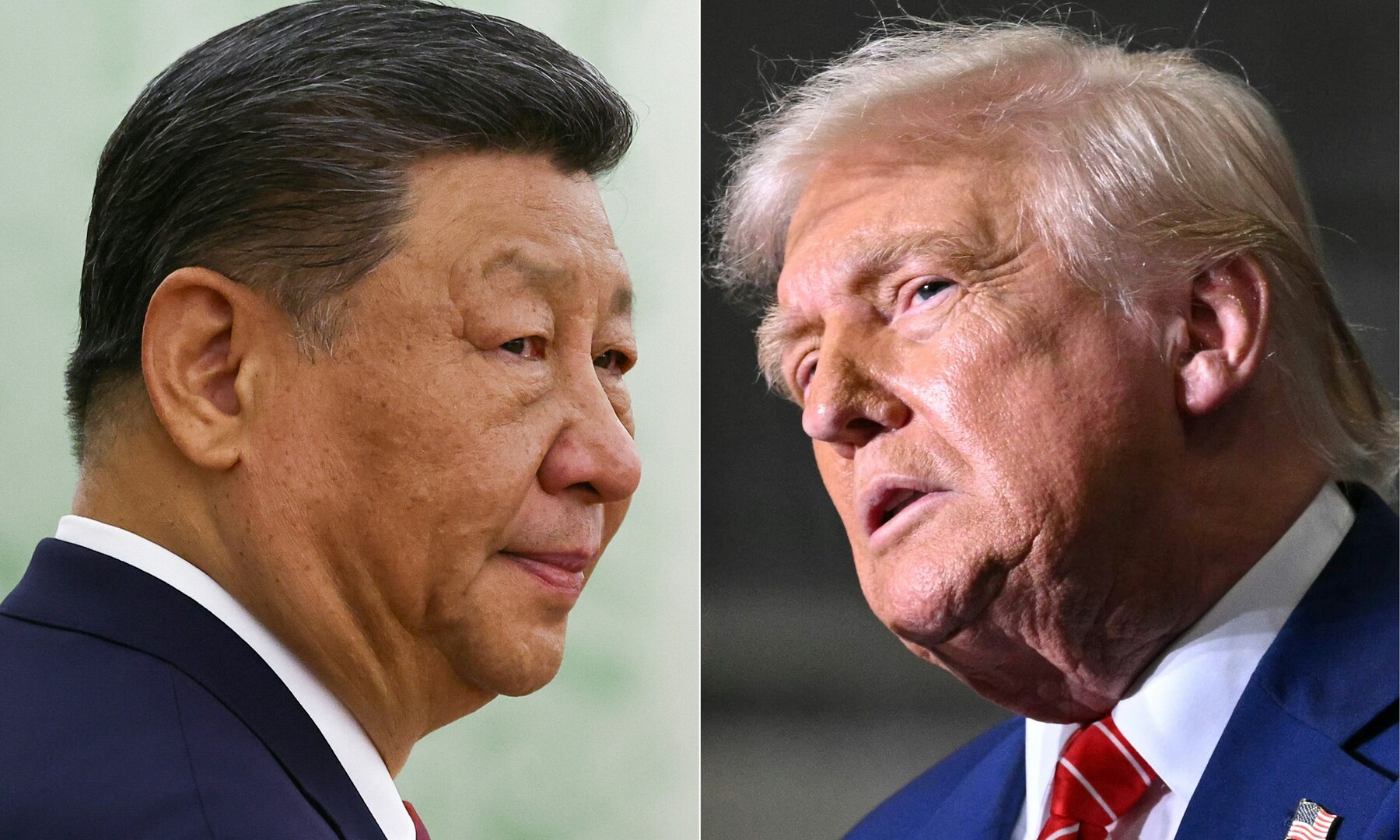
China’s hold over the industry had been a concern for the US and other countries for some time, but their alarm grew after Beijing imposed export controls in April.
The restrictions affected supplies of samarium, gadolinium, terbium, dysprosium, lutetium, scandium, and yttrium, and required companies shipping materials and finished products overseas to obtain export licences.
The restrictions followed a similar move by China in February, when it placed export controls on tungsten, bismuth and three other “niche metals”.
While news of a deal on rare earths signals a potential reprieve for manufacturers, the details of its implementation remain largely unclear.
What has been the impact of the export restrictions?
Chinese customs data shows the sale of rare earths to the US dropped 37 percent in April, while the sale of rare earth magnets fell 58 percent for the US and 51 percent worldwide, according to Bloomberg.
Global rare earth exports recovered 23 percent in May, following talks between US and Chinese officials in Geneva, but they are still down overall from a year earlier.
The greatest alarm has been felt by carmakers and auto parts manufacturers in the US and Europe, who reported bottlenecks after working their way through inventories of rare earth magnets.
“The automobile industry is now using words like panic. This isn’t something that the auto industry is just talking about and trying to make a big stir. This is serious right now, and they’re talking about shutting down production lines,” Mark Smith, a mining and mineral processing expert and the CEO of the US-based NioCorp Developments, told Al Jazeera.
Even with news of a breakthrough, Western companies are still worried about their future access to rare earths and magnets and how their dependence on China’s supply chain could be leveraged against them.
The Financial Times reported on Thursday that China’s Ministry of Commerce has been demanding “sensitive business information to secure rare earths and magnets” from Western companies in China, including production details and customer lists.
What have the US and China said about rare earth exports?
Trump shared some details of the agreement on his social media platform, Truth Social, where he also addressed concerns about rare earths and rare earth magnets.
“We are getting a total of 55% tariffs, China is getting 10%. The relationship is excellent,” Trump said, using a figure for US duties that includes levies introduced during his first term.
“Full magnets, and any necessary rare earths, will be supplied, up front, by China. Likewise, we will provide to China what was agreed to, including Chinese students using our colleges and universities (which has always been good with me),” Trump said.
Ahead of the negotiations in London, China’s Ministry of Commerce had said it approved an unspecified number of export licences for rare earths, and it was willing to “further strengthen communication and dialogue on export controls with relevant countries”.
However, an op-ed published by state news outlet Xinhua this week said rare earth export controls were not “short-term bargaining tools” or “tactical countermeasures” but a necessary measure because rare earths can be used for both civilian and military purposes.
NioCorp Developments’ Smith said Beijing is unlikely to quickly give up such powerful leverage over the US entirely.
“There’s going to be a whole bunch of words, but I really think China is going to hold the US hostage on this issue, because why not?” he said.
“They’ve worked really hard to get into the position that they’re in. They have 100 percent control over the heavy rare earth production in the world. Why not use that?”
Deborah Elms, the head of trade policy at the Hinrich Foundation in Singapore, said it was hard to predict how rare earths would be treated in negotiations, which would need to balance other US concerns like China’s role in exporting the deadly opioid fentanyl to the US.
Beijing, for its part, will want guarantees that it can access advanced critical US technology to make advanced semiconductors, she said.
Gold Price Forecast: XAU/USD rallies hard as Israel-Iran conflict sparks flight to safety
Gold price is gaining roughly 1.50% in Asian trading on Friday, underpinned by intense flight to safety amid escalating geopolitical tensions between Israel and Iran.
Gold price looks to record highs at $3,500
Israel said earlier on that it attacked Iranian nuclear targets to block Tehran from developing atomic weapons.
Several Iranian media outlets now claim that Iran will declare a war on Israel and retaliate "soon."
Iran's Armed Forces General staff responded on Friday, warning that Israel and the US will "pay a very heavy price".
Against this backdrop, US President Donald Trump has convened a meeting of the National Security Council in the White House situation room later in the day at 15 GMT.
Investors run for cover in the traditional safe-haven assets such as Gold price, the US Treasury bonds and the Japanese Yen (JPY) in times of market panic and uncertainty.
Therefore, the ultimate store of value, Gold price, is seeing unabated demand as it extends its winning streak into a third consecutive day on Friday, sitting at the highest level in seven weeks.
Gold buyers now aim for the record high of $3,500 if the Mid East conflict intensifies, with Iran initiating a harsh response to the Israeli pre-emptive strikes on Iran’s main enrichment facility in Natanz.
However, the strengthening haven demand for the US Dollar (USD) could impede Gold price rally.
Markets shrug off the latest trade headlines as geopolitics dominate alongside risk-off flows.
Reuters reported that tariffs on a range of imported household appliances, which are currently at 50% for most countries, would take effect on an additional range of “steel derivative products” on June 23.
Looking ahead, all eyes will remain on Iran’s probable retaliation to the Israeli strikes and the US’ response to the Middle East conflict.
The University of Michigan (UoM) Consumer Sentiment and Inflation Expectations could play second fiddle to the geopolitical headlines.
Markets ramp up odds for a US Federal Reserve (Fed) interest rate cut in September following softer-than-expected US Consumer Price Index (CPI) and Producer Price Index (PPI) data released earlier in the week.
Gold price technical analysis: Daily chart
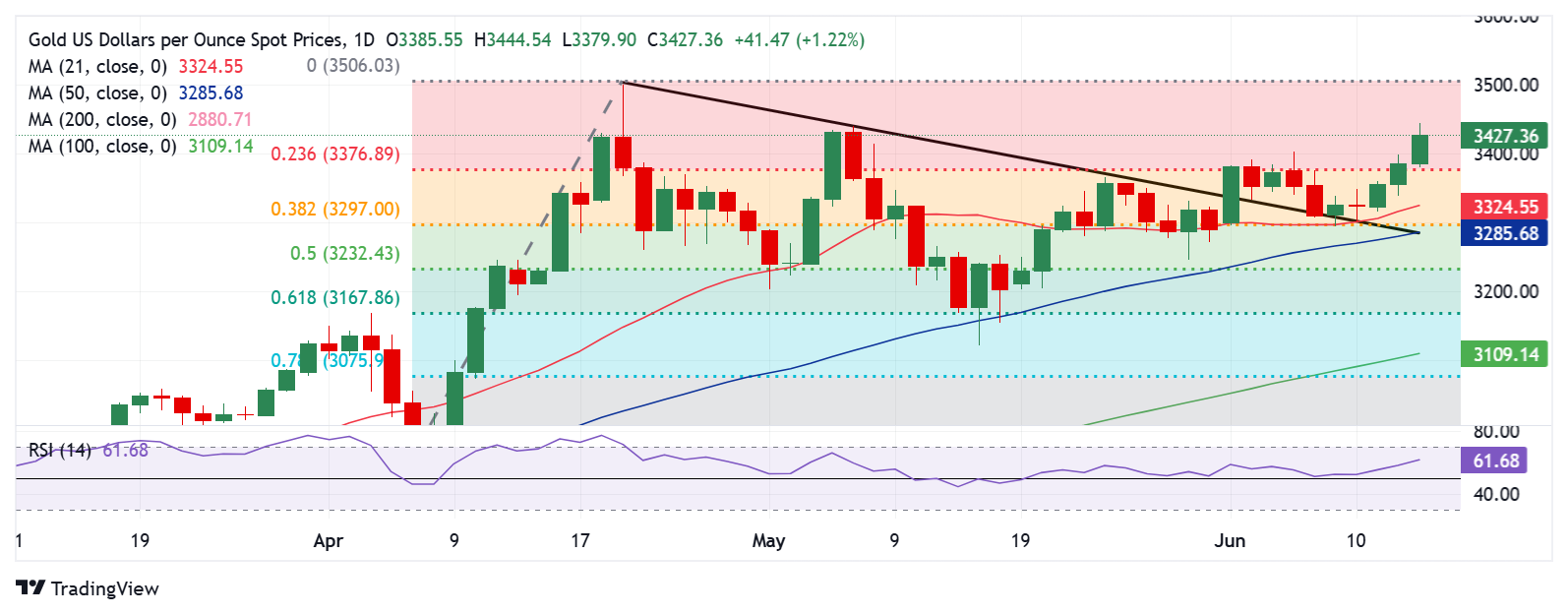
Having closed Thursday above the critical resistance at $3,377, the 23.6% Fibonacci Retracement (Fibo) level of the April record rally, Gold price solidified its bullish momentum on Friday.
The 14-day Relative Strength Index (RSI) holds firm above the midline, currently near 62, suggesting that there is more room for the upside.
The next stiff resistance is spotted at the $3,450 psychological level, above which the lifetime high of $3,500 will be threatened.
On the downside, the immediate support is aligned at the $3,400 threshold, below which the resistance-turned-support of the 23.6% Fibo level at $3,377 will come into play.
Deeper declines will likely challenge the 21-day Simple Moving Average (SMA) of $3,325.
By Tsvetana Paraskova - Jun 13, 2025, 6:00 AM CDT
The plans of many EU countries to boost nuclear power capacities will need an investment of as much as $278 billion (241 billion euros), according to estimates by the European Commission.
Many EU countries have drafted plans to increase nuclear power capacity or even return to nuclear energy after decades of no nuclear generation, as they look to reduce imports of fossil fuels and meet emissions reductions and net-zero goals with more nuclear power.
Some EU countries have started considering a return to nuclear power after four decades—the latest examples include Denmark and Italy, which are looking at small modular reactors (SMRs) to complement their renewable energy generation.
Now, the European Commission is preparing an update to its Nuclear Illustrative Programme (PINC) to estimate the investment needs of the nuclear power sector in the EU.
In a draft of the analysis reported by Reuters on Friday, the Commission says that the EU member states have so far laid out plans to expand their nuclear power capacity to 109 gigawatts (GW) by 2050, up from 98 GW at present.
The expansion will need $237 billion (205 billion euros) in investments in new nuclear power generation capacity, as well as $42 billion (36 billion euros) in investments to extend the lifespan of operating reactors. The investment includes both public and private funds, according to the European Commission’s estimates.
Germany, which has been opposing for years EU attempts to treat nuclear power as a green electricity source on par with renewable energy, has dropped this opposition under new chancellor Friedrich Merz, which could make EU energy policy much easier to adopt.
Since the 2022 energy crisis, Germany and France have clashed on how nuclear energy should be treated in the green transition in the EU.
Now, Merz’s Germany appears to be shifting its anti-nuclear stance on EU energy policies, French and German officials told the Financial Times last month.
By Tsvetana Paraskova for Oilprice.com
German Chancellor Friedrich Merz, together with the leaders of France and the United Kingdom, promised to impose tough sanctions on Russia if it did not agree to a ceasefire with Ukraine. But he did not keep the promise, thereby undermining trust in Europe, believes Lithuanian President Gitanas Nausėda, according to Bild .
"This is a problem. And it affects not only trust in our sanctions but also trust in all our measures toward Russia and our support for Ukraine. We have repeatedly announced that we will support Ukraine and supply fighter jets, long-range missiles, and ammunition. But we are unable to fulfill these promises," Nausėda said in an interview with Bild.
According to him, the sanctions that have already been imposed on Russia since February 2022 have not had the effect the West expected. First, the sanctions were not decisive enough, and second, third countries are helping Russia to circumvent them.
"That is why the Russian economy, although not in the best condition, still functions relatively well under these circumstances," the Lithuanian leader said.
Currently, the European Union is preparing its 18th package of sanctions against Russia, and Lithuania is demanding that it "resemble a Molotov cocktail." As Nausėda said, it means the package must include all energy companies that supply money to the Russian state budget: Nord Stream, Rosatom, Gazprom, Lukoil.
"The remaining Russian banks must also be excluded from the SWIFT system, as well as the rest of the shadow fleet vessels. Otherwise, we will be seen as weak and perceived as if Europe is unwilling to make bold decisions," he stressed.
Sanctions against Russia
During a visit to Kyiv in May, the leaders of Germany, France, and the United Kingdom gave Russia a deadline to agree to an unconditional 30-day ceasefire with Ukraine. In the event of non-compliance, the countries threatened to impose tough sanctions.
The final day for agreeing to a ceasefire was Monday, May 12. Moscow did not comply with this demand, but Germany has yet to impose punitive measures.
At the beginning of June, German Defense Minister Boris Pistorius once again announced the upcoming tough sanctions against Russia.
https://newsukraine.rbc.ua/news/lithuanian-president-slams-broken-promise-1749373411.html
Marler Clark retained by California woman likely sickened by Salmonella-tainted eggs
Seattle, WA – As of June 5, 2025, a total of 79 people infected with Salmonella Enteritidis have been reported from 7 states (Arizona 3, California 63, Kentucky 1, Nebraska 2, New Jersey 2, Nevada 4, Washington 4). The attorneys at Marler Clark have been hired by one of the likely California victims in this outbreak. Health officials in California and other states are continuing to investigate this outbreak and have determined that there is a link to August Egg Company, based in Hilmar, California. 1.7 million eggs have been recalled from multiple states.
Outbreak Facts
Illnesses started on dates ranging from February 24, 2025, to May 17, 2025. Of the 61 people with information available, 21 have been hospitalized. No deaths have been reported.
Epidemiologic, laboratory, and traceback data show that eggs distributed by August Egg Company may be contaminated with Salmonella Enteritidis and may be making people sick. On June 6, 2025, August Egg Company recalled eggs. Egg Recall list.
The recalled eggs were sold at grocery stores in California and Nevada, including FoodMaxx, Lucky, Raleys, Ralphs, Safeway, Food 4 less, Save Mart and Smart & Final. They were also sold at Walmart stores in Arizona, California, Illinois, Indiana, Nebraska, Nevada, New Mexico, Washington and Wyoming.
90% of those interviewed recalled eating eggs. State health officials have identified illness sub-clusters at two unnamed restaurants. Eggs were served at both sub-cluster locations.
Six ill people from Kentucky, New Jersey, and Washington reported traveling to California and Nevada before they got sick.
Salmonella
“Given the lag time in reporting and broad sales of the eggs, this outbreak will increase in number over the coming weeks,” said Bill Marler, managing partner at Marler Clark. “In addition, the CDC estimates that for every one person counted, there are nearly 40 other sick but will remain uncounted,” added Marler.
William (Bill) Marler will be representing a California victim in this Salmonella egg outbreak. An accomplished attorney and national expert in food safety, Bill has become the most prominent foodborne illness lawyer in America and a major force in food policy in the U.S. and around the world. As an food safety expert, Bill is featured in the current Netflix documentary called Poisoned, the Dirty Truth About Your Food. Over the last 30 years, Marler Clark, The Food Safety Law Firm, has represented thousands of individuals in claims against food companies whose contaminated products have caused life altering injury and even death.
If you would like to speak with Bill Marler about this outbreak, please contact Julie Dueck at 206-930-4220 or jdueck@marlerclark.com.
By Adedapo Adesanya
Nigeria and Saudi Arabia are struggling to reach an agreement on a record $5 billion crude oil-backed loan, Reuters is reporting.
According to four sources which spoke with the publication, there were concerns among banks which would finance the deal due to recent decline in crude prices, which is trading around $67 per barrel.
At $5 billion, the Aramco loan would be backed by at least 100,000 barrels per day of oil, the sources said.
The facility would be Nigeria’s largest oil-backed loan to date and Saudi Arabia’s first participation of this scale in the country.
The decline in oil price could shrink the size of the deal, the sources said.
According to two of the sources, President Bola Tinubu broached the loan when he met with Saudi Crown Prince Mohammed bin Salman in Riyadh at the Saudi-African Summit in November 2023.
However, this is the first time that such conversation have been made public as the federal government didn’t announce any plans to the public.
According to Reuters, the slow progress in discussions reflects the strain of the recent oil price drop, caused largely by a shift in policy by the Organisation of the Petroleum Exporting Countries and allies, OPEC+ to regain market share rather than curtail supply.
The banks involved in the talks that are expected to co-fund part of the loan with Aramco, the state oil company of Saudi Arabia, have expressed concerns about oil delivery, which has slowed discussions.
It is believed that Gulf banks and at least one African lender are involved.
“It’s hard to find anyone to underwrite it,” one source said, citing concerns over the availability of the cargoes.
The report claimed that Nigeria is using at least 300,000 barrels per day to repay NNPC’s other oil-backed loans, adding that if the Saudi deal is reached, it would almost double the roughly $7 billion of loans taken in the last five years.
The amount of oil going towards repaying the loans is fixed, but when the crude price falls, it takes longer to repay them.
So when prices are lower, the Nigerian National Petroleum Company (NNPC) Limited has to funnel more crude oil to joint-venture partners like to Shell, Oando, and Seplat for its portion of operation costs.
Nigeria is having difficulties increasing its crude production to its set target of 2.5 million barrels per day and with prices lower than $70 per barrel at the international market, the country is finding it difficult to make enough revenue.
https://businesspost.ng/economy/nigeria-saudi-struggle-to-agree-on-5bn-crude-oil-loan/
European Commission President Ursula Von der Leyen proposed an 18th round of sanctions on Russia over the war in Ukraine
The move comes ahead of a G7 summit in Canada next week where allies will push US President Donald Trump to be more aggressive in punishing the Kremlin.
"We are ramping up pressure on Russia, because strength is the only language that Russia will understand," European Commission president Ursula von der Leyen said.
"Our message is very clear, this war must end. We need a real ceasefire, and Russia has to come to the negotiating table with a serious proposal."
The European Commission, the EU's executive, suggested cutting the current oil price cap from $60 to $45 as Moscow drags its feet on a ceasefire in Ukraine.
The cap is a G7 initiative aimed at limiting the amount of money Russia makes by exporting oil to countries across the world.
Set at $60 by the G7 in 2022, it is designed to limit the price Moscow can sell oil around the world by banning shipping firms and insurance companies dealing with Russia to export above that amount.
To have most impact the EU and other G7 partners need to get the United States to follow suit and agree to the cut in level.
But Trump so far has frustrated Western allies by refusing to impose sanctions on Russia despite President Vladimir Putin's failure to agree a Ukraine ceasefire.
"My assumption is that we do that together as G7," von der Leyen said. "We have started that as G7, it was successful as a measure from the G7, and I want to continue this measure as G7."
'Massive' sanctions threatened
Trump last week said he had a deadline to sanction Russia "in my brain", but warned that he may also target Kyiv if no advances are made in his peace push.
European leaders in May threatened Moscow with "massive" sanctions if it did not agree a truce.
"Russia lies about its desire for peace. Putin is taking the world for a ride. Together with the United States, we can really force Putin to negotiate seriously," EU foreign policy chief Kaja Kallas said.
As part of its 18th round of sanctions since Russia's 2022 invasion, the EU also proposed measures to stop the defunct Baltic Sea gas pipelines Nord Stream 1 and 2 from being brought back online.
Officials said they would also look to target some 70 more vessels in the "shadow fleet" of ageing tankers used by Russia to circumvent oil export curbs.
The EU in addition is looking to sever ties with a further 22 Russian banks and add more companies, including in China, to a blacklist of those helping Moscow's military.
One EU diplomat described the latest proposals as "one of the most substantive and significant packages we've discussed recently".
"It will hurt Russia's ability to finance its war machine. Now let's see how the discussions evolve."
The sanctions will need to be agreed by all 27 EU countries, and could face opposition from Moscow-friendly countries Hungary and Slovakia.
© 2025 AFP
Saudi Arabia's crude oil exports to China are expected to dip slightly in July, though volumes will remain robust for the third consecutive month, highlighting Riyadh’s determination to defend its market share in the world’s largest crude importer.
Trade sources reported Tuesday that Saudi Aramco will supply around 47 million barrels of crude to China in July, down marginally from 48 million barrels in June. Despite the one-million-barrel drop, the allocation remains high, signaling Saudi Arabia’s continued emphasis on maintaining a competitive edge in the Asian market.
Sources noted that Chinese state-owned refiners such as Sinopec, PetroChina, and Aramco’s Fujian joint venture will receive increased volumes next month. In contrast, supply to three independent refiners will be reduced, reflecting a strategic pivot toward long-term partners.
The slight adjustment follows Aramco’s recent decision to lower the official selling price of its flagship Arab Light crude by 20 cents per barrel for Asian buyers starting in July. The grade will now be priced at $1 above the regional benchmark, a move analysts say is aimed at protecting Saudi Arabia’s foothold in a crowded and competitive market.
Saudi Arabia faces mounting pressure from rival suppliers such as Russia and Iran, both of which are seeking to expand their presence in the Chinese energy market by offering discounted barrels and flexible terms.
China, which imported more than two-thirds of its crude in 2024, remains a critical market for Aramco. The company continues to prioritize securing long-term contracts and stable supply flows despite ongoing geopolitical uncertainty and shifts in global demand.
https://oilprice.com/Company-News/Saudi-Aramco-To-Send-Less-Crude-to-China-in-July.html
Most countries in the Group of Seven nations are prepared to go it alone and lower the G-7 price cap on Russian oil even if U.S. President Donald Trump decides to opt out, four sources familiar with the matter said.
G-7 country leaders are due to meet on June 15-17 in Canada where they will discuss the price cap first agreed in late 2022. The cap was designed to allow Russian oil URL-E to be sold to third countries using Western insurance services provided the price was no more than $60 a barrel.
The European Union and Britain have been pushing to lower the price for weeks after a fall in global oil prices made the current $60 cap nearly irrelevant.
The sources, who declined to be named, said the EU and Britain are ready to lead the charge and go it alone, backed by the other European G-7 countries and Canada.
They said it is still unclear what the U.S. will decide, though the Europeans are pushing for a united decision at the meeting. Japan’s position also remains uncertain, they said.
“There is a push among European countries to reduce the oil price cap to $45 from $60. There are positive signals from Canada, Britain and possibly the Japanese. We will use the G-7 to try to get the U.S. on board,” one of the sources said.
The White House had no immediate comment. During the G-7 finance ministers meeting in the Canadian Rockies last month, U.S. Treasury Secretary Scott Bessent remained unconvinced there was a need to lower the cap, according to sources.
However some U.S. Senators may endorse the idea, including Lindsay Graham, who in recent weeks told reporters he supports lowering the cap. Graham is pushing a hard-hitting new set of Russia sanctions that could impose steep tariffs on buyers of Russian oil.
The EU has proposed lowering the price to $45 a barrel in its latest 18th package of sanctions. The package must have unanimity from member states in order for it to be adopted, which could take several weeks.
Russia’s largest export grade, Urals, trades at around a $10 a barrel discount to the Dated Brent benchmark BFO-URL-NWE out of Baltic ports. Brent futures have been trading below $70 a barrel since early April.
Sources said Washington’s buy-in was not essential to lower the cap owing to Britain’s dominance in global shipping insurance, and the EU’s influence on the Western rules-abiding tanker fleet.
The U.S., however, does matter when it comes to dollar-denominated payments for oil and its banking system.
The EU and its Western allies have been progressively cracking down on Russia’s shadow fleet of tankers and related actors, which work to circumvent the cap.
The pressure has started to hurt Moscow’s revenues and Western allies hope this will push more of the oil trade back under the cap. Russia’s state-owned oil producer Rosneft reported a 14.4% slump in profits last year.
(Reporting by Julia Payne and John Irish; additional reporting by Jarrett Renshaw in Washington; editing by Jan Harvey)
Related:
https://www.insurancejournal.com/news/international/2025/06/12/827354.htm
NEW DELHI: India's top four oil suppliers and key members of the OPEC+ alliance, Saudi Arabia, Russia, Iraq, and the UAE have significantly ramped up production and directed a major portion of the additional output to India.
Their collective market share has reached approximately 78% in India, the world's third-largest oil consumer. These nations have supplied an additional 375,000 barrels per day (bpd) to India in May compared to April, according to energy cargo tracker Vortexa. The collective increase surpassed their committed additional production of 359,000 bpd under Opec+'s output expansion plan of 409,000 bpd.
Russia maintained its leading position among India's crude suppliers due to ongoing barrel discounts. In the OPEC+ May supply increase, Saudi Arabia agreed to raise output by 166,000 bpd, Russia by 79,000 bpd, Iraq by 37,000 bpd and the UAE by 77,000 bpd.
Their exports to India increased by 135,673 bpd, 114,016 bpd, 66,642 bpd and 58,365 bpd respectively, resulting in market shares of 13.1%, 35.4%, 21.4% and 7.6% in May. Their combined share increased by 8.1 percentage points to 77.5%.African suppliers' share decreased to 4.9% from 11.8%, whilst US crude exports to India reduced to 5.7% from 7%.Saudi Arabia, the largest contributor to the group's supply increase, delivered the highest additional volume to India in May, increasing its market share to 13.1%, a 3% point rise from April. This increase resulted from price reductions offered to Asian purchasers, with Saudi Aramco reducing the May OSP for Arab Light by $2.30 per barrel. The premium has decreased to $1.20 above the Oman/Dubai benchmark for Asian buyers. For July loadings, the premium remains at $1.20, after a brief increase to $1.40 for June."
The recent Saudi Aramco's official selling price (OSP) cuts for May loadings, close to four-year low, along with the widening Brent-Dubai Exchange of Futures for Swaps (EFS) made Middle Eastern crude grades more competitively priced than other Brent-linked crudes," Xavier Tang, market analyst at Vortexa said, according to the Economic Times." Production increases from Saudi Arabia and other OPEC members play an essential role in the Dubai crude price structure," he added.
Eight OPEC+ nations have committed to increase output by an additional 411,000 bpd in June and July. The increased supply has affected prices, which have remained between $60-65 per barrel for over two months, significantly below the 2024 average of $80.Saudi Arabia's competitive pricing approach reflects the global competition for India's expanding crude market. "Saudi is offering attractive prices to gain share in India," an Indian refinery executive told the outlet.
Kenya hopes it will begin commercial crude oil production and exports next year, Opiyo Wandayi, Cabinet Secretary for Energy and Petroleum, said on Monday, as companies are finalizing an asset sale and development project plans for an onshore resource basin.
The East African country has oil and gas resources, but development has stalled after UK-listed Tullow Oil failed to secure investor partners for a major oil project that has been years in the making.
Tullow Oil and its minority partners sought to develop the South Lokichar project for years. However, French supermajor TotalEnergies and London-listed Africa Oil decided two years ago to withdraw from the project in Kenya, leaving Tullow Oil the sole owner of the blocks and further complicating Kenya’s oil dream.
Plans have been made for the development of the oil fields discovered in the South–Lokichar Basin in Kenya’s north. The partners had sought to secure financing for a pipeline to ship the crude out of the landlocked northern region.
Earlier this year, Tullow Oil plc said it had signed a heads of terms agreement with Gulf Energy Ltd to sell all its working interests in Kenya for at least $120 million.
Currently, Gulf Energy is finalizing the acquisition of Tullow Oil’s assets, while the Field Development Plan (FDP) for the South Lokichar basin is pending approval, Kenyan media reported on Monday.
The project is expected to produce between 60,000 and 100,000 barrels per day (bpd) initially, with an estimated 560 million barrels recoverable over 25 years.
This could position Kenya as a player in the global oil market, Wandayi said today.
The cabinet secretary said in March that Kenya expects to launch an oil and gas exploration round for 10 blocks in September.
The Kenyan government has renewed its efforts to launch an oil and gas industry and is offering tax incentives, among other incentives.
By Charles Kennedy for Oilprice.com
More Top Reads From Oilprice.com
In-brief analysis
In 2024, the United States produced a record amount of energy, according to data in our Monthly Energy Review. U.S. total energy production was more than 103 quadrillion British thermal units in 2024, a 1% increase from the previous record set in 2023. Several energy sources—natural gas, crude oil, natural gas plant liquids, biofuels, solar, and wind—each set domestic production records last year.
Natural gas accounted for about 38% of U.S. total energy production in 2024 and has been the largest source of U.S. domestic energy production every year since 2011, when it surpassed coal. U.S. dry natural gas production was nearly 38 trillion cubic feet, about the same as in 2023.
Domestic crude oil accounted for about 27% of U.S. total energy production in 2024, as the United States continues to be the world’s top crude oil-producing country. U.S. crude oil production was a record 13.2 million barrels per day in 2024, 2% more than the previous record set in 2023. Almost all of the production growth came from the Permian region that spans parts of New Mexico and Texas.
Coal accounted for about 10% of U.S. total energy production in 2024. At 512 million short tons, last year’s coal production was the lowest annual output since 1964. Coal was the largest source of U.S. energy production from 1984 through 2010.
Natural gas plant liquids (NGPL), which includes fuels such as ethane and propane that are associated with natural gas processing, accounted for about 9% of U.S. total energy production in 2024. NGPL production was a record 4 trillion cubic feet in 2024, up 7% from 2023. Domestic NGPL production have increased every year since 2005 as U.S. natural gas production and processing capacity have increased.
Biofuels, wind, and solar production each set records in 2024, contributing to record total renewable energy production in the United States. In 2024, U.S. total biofuels production, which includes ethanol, renewable diesel, biodiesel, and other biofuels such as sustainable aviation fuel (SAF), was a record 1.4 million barrels per day, up 6% from previous records set in 2023.
In 2024, U.S. solar and wind production increased by 25% and 8%, respectively, as new generators came online. Output from other energy sources that are primarily used for electric power generation either peaked decades ago (hydropower and nuclear) or fell slightly from their 2023 values (geothermal).
We convert sources of energy to common units of heat, called British thermal units, to compare different types of energy that are usually measured in units that are not directly comparable, such as barrels of crude oil and cubic feet of natural gas. Appendix A of our Monthly Energy Review has the conversion factors that we use for each energy source.
Principal contributor: Mickey Francis
10 June 2025 - 12:11BY CLYDE RUSSELL

In the four months since US President Donald Trump returned to the White House, Asia's imports of US energy commodities have fallen from the same period last year
Asian countries aren't rushing to buy US energy commodities, even though lifting imports of crude oil, liquefied natural gas and coal will help meet President Donald Trump's demand for lower trade surpluses.
While rare earths may be the immediate talking point in talks between the Trump administration and China, the real action behind any deal will be in the big three energy commodities.
The same is true for other Asian economies seeking to curry favour with Trump and get a better deal than the hefty tariffs imposed on many in his “Liberation Day” measures announced on April 2, and subsequently paused for 90 days.
However, in the four months since Trump returned to the White House, Asia's imports of US energy commodities have fallen from the same period last year.
Imports of crude oil from February to May declined to 1.53-million barrels per day (bpd) from 1.55-million bpd in the same period in 2024, according to data from commodity analysts Kpler.
Asia's imports of US liquefied natural gas (LNG) were 4.78-million metric tons in the February to May period, down 40% from the 8.04-million tonnes in the same four months last year.
SA proposes buying US gas as it seeks trade deal
Minister in the Presidency Khumbudzo Ntshavheni said LNG imports would be augmented with US investment in gas infrastructurePOLITICS2 weeks ago
Arrivals of all grades of coal were 13.79-million tonnes in the four-month period, down from 14.19-million tonnes from February to May last year.
What the numbers show is that Asia, the world's top commodity importing region, isn't increasing its purchases of US commodities.
What the numbers don't show is that within the broader picture there are some dynamics at work that show that some Asian countries may be in the early stages of trying to ramp up imports of US energy.
India is buying more from the US, with Kpler estimating imports of 253,000 bpd of crude oil in the four months from February to May, up from 175,000 bpd over the same period last year.
June crude arrivals are forecast by Kpler to be 439,000 bpd, which would be the second-highest monthly total on record.
While US oil is less than 10% of India's total imports, that it is rising in what is a competitive market for pricing may indicate a desire to do more trade with the US.
India has also been buying more US coal, with Kpler data showing imports of 3.1-million tonnes in May, the highest on record.
India's imports of US coal were 8.82-million tonnes in the four months from February to May, up 12% from the 7.85-million tonnes for the same period last year.
Similar to crude, US coal is a small percentage of India's total coal imports, but the rising imports are worth noting given US coal has a more costly freight component than its competitors from Indonesia, Australia and SA.
Outside India, other Asian coal importers haven't been increasing shipments from the US, with second-biggest buyer Japan importing 1.75-million tonnes in the February to May period, down from 2.15-million tonnes for the same months in 2024.
Egypt in talks to buy 40-60 LNG cargoes amid energy crunch: sources
Egypt is in talks with energy firms and trading houses to buy 40-60 cargoes of liquefied natural gas amid a worsening energy crunch ahead of peak ...NEWS2 weeks ago
Japan has also been buying less US LNG, with only 1.04-million tonnes arriving from February to May, down from 1.75-million tonnes for the same period in 2024.
The drop in shipments of US LNG to Asia is most likely price-related as higher spot prices have seen cargoes move to Europe, which is using LNG to refill natural gas storages depleted during the northern winter.
The loss of China as a market for US LNG amid the ongoing tariff war has also hurt US volumes to Asia, with Kpler showing no cargoes arrived in the world's biggest buyer of the super-chilled fuel in March, April and May.
China's imports of US coal have also dropped to almost zero, with only one cargo of about 35,000 tonnes arriving in May, while no crude was imported in May.
Outside India, the only other major importer in Asia that has increased its purchases of US energy is South Korea, with imports of crude rising to the second-highest on record in May at 593,000 bpd.
South Korea has also lifted its imports of US LNG in recent months, with May's 560,000 tonnes the highest since October last year, with Kpler forecasting another increase in June to 570,000 tonnes.
However, the overall picture is that Asia's commodity importers are largely holding back on increasing imports of US energy.
It may be the case that they are planning on using imports as leverage in talks with the Trump administration, or it may also be that the delivered prices of US crude, coal and LNG are not competitive.
However, at the moment buying more US energy to lower trade surpluses is not yet a thing in Asia.
- The author is an Asian commodities and energy columnist
(Bloomberg) -- US oil production is poised to rise this year and next as President Donald Trump pushes for more drilling. But as crude prices tumble, most of the growth will come from a surprising source: the Gulf of Mexico.
Most Read from Bloomberg
Producers in the body of water — which Trump dubbed the Gulf of America — will bring on 300,000 barrels of new daily output this year, according to forecaster Wood Mackenzie Ltd. This growth, the most since 2009, will account for about half of the US’s output gains. Next year, the Gulf’s 250,000 barrels of new daily output will represent all of the US’s growth.
The Gulf’s rising importance represents a turnaround from the past two decades, when the region — tarnished by the Deepwater Horizon oil spill, spiraling costs and pandemic shutdowns — took a backseat to the shale boom that has made the US the world’s largest oil producer. But now tumbling crude prices have shale drillers cutting rigs, workers and investment plans, while major, longer-term Gulf projects are starting to come online.
“Most people are focused on onshore, when the real growth this year will come from offshore,” Miles Sasser, a senior research analyst at Wood Mackenzie, said in an interview. “The projects in the Gulf of America are ramping up nicely, and that should come as a surprise to many.”
Trump has promised to unleash US oil and gas production, and his administration is reworking policies to help boost flows, including from the Gulf. He has also created a National Energy Dominance Council to help expand production. But his global trade war and the OPEC+ supply increases that he has encouraged have hammered crude prices, spurring the pullback by shale drillers.
Chevron Corp. will grow Gulf production 50% from last year, to 300,000 barrels a day by 2026. Shell Plc has Sparta, a 90,000 barrel-a-day project coming online in 2028, while BP Plc has a series of projects through the end of the decade that will increase production capacity by about 20% to more than 400,000 barrels a day. These are all coming at a time when frackers are warning US shale production may have peaked.
Production growth in the Gulf has only outperformed shale in three of the past 10 years, and each of those instances came amid low oil prices and slowing demand, said Jesse Jones, a senior upstream analyst at Energy Aspects.
https://finance.yahoo.com/news/trump-energy-dominance-push-helped-110000586.html
By Alex Kimani - Jun 10, 2025, 7:00 PM CDT
Saudi Arabia is getting ready to engage in a protracted oil price war with its rivals, Bank of America’s leading commodities expert told Bloomberg on Monday. According to Francisco Blanch, BofA’s head of commodities research, the unfolding oil price war is going to be “long and shallow”, rather than “short and steep” as the Kingdom tries to claw back lost market share, especially from U.S. shale producers.
Last month, OPEC+ announced a third output increase of 411,000 b/d for the month of July, a similar clip to the previous two months. Commodity experts began warning last year that Saudi Arabia was willing to ditch its traditional role as OPEC’s swing producer by abandoning its unofficial price target of $100 a barrel in favor of increased output. Saudi Arabia accounted for 2 mb/d of the group’s 3.15 mb/d in output cuts before it started unwinding in April.
Traders are now bracing for hard times, with oil futures traders betting that the ongoing unwinding of production cuts by OPEC+ will eventually lead to a supply glut and even lower oil prices. According to the latest Commitment Of Traders (COT) report by CME Group, open interest in calendar spread options hit record levels in the current week, with speculators holding the biggest net position bets on weaker U.S. crude futures curve since 2020.
Oil futures charts are flashing an unusual “hockey-stick” shape of the curve, with oil markets pricing tight supply through 2025, followed by an oversupply in 2026, according to the report. The spread between the WTI July contract and the August contract narrowed 3 cents on June 5 to $0.93 a barrel, while the spread between the December 2025 contract and the December 2026 contract widened by 10 cents to $0.53.
Related: Saudi Aramco To Send Less Crude to China in July
“There is a lot of risk in the trade,” Nicky Ferguson, head of analytics at Energy Aspects Ltd, told Yahoo Finance, adding that rising activity is being driven by “strong prompt, weak deferred balances, and a very changeable geopolitical environment that makes holding futures difficult.”
This is hardly the first time that Saudi Arabia is engaging in a race to the bottom with its rivals. The kingdom has undertaken a similar strategy at least twice over the past decade, with varying degrees of success. U.S. shale producers successfully weathered the 2015 oil price war by rapidly reorganizing into a meaner and leaner production machine that could breakeven at WTI price of as low as $35 per barrel, down from $70 per barrel just a few years earlier. Five years later, the U.S. Shale Patch required the direct intervention of then U.S. President Donald Trump, whose threats of withdrawing military support for Saudi Arabia persuaded de facto Saudi ruler Crown Prince Mohammed bin Salman to toe the line and abandon the oil price war.
Unfortunately, U.S. shale producers are more vulnerable this time around: a March Dallas Fed Energy Survey found that the U.S. Shale Patch requires WTI prices of $65 per barrel or more to drill profitably. U.S. rig counts have declined 4% Y/Y and are now 7% below the 5-year average as producers scale back drilling activity amid rising costs. Tariffs on U.S. steel imports are partly to blame here, increasing the price of fracking equipment. Meanwhile, geological constraints are also posing a significant obstacle to efforts to ramp up production as the nearly two-decades-old U.S. shale boom plateaus. The EIA has predicted a small increase in U.S. crude output to 14 million barrels per day in 2027, up from 13.2 million barrels in 2024.
That said, Saudi Arabia and OPEC+ do not have carte blanche to continue flooding the markets with oil: the Kingdom needs Brent price of at least $96.20 per barrel to balance its books in fiscal year 2025, approximately $30 per barrel higher than current Brent price. Further, the country drew down considerably on its foreign exchange reserves in past oil price wars, limiting its ability to sustain another long war now.
However, Saudi Arabia is likely to gain more leverage in future showdowns as it continues to diversify its economy. The country is accelerating its $2.5 trillion mining plans, while also investing in technologies to optimize oil production and lower carbon emissions. Saudi Arabia’s mineral reserve potential has grown dramatically over the past decade, from $1.3 trillion forecasted eight years ago to $2.5 trillion currently. The Kingdom has set a goal to rapidly grow the mining sector, with its contribution to the economy expected to jump from $17 billion to $75 billion by 2035.
https://oilprice.com/Energy/Crude-Oil/BofA-The-Saudis-Are-Readying-for-a-Long-Oil-Price-War.html
Abu Dhabi’s main oil company is evaluating whether it can acquire some of BP Plc’s key assets, should the embattled British firm decide to break itself up or come under pressure to divest more units, according to people familiar with the matter.
Abu Dhabi National Oil Co. (Adnoc) has been internally studying prospects for acquiring certain BP assets and has held initial consultations with bankers, the people said, requesting anonymity as the discussions are private. It is also considering partnering with another bidder to split the assets, they added.
Adnoc is most interested in BP’s liquefied natural gas (LNG) and gas fields, rather than acquiring the entire company, though it has considered that option, the people said. Adnoc recently launched an international unit called XRG PJSC, tasked with pursuing gas and chemicals deals, with a target enterprise value of $80 billion.
Any deal would likely be pursued through XRG, some sources noted. Adnoc or XRG may also consider BP’s fuel retailing business. Adnoc referred questions to XRG, which declined to comment. BP also declined to comment. The plans remain under consideration and Adnoc could ultimately choose not to bid, the people said.
BP has faced prolonged underperformance, driven largely by its earlier focus on a net-zero strategy. CEO Murray Auchincloss is attempting a reset by shifting back to oil and gas and has promised asset sales. Several oil majors have examined BP’s assets amid a drop in its market value—down a third in just over a year to below $80 billion.
Adnoc is not interested in BP’s oil production assets or refineries, making a full takeover unlikely. Political sensitivities are also a deterrent. A UAE-linked firm recently faced backlash in the UK over its proposed acquisition of the Telegraph, after British authorities moved to block foreign state ownership of newspapers. Nonetheless, Abu Dhabi-based firms have begun investing in UK assets again, suggesting a thaw in relations.
Also Read: Lower oil prices will not impact flow of orders from Middle East: L&T
Funding is another potential hurdle. Despite being cash-rich and able to tap the debt market, Adnoc lacks a publicly traded stock and would have to pay entirely in cash for any full acquisition.
Adnoc and BP share a long-standing relationship. BP played a key role in discovering oil in Abu Dhabi over 50 years ago and holds a minority stake in Adnoc’s largest onshore field, which produces the Murban crude benchmark. BP also holds a 10% stake in an LNG facility under construction in the UAE and has joint ventures with Adnoc for gas development in Egypt and the eastern Mediterranean.
In May, XRG stated its ambition to become one of the world’s leading integrated gas companies within a decade, targeting LNG capacity of 25 million tonnes per year.
(-By Anthony Di Paola and Dinesh Nair; With assistance from Mitchell Ferman)
By Irina Slav - Jun 12, 2025, 3:19 AM CDT
Energy Secretary Chris Wright does not expect U.S. crude oil production to decline in 2026, although the Energy Information Administration forecast such a development.
“That is a projection — we don’t know what’s going to happen next year,” Wright told Bloomberg in an interview. “We have seen weak prices for a few months, and if prices are too low for an economic incentive, you’ll see some drilling reduce on the margin. I think it’s unlikely you’ll see enough reduction to actually see a decline in production next year.”
The Energy Information Administration said earlier this week it expected oil production in the U.S. to decline from 13.5 million barrels daily in the second quarter of this year to 13.3 million barrels daily in 2026 as shale oil peaks. The authority cited weak oil prices as one reason for the expected decline, while some industry executives have pointed to the exhaustion of low-cost shale deposits as a driver of the potential future decline.
Bloomberg noted in its report that shale drillers have been laying off workers and cutting the number of drilling rigs in the patch but Wright said that “This administration is making it lower cost for them to drill wells and therefore a lower threshold at which they would start to pull back activity.”
The most vulnerable players in the shale patch are smaller independents. Supermajors such as Exxon, Chevron, and ConocoPhillips are in a business-as-usual mode, yet some of them have already said that the peak in U.S. oil production is being accelerated and could come sooner than previously expected.
“As you know that most of the shale basins now have either plateaued or are starting to decline, except for the Permian,” Occidental’s Vicki Hollub said on the company’s Q1 call.
Conoco’s Ryan Lance, for his part, said that at $60 per barrel, “the folks that don't have the kind of cost of supply sitting in their portfolio are going to find themselves cash-strapped and returns-strapped.”
Guyana's offshore oil industry is set to take a major leap forward as the One Guyana floating production, storage, and offloading (FPSO) vessel readies its first export cargo. According to Reuters, the inaugural shipment of the newly branded 'Golden Arrowhead' crude grade is slated for late August to early September, marking a critical milestone for the ExxonMobil-led consortium that includes Hess Corp. and China's state-run CNOOC.
The One Guyana FPSO, now the fourth production vessel operating in the prolific Stabroek Block, will push Guyana's total offshore production capacity beyond 900,000 barrels per day (bpd). The first cargo will reportedly consist of approximately one million barrels, which the consortium plans to market via a public tender in the coming weeks.
The debut of Golden Arrowhead adds a new light, sweet crude grade to the global market, positioning Guyana favorably among producers of high-quality blends highly sought after by refiners.
Guyana is rapidly climbing up the ranks of global oil exporters, having shipped 582,000 bpd last year. Industry forecasts anticipate Guyana could reach 1.7 million bpd by 2030 if current expansion plans proceed as scheduled, as reported by Reuters.
This latest development, including the upcoming tender, highlights Guyana’s growing strategic importance in the global crude supply chain. With ExxonMobil, Hess, and CNOOC maintaining aggressive development schedules in the Stabroek Block, Guyana is on track to retain its status as one of the fastest-growing non-OPEC oil producers.
In just six years, Guyana has transformed from one of South America’s poorest nations into the world’s newest petrostate. With a population under one million, the country is now projected to become the continent’s second-largest oil producer, trailing only Brazil.
Guyana is now a critical supplier to the global petroleum market and is on pace to become the world’s leading per capita oil producer, with output forecast to surpass one million barrels per day by the end of 2027.
By Charles Kennedy for Oilprice.com
More Top Reads From Oilprice.com

Click the link to read the article on the Cowboy State Daily website (David Madison).
Here’s an excerpt:
June 3, 2025
A new U.S. Geological Survey study identifies Wyoming’s western border as part of a massive geothermal reserve. Geologists say it could be tapped to generate electricity equal to 10% of America’s current power supply.
A new federal assessment identified Wyoming as part of a massive underground geothermal energy resource that could generate electricity equal to 10% of America’s current power supply…A May U.S. Geological Survey’s report on geothermal systems in the Great Basin found that the arid lands of Nevada and adjoining parts of California, Oregon, Idaho, Utah and a sliver of Wyoming’s western border with Idaho contain enough geothermal energy to generate 135 gigawatts of electricity from the upper 6 kilometers of the Earth’s crust. The assessment spotlights the potential for a dramatic increase in geothermal electricity production, which now provides less than 1% of the nation’s power supply. However, realizing this potential depends on widespread deployment of enhanced geothermal systems technology.
“USGS assessments of energy resources are about the future,” said Sarah Ryker, acting director of the USGS. “We focus on undiscovered resources that have yet to be fully explored, let alone developed.”
Enhanced geothermal systems involve engineers creating open fractures in impermeable rock, allowing water to circulate and extract heat to generate electricity…With the recent findings from the USGS, the current focus is on enhanced geothermal systems, which makes geothermal electricity generation possible in more places…That’s where fracking technology from the oil and gas industry comes in, which Wyoming knows well.
“We call it hydraulic stimulation. And oil and gas, they call it fracking. It’s the same physics, but it’s a different process,” Podgorney said.
To reverse the climate crisis, COP30 must address the unforeseen consequences of the critical mineral boom, which is adding more deforestation and CO2 emissions
Next week, scientists, negotiators and government attaches gather in Bonn for the halfway point to COP30 – a critical moment to decide the agenda for the Brazil conference. One issue in particular has been neglected for far too long by previous COPs, and must not be left off the table: the climate consequences of mineral mining.
Global Witness, alongside a growing coalition of over 65 civil society groups, academics and industry voices, is calling for COP30 to deliver an agreement that puts climate, environment and human rights protections at the heart of mineral extraction for the energy transition.
Our call is simple: the minerals powering clean energy must not exacerbate climate change and human rights abuses.
The climate cost of the clean energy boom
Since the adoption of the Paris Agreement in 2015, the push for a low-carbon economy has ignited an unprecedented demand for so-called “transition minerals” – the copper, cobalt, lithium and rare earths used in wind turbines, solar panels, electric vehicles and battery storage. This demand is expected to quadruple in coming years.
But there is a dangerous irony. In the rush to decarbonise, the very process of extracting and processing these minerals is producing serious climate harms – deforestation in carbon-rich rainforests, emissions-intensive refining processes, and destruction of wetlands and peatlands that are vital carbon sinks.
In some places, mining expansion is undermining the climate resilience of entire ecosystems and putting Indigenous territories and livelihoods at direct risk.
This should become a central climate issue. If left unchecked, mineral extraction could erode the very carbon sequestration potential we need to achieve net zero. According to the International Resource Panel, unchecked resource extraction is already the primary driver of the triple planetary crisis: climate change, biodiversity loss and pollution.
U.S. mutual tariff uncertainties continue and earnings concerns grow due to falling lithium prices
![[Yonhap News]](https://wimg.mk.co.kr/news/cms/202506/09/news-p.v1.20250609.7dffc8e802724dec93ecbaf096e7ebda_P1.jpeg)
Despite the upward atmosphere of the stock market, secondary battery-related stocks have been weakening due to the downward trend in target stock prices by securities companies. Shares of LG Energy Solution and Samsung SDI fell 2.06 percent and 2.01 percent, respectively, on the 9th.
On this day, three securities companies, Mirae Asset Securities, Hanwha Investment & Securities, and iM Securities, all lowered their target stock prices of LG Energy Solution.
Mirae Asset Securities lowered its target stock price from 440,000 won to 390,000 won, citing the risk of further falling sales prices due to falling lithium prices.
Hanwha Investment & Securities cut its target stock price to 390,000 won from 430,000 won, saying the outlook for U.S. shipments worsened due to uncertainties in U.S. policy.
iM Securities also lowered its target price of LG Energy Solution from 450,000 won to 400,000 won, citing uncertainties caused by the U.S. mutual tariff policy.
On the same day, iM Securities lowered Samsung SDI's performance forecast, and its target stock price was also lowered from 270,000 won to 235,000 won.
This is because the recovery of the European electric vehicle market is slower than expected, and the U.S. market is also restricted from shipments due to mutual tariffs.
In this report, iM Securities predicted Samsung SDI's operating profit for the second quarter to be -231 billion won, and predicted that the deficit would be larger than the market estimate (-90.8 billion won).
Samsung Securities released a report on POSCO Holdings on the 5th and analyzed that the secondary battery industry will continue to be sluggish until the end of this year.
However, as the preliminary decision on anti-dumping tariffs on hot-rolled imports from China and Japan is scheduled to be made between June and August this year and the effect of the steel production cut announced by the Chinese government earlier this year is expected to be visible, it is expected that the steel industry will recover its performance in the second half of the year.
Shares of EcoPro BM and EcoPro plunged 3.95% and 2.76% on the same day, respectively, on the prospect of a prolonged sluggish performance in the secondary battery industry.
By Charles Kennedy - Jun 09, 2025, 1:48 PM CDT
US residential solar financing has taken a sharp dive, with Mosaic, a top lender underwriting over $15?billion in home energy loans, filing for Chapter 11 bankruptcy on Monday.
Founded in 2010, Mosaic enabled rooftop solar, battery storage, and efficiency upgrades for over 500,000 homeowners, but was struck hard by rising interest rates, uncertainties around federal Sections 25D and 48E tax credits, and tighter capital conditions.
The company secured $45?million in debtor-in-possession financing, including $15?million in fresh capital, enabling Mosaic to continue operations and fulfill ongoing loan and construction commitments. Court filings also show motions to maintain payroll, vendor contracts, and complete installations caught mid-project, according to PV magazine.
Mosaic’s filing extends a troubling trend in solar finance. This week Sunnova, another major rooftop provider, also filed for Chapter 11, listing assets and liabilities between $10?billion and $50?billion, and laying off 55% of its workforce (~718 employees).
Both firms cited weakened demand, rising rates, rollback of subsidies in key markets like California, and policy uncertainty—including threats to solar tax credits.
Industry analysts warn that Mosaic’s collapse may slow new rooftop solar installations in 2025, undermining the 1.1?GWdc of residential PV added in Q1, already down 13% year-on-year.
Projects funded through other third-party models, like power-purchase agreements, may outlast bank-loan structures, but the disruption jeopardizes momentum for residential solar growth.
For energy markets, the broader takeaway is not optimistic because it is impossible to decouple solar demand from financing and regulation. As Washington debates tax-credit extensions, installers and financiers are vulnerable. The coming weeks are pivotal, with Congress potentially taking a firm stance on whether the residential solar boom remains intact or buckles under financial strain.
By Charles Kennedy for Oilprice.com
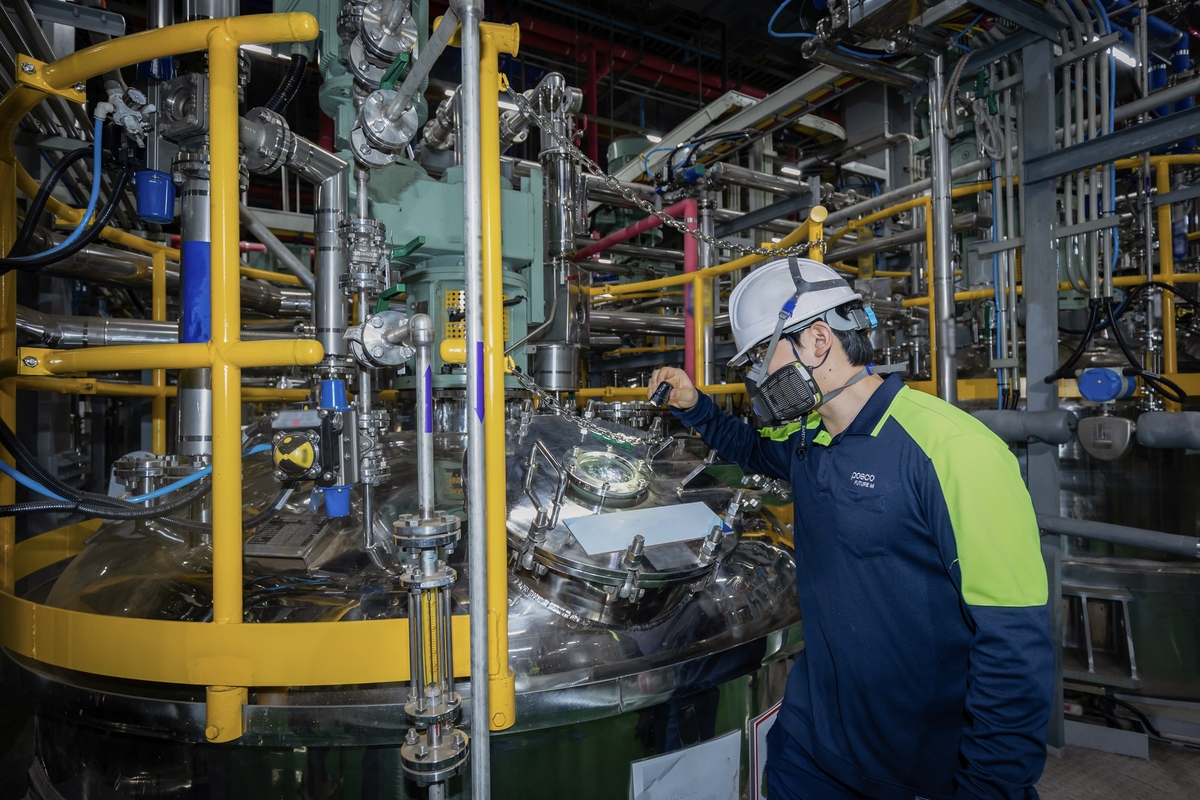
SEOUL, June 10 (Yonhap) -- POSCO Future M Co., the battery materials unit of POSCO Holdings Inc., said Tuesday it has completed a key production facility as part of efforts to establish a fully integrated domestic supply chain for battery materials.
The precursor plant, built within the existing cathode materials complex in Gwangyang, about 290 kilometers south of Seoul, has an annual output capacity of 45,000 tons, enough to supply batteries for about 500,000 electric vehicles, the company said in a press release.
"In addition to building a nickel supply network across POSCO Group, the completion of this precursor plant allows us to complete a self-sufficient system covering raw materials, intermediate materials and cathodes," the company's President Eom Gi-chen said in the release.
He said the facility will help bolster the competitiveness of South Korea's battery industry amid ongoing global supply chain realignments.
In the battery industry, a precursor refers to the intermediate material stage before becoming cathode active material.
The company expects the new plant will help reduce vulnerabilities stemming from shifting global trade policies.
As of March, more than 90 percent of Korea's precursor imports came from China. However, under the U.S. Inflation Reduction Act, batteries that use Chinese-made precursors are no longer eligible for tax credits due to the application of Foreign Entity of Concern (FEOC) rules starting this year, according to market tracker SNE Research.
This undated file photo, provided by POSCO Future M, shows a worker at the company's newly completed precursor plant in Gwangyang, about 290 kilometers south of Seoul. (PHOTO NOT FOR SALE) (Yonhap)
kyongae.choi@yna.co.kr
(END)
The Tokyo High Court on Friday overturned the earlier district court ruling against the former executives of Tokyo Electric Power Company (TEPCO) to pay compensation of 13 trillion yen ($90 billion) for their failure to prevent the 2011 disaster at the Fukushima Daiichi nuclear plant, according to local media.
The High Court’s ruling centered around TEPCO management’s failure to implement countermeasures following the government’s long-term earthquake assessment in 2002, which predicted a possible tsunami of up to 15.6 meters. The court ruled in favor of the executives, finding that the massive tsunami of up to 15 meters that caused the disaster was not foreseeable. Presiding Judge Toshikazu Kino emphasized that the government’s assessment did not provide a sufficient basis for the management to efficiently safeguard against the huge tsunami.
The ruling runs contrary to the National Diet Investigation Commission’s (NAIIC) report in 2012, which concluded that the accident was a “manmade disaster,” resulting from the “collusion between the government, the regulators and Tokyo Electric Power Co.” The report further stated that the “root causes were the organizational and regulatory systems that supported faulty rationales for decisions and actions.” The NAIIC criticized TEPCO for its poor governance and lack of safety culture, particularly regarding the risk of a predicted station blackout due to flooding. The report also recommended amending nuclear power laws and regulations in Japan to emphasize the primary responsibility of operators for safeguarding their nuclear facilities.
The civil suit was brought by 48 shareholders against the former executives of TEPCO over the nuclear disaster, which was triggered by a massive earthquake and tsunami on March 11, 2011. Although the plant’s systems detected the earthquake and automatically shut down the nuclear reactors, the subsequent tsunami overwhelmed the facility, causing massive chemical explosions. This occurred after the floodwater disabled emergency generators, leading to the reactors overheating. The incident had killed more than 180,000 people along Japan’s north-east coast.
The Tokyo District Court in July 2022 ruled that the former executives were liable for compensation after finding that the government’s assessment was “scientifically credible” and that a massive tsunami hitting the plant was foreseeable.
The High Court ruling follows Human Rights Now’s recent submission to the Human Rights Council’s 59th session, which highlighted that more than 30,000 people displaced by the Fukushima disaster are still designated as internally displaced persons (IDPs) and face persistent human rights violations.
According to a report from Mining.com, SolGold, a company primarily engaged in exploration and development in Ecuador, announced that it would voluntarily delist from the Toronto Stock Exchange starting June 18.
The miner will continue to be listed on the London Stock Exchange and is also considering a secondary listing on the Australian Securities Exchange (ASX).
SolGold, founded in Australia and currently headquartered in London, recently appointed Dan Vujcic as its new CEO. The former investment banker at Morgan Stanley and Citigroup, and most recently the CFO of MAC Copper, stated in an interview earlier this year that the ASX was a "natural home" for the company's copper-gold assets.
The company is backed by mining giants including BHP and Newmont. It is currently advancing the development of its Cascabel copper-gold project in northern Ecuador. The project is expected to commence development as early as 2028, three to four years ahead of the previous schedule.
The latest strategy involves open-pit development initially, followed by a transition to underground mining.
SolGold believes that the scale of Cascabel positions it as a multi-generational asset, capable of ranking among the top 20 copper-gold mines in South America.
Strategic Adjustments
Accelerating the development plan is part of a broader restructuring by the company, which includes establishing a subsidiary to hold its exploration assets. The company claims to hold over 89 licenses within a high-potential copper-gold target area spanning 3,000 square kilometers.
This move comes at a time when the global copper market is tightening, driven by growing demand due to copper's critical role in electrification and the scarcity of new discoveries.
SolGold hopes that this restructuring and accelerated development will garner greater investor support, especially amid geopolitical instability and tariff fluctuations affecting global supply chains.
https://news.metal.com/newscontent/103366351/Centerra-Gold-Delists-from-Toronto
Gold mine output in Australia fell 7% quarter-over-quarter as more miners used lower-grade stockpiled material to blend into their mill feed, a new report says.
Australia, the world’s largest gold producer after China, produced 73 tonnes of the yellow metal in the first three months of 2025 compared with 79 in the previous quarter, Melbourne-based mining consultants Surbiton Associates said in a statement dated Sunday. Production in the first quarter of 2024 was 70 tonnes.
The rising price of gold, which hit a historic high of $3,500 per oz. in April, is making previously unprofitable lower-grade ore economic, pushing miners to use more lower-quality material into their feed. Reclaimed stockpiled material now represents about 15% of the total ore being treated in Australia, up from about 1% a year ago, Surbiton says.
“Effectively the recent decline in Australian gold production was largely the result of higher gold prices,” Sandra Close, a director of Surbiton Associates, said in the statement.
Higher gold prices “mean that it is economic to reclaim more low-grade material from stockpiles to feed into the treatment plants, so the weighted average head grade of ore being treated declines,” Close added. “Although lower head grades result in less gold being produced and means cash costs and all-in sustaining costs per ounce increase, the value of each ounce of gold is higher.”
38% price rise
London Bullion Market Association gold prices averaged $2,859.60 an oz. in the first quarter of 2025, a 7.4% rise over 2024’s final quarter, World Gold Council data show. Compared with a year ago, first-quarter prices jumped 38%.
While higher gold prices could be expected to boost output by encouraging the startup of new projects and the re-commissioning of past-producing mines, many existing treatment plants are running close to their limit, Close said. This has caused a shortage of immediate treatment capacity for emerging small miners that want to sell parcels of ore or to have their ore toll-treated.
Mixed bag for output
Even so, “many gold producers are experiencing high margins and are doing very well,” Close said.
AngloGold Ashanti’s (NYSE: AU) and Regis Resources’ (ASX: RRL) Tropicana mine, Gold Fields’ (NYSE, JSE: GFI) St Ives and Newmont’s (TSX: NGT; NYSE: NEM) Tanami were among the Australian operations that saw production drop during the first quarter. Tropicana produced 57,000 fewer ounces, while output at Tanami fell by 46,000 oz. and that of St Ives fell by 40,500 ounces.
Among the operations that produced more gold were Newmont’s Cadia mine, up 25,000 oz.; Bellevue Gold Mines’ (ASX: BGL) Bellevue, up 22,000 oz.; and Agnico Eagle Mines’ (TSX: AEM; NYSE: AEM) Fosterville property, up 7,000 ounces.
https://www.mining.com/australia-gold-output-falls-as-miners-tap-stockpiles/
Seabridge Gold Inc. (TSE:SEA - Get Free Report) NYSE: SA's share price crossed above its 200-day moving average during trading on Tuesday . The stock has a 200-day moving average of C$17.24 and traded as high as C$20.17. Seabridge Gold shares last traded at C$19.65, with a volume of 105,436 shares.
Get Seabridge Gold alerts: Sign Up
Seabridge Gold Trading Down 1.9%
The business has a 50 day moving average price of C$16.93 and a 200-day moving average price of C$17.24. The company has a current ratio of 2.28, a quick ratio of 3.34 and a debt-to-equity ratio of 58.83. The company has a market cap of C$1.81 billion, a P/E ratio of -139.15 and a beta of 1.09.
About Seabridge Gold
Seabridge Gold Inc is a development stage company involved in the evaluation, acquisition, exploration, and development of gold properties sited in North America. The company's principal projects include the Kerr-Sulphurets-Mitchell property located in British Columbia, the Courageous Lake property located in the Northwest Territories and its newly acquired Iksut Property located in northwestern British Columbia.
Read More
This instant news alert was generated by narrative science technology and financial data from MarketBeat in order to provide readers with the fastest and most accurate reporting. This story was reviewed by MarketBeat's editorial team prior to publication. Please send any questions or comments about this story to contact@marketbeat.com.
Before you consider Seabridge Gold, you'll want to hear this.
MarketBeat keeps track of Wall Street's top-rated and best performing research analysts and the stocks they recommend to their clients on a daily basis. MarketBeat has identified the five stocks that top analysts are quietly whispering to their clients to buy now before the broader market catches on... and Seabridge Gold wasn't on the list.
While Seabridge Gold currently has a Hold rating among analysts, top-rated analysts believe these five stocks are better buys.
View The Five Stocks Here
Gold and Platinum Prices Surge Amid Inflation and Supply Concerns
Gold prices experienced a notable uptick following a softer-than-expected inflation reading, which has fueled speculation about potential interest rate cuts by the Federal Reserve later this year. According to Mining.com, underlying US inflation rose less than anticipated for the fourth consecutive month in May, indicating that companies are managing to limit the pass-through of higher tariff costs to consumers.
The dollar and bond yields fell in response to the inflation data, resulting in gold climbing by as much as 1.1% before settling. The precious metal, which does not yield interest, often benefits from a lower rate environment. Ole Hansen, head of commodities strategy at Saxo Bank A/S, noted that the benign inflation reading has improved the likelihood of a rate cut, possibly earlier than the October timeline currently anticipated by the market. However, Hansen cautioned that further economic deterioration is necessary for gold prices to break out of their current range.
Meanwhile, platinum has continued its remarkable surge this year, climbing over 40% as the market faces signs of tightness. The price of platinum, which is utilized in jewelry, autocatalysts, and various industries, rose by 5.2% to $1,283.79 an ounce. The physical platinum market is heading for another year of deficit, driven by strong demand from China for a cost-effective alternative to gold jewelry. Additionally, a significant outflow of platinum to the US earlier this year, amid concerns about potential tariffs, has further constrained supply in major trading hubs like Zurich and London.
According to IndexBox, platinum output in South Africa, the world's largest producer, has declined due to adverse weather conditions and other disruptions, contributing to the price increase. This trend has positively impacted the shares of mining companies such as Anglo American Plc spinoff Valterra Platinum Ltd., Impala Platinum Holdings Ltd., and Sibanye Stillwater Ltd. Despite the challenges posed by the global shift towards electric vehicles, which do not utilize platinum, the metal's market remains robust, as noted by George Heppel, an analyst at BMO Capital Markets.
As of 10:35 a.m. in New York, bullion rose by 0.3% to $3,334.78 an ounce, while the Bloomberg Dollar Spot Index declined by 0.2%. Silver experienced a decline, whereas palladium saw an increase in its value.
Source: IndexBox Market Intelligence Platform
https://www.indexbox.io/blog/gold-and-platinum-prices-surge-amid-inflation-and-supply-concerns/
8 June 2025 19:21 (UTC+04:00)
China has partially lifted export restrictions on certain rare earth elements in response to growing global demand driven by industries such as robotics and clean-energy vehicles, , Azernews reports, citing the Chinese Ministry of Commerce.
While the ministry did not disclose which specific metals are included under the relaxed rules, the announcement signals a shift in Beijing’s trade policy amid increasing international pressure and evolving market dynamics.
The move comes as former U.S. President Donald Trump stated that Chinese President Xi Jinping had agreed to resume the export of rare earth minerals to the United States — a gesture that may help ease longstanding trade tensions between the two economic giants.
China initially imposed strict limitations on the export of key rare earth elements — including tungsten, tellurium, bismuth, molybdenum, and indium — earlier this year. The restrictions, which began in February during the Trump administration’s efforts to raise tariffs on Chinese goods, were justified by Beijing as necessary to protect national security, prevent the proliferation of weapons, and uphold the stability of global production and supply chains.
These rare earth metals are critical components in a wide range of advanced technologies, including defense systems, green energy equipment, smartphones, and batteries for electric vehicles. Any disruption in their supply has wide-reaching implications for global manufacturing and innovation.
In a related development, China’s Foreign Ministry has announced an upcoming China-U.S. dialogue on economic and trade issues to be held in London. A Chinese delegation led by Vice Premier He Lifeng will be visiting the UK from June 8 to 13 to participate in the discussions.
The easing of export controls — paired with the resumption of high-level trade talks — suggests a cautious recalibration of China’s rare earth policy, potentially opening the door for greater cooperation in critical supply chains at a time when global industries face mounting resource constraints.
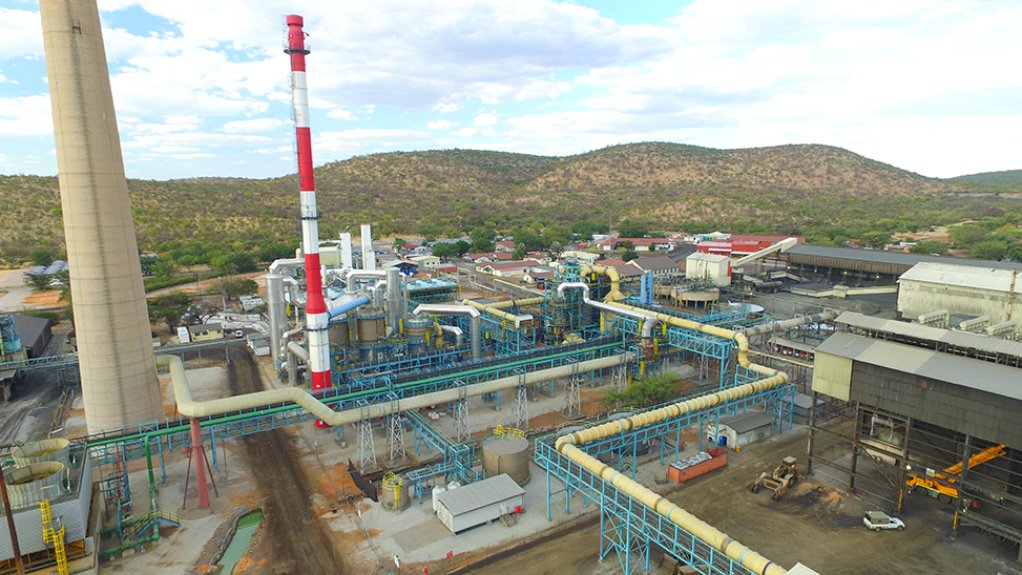
China’s Sinomine Resource Group said on Friday it has temporarily paused copper smelting operations at its Tsumeb plant in Namibia, citing a shortage of concentrate following a rapid expansion in smelter capacity worldwide.
Sinomine acquired the Tsumeb smelter, one of the few facilities in the world that can treat arsenic and lead-bearing copper concentrates, from Dundee Precious Metals in 2024.
The smelter, with capacity to process 240 000 metric tons of copper concentrate annually, has previously processed metal from countries such as Chile, Peru and Bulgaria.
Global copper smelting capacity has expanded rapidly in recent years, outstripping production of the metal whose demand has been boosted by its use in renewable energy technologies, including electric vehicles.
Sinomine Tsumeb Smelter CEO Loggan Lou said in a statement that increased smelting capacity in major copper-producing regions has “resulted in substantial overcapacity”.
“This has led to a shortage of copper concentrate, placing pressure on smelters worldwide, including Tsumeb,” Lou said.
Sinomine plans to upgrade the smelter to enable the commercial production of multiple critical metals and minerals.
Last September, Sinomine announced that the Tsumeb Smelter contains 746 metric tons of germanium, a critical mineral essential for chipmaking, infrared technology, fibre optic cables, and solar cells.
The smelter is also exploring the addition of germanium and zinc smelting lines to the smelter.
In the hills of eastern Serbia and the valleys of western Tajikistan, villagers say they’re paying the price for China’s global mining ambitions. The Chinese-owned Zijin Mining Group, operating major copper and gold projects in both countries, stands accused of polluting the air, poisoning rivers, and displacing communities—while receiving strong political backing under the umbrella of Beijing’s Belt and Road Initiative (BRI).
In Bor, Serbia, residents near Zijin’s Cukaru Peki copper mine complain of worsening air quality, arsenic, and fine particulate matter still lingering in the atmosphere despite the company’s reported $259 million investment in environmental improvements.
“You used to see the smoke,” says Violeta, a Bor resident. “Now you don’t—but it still stinks.”
In Krivelj, just outside Bor, Milos Bozic says the dust has made farming impossible. Professor Snezana Serbula of the Bor Technical Faculty confirms that PM particles and arsenic persist in the air. Meanwhile, residents like Dragoslav Stanculovic in nearby Ostrelj refuse to sell their properties. “What am I supposed to do—sell my dignity?” he asks.
Despite environmental alarms, the Serbian government has doubled down on its support for Zijin, with Chinese companies now Serbia’s top exporters, surpassing $1 billion in trade by 2024.
In Tajikistan, the story echoes Serbia’s. In Khumgaron and Shing, villagers say Zijin’s Zarafshon gold mine, where the company owns a 70% stake, has brought choking air and poisoned water. “Thick smoke covers the village in the morning,” says Abutolib Mukhtorov.
Local residents in both countries report broken promises of relocation, inadequate compensation, and police intimidation of those who speak out. In Tajikistan, women who protested in Panjakent were detained. Firuza Kahorova recalls collapsing during the protest and being mocked by authorities: “They said, ‘Don’t give her water—give her dirt.’”
Zijin claims 98% of Serbian land was acquired voluntarily and insists its projects meet environmental laws, branding Cukaru Peki as Serbia’s first “green mine.” In Tajikistan, Zijin has been fined, but continues operating with 20-year plans and strong support from the government, which highlights tax revenues and economic benefits.
But for many residents, those benefits are illusory. “Peaches don’t grow. Cucumber flowers fall off. The river’s poisoned,” says Asadulo Rahmonov in Tajikistan. “It’s not progress. It’s survival.”

Almonty is in the final stages of completing its processing facilities at the Sangdong Mine, with first production anticipated in 2025. Credit: Almonty Industries.
Almonty Industries, a tungsten concentrate producer, has received a formal letter from the US House Select Committee on the strategic competition between the US and the Chinese Communist Party.
The move highlights the company’s critical role in strengthening the US critical mineral supply chain amid growing geopolitical uncertainity.
Almonty’s Sangdong Mine in South Korea has been acknowledged by the Committee for its potential to become the largest tungsten producer outside of China.
The company is in the final stages of completing its processing facilities at the mine, with first production anticipated in 2025.
This move is set to significantly enhance the resilience of the US supply chain for tungsten, which is vital for defence applications including munitions and aerospace, especially since there has been no commercial production of tungsten in the US since 2015.
The Committee has expressed a strong interest in ongoing engagement with Almonty, focusing on potential collaboration to support the US defence industrial base.
GlobalData Strategic Intelligence US Tariffs are shifting - will you react or anticipate? Don’t let policy changes catch you off guard. Stay proactive with real-time data and expert analysis. By GlobalData Learn more about Strategic Intelligence
This includes integrating supply chains with US defence contractors and considering potential contributions to the National Defense Stockpile.
Almonty has responded to all inquiries from the Chairman and Ranking Member of the US House Select Committee.
The significance of this development is heightened by the company’s plans to redomicile to the US, which would make Almonty the only US-based company producing tungsten concentrates at a commercial scale.
Almonty president and CEO Lewis Black said: “This recognition from US congressional leaders affirms that Almonty’s Sangdong project is far more than a commercial endeavour – it is strategic infrastructure vital to the security and resilience of US and allied supply chains.
“As we prepare to redomicile to the United States, our objective is to go beyond being a supplier. We are positioning Almonty as a trusted partner in reshoring and friend-shoring critical mineral capacity at a time when geopolitical pressures demand greater transparency, reliability and allied control. We are deeply aligned with US national security priorities and remain focused on delivering long-term value to our shareholders.”
Last month, the company executed a binding offtake agreement with Tungsten Parts Wyoming, a US-based defence contractor, and Metal Tech, an Israel-based tungsten processor, to supply tungsten oxide.
https://www.mining-technology.com/news/almonty-industries-us-tungsten-production/
Godwin Beene, Country Manager for Zambia at mining firm First Quantum Minerals, will speak at the upcoming African Mining Week (AMW) conference – Africa’s premier event for the mining sector. During the event, Beene will join a high-level panel discussion titled Zambia: Accelerating Exploration and Development Through License Allocation and Global Partnerships, where he is expected to share insights into the company’s Zambian strategy.
Beene’s participation at AMW 2025 comes as Zambia intensifies efforts to attract global investment and scale-up copper production to three million tons per annum by 2031. As a key player in the market, First Quantum Minerals plays a pivotal role in driving Zambia’s mining sector forward. Beene’s participation at AMW 2025 presents an opportunity for the company to engage with potential partners, investors and service providers aligned with the company’s long-term strategy.
AMW serves as a premier platform for exploring the full spectrum of mining opportunities across Africa. The event is held alongside the African Energy Week: Invest in African Energies 2025 conference from October 1-3 in Cape Town. Sponsors, exhibitors and delegates can learn more by contacting sales@energycapitalpower.com.
First Quantum Minerals continues to advance several impactful mining operations in Zambia. At the Kansanshi Mine, the company produced 46,544 tons of copper in Q1, 2025 alone, with a full-year target of 190,000 tons of copper and 110,000 ounces of gold. The Kansanshi S3 Expansion Project is also on track to begin production this year, setting the stage for increased output in the coming years. The S3 Expansion Project comprises an expanded mining fleet and smelter as well as the development of the South East Dome pit and a new processing plant. This will increase the life of mine until 2040.
Meanwhile, Sentinel Mine reported 46,361 tons of copper production in Q1, 2025, with aims to reach 230,000 tons by year-end. At the Enterprise Nickel Mine – situated 12 km from the Sentinel copper mine – the company produced 4,649 tons of nickel during Q1, 2025, increasing output by 25% compared to the previous quarter. The company plans to produce 25,000 tons of nickel in 2025 at the mine, with a focus on ore quality and grade control.
At AMW 2025, Beene’s insights will provide greater understanding of these projects, including their impact on Zambia’s mining industry. Held under the theme From Extraction to Beneficiation: Unlocking Africa’s Mineral Wealth, the event will serve as a key platform for forging global partnerships, accelerating exploration and promoting sustainable growth across the continent’s mining sector. With a session focused on Zambia, industry leaders such as Beene will engage with government officials, financiers and technology providers to shape the future of mining in the country.
https://energycapitalpower.com/first-quantum-minerals-zambian-country-manager-joins-amw-2025/
Confident Investing Starts Here:
Easily unpack a company's performance with TipRanks' new KPI Data for smart investment decisions
Receive undervalued, market resilient stocks right to your inbox with TipRanks' Smart Value Newsletter
Zijin Mining Group Co ( (HK:2899) ) has provided an announcement.
Zijin Mining Group Co., Ltd. has announced its first extraordinary general meeting in 2025 to discuss and approve the spin-off and listing of its subsidiary, Zijin Gold International Company Limited, on the Hong Kong Stock Exchange. This strategic move is aimed at enhancing the company’s operational independence and sustainable growth, while safeguarding the interests of shareholders and creditors. Additionally, the meeting will address the Employee Stock Ownership Scheme for 2025, reflecting Zijin’s commitment to aligning employee interests with corporate objectives.
The most recent analyst rating on (HK:2899) stock is a Buy with a HK$21.50 price target. To see the full list of analyst forecasts on Zijin Mining Group Co stock, see the HK:2899 Stock Forecast page.
More about Zijin Mining Group Co
Zijin Mining Group Co., Ltd. is a leading Chinese mining company primarily engaged in the exploration and development of gold, copper, and other mineral resources. The company is focused on expanding its operations and market presence through strategic initiatives such as spin-offs and listings.
Average Trading Volume: 67,770,230
Technical Sentiment Signal: Strong Buy
Current Market Cap: HK$516.4B
See more insights into 2899 stock on TipRanks’ Stock Analysis page.
Disclaimer & Disclosure
Looking for a trading platform? Check out TipRanks' Best Online Brokers guide, and find the ideal broker for your trades.

President of Uzbekistan Shavkat Mirziyoyev, speaking at the plenary session of the IV Tashkent International Investment Forum, announced extremely important and noteworthy data on the subsoil resources of our country.According to the head of state, today, as a result of the rapid development of the fourth industrial revolution in the world, the demand for technological minerals is increasing several times.
In such conditions, the subsoil resources of Uzbekistan are of global importance and can become a new growth point for our economy. In his speech, the president emphasized that Uzbekistan has large reserves of valuable minerals such as tungsten, molybdenum, magnesium, lithium, graphite, vanadium and titanium. According to expert estimates, the total value of Uzbekistan's subsoil resources is close to $3 trillion. At the same time, the head of state emphasized that our country has every opportunity to become a regional center for the production of products with high added value from mineral resources.“We are currently building future metal technoparks in the Tashkent and Samarkand regions.
Innovative, high-tech production will be established here. This will serve to further expand the economic potential of our country,” said Mirziyoyev.During his speech, the President also put forward a new initiative that may interest foreign investors. According to it, investors who fully establish a chain of production of finished products in Uzbekistan, starting from geological exploration, will receive a 10-year rent tax refund.“I am sure that such conveniences and privileges will be very interesting for our foreign partners. We aim to establish long-term and effective cooperation with you, further expand mutually beneficial business partnerships,” the head of state emphasized.
This speech by Shavkat Mirziyoyev was widely discussed among the forum participants and international experts, and Uzbekistan’s economic potential and investment opportunities are once again in the spotlight.
US copper tariff threats have created a lucrative windfall for Freeport-McMoRan Inc., America’s largest copper producer, though the company’s CEO warns that comprehensive trade barriers could ultimately damage the very industry President Donald Trump seeks to strengthen.
“If global growth is disrupted, that could lead to an impact on copper prices,” CEO Kathleen Quirk told Bloomberg News during an interview at the company’s Phoenix headquarters. “Ironically, if we’re trying to build up the US copper industry, slowing GDP growth and inflation could put a lot of pressure on mines here.”
The tariff speculation has created a substantial price differential, with US copper trading approximately 9.3% above London Metal Exchange rates. This premium previously reached 13% in April, translating to roughly $800m in annual financial benefits for Freeport’s copper sales, according to Bloomberg News.
Trump directed the Commerce Secretary in late February to investigate foreign copper imports under Section 232 of the Trade Expansion Act, with a 270-day deadline for recommendations. This provision grants presidential authority to impose restrictions citing national security concerns.
Freeport controls about 70% of America’s processed copper through seven open-pit facilities and one smelter. The pricing advantage encourages traders to direct supplies toward US markets ahead of potential duties.
However, Quirk acknowledges the double-edged nature of protection measures. “We do benefit from having a copper tariff because it prices our copper higher domestically,” the 62-year-old CEO told Bloomberg News. “If we have these big tariffs and trade wars, that makes us concerned for global demand for copper.”
The company operates internationally across Indonesia, Spain, Peru and Chile, making it vulnerable to retaliatory measures or reduced global consumption.
Quirk, who became CEO last year after joining Freeport in 1989, advocates for alternative support mechanisms including tax credits similar to those available for lithium and nickel producers under the Inflation Reduction Act.
https://www.miningmx.com/trending/61451-copper-tariffs-offer-mixed-blessing-for-industry/
Uncertainty Dominates Copper Market Outlook
By Metal Miner - Jun 11, 2025, 2:00 PM CDT
Copper Prices Open June With Uncertainty
Comex copper prices appeared surprisingly stable in the first weeks of June as they took a pause from the heightened volatility that had plagued the market since the start of the year. While it remained sideways, the trend showed modest optimism. As of June 9, prices sat roughly 10 cents higher than where they started the month.
U.S. trade policy largely ruled copper market sentiment during the first half of 2025. For instance, the possibility of U.S. copper tariffs fueled a strong rally during Q1. However, this had at least partially collapsed by April. That drop followed the announcement of reciprocal tariffs that risked a much gloomier demand outlook for the industrial metals sector.
Even if the pause in reciprocal tariffs proves only temporary, it still allowed copper prices to claw back some of their gains before stabilizing in May. Copper prices today, like other indices, seem to be awaiting more clarity.
U.S. Trade Policy to Decide Copper Price Trend
While there are plenty of other factors that shape the global copper market, few seem to be getting much attention since the start of the year. All eyes remain fixed on the U.S. trade negotiations currently underway, all of which could have big implications for U.S. demand depending on how they shake out.
Discussions with China resumed on June 10, offering some optimism to markets. China faces the most significant tariff rates, even though most remain on pause for now. This makes the ongoing negotiations among the most consequential to the fate of the global economy in the coming year. Beyond China, there is a long list of other countries in talks with the U.S. as well.
Investment fund positioning has largely echoed cautious optimism. According to data from the LME, funds remain net long, suggesting the overall expectation that copper prices will appreciate in the months ahead. However, the bias sits at a noticeably lower level than where it stood at its peak earlier this year or in the year past.
As large position holders, these funds hold significant sway over market direction. This makes their overall sentiment critical to determining copper prices today, tomorrow, and in the future.
U.S. Copper Tariffs Remain in Limbo
As markets follow trade negotiations, potential U.S. copper tariffs still loom on the horizon. The White House has offered little clarity as to where it stands with the possible duties since announcing an investigation into copper imports in February. The impact of the announcement has been playing out across global exchanges, with Comex copper prices today securing and maintaining a historically wide premium over their LME counterparts.
Source: MetalMiner Insights, Chart & Correlation Analysis Tool
After years of parity, Comex prices have averaged nearly 9% higher since the start of 2025. At its highest in early April, Comex prices held a more than 20% premium over LME prices. As Comex prices trended sideways over the last months, the recent gains in LME prices helped narrow that spread to an extent. However, as of early June, it appears that investors are still pricing in a roughly 7% likelihood that copper tariffs will hit the U.S.
Shifting Trade Flows and U.S. Demand
Beyond pricing dynamics, possible copper tariffs have had a notable influence over exchange inventories, helping shift trade flows to the United States. Comex copper inventories now tower over both SHFE and LME inventories, which is historically atypical considering the relative immaturity of the Comex copper contract.
Source: MacroMicro
U.S. demand remains strong amid the proliferation of data centers and the growing need for electrification. That said, the sharp uptick in Comex stocks also poses a threat to Comex copper prices should the U.S. decide not to impose copper tariffs. Elevated stocks will offer no support to prices, especially if ongoing trade negotiations sour demand expectations over the coming months in addition to forgoing copper tariffs.
However, much like the currently sideways copper price trend, much remains undecided. This means volatility likely awaits the copper market in the second half of the year, a perhaps unwelcome disruption to the brief moment of calm markets have enjoyed over the last month.
https://oilprice.com/Metals/Commodities/Uncertainty-Dominates-Copper-Market-Outlook.html
Analysts said a US economic slowdown and expected rises in government debts were driving investors away from the dollar. Photograph: Justin Lane/EPA
The dollar sank to its lowest level in more than three years on Thursday and the FTSE 100 closed at a record high as Donald Trump’s latest trade threats and the weakening economy appeared to bring forward interest rate cuts by the Federal Reserve.
Foreign exchange traders sold the dollar in favour of the yen and the euro, which both climbed by about 1% against the US currency to leave it almost 10% down on its value against a basket of currencies since the beginning of the year.
In London, the FTSE 100 ended the day at 8,884 points, above the previous closing high of 8,871 points set on 3 March this year, as investors looked for alternatives to US company shares.
Analysts said there was little appetite to buy dollars at a time when recent data showed the jobs market weakening and while erratic White House policies clouded the outlook for the US economy.
The slide came after the US president revived last month’s threat to unilaterally impose country-specific tariff rates within the next two weeks. “We’re going to be sending letters out in about a week and a half, two weeks, to countries, telling them what the deal is,” Trump told an event in Washington on Wednesday.
Markets were also unsettled by growing speculation that the Federal Reserve would begin to cut the cost of borrowing more quickly than expected after consumer inflation came in lower than expected and producer inflation dropped.
Weaker job hiring was another factor after the four-week average number of initial applications for unemployment support rose by 5,000 to 240,250 in May, the highest since August 2023.
“There’s clearly solid dollar selling,” said Kit Juckes, the chief foreign exchange strategist at Société Générale.
On the FTSE rally, Neil Wilson, the UK investor strategist at Saxo Markets, said: “I think we have clearly seen a rotation in global equity markets as investors have for the first time in years questioned the TINATA – there is no alternative to America.
“Investors are looking elsewhere and consistently conversations with clients revolve around geographic diversification and reducing exposure to the US.”
Talks between India and the US over tariffs on steel and aluminium imports imposed by Washington – and the threat of import duties on Indian pharmaceuticals – were also reported to be at loggerheads, leading to speculation that if talks break down, New Delhi may retaliate with tariffs on US imports.
Bloomberg reported that India’s negotiators had objected to a long list of US demands that included allowing genetically modified crops to be imported and the easing of price controls on medical devices.
https://finance.yahoo.com/news/dollar-slides-three-low-trump-161545503.html
Harmony Gold Mining ( (HMY) ) has issued an update.
On June 12, 2025, Harmony Gold Mining Company Limited announced that African Rainbow Minerals Limited (ARM), an associate of Dr. Patrice Motsepe, has executed a hedging collar transaction involving 18 million ordinary shares of Harmony. This strategic move allows ARM to access future funding while maintaining potential upside exposure to Harmony’s share price. ARM remains committed to Harmony as a strategic investment, reflecting confidence in the company’s management and growth potential.
The most recent analyst rating on (HMY) stock is a Hold with a $12.06 price target. To see the full list of analyst forecasts on Harmony Gold Mining stock, see the HMY Stock Forecast page.
Spark’s Take on HMY Stock
According to Spark, TipRanks’ AI Analyst, HMY is a Outperform.
Harmony Gold Mining shows strong financial performance and robust earnings call results, particularly due to record free cash flows and strategic investments. The technical analysis indicates a neutral trend, while the valuation is moderate. Despite some operational challenges, the overall outlook is positive, supporting a solid stock score.
To see Spark’s full report on HMY stock, click here.
More about Harmony Gold Mining
Harmony Gold Mining Company Limited is a prominent player in the mining industry, primarily focusing on the extraction and production of gold. The company is based in South Africa and is listed on the Johannesburg Stock Exchange under the share code HAR.
Average Trading Volume: 6,263,042
Technical Sentiment Signal: Buy
Current Market Cap: $9.27B
https://www.tipranks.com/news/company-announcements/harmony-golds-strategic-hedging-collar-by-arm
A US copper trade group is asking the government to impose tariffs on certain imported products while sparing some feedstocks as part of an ongoing trade investigation.
In a 6 June filing to US trade regulator the US Bureau of Industry and Security, the Copper Development Association recommended that the US impose tariffs on all semi-fabricated copper and copper alloy products, such as plates, sheets, strip, and wire, and requested a tariff exemption for raw material feedstocks, including copper cathodes and scrap copper.
The group seeks the exemptions because it believes tariffs on refined copper cathodes would hurt the domestic semi-fabrication industry and potentially worsen national security risks.
The group also called for a ban on all US copper scrap exports to reduce access to US supplies by China and other countries.
The US imported 1.7mn metric tonnes (t) of copper and its derivatives in 2024 and exported 956,700t of copper scrap, according to customs data. Copper cathode made up the majority of copper imports last year at 903,100t, which predominantly came from the US' free trade partners Chile, Canada, Peru and Mexico.
Copper is currently not considered a critical mineral according to the US Geological Survey (USGS), but in the filing, the association requested copper be added to the newest version of the USGS critical minerals list, which is expected to be published later this year.
Critical minerals are defined as those used to manufacture products considered essential to American economic and national security.
Steel Dynamics, CMC and Gerdau simultaneously announce price increases for new orders
At least three major US steel companies – Steel Dynamics, Commercial Metals Company (CMC) and Gerdau Long Steel North America – have announced a $60 per short tonne price increase for rebar. Kallanish reports this with reference to the companies’ letters to customers.
In addition to the basic increase, all three producers also increased the price of 20-foot rebar bars by an additional $40 per short ton.
Steel Dynamics prices have increased for all orders received after the close of business on Thursday, June 5. Orders confirmed prior to that date will remain at the old prices, provided they are shipped by June 21.
“We are constantly monitoring the North American market and strive to provide the highest quality products at competitive prices,” Steel Dynamics North America’s sales team said in a letter.
At CMC’s plants in South Carolina, Florida, Tennessee and New Jersey, the price increased on Friday, June 6. Orders placed by the end of the business day on Thursday are also protected from the increase, provided they are shipped by June 19.
At Gerdau Long Steel North America, the new prices took effect for orders received after the close of business on Friday. Orders confirmed earlier are also not subject to adjustment if the products are shipped before June 22.
In its announcement, Gerdau noted that it reserves the right to make adjustments to its pricing policy depending on the market situation in order to maintain a competitive position in the market.
As a reminder, rebar prices in the US decreased by 1.9% – to $765/t in May, breaking two months of stability. Although prices remained 7.7% higher than at the beginning of the year, the market showed signs of weakness amid declining demand, fluctuations in the scrap market, excess inventories and uncertainty over tariffs.
https://gmk.center/en/news/three-major-us-steelmakers-raise-rebar-prices-by-60-t/
As of the week ending June 6, the global cold rolled sheet market is displaying clear regional divergence. Germany maintains a steady and self-reliant supply chain, while the U.S. and China face heightened volatility driven by trade restrictions, economic uncertainties, and cautious demand across key sectors.
The U.S. Cold Rolled Sheet industry has witnessed a price drop of late, led by changing patterns of demand and lowering domestic import volumes. Total supply continues to remain tight as the restricted steel imports along with the effects of heavy import tariffs on the back of tepid demand continue to put pressure on the local market. The changing import scene brought in uncertainty of whether supplies would be available or not, leading to domestic producers having to rethink their near-term production and distribution plans. In turn, demand for cold rolled sheet products is also weak, as influenced by a conservative economic climate. Although segments such as construction and auto are providing some degree of support, overall market demand is slowing down as purchasers are becoming increasingly tight-fisted with buying decisions and alter inventories as well. Market volatility, fueled by trade tariffs and persistent geopolitical tensions, remains a drag on buyer sentiment.
German cold rolled sheet prices remain stable. The stability is attributed to level production and consistent demand, which are characteristic of a good market equilibrium. German steelmakers have maintained a consistent output, which guarantees production matches domestic consumption. Moreover, import and export pressures have not been significant concerns, as local producers are sufficiently meeting most of the demand without depending on foreign products.
Cold rolled sheet prices in China experienced decline due to fluctuation in supply and demand. Additionally, demand for Cold Rolled Sheet in China remains weak, hard hit by unfavourable terminal sector procurement and harsh weather conditions, which reduced building and manufacturing activity. Even the issuance of new national standards created uncertainty on the market as buyers were reluctant to purchase. Also, social inventory changes are a slowdown in demand as buyers postpone fresh purchases. Additionally, speculations of an impending global recession have sapped market sentiment, prompting downstream industries to exercise restraint in restocking Cold Rolled Sheet at previous levels.
According to ChemAnalyst, cold rolled sheet prices in the U.S. and China may face downward pressure as inventory levels rise. In contrast, prices in Germany are expected to remain stable, supported by steady market conditions with no significant fluctuations observed.
With a market cap of $28.8 billion , Nucor Corporation ( NUE ) is a leading North American manufacturer of steel and steel products. Operating through its Steel Mills, Steel Products, and Raw Materials segments, Nucor produces a wide range of materials, including sheet steel, structural beams, steel joists, and direct reduced iron (DRI).
Companies worth more than $10 billion are generally described as “large-cap” stocks, and Nucor fits this criterion perfectly. With a strong presence across the United States and Canada, the company has expanded through acquisitions and a strategic network of mini-mills to serve diverse industrial markets.
Shares of the Charlotte, North Carolina-based company have decreased 26.9% from its 52-week high of $170.52 . NUE’s shares have fallen 1.6% over the past three months, underperforming the VanEck Steel ETF’s ( SLX ) 9.1% gain over the same time frame.
In the longer term, NUE stock is up 6.8% on a YTD basis, lagging behind SLX’s 12.8% increase . In addition, shares of the steelmaker have declined 20.7% over the past 52 weeks, compared to SLX’s 2.4% dip over the same time frame.
Despite a few fluctuations, the stock has been trading mostly below its 50-day and 200-day moving averages since last year.
Shares of Nucor rose 1.9% following its Q1 2025 results on Apr. 28 due to stronger-than-expected financial performance , including an adjusted profit of $0.77 per share and revenue of $7.8 billion. The 10% increase in shipments from its steel mills segment to 6.4 million tonnes, driven by higher domestic demand and rising spot prices of hot-rolled coil (HRC), also boosted investor confidence.
However, NUE stock has performed weaker than its rival, Steel Dynamics, Inc. ( STLD ). STLD stock soared 17.3% on a YTD basis and 8.2% over the past 52 weeks.
https://www.inkl.com/news/how-is-nucor-s-stock-performance-compared-to-other-steel-stocks
Stainless steel mill resumes price limits, low-priced supply decreases, and quotations become more concentrated [SMM Stainless Steel Daily Review]
[SMM Daily Review of Stainless Steel: Stainless Steel Mills Resume Price Limits, Low-Priced Supplies Decrease, Quotations Become More Concentrated] SMM reported on June 11 that today, the SS futures market showed a trend of stopping falling and rebounding, once again testing and returning to 12,600 yuan/mt. Yesterday, some agents and traders took advantage of the low prices to build positions and purchase goods, which, to a certain extent, alleviated the shipping pressure on stainless steel mills. This morning, stainless steel mills resumed their price limit operations. Despite the significant downward shift in the market's price center and the lack of obvious positive support, making it difficult for prices to rebound sharply, the resumption of price limits by steel mills, combined with the current low prices in recent years, has also faced resistance to further price declines.
Some low-priced supplies have disappeared, and quotations have become more concentrated. In the futures market, the most-traded 2508 contract stopped falling and rebounded. At 10:30 a.m., SS2508 was quoted at 12,505 yuan/mt, down 40 yuan/mt from the previous trading day. In the Wuxi region, the spot premiums/discounts for 304/2B stainless steel ranged from 465-665 yuan/mt.
In the spot market, the cold-rolled 201/2B coils in Wuxi and Foshan were both quoted at 7,800 yuan/mt; the cold-rolled trimmed 304/2B coils had an average price of 12,925 yuan/mt in Wuxi and 12,925 yuan/mt in Foshan; the cold-rolled 316L/2B coils were priced at 24,000 yuan/mt in Wuxi and 24,000 yuan/mt in Foshan; the hot-rolled 316L/NO.1 coils were quoted at 23,350 yuan/mt in both regions; the cold-rolled 430/2B coils were both priced at 7,500 yuan/mt in Wuxi and Foshan. Currently, the stainless steel market is mired in the traditional consumption off-season, with downstream demand remaining sluggish.
Safeguard Duty On Steel Products: The Centre may hike safeguard duty on steel products beyond 12 per cent, sources have informed ET NOW. The Centre may hike safeguard duty on steel products beyond 12 per cent, sources have informed ET NOW.
Sources said that the government is currently evaluating the possibility of increasing safeguard duty to 24 per cent from existing 12 per cent. The Steel Ministry , sources added, is in favour of further hike in safeguard duty to protect the domestic industry.
The development assumes significance as it has come amid rising concerns that Chinese steel products may enter the market and hurt the domestic players.
Sources said that the government is awaiting the final investigation report by Directorate General of Trade Remedies (DGTR), under the Ministry of Commerce and Industry, before announcing any decision regarding the doubling of safeguard duty on steel.
Earlier in April, the central government had issued a notification where it announced a provisional safeguard duty of 12 per cent for 200 days on steel products.
A safeguard duty is a temporary tariff or tax imposed on imports to protect domestic industries from a sudden surge in imports.
In December 2024, the Steel Ministry in a meeting with the Commerce Department had proposed for levying 25 per cent safeguard duty on certain steel products imported into the country.
The DGTR started the investigation into the sudden surge in imports of 'Non-Alloy and Alloy Steel Flat Products', used in various industries, including fabrication, pipe making, construction, capital goods, auto, tractors, bicycles and electrical panels. The investigations were conducted following a complaint from the Indian Steel Association on behalf of its members including ArcelorMittal Nippon Steel India; AMNS Khopoli; JSW Steel; JSW Steel Coated Products; Bhushan Power & Steel; Jindal Steel and Power; and Steel Authority of India Limited.
Import of steel products increased from 2.293 million tonnes during 2021-22 to 6.612 million tonnes during the period of investigation (October 2023 to September 2024, and the three preceding fiscal years - 2021-24). The imports increased from countries including China, Japan, Korea, and Vietnam.
The government is also exploring ways to help producers affected by US tariffs
The Canadian government will soon announce measures to combat steel dumping from abroad and help local steelmakers affected by US tariffs. This was stated by Industry Minister Melanie Joly, Bloomberg reports.
“We cannot tolerate any form of unfair practices by different countries when it comes to our Canadian market,” she said.
Last year, Canada already imposed 25% duties on Chinese steel and aluminum products in an effort to align its trade policy with the US and protect its producers.
Joly did not give a direct answer whether the new measures will be directed specifically against China or whether Canada is considering raising tariffs on Chinese steel and aluminum to 50% to match Trump’s duties.
According to her, negotiations are underway with steel company executives and labor unions. The minister added that the Carney government is looking for the most effective measures, while avoiding the start of another trade war.
Mélanie Joly also said that the government is exploring ways to help producers affected by the US tariffs on steel and aluminum.
“We will make sure that Canadian steel and aluminum are purchased as part of our major infrastructure projects,” the minister said.
Canadian Prime Minister Mark Carney has so far refrained from further retaliatory measures after Trump raised tariffs on metal imports from 25% to 50%. He stated that officials are in intensive talks with the US on trade relations.
According to the American Iron and Steel Institute, last year imports accounted for 23% of rolled steel consumption in the US, while the share of Canadian imports was 6.3%.
At the end of May, the Canadian Steel Producers Association (CSPA) issued a strong statement in response to the Trump administration’s decision to increase the duty on steel imports to the US to 50%. They emphasized that such actions could lead to serious disruptions in the closely integrated steel supply chains between the countries. This would have negative consequences for both Canadian and American companies.
The CSPA demanded an immediate response from the Canadian government: full restoration of mirror duties on American steel, as well as the introduction of new restrictions on imports of cheap and unfairly traded steel products from other countries.
https://gmk.center/en/news/canada-considers-steps-to-counter-dumped-steel-imports/
Impact of Trump's 50% Tariffs on Global Steel Markets
US President Donald Trump's decision to double Section 232 tariffs on steel and aluminum imports from 25% to 50% has sent shockwaves through global markets. The source highlights the immediate repercussions, with domestic steel prices in the US climbing significantly. According to IndexBox data, rebar prices have surged by $60 to $810-840 per short ton, while hot-rolled coil has seen a $20 increase, reaching $870-890.
The tariffs, effective from June 4, were justified by the White House as a measure to enhance national security by supporting the domestic steel industry. However, the implications extend far beyond US borders. The European Union, which exported 3.8 million tons of steel to the US annually, faces a severe disruption, as the new tariff effectively halts further shipments. This export loss, coupled with existing trade barriers, has exacerbated Europe's steel oversupply, leading to a EUR50 per ton drop in domestic steel prices.
The global impact is further magnified by the US's role as a major scrap exporter. While past tariff hikes lifted US scrap export prices, the current 50% increase may have a muted impact due to sluggish global demand. Turkish steelmakers, significant buyers of US scrap, are experiencing squeezed margins amid low-priced Asian competition, with prices softening despite a brief recovery.
China, although minimally involved in direct steel trade with the US, adds to the global oversupply issue with a 9% year-to-date export surge. Falling domestic prices in China are dragging down Asian export benchmarks, challenging producers worldwide and threatening investments in decarbonization.
As the US leverages these tariffs in ongoing trade negotiations, the global steel market is bracing for further turbulence. With the potential for retaliatory measures from Brussels and shifting trade flows, the industry faces a fragmented and uncertain future.
Source: IndexBox Market Intelligence Platform
https://www.indexbox.io/blog/impact-of-trumps-50-tariffs-on-global-steel-markets/
![Hyundai Steel's plant in Pohang, North Gyeongsang [JOONGANG ILBO]](https://koreajoongangdaily.joins.com/data/photo/2025/06/12/39cc2cb7-eaac-4956-b052-e9d009ef455c.jpg)
Hyundai Steel, Korea's second-largest steel manufacturer, has temporarily shut down its No. 2 plant in Pohang, North Gyeongsang, due to a prolonged industrywide slump, the company said Wednesday.
The suspension took effect Saturday due to a lack of production volume amid severe industry wide demand contraction. A company official said future decisions will be made through discussions with the labor union. The latest move marks a reversal from Hyundai Steel's earlier decision. In November last year, the company, a unit of Hyundai Motor Group, announced a plan to close the plant due to low operations but later reversed it following strong opposition from the union. The company decided to scale down operations instead. However, continued weakness in global demand, compounded by sluggish domestic market conditions, has led to the latest decision for a full suspension of operations at the facility. The company has been dealing with a tough business environment this year, including steel tariffs imposed by Washington under U.S. President Donald Trump. Earlier this year, Hyundai Steel began offering voluntary retirement packages to workers at its Pohang complex as part of restructuring efforts. Hyundai Steel is also reportedly pushing to sell off its heavy machinery division at Pohang plant No. 1 to streamline underperforming business units.
Iron ore futures prices slipped on Monday as weak data from top consumer China weighed on investor sentiment, although hopes of progress in trade talks between the world's two largest economies limited losses.
The most-traded September iron ore contract on China's Dalian Commodity Exchange (DCE) TIO1! closed daytime trade 0.71% lower at 703 yuan ($97.83) a metric ton.
The benchmark July iron ore
China's producer deflation deepened to its worst level in almost two years in May while consumer prices extended declines, as the economy grappled with trade tensions and a prolonged housing downturn.
Three of U.S. President Donald Trump's top aides will meet with their Chinese counterparts in London on Monday for talks aimed at resolving a trade dispute between the two superpowers that has kept global markets on edge.
While both countries agreed on a 90-day trade truce on May 12 in Geneva, that temporary deal did not address broader concerns straining the bilateral relationship. The market is eager to see whether a final deal will be agreed, easing pressure on global economic growth.
Additionally, China's iron ore imports in May missed expectations, dropping 4.9% from April, as mills exercised caution in buying seaborne cargoes in anticipation of seasonally slower steel consumption.
The falling portside iron ore inventory and hot metal output levels - a gauge of iron ore demand - remaining high acted as a buffer, arresting a more significant price decline, said analysts.
Other steelmaking ingredients on the DCE were mixed, with coking coal NYMEX:ACT1! adding 0.13% and coke (DCJcv1) down 1.22%.
Steel benchmarks on the Shanghai Futures Exchange were rangebound. Rebar RBF1! and hot-rolled coil EHR1! were little changed, wire rod (SWRcv1) shed 0.66% and stainless steel HRC1! ticked down 0.47%.
($1 = 7.1856 Chinese yuan)
Iron ore futures prices extended their decline into a second straight session on Tuesday, dragged by expectations of growing supply, although resilient demand from top consumer China and hopes of easing Sino-US trade tensions curbed losses.
The most-traded September iron ore contract on China's Dalian Commodity Exchange (DCE) TIO1! closed daytime trade 0.85% lower at 698.5 yuan ($97.16) per metric ton.
The benchmark July iron ore (SZZFN5) on the Singapore Exchange was down 0.63% to $94.1 a ton, as of 0700 GMT after hitting the lowest since June 3 at $93.9 earlier in the session.
Shipments of the key steelmaking ingredient from top suppliers Australia and Brazil climbed nearly 2% from the prior week to 29.19 million tons as on June 8, the highest level for a single week since December, data from consultancy Mysteel showed.
Iron ore imports in June are set to rise as mills have increased the usage of imported cargoes due to their price competitiveness and as miners will ramp up shipments by the month-end to achieve quarterly targets, analysts at consultancy Shanghai Metals Market said in a note.
"Given that steel margins remained healthy, hot metal output is likely to consolidate at a high level," analysts at Hongyuan Futures said in a note.
Hot metal output is typically used to gauge iron ore demand, with the daily average at 2.42 million tons, as of June 5, 2.6% higher than the same period a year before, according to Mysteel data.
Additionally, investors are hoping that the U.S. and China would improve ties as they enter another round of trade talks among in London on Tuesday.
Other steelmaking ingredients on the DCE posted gains, with coking coal NYMEX:ACT1! and coke (DCJcv1) up 0.51% and 0.48%, respectively.
Steel benchmarks on the Shanghai Futures Exchange traded in a tight range. Rebar RBF1! and hot-rolled coil EHR1! were little changed, wire rod (SWRcv1) ticked 0.12% lower and stainless steel HRC1! fell 1.46%.
($1 = 7.1889 Chinese yuan)
Low consumer confidence, US tariffs and instability hamper the sector's recovery
The EU’s automotive industry, which consumes about 20% of European steel, continues to be in crisis. According to the European Steel Association EUROFER, in 2025, production in the sector will again decline by 2.6% y/y, despite previous expectations for growth. This is the second consecutive year of decline: in 2024, car production fell by 9.7%.
After a short-term recovery in 2023 (+8% y/y) amid the low base of previous years, car production went down again due to a number of factors. The key factors include weak consumer demand, high inflation, falling real incomes, and uncertainty around electric vehicles and future environmental standards.
The sector is particularly negatively affected by instability in foreign trade: new duties on imports of European cars announced by the United States put additional pressure on the industry. In addition, the EU market is under increasing pressure from Chinese electric vehicle manufacturers, while European companies’ own investments in this segment are hampered by a lack of charging infrastructure and regulatory uncertainty.
Despite a certain recovery in demand in 2023-2024, new car registrations in 2024 remained 2.4 million below the pre-pandemic level. In the first quarter of 2025, sales went down again (-1.9% y/y), and the gasoline car market fell by more than 20%.
EUROFER predicts that a partial recovery may occur in 2026 (+1.9% y/y), but production volumes will remain far from 2019 levels. A return to stable growth is only possible if the macroeconomic situation improves, consumer confidence rises and trade tensions ease.
Steel consumption in the EU continues to decline and, according to EUROFER, will decline for the fourth consecutive year in 2025. In particular, the association expects both real and apparent steel consumption to decline again – by 3.3% y/y and 0.9% y/y, respectively.
https://gmk.center/en/news/eu-car-production-to-decline-by-2-6-y-y-in-2025-eurofer/
Who dominates the global steel market: Chinese giants, European players and American corporations
In 2024, the global steel market maintained its stabilization trend, with global production reaching 1.884 billion tonnes, slightly less than in 2023 (1.904 billion tonnes). The spotlight was on the leading companies that set the pace in the industry and influence pricing, innovation and environmental standards, according to the World Steel in Figures annual report of the World Steel Association.
China Baowu Group became the absolute leader again, producing 130.09 million tons of steel in 2024. This is almost twice as much as its closest competitor, ArcelorMittal, whose production amounted to 65 million tons.
China’s Ansteel Group took the third position (59.55 million tons), followed by Japan’s Nippon Steel Corporation with 43.64 million tons, which remains the largest producer outside of China.
The top 10 also includes the following companies:
HBIS Group (China) – 42.28 million tons;
Shagang Group (China) – 40.22 million tons;
Jianlong Group (China) – 39.37 million tons;
POSCO Holdings (South Korea) – 37.97 million tons;
Shougang Group (China) – 31.57 million tons;
Tata Steel Group (India) – 31.02 million tons.
Chinese companies confidently dominate the top ten: 6 out of 10 positions belong to them. This reflects the overall picture: in 2024, China produced more than 1 billion tons of steel, which is more than half of the world’s total production.
India, which ranked second among the producing countries, is represented not only by Tata Steel but also by JSW Steel Limited (26.95 million tons) and SAIL (19.10 million tons), which also made it into the top 20.
American players, although inferior to the Asian giants in terms of volumes, still hold strong positions. Nucor Corporation (20.66 million tons), Cleveland-Cliffs (16.4 million tons) and U.S. Steel (14.18 million tons) are the main producers in the United States, along with Steel Dynamics, Inc. which produced 10.2 million tons.
Among European companies, Thyssenkrupp (Germany) holds the top position with 10.26 million tons, while Voestalpine (Austria) and other traditional players are no longer in the top 50.
Overall, the ranking shows a clear trend: Asia, in particular China and India, continues to strengthen its position, while Western companies are focusing on production modernization, decarbonization and niche technologies.