
Daniel Andrews has said: “every job is worth fighting for” and that “every government needs to ensure that every job stays here in Australia.”
Ms Britnell says “The smelter is an integral part of the south-west’s economy and I will do everything in my power to support Alcoa to ensure it has a future in Portland."
“There is a strong worldwide demand for aluminium and Portland’s smelter has a history of strong performance and has a massive part to play in Victoria’s economy – there’s no question it needs to remain."
“The policies of the Andrews Labor Government have forced electricity prices sky high, and placed enormous pressure on the business.”
“Daniel Andrews can’t sit on his hands, he must act and support Alcoa to make the Portland smelter is sustainable.”
“The potential closure of the Portland smelter would be devastating for the community, the Premier must step up and work with Alcoa to ensure ongoing sustainability and drive down energy costs.”
“Daniel Andrews and his Melbourne-centric government have ignored regional Victoria for too long, he can’t simply wash his hands of this, he must step up to the plate and support the Portland community.”
After trade talks in U.S., China ramps up Brazilian soy purchases
Chinese importers have been busy booking fresh purchases of soybeans from Brazil this week, despite the White House announcement that China had agreed to buy up to $50 billion of U.S. farm products annually during trade talks last week.
Two traders said China has booked at least eight boatloads, or 480,000 tonnes worth $173 million, of Brazilian soybeans since Monday.
While Brazil is China’s largest soybean supplier, large purchases from Brazil are unusual at this time of year.
The lack of purchases from the United States so far this week shows China is in no hurry to buy U.S. products in the wake of last week’s phase one trade agreement, that U.S. President Donald Trump hopes will be signed next month.
Trump said on Twitter on Sunday that China has already begun making U.S. agricultural purchases. But three U.S. soybean exporters said there have been no U.S. sales to China since last week’s talks in Washington, and none have been confirmed by the U.S. Department of Agriculture.
“I’ve not had any inquiries at all for U.S. (shipments),” said one of the U.S. soybean exporters. “There were a few November boats bought from Brazil and several new-crop South American boats for March forward but nothing here.”
Another U.S. exporter said a drop in Brazilian soybean prices sparked fresh demand from commercial soy importers that have been unable to profitably import American soybeans for more than a year unless given tariff waivers.
State-owned firms COFCO and Sinograin, which are exempt from the 25% retaliatory duties on U.S. imports, have “little appetite” to buy unless U.S. prices drop further, the second U.S. exporter said.
Before the trade war, China imported most of its U.S. soy between October and January, turning to South America around February.
Prices for U.S. soybeans loaded at Gulf Coast terminals in November and December and shipped to China are now near par with Brazilian soy prices. But when prices for soybeans from the two top suppliers are similar, Chinese importers tend to favor Brazilian beans due to their higher average protein content.
Chinese importer Hopefull Grain & Oil bought 10 cargoes of Brazilian soy last week ahead of U.S.-China talks and at least 3 cargoes this week, two of the trade sources said.
Wilmar was also a buyer, with about 5 to 6 cargoes purchased from Brazil this week, according to a U.S. exporter and two traders, one of whom was based in Beijing while the other worked for a Chinese trading house.
Both Hopefull and Wilmar declined to comment.
The companies are believed to have used up their waivers for tariff-free U.S. purchases in recent waves of buying, a U.S. exporter and a Chinese importer said.
White House economic adviser Larry Kudlow acknowledged on Thursday that China’s “serious commitment” to buy up to $50 billion of agricultural products would depend in part on private companies and market conditions.
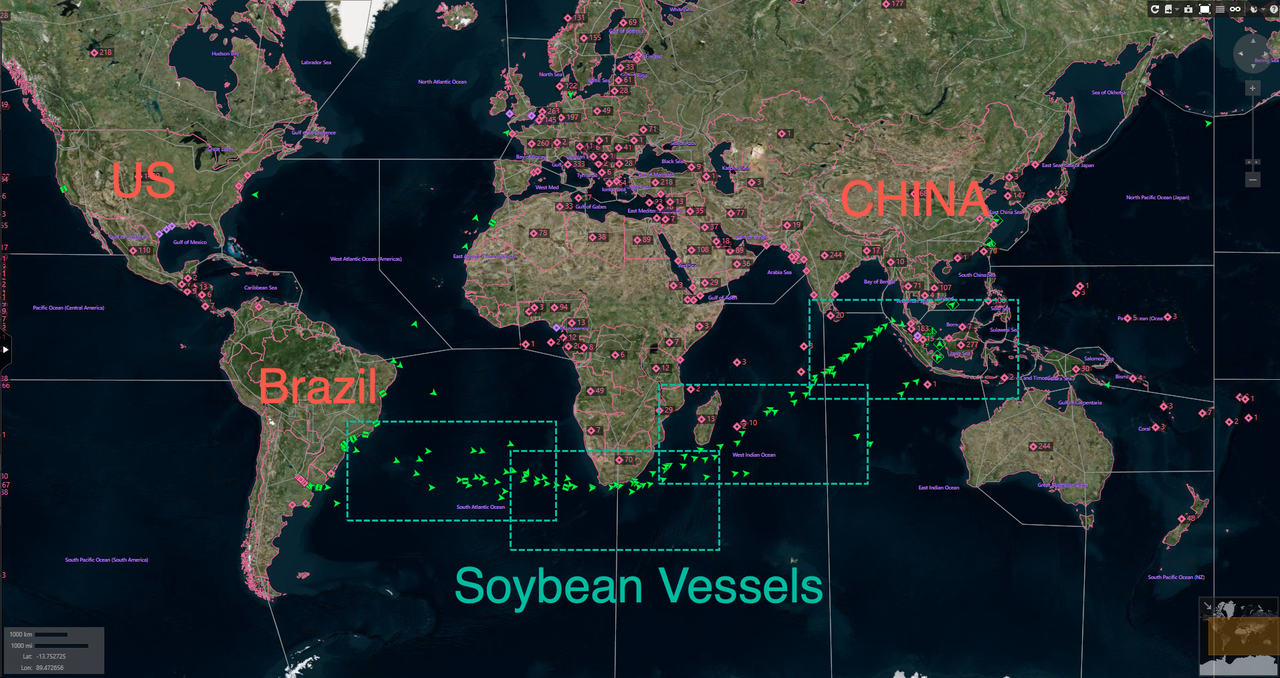
Soybeans are one of the leading agriculture products that the U.S. exports to China -- so when Trump touts "China Is Purchasing U.S. Agricultural Products Now," one would expect to see a whole bunch of soybeans -- but as the one trader said, China abandoned the U.S. market for Brazil.
Also, check out a vessel map from Saturday, each green dot is a bulk carrier hauling soybeans. Notice how there is just one bulk carrier transporting soybeans off the East Coast, while dozens and dozens of vessels are traversing back and forth from Brazil and China.
https://www.zerohedge.com/markets/trump-touts-china-buying-agriculture-products-traders-firmly-disagree
Another year, another portfolio review by Alcoa.
The U.S. aluminium producer has just announced a five-year review of around 4.0 million tonnes of alumina capacity and 1.5 million tonnes of smelter capacity.
Assets will be improved, curtailed, closed or sold.
It’s not quite an annual event but Alcoa shareholders have been here many times before as the company keeps trying to move down the cost curve in the face of chronically depressed prices.
On the London Metal Exchange (LME) three-month aluminium has ground steadily lower over the course of 2019 and at a current $1,720 per tonne is close to the near three-year low of $1,705 recorded earlier this month.
This time around, however, Alcoa is throwing an extra ingredient into the cost-cutting mix - sustainability.
The company “expects to be the lowest emitter of carbon dioxide among all global aluminium companies”.
Going green is the new differentiator in the cut-throat business of making aluminium.
GREEN POWER
Aluminium is one of the metals expected to benefit from the “green revolution” given its recyclability and light-weighting potential in the automotive sector.
However, its green credentials have recently come in for some serious scrutiny.
The part suspension of the Alunorte alumina refinery in Brazil last year and closures in China this year have served as a reminder that aluminium has its own tailings dam issues, a sensitive topic after the devastating dam failure at Vale’s Brumadinho iron ore mine.
Moreover, aluminium is only as “green” as the power source used to make the stuff, particularly since power is such an important input in the aluminium smelting process.
Alcoa is hoping to leverage its existing strengths on both fronts.
Its entire production chain is certified by the Aluminium Stewardship Initiative, it boasts “the lowest carbon footprint of any (alumina) refining system in the world” and is one of the lowest emitters among major aluminium producers.
Around 70% of the electricity powering its smelters comes from renewable sources, a ratio that Alcoa hopes will rise to around 85% after its portfolio review.
BLACK ALUMINIUM
Alcoa has the advantage of being based in North America, which thanks to Canada’s massive hydroelectric dam system has one the highest renewable energy profiles of any major producing region.
Hydro power accounted for 82% of North American aluminium production last year, according to the International Aluminium Institute (IAI).
Latin America was close behind with 77%, albeit with a much smaller smelter network.
In Europe hydro power fed 75% of aluminium production last year. Rusal’s giant Siberian smelters are an important part of that calculation.
If these are the “green” aluminium production hubs, the “black” ones are in China, the world’s largest producing nation, and in the rest of Asia. Hydro powered around 10% of aluminium output in each region last year with coal accounting for the rest, according to the IAI.
Coal is a particularly problematic source of power for any metal that wants to claim it is environmentally sustainable.
Chinese producers are increasingly reacting to this emerging power-source differentiation in the aluminium production sector.
Hongqiao Group, the country’s largest producer, last week announced it will take the lead in developing a “green aluminium” industrial park in Yunnan, a Chinese province rich in hydropower resources.
It will follow a trail blazed by other Chinese producers such as Chalco and Henan Shenhuo, which have also been building out “green” capacity in Yunnan.
Since most Chinese producers are prohibited from building more aluminium production capacity, new plants in Yunnan are replacing older, coal-powered smelters in heavily industrialized provinces such as Shandong.
But while part of the country’s aluminium production is migrating to hydro-rich provinces, another part is locked into stranded coal deposits in the northwestern provinces.
That means the evolving green-black aluminium differentiation is not going to go away any time soon.
HOW MUCH TO GO GREEN?
The question is whether sustainable “green” aluminium will end up commanding a financial premium over non-green metal.
Is differentiation a mere branding exercise or can it be a financial driver as well?
“We have a series of products right now that are either focused on being low-carbon or being made on a certain amount of recyclable material (...) that have been able to command a premium in the market-place,” according to Roy Harvey, Alcoa President and Chief Executive Officer.
However, Harvey conceded on the company’s quarterly earnings call that “this is just a nascent market” which will “take time to develop.”
Alcoa hopes that what is a niche market today becomes a global market tomorrow.
Alcoa’s sustainability message is, according to Harvey, “something that is a natural addition and is in fact the way that Alcoa’s succeeds into the future because we do the right thing and because at some point the market recognizes that is value in that responsibility.”
BATTLEGROUND
The aluminium industry is just at the start of its own green revolution.
It is being driven by producers such as Alcoa, Rusal and Norway’s Hydro, all of which already enjoy high renewable energy inputs into their smelters.
The next phase will be the evolution of the smelting process itself.
Alcoa and Rio Tinto have formed a joint venture, ELYSIS, to commercialize a smelting process that generates oxygen and eliminates all direct greenhouse gas emissions.
The aim is to have a technology package for sale in 2024, either for retrofitting existing smelters or building new greenfield plants.
Apple is also part of the joint venture, a clear sign of the interest from consumer groups in ensuring their metal ticks all the sustainability boxes.
It’s just part of a bigger technological rethink by aluminium products.
Rusal, for example, is working on ways of converting waste such as “red mud” into saleable products. Its Sayanogorsk smelter site already processes or sells over 90% of the waste produced and the goal is to move the rest of the company’s smelters up to a similar ratio.
Expect similar announcements from other producers to follow.
The concept of “green” aluminium is only a couple of years old but sustainability looks set to be a defining feature of this market for years to come.
https://www.oaktreecapital.com/insights/howard-marks-memos
suggested I write a memo about negative interest rates. My reaction was immediate and unequivocal: “I can’t. I don’t know anything about them.” And then I realized that’s the point. No one does.
MGL: Must reading.
MGL: Above average.
MGL: Permian prices collapse again, post the 2bcf add to pipe capacity?
Many privately held firms in Shandong, China’s third-biggest province by economic output, are struggling to repay short-term debt due to declining industry fundamentals, entangled cross guarantees and ill-managed investments, S&P Global Ratings said.
China’s slowing economy and enforcement of environmental protection rules have pressured the profitability and cash flow of Shandong companies in over-capacity sectors including oil refining, petrochemicals, steel, aluminium and textiles, S&P said.
“The Shandong economy is skewed toward gritty smoke-stack industries where companies are typically highly leveraged,” said Chang Li, China country specialist for S&P Global Ratings.
“We view the plight of Shandong POEs (privately owned enterprises) as indicative of China’s wider challenge: the difficulty of transitioning to a higher value-added economy, while managing high debt and slowing growth.”
Private firms in Shandong are also frequent users of the cross guarantee, which has the potential to send one company’s liquidity problems reverberating through the credit system, the ratings agency said.
Reuters reported in February, citing court rulings, that at least 28 private companies in Dongying, a hub for oil refining and heavy industry in Shandong, are seeking to restructure their debts and avoid bankruptcy, mainly due to souring loans that they guaranteed for other firms.
For a private firm to get bank loans in China, especially those in traditional, capital-intensive industries, it often needs substantial collateral or the guarantee of another company. The guarantor itself is very likely to have taken on loans guaranteed by other firms.
Complicating the situation is the weak transparency of these companies in disclosing their full exposures, potentially creating vicious cycles where complex cross guarantees spread solvency risks to the entire region, swamping the good credits along with the bad.
“We foresee no immediate relief to Shandong’s POE liquidity and refinancing challenges given China’s slowing economy. We expect Shandong POE credit risk will remain significant for the next 12 months,” S&P said.
The ratings agency added that Shandong’s support will be limited, as the provincial government has been favouring high-value-added sectors in recent years, and may not mind letting some private firms in over-capacity industries go under, if there is no systemic risk.
Miner Anglo American (AAL.L) said on Tuesday it was on track to meet annual output targets after production rose 4% in the third quarter, driven by a ramp up at its Minas-Rio mine in Brazil and rise in coking coal production.
Minas-Rio, one of Anglo’s biggest growth projects that was suspended last year, is expected to produce 20-22 million tonnes of iron ore in 2019, up from previous expectations of 19-21 million tonnes, the company said.
Production of iron ore at Minas-Rio was 6.1 million tonnes, and metallurgical coal jumped 22% to 6.6 million tonnes in the quarter ended Sept. 30, the company said.
Miner Anglo American said copper and thermal coal production would be at the lower end of their guidance ranges after output increased 4% in the third quarter of the year, as a fall in copper, coal and diamond production kept a lid on growth.
Still, the company said it remained broadly on track to deliver within its full-year production targets, with an increase in production guidance at Minas-Rio.
Copper production decreased by 8% to 158,900 tonnes due to unprecedented drought conditions impacting Los Bronces in Chile.
Copper production guidance was tightened to a range of 630,000 to 650,000 tonnes (previously 630,000 to 660,000 tonnes) due to the severe drought, which also remained a risk for 2020 production, the company said.
Production guidance for export thermal coal was tightened to about 26m tonnes from a range of 26m to 28m tonnes due to lower than expected production from Cerrejón, the company added.
De Beers' diamond production decreased by 14% to 7.4m carats due to planned mine closures and the underground transition at Venetia. Production guidance was unchanged at about 31m carats.
As per usual, a soft pound gave a fillip to blue-chips
5.15pm: FTSE 100 in positive finish
FTSE 100 closes up around 50 points Pound weakened as prospect of a 2019 General Election looms Just East surges to Footsie podium
FTSE 100 index closed higher on Tuesday, aided by the decline in sterling and as traders await the next vote on Brexit in parliament.
Expected is a key vote around 7.30pm on the Commons debate timetable on the latest Brexit plan. Word is that Prime Minister Boris Johnson will call for a general election if MPs don't back the proposed three day timetable.
The Footsie finished up 50.85 points at 7,214.59.
But the more UK -company focused FTSE 250 plunged 108 points to stand at 20,200.79.
The pound lost 0.11% to 1.2946 against the US dollar.
"Pound traders are broadly opting to stay on the side-lines rather than guess the outcome of today’s voting," said Fiona Cincotta, market analyst at City Index.
She added: "Should the House of Commons reject the idea of pushing the legislation through in just 3 days, Bojo’s Brexit bill could potentially under much more scrutiny. This opens up the probability of a more drawn out Brexit. This would also give the opposition ore time to get their act together and push for an election or second referendum."
Top riser on FTSE 100 was take-away app Just Eat (LON:JE.) which gained a stonking 24.19% to 732p as a bidding war looms as it rejected a hostile £4.9bn bid from investment firm Prosus in favour of a £8.4bn merger with Dutch rival Takeaway.com.
4pm: Footsie clings to gains
Having entered the final hour of trading, the Footsie has been engaged in holding its station, clinging on to earlier gains.
London's top-shares index was up 45 points (0.6%) at 7,208, some 12 points off its intra-day high and almost 70 points above its low.
Sterling has now lost almost half a cent today to US$1.2916 as traders remain on alert for a General Election to be called if Parliament does not pass the withdrawal agreement bill (WAB).
Pound gets Brexit butterflies as Johnson talks up election; investors hungry for Just Eat... https://t.co/ODdoMSLCvt$JE $GBP #Brexit #WAB #sterling #pound
— Connor Campbell (@Connor Spreadex
“As tension builds ahead of this evening’s votes on the Brexit withdrawal agreement bill, the pound lost a step on Tuesday afternoon,” reported Connor Campbell at Spreadex.
“The currency’s stoic open was gradually chipped away at as the day went on. Now sterling is down 0.4% against the dollar and 0.3% against the euro, tripping away from Monday’s fresh 5-month highs. Not only is it feeling nervy pre-vote, it is also dealing with the re-raised spectre of a general election,” Campbell added.
“Boris Johnson has threatened to pull the WAB if MPs decline his timetable in Tuesday’s 2nd vote, and instead seek to send the public to the polls pre-Christmas (this is as long as the EU would grant a 3-month extension as requested by the Benn act),” he said.
Wells Fargo Economics reckons there is a “better-than-ever” chance the bill will be ratified in the next few days; possibly it meant “better-than-even” chance.
“Given the challenges negotiators are likely to face in the coming years as they work to agree on a new trading arrangement, we think most of the Brexit optimism will be front-loaded in the next few weeks,” the economics group predicted.
3.00pm: FTSE 100 kicks on as sterling tumbles on General Election fears
The FTSE 100 has kicked on after sterling took a tumble on foreign exchange markets.
A Downing Street source has been quoted as saying, “if Parliament votes again for delay by voting down the programme motion, and the EU offers delay until 31 Jan -- then we will pull the Bill, there will be no further business for Parliament and we'll move to an election before Christmas”.
The FTSE 100, which usually receives a fillip from a weak exchange rate, climbed above 7,200 to 7,209, up 46 points (0.6%) on the day as sterling fell to US$1.2929, down a third of a cent.
STERLING FALL CAUSED BY BBC POLITICAL EDITOR TWEET THAT GOVT WILL PULL BREXIT LEGISLATION AND PUSH FOR ELECTION IF LAWMAKERS VOTE DOWN BILL
— Quantitative Trading (@fiquant) October 22, 2019
Not sure he will spell it out at the despatch box, but it seems if MP s won't agree govt timetable for Brexit legislation tonight, they will pull it, and if EU then offers a delay, they would push straight for an election instead
— Laura Kuenssberg (@bbclaurak) October 22, 2019
Sterling's stumble lifted spirits a bit after what Howard Archer of the EY ITEM Club called “a dismal October CBI industrial trends survey”.
“There is not even any sign of manufacturers getting a temporary boost in October from increased stock-building ahead of the 31 October Brexit deadline. The balance for stocks of finished products fell back to a six-month low of +11% in October after jumping to +28% in September (the highest since May 2009) from +14% in August,” Archer reported.
“The survey shows the orders balance fell to -37% in October, which was the weakest level since March 2010. It was down from -28% in September and -13% in August, and substantially below the long-term average of -13%,” Archer observed.
“The simultaneously released CBI quarterly survey showed that confidence among manufacturers was the lowest since July 2016. Specifically, the business optimism index weakened to -44% from -32% in July. Manufacturers were particularly downbeat about export prospects (the lowest since October 2001),” he added.
Meanwhile, in the US, the Dow Jones is more or less unchanged while the broader-based S&P 500 is up 5 points (0.2%) at 3,012.
1.40pm: Blue-chips consolidate gains
The Footsie remained in positive territory ahead of what is expected to be a modestly firmer start on Wall Street.
London’s index of blue-chip shares was up 34 points (0.5%) at 7,197.
Across the pond, while the Dow Jones is expected to open 5 points lower at 26,822 – weighed down by negative sentiment towards fast-food giant McDonalds after an earnings miss – the S&P 500 is tipped to start 4 points higher at 3,011.
In the UK, the CBI’s total orders balance dropped to -37 in October from -28 in September. Economists had pencilled in a figure of -30.
“Manufacturers appear to be experiencing the full force of the global downturn and aren’t enjoying any relief this time from preparations ahead of the October Brexit deadline,” observed Samuel Tombs at Pantheon Macroeconomics.
“Granted, the total orders balance is not seasonally adjusted and it has fallen by an average of six points over the last 42 years. Nonetheless, our seasonally adjusted version of the balance also dropped in October and points to manufacturing output falling at a 4% year-over-year rate soon. In addition, the quarterly business optimism balance dropped to the lowest level since July 2016, while all three investment intentions balances, relating to building, machinery and training, fell to their lowest levels since the financial crisis,” he added.
12.05pm: Just Eat share price super-sizes
Led by Just Eat PLC (LON:JE.), the FTSE 100 has reversed track and hurtled into positive territory.
London's index of leading shares was up 35 points (0.5%) at 7,199, thanks in part to a 25% increase in the share price of Just Eat after the online takeaway giant received a hostile takeover bid from a company owned by South African e-commerce giant Naspers.
The shares are trading at around 735p, 25p above Naspers’ offer price, which suggests the market is expecting a bidding war to ensue, as Just Eat management had previously agreed to a merger with the Dutch company, Takeaway.com.
“The 710p cash offer from Prosus is a 20% premium to the Takeaway.com offer and about 12% higher than the shares were trading before the latter’s bid. Always a strong possibility given the increasingly low-ball offer from Takeaway.com, a bidding war is now on. You may need more like 750p to sort this out,” suggested Neil Wilson.
Today’s borrowing figures put PSNB at £40.3bn in the first half of 2019-20, up 22% on the same period in 2018-19. But back at the Spring Statement, the OBR projected that full-year borrowing would reach £40.6bn (adjusting for student loans), down v slightly on the 2018-19 total pic.twitter.com/sKN0l3GGlQ
— Matt Whittaker (@MattWhittakerRF) October 22, 2019
On the macro front, the public sector net borrowing excluding public sector banks – “PSNB ex.” in the jargon – rose to £9.4bn in September from £8.8bn the year before but was below the consensus forecast of £9.7bn.
“September’s relatively small increase in borrowing leaves the public finances looking a little healthier than before, though the government still is on course to exceed next year’s 2% of GDP [gross domestic product] borrowing limit,” said Samuel Tombs, the chief UK economist at Pantheon Macroeconomics.
“No political appetite exists for further austerity measures to reduce the deficit. Indeed, the Chancellor allocated in last month's Spending Round an extra £12bn to departments to spend in 2020/21, over and above that already planned for in the Spring Statement, while both parties will pledge giveaways to the electorate in the election likely to be held in the coming months. If the next Budget is held as currently planned on November 6, voters can expect pre-election sweeteners from the Conservatives,” Tombs declared.
Also on the home front – literally, in this case – the provisional seasonally adjusted estimate of UK property transactions for September was 101,740 residential and 10,500 non-residential transactions.
The provisional seasonally adjusted count of residential property transactions in September was 2.3% higher than in September 2018 and 5.0% higher than in August 2019, Her Majesty’s Revenue & Customs revealed.
The provisional seasonally adjusted count of non-residential property transactions in September was 0.2% higher than in September 2018 and 7.7% higher than in August 2019.
“A seasonally inspired spike in transactions will be welcomed across an otherwise weary market landscape and while uncertainty continues to dominate the property sector, this late rally in the number of homes being sold proves there is plenty of life in the old dog yet,” ventured Shepherd Ncube, the chief executive officer of Springbok Properties.
“There remains a huge appetite for home ownership across the UK and while transactions may have plateaued in recent years they have remained consistently stable, with pent up demand from homebuyers occasionally giving way in the form of a monthly spike in sales,” he added.
Property listings website operator Rightmove PLC (LON:RMV) was heartened by the news and added 12p to yesterday’s gains to advance to 581.8p.
Yesterday, Rightmove reported that house prices are rising at their lowest rate in October since 2008, climbing 0.6% while property listing numbers are down 13.5% on levels seen a year ago.
10.00am: Stocks chug lower
London's leading shares are lower on balance as traders await the outcome of Boris Johnson's “one more heave” to get Brexit over the line.
The FTSE 100 was down 14 points (0.2%) at 7,150, with travel firm TUI AG (LON:TUI), down 5.1% at 1,012.5p, leading the retreat after Morgan Stanley cut its rating on the stock to “equal weight”.
Also under the cosh is Reckitt Benckiser PLC (LON:RB.) after it slashed full-year sales guidance in its third-quarter trading update.
The Anglo-Dutch fast-moving consumer goods giant's shares were down 5.0% at 5,577p.
Anglo-American PLC (LON:AAL), up 1.3% at 1,965.2p, was the top-performing blue-chip after its third-quarter production update.
Whitbread plc (LON:WTB) was another stock on the rise, hardening 0.8% to 4,238p, after its interims.
“Now without the significant buttress of the Costa business, Whitbread is finding life tough,” declared Richard Hunter, the head of markets at interactive investor.
“Whitbread’s reliance on the hotels market makes the company less diversified and therefore more vulnerable to economic swings. The shares have underperformed of late, having declined 13% over the last six months and 7% over the last year, the latter of which compares to a 1.7% increase in the wider FTSE100. With the real potential of economic clouds on the horizon, the market consensus of the shares has now swung to a sell in the absence of any sustained cheer from the company,” Hunter noted.
8.45am: Stuttering start ahead of the Withdrawal Agreement Bill
The FTSE 100 made a stuttering start to proceedings with caution the watchword ahead of Boris Johnson’s final bid get the UK out of the EU by the end of the month.
Later Tuesday, MPs will be asked to back the Prime Minister’s Withdrawal Agreement Bill. If Johnson is successful, and at this stage, it is still a big ‘if’, the Commons will be asked to approve an intensive three-day timetable in which to consider the legislation.
“There are yet plenty of hurdles for the government to clear after winning the vote that will keep traders mindful of downside risks,” said Neil Wilson, an analyst at Markets.com.
The morning’s big mover was Reckitt Benckiser (LON:RB.), which cut its sales target after a dour third-quarter update. The shares fell 4.5%.
On the upside, there was a recovery from recent lows for the miners led by Antofagasta (LON:ANTO), which was up 1.5%.
6.43am: Hesitant start predicted
The FTSE 100 will start very hesitantly ahead of a potentially big Brexit day in parliament.
London's blue-chip index is predicted to drop three points to 7,163, according to spread betters, having added 13 the day before.
Boris Johnson is thought to have the House of Commons numbers to win a vote on his withdrawal agreement bill (https://www.gov.uk/government/publications/eu-withdrawal-agreement-bill - WAB), in what is known as the second reading of the bill on Tuesday, but may find it more difficult to get the deal through on the accelerated timeline for approval by 31 October.
This timeline, known as the programme motion, allows only three days’ of consideration and debate on the WAB, and many MPs who say they are willing to vote for the second or third readings are opposed to the current programme.
But even if the WAB continues its passage, various groups of MPs are planning to try to add amendments, including the push for a customs union and/or a confirmatory referendum.
"The prospect of an extension has continued to support the pound which made another five-month high against the US dollar yesterday above the 1.3000 level," said Michael Hewson at CMC Markets.
"For now, this appears to be acting as a short-term top, with markets reluctant to drive the currency too much higher given that there could be many more political twists and turns before any deal gets across the line."
Economists at Pantheon Macroeconomics noted that the pound has only been tickling the 1.3 mark rather than going much higher, saying “markets are right to view the passing of the WAB as far from a done deal”.
“By our reckoning, the customs union amendment will be only one vote short of passing if the SNP, Lib Dems and others back it, so the vote essentially looks likely to be a toss-up,” Pantheon said.
But the big votes are not scheduled until late on Tuesday evening, so investors can safely mull over some corporate news in the meantime, plus perhaps the second term for Canada’s Justin Trudeau confirmed overnight.
Hotel sector squeeze
Premier Inn owner Whitbread plc's (LON:WTB) half-year results come amid some negative news from the hotels sector.
At the end of last week, smaller rival easyHotel gave a grim assessment of UK market, saying its London hotels performed well enough but regional hotels saw a 2.8% decline, with many regions hit by double-digit drops.
Across the UK, sector-wide revenue per available room (revpar) is down by an average of 0.7% this year, according to market data from STR Global.
Recently, however, UBS upgraded the shares to 'buy' from 'neutral' as they said the recent share price valuation implies that the market is predicting Whitbread's revpar will fall 10%, while the analysts reckon the fall will be nearer 3%.
In the first quarter, Premier Inn reported a 6.0% fall in revpar, with total accommodation sales down 1.5% and like-for-like sales down 4.6%, blaming weaker business and consumer confidence due to Brexit uncertainty.
Tough for Travis
Similarly, after a profit warning by a sector peer last week, builders’ merchant Travis Perkins PLC (LON:TPK) will post what analysts say is “a relatively important update” on Tuesday.
Investors will be wondering how the economic backdrop has impacted the company’s third quarter, especially after Grafton’s warning last week that UK business has been hit by "increased economic uncertainty" that was preventing consumers from spending on home improvement projects.
With such strong pressure from macro conditions, Peel Hunt said this might mean the benefits from Travis Perkins’ operational improvements may be offset.
Also hotly anticipated will be news on sales at Wickes and the plumbing and heating division, which have been dividing consensus forecasts for adjusted results.
Anglo's diversity
Diversified miner Anglo American (LON:AAL) is to deliver third-quarter production reports on Tuesday.
Shares in many companies in the sector have stumbled in the last six months amid the ongoing trade war between the US and China, the world’s two biggest economies and major base metals importers.
Anglo American could be a winner since it should be better protected from copper and iron ore volatility as its 80%-owned platinum group metals division Amplats turned a corner and has risen strongly this year thanks to rising demand for palladium, used in batteries, and platinum, which has benefited from a bullish precious metals market.
RBC Capital Markets rates the diversified miner a “top pick” and raised its target price to 2,300p, meanwhile Credit Suisse has rated it an “outperform”.
Significant events on Tuesday 22 October:
Interims: Whitbread Group PLC (LON:WTB)
Trading statement: Anglo American plc (LON:AAL), Bunzl PLC (LON:BNZL), Gear4Music Holdings PLC (LON:G4M), Reckitt Benckiser Group PLC (LON:RB.), St James's Place PLC (LON:STJ), Travis Perkins PLC (LON:TPK)
AGMs: Accrol Group PLC (LON:ACRL), McBride (LON:MCB)
Economic announcements: UK public sector net borrowing, CBI industrial trends survey, US existing home sales, China policy decision
Business Headlines
Financial Times:
Downing Street believes Boris Johnson is on course to secure a narrow victory when MPs vote on his Withdrawal Agreement bill, although the backlash was furious over his attempt to railroad the whole legislation process through parliament with extremely limited scrutiny. Justin Trudeau’s Liberal party survived a multipronged challenge from both the left and right in Canada’s general election on Monday but he will return to power as the head of a minority government. Parties involved in opioid crisis litigation on Monday sketched out a $48bn proposal that could end thousands of lawsuits if four US states can convince their fellow plaintiffs to accept the deal from drugmakers and distributors. Botched public sector outsourcing contracts wasted at least £14.3 billion of taxpayers’ money in the past three years, according to the think-tank Reform. Coty is exploring the sale of its professional hair and nail products business, including Wella and Clairol, as it seeks to cut debt. Adam Neumann, the flamboyant co-founder of WeWork, is favouring a $9.5bn rescue proposal from his largest investor that would pay him about $200m to cede his outsize voting power and chairmanship of the crisis-hit property company.
The Times:
An influential think tank has questioned the value of a tax break for entrepreneurs, saying that it does little to promote business investment and only makes wealthy people even richer. More than £1 billion was wiped off Smith & Nephew’s market value yesterday after its chief executive stood down only 18 months into the role amid a dispute about his pay. Investors keen for swift and substantial capital growth might prefer to own Prudential shares, writes Tempus, those seeking a reliable income might be better off with M&G. The Financial Reporting Council has criticised the lack of diversity at accountancy firms, where women make up only 17% of partner-level roles. An Israeli drug company accused of helping to fuel America’s opioid addiction crisis has laid out a framework for a global settlement deal. Teva Pharmaceuticals said that it had offered $250 million in cash and a supply of Suboxone, an opioid addiction treatment, worth $23 billion to settle sprawling litigation against the company. The population of Britain is set to increase by three million over the next decade, with 80 per cent of the growth driven by immigration, according to official projections published yesterday.
The Daily Telegraph:
Boris Johnson is expected to abandon Brexit legislation in Parliament rather than accept a customs union or second referendum, rebel MPs were warned. Campaigners ask the Treasury to investigate the City watchdog's handling of the Woodford failure amid concerns the regulator is shirking its responsibilities. Endemol Shine is on the brink of a €2 billion takeover by television company Banijay. British esports firm Gfinity almost doubled its revenues on the back of a surge in the popularity of professional video game tournaments.
The Guardian:
Up to 12,000 Asda workers could lose their jobs next week, according to union officials, if they refuse to sign up to a new contract. Four major pharmaceutical companies agreed to a $260 million payout over the US opioid epidemic on Monday, hours before a landmark federal trial.
Daily Mail:
PWC could face legal action over claims it leaked highly sensitive information about the scandal-hit insurer Quindell in 2015. Sirius Minerals has insisted there are no plans to take the business private following controversial comments made by its boss.
A U.S.-China trade deal could be finalized by the New Year, according to Trump’s top advisor.
The outcome will hinge on mid-November negotiations in Chile, said Peter Navarro, director of trade and manufacturing for President Trump, at the Citizen by CNN Conference in New York City Thursday morning.
“The best thing to do is to just see what happens in Chile,” he said. “It will be a good indication to see where we are… As the president says many times, we’ll either get a great deal or we won’t, we’ll see what happens.”
The APEC Economic Leaders’ Meeting in Santiago, Chile on November 17, is part of a year-long Asia-Pacific Economic Cooperation forum facilitating cooperation among 21 Pacific Rim economies, including the U.S. and China. The meeting, facilitated by President of Chile Sebastian Pinera, will address “emerging trade challenges and the future of cooperation between APEC [Asia-Pacific Economic Cooperation] economies,” according to the event’s site.
FILE - In this file photo dated Wednesday, Sept. 11, 2019, U.S. White House trade adviser Peter Navarro speaks during a television interview at the White House, in Washington, U.S.A. The U.S. is threatening to pull the United States out of the 145-year-old Universal Postal Union, as Navarro said they opposes options being considered that would maintain the current limits. (AP Photo/Alex Brandon) More
With the presidential election approaching in 2020, China may want to wait for the outcome (and potentially a new U.S. president) instead of reaching a deal. “They [China] may play the string out, but that would be a miscalculation... They have underestimated the resolve of the president... [The Trump tariffs are] giving China the incentive to come to the bargaining table.” said Navarro. “Their [China’s] economy is hurting.”
When Jim Sciutto, chief national security correspondent for CNN, said the war is hurting the U.S. too, Navarro disagreed. “I don’t know that,” said Navarro, who emphasized that the costs of tariffs burdened by manufacturers and farmers have been offset by job growth and subsidies for farmers. A notion he has shared with Yahoo Finance.
Sarah Paynter is a reporter at Yahoo Finance. Follow her on Twitter @sarahapaynter
Read the latest financial and business news from Yahoo Finance
Follow Yahoo Finance on Twitter, Facebook, Instagram, Flipboard, SmartNews, LinkedIn, YouTube, and reddit.
More from Sarah:
Eric Trump on paying contractors: We pay ‘people when they do great jobs’
Bethenny Frankel on real estate: ‘Don’t worry about taking your losses on a sell’
Rich millennials are like their older cohorts: study
President Donald Trump reiterated that the United States will be withdrawing from the Paris Climate Agreement, praising soaring U.S. oil and gas production at the same time.
“I withdrew the United States from the terrible, one-sided Paris Climate Accord,” President Trump said at the 9th Annual Shale Insight Conference in Pittsburgh on Wednesday, less than two weeks before the United States can formally begin the process to pull out of the climate agreement on November 4.
This day is the earliest date on which the U.S. can submit a formal letter to the United Nations to begin the process of withdrawal, which would be completed one year after that, right around the time of the 2020 presidential election.
“The Paris Accord would’ve been shutting down American producers with excessive regulatory restrictions like you would not believe, while allowing foreign producers to pollute with impunity,” President Trump said at the Pittsburgh conference, touting America’s air and water as ones of the cleanest on earth.
“And, you know, as I said before, we’re now number one, not by a little bit, but by far. Way ahead of Saudi Arabia. Way ahead of Russia. But we can do even much better than that,” the U.S. President added, referring to U.S. oil production.
Petroleum and natural gas production in the United States jumped by 16 percent and 12 percent, respectively, in 2018, setting new production records and placing the United States as the world’s single largest producer of oil and natural gas, EIA has estimated. Related: Two Dead Following ISIS Attack On Iraqi Oil Field
Although the Trump Administration will soon formally begin the withdrawal from the global climate agreement, cities, states, and businesses continue to pledge emissions reduction through organizations such as America’s Pledge and We Are Still In. Across America, 24 states have committed to upholding the U.S. commitment to the Paris Accord of reducing emissions 26 to 28 percent below 2005 levels by 2025.
The Trump Administration’s intent to start the withdrawal process drew criticism from the Center for American Progress, whose president and CEO Neera Tanden said:
“Instead of projecting strength, this action weakens America on the world stage and cedes leadership on climate change and other challenges of our time to countries like Russia and China.”
By Tsvetana Paraskova for Oilprice.com
More Top Reads From Oilprice.com:
n initial pact on U.S-China trade will include much of a scrapped May deal’s agreement regarding intellectual property and will target enforcement mechanisms, White House trade adviser Peter Navarro said on Thursday, adding that he hopes the Chinese negotiate in “good faith.”
“The good news about this phase one ... is it adopted virtually the entire chapter in the deal last May that they reneged on for IP,” Navarro told Fox Business Network in an interview. “Practically it means, if they steal our IP we’ll be able to take retaliatory action without them retaliating.”
Teck Resources, Canada’s largest diversified miner, has kicked off a cost-cutting program that will see layoffs and the deferral of capital spending projects as the ongoing US-China trade hit the company’s third-quarter profit.
Revenue for the three months through September declined by 5.4% to C$3.04 billion, compared to a year ago, even as its energy and zinc units partly offset weak base metal and steelmaking coal prices caused by global economic uncertainty.
The Vancouver-based mining giant’s adjusted profit fell to C$403 million, or C$0.72 per share, in the quarter ended Sept. 30, from C$466 million, or C$0.81 per share, a year earlier. Analysts on average were expecting it to earn 66 Canadian cents per share, based on estimates by financial markets data firm Refinitiv.
“Over the past few years, we have focused our attention on maximizing production to capture margin during periods of higher commodity prices,” the company’s president and CEO, Don Lindsay, said. “However, current global economic uncertainties are having a significant negative effect on the prices for our products, particularly steelmaking coal.”
As part of the planned cost-cutting measures, Teck said it would eliminate around 500 full-time jobs. Some of them, it said, will come from attrition, the expiry of temporary or contract positions and current job vacancies.
Lindsay noted that while Teck would focus on improving efficiency and productivity across its business for the balance of 2019 and 2020, it will continue to forge ahead with certain key projects.
One of them, the company said, is Quebrada Blanca Phase 2 (QB2) project in Chile. Construction at one of the world’s largest undeveloped copper resources is expected to be completed in the fourth quarter of 2021, with ramp-up to full production expected during 2022.
Teck in late 2018 teamed up with the Japanese Sumitomo Metal Mining Co Ltd and Sumitomo Corp to boost the production of its aging open-pit mine in northern Chile to 300,000 tonnes of copper a year from 23,400 tonnes in 2017.
Copper, one of four business units at Teck besides steelmaking coal, oil and zinc, is considered a company’s priority.
https://www.mining.com/teck-to-lay-off-workers-cut-spending-as-us-china-trade-war-weighs-on-profit/
(Bloomberg Opinion) -- Saudi Arabia should give up trying to manage the global crude market and return to the pump-at-will policy it briefly adopted in 2014 under its longest serving oil minister Ali Al-Naimi.
In the mercantilist world in which we now live, where decisions are based on narrow national interest, it makes no sense for the world's lowest-cost oil producer to subsidize shale and prop up other high-cost suppliers.
Of course when it does, oil prices will crash just as they did in 1986 when the country finally abandoned fixed official selling prices. And then, in the aftermath, global investors will get in a flap about all things Saudi: the IPO of the kingdom’s state oil company, the financing required to fund a young and under-employed population, Mohammed bin Salman’s ambitious Vision 2030 plan to transform the economy away from its dependence on oil.
Despite the risks, it’s time to admit that market management is failing, even though Saudi Arabia and it “allies” say that it isn’t.
The OPEC+ agreement was meant to drain excess stockpiles in six months. But we are now approaching a fourth year of Saudi Arabia leading a global alliance of producers in trying — and failing — to push up oil prices in a sustainable way.
For a while it appeared that the cuts were having the desired effect. Inventories came down and Brent prices rose from about $45 a barrel in June 2017 to reach a high of $86 in October 2018. But they swiftly fell back towards $50 and a second round of cuts that began in January has failed to keep them above $60. Even the temporary loss of more than half of Saudi Arabia’s oil production — and most of the world’s spare capacity — in an attack on two of the kingdom’s biggest processing facilities failed to lift prices for more than a few days.
The latest data from OPEC itself — along with the International Energy Agency and the U.S. Energy Administration — show the failure of the policy.
All three see global oil inventories building in the first half of next year in the face of what is starting to look like America's forever trade war. The global gridlock has also prompted a reduction in forecasts for growth in oil demand this year and next. The average level of Saudi oil production in the first eight months of 2019 was the lowest since 2014 — even excluding the dip caused by the Sept. 14 attacks on the kingdom’s oil processing infrastructure. And it will have to come down further next year if the kingdom wants to continue trying to manage the market.
Meanwhile Russia, the kingdom’s leading partner in the OPEC+ group of countries that came together to manage supply, has seen its output continue to rise each year, even as it has come to dominate OPEC+ policymaking.
Saudi Arabia should let American shale drillers take the strain. After all, aren't they the producers of the marginal barrel of crude now? As long as Saudi Arabia and its cohorts continue to restrict output and subsidize shale they are merely delaying an answer to the question.
It’s time to discover a true price of oil.
Saudi Arabia will learn to work with this over time, just as it did after 1986. And it will probably find that that price isn’t as low as the kingdom fears. Eventually, shale producers will be forced to cut back — or they won’t.
If they are forced to cut, then Saudi Arabia will get the price support it craves, without having to lower its own output. But if shale production can just keep going up and up, even in a lower-price environment, then it proves just as emphatically that the Saudi-led policy of market management is a busted flush anyway.
Will they do it? I doubt it.
Current oil minister Abdulaziz Bin Salman sees it as his job “to ensure that the oversupply doesn’t continue.” December’s OPEC and OPEC+ meetings will likely yield the promise of further output cuts and Saudi Arabia will pump even less next year in a vain attempt to prop up prices. But it would be nice to believe that they are capable of change.
To contact the author of this story: Julian Lee at jlee1627@bloomberg.net
To contact the editor responsible for this story: Melissa Pozsgay at mpozsgay@bloomberg.net
This column does not necessarily reflect the opinion of the editorial board or Bloomberg LP and its owners.
Julian Lee is an oil strategist for Bloomberg. Previously he worked as a senior analyst at the Centre for Global Energy Studies.
For more articles like this, please visit us at bloomberg.com/opinion
©2019 Bloomberg L.P.
https://finance.yahoo.com/news/saudi-arabias-best-bet-crash-060024198.html
The U.S. pullout from Syria sparked strong—and opposing—reactions, as a move of that magnitude was bound to do. Trump bashers bashed Trump for quitting and Trump supporters cheered the America First agenda. And some pointed to the fact that this may be part of a larger reshuffling of priorities that could result in the United States effectively leaving the Middle East. Either way, the aftershock in the oil industry could be wide reaching.
It also could form strange alliances. In a recent story for Bloomberg, Liam Denning noted the unexpected unanimity between President Trump and one of the more popular Democratic contenders for the White House, Elizabeth Warren, on the troop pullout.
“The methods and language may be different,” Denning wrote. “But neither looks committed to the U.S. presence that has endured in the Middle East for decades.”
Indeed, it seems that Washington’s attention is shifting away from the Middle East and towards home. Even the troops Trump sent to Saudi Arabia after the attacks on its oil infrastructure were paid for by Riyadh, leading one analyst to call the move “Americans going pseudo-mercenary,” Denning writes.
That Trump and Warren agree on anything may be surprising at first, but a deeper look might suggest this agreement reflects the shifting priorities of their voters. The people who voted Trump into the White House wanted, among other things, of course, jobs, even in doomed industries such as coal. People who vote Democrat and may vote for Warren, care more about climate change than the never-ending conflicts in the Middle East. Related: Iraq's Return To Oil's Top Table
Besides, there is Trump’s weakness for tariff and sanction action. These have become his weapons of choice in international disputes, which are not as violent as troop deployment. The question of whether sanctions work is a different matter, but the fact remains that for all the alarm about Trump starting a war basically as soon as he enters office, he has mostly reserved his belligerence for Twitter.
So, what happens if the American troop exodus from the Middle East continues? The power balance there is already changing. Russia has expanded its influence in the region through its alliance with the Syrian government and its closeness with Iran.
China has been reluctant to stir this particular geopolitical pot directly, but it will sure step into premises vacated by the U.S. After all, China has the most to lose from an escalation of violence in its main supplier of crude oil. Related: There’s Tremendous Room For Growth In Offshore Oil & Gas
Speaking of oil supply, that’s a big part of the reason why Trump feels confident he can pull out U.S. troops from the Middle East. Whole still importing quite a lot of oil, the United States is nowhere as import-dependent as in the early 70s when the Arab oil embargo almost caused an economic collapse because of the spike in oil prices. It imports 6 million barrels daily, according to the EIA’s latest petroleum status report, and produces 12.6 million bpd.
True energy independence may be still out of reach, but the U.S. is no longer vitally dependent on Middle Eastern oil. It will certainly keep its allies—and arms buyers, of course—there close but thinking in Washington may be changing to reflect this reduced need for securing Middle Eastern oil flows with a presence on the ground.
By Irina Slav for Oilprice.com
More Top Reads From Oilprice.com:
Brazilian state-run oil firm Petroleo Brasileiro SA posted a significant production boost in the third quarter, as heavy investments in its deepwater, pre-salt zone showed signs of paying off.
Investors and analysts have been watching the firm’s production figures closely in recent quarters, and the company’s ability to swiftly boost output is key to its current strategy.
In a securities filing, Petrobras, as the firm is commonly known, said it produced 2.878 million barrels of oil equivalent per day (boepd) in the third quarter, up 9.3% from the previous quarter and 14.6% from the same period a year ago.
August monthly production reached a new record of 3 million boepd, and daily production hit a high of 3.1 million boepd during the month. The company is on target to reach its annual production target of 2.7 million boepd, Petrobras added in the filing.
First quarter production at Petrobras was considered weak, and while second-quarter figures were markedly better, some analysts were spoked by poor June figures, which were affected by a number of stoppages. In late July, Chief Executive Roberto Castello Branco revised the firm’s 2019 annual target to 2.7 million boepd from a previous 2.8 million, which hit Petrobras shares.
Third quarter production in Petrobras’ core pre-salt region climbed 17% from the previous quarter. Post-salt production, which also takes place in deep waters, as well as onshore production remained roughly steady on a quarterly basis.
Shallow-water production increased 9.8% from the second quarter, Petrobras said, as platform stoppages were reversed.
The company said its new P-68 production platform left the shipyard in September and is currently in the anchoring process. It will begin producing in Petrobras’ Berbigao and Sururu oilfields in the fourth quarter.
Carlyle Group (CG.O) said on Friday it had dropped out as a stakeholder in Lone Star Ports LLC, which proposed a $1 billion crude oil export terminal near Corpus Christi, Texas.
Sean Strawbridge, chief executive of the Port of Corpus Christi, said Carlyle notified the port on Oct. 8 it would no longer proceed with its investment. That left construction company Berry Group as the sole backer.
Carlyle said in a statement Berry Group was “now the sole owner of Lone Star,” but did not comment on why it dropped out of the project, which it said continues to be actively developed.
Lone Star in September filed a lawsuit against Carlyle in a Texas state court, alleging the private equity firm breached its contract to jointly pursue the project and asking the court to award it full ownership. The lawsuit also sought unspecified damages.
The project was one of at least nine crude oil export terminals proposed for the U.S. Gulf Coast to load U.S. shale oil onto supertankers that carry around 2 million barrels apiece. Carlyle was competing with projects in the same area proposed by commodities trader Trafigura AG and refiner Phillips 66 (PSX.N).
“Interest in Harbor Island remains at an all-time high,” Strawbridge said. The port will continue dredging in the area to make it more attractive to export crude, he said.
Lone Star and Berry did not immediately respond to requests for comment.
The U.S. shale boom has prompted a surge in oil exports, which last week hit 3.25 million barrels per day (bpd) and continued to fuel a race to build new export terminals.
However, only one or two of the proposed projects may get built in coming years, with offshore terminals proposed by pipeline operator Enterprise Products Partners LP (EPD.N) and Phillips 66 having the best chance of moving forward, said Sandy Fielden, an energy analyst at financial services company Morningstar.
Investors also have grown wary of global oil demand and have questioned “if the world is ready to absorb that amount of additional exports,” Fielden said.
Carlyle’s project had faced hurdles including a months-long delay after regulators called for a full environmental review. It also faced fierce competition with Trafigura, which launched its project earlier, with an easier path to regulatory approval and fewer objections from environmentalists.
Carlyle earlier this year had been looking to sell a 25% stake in the project with companies that operate U.S. pipelines and storage terminals for $625 million, a source familiar with the matter had said.
Enterprise signed long-term agreements with oil major Chevron Corp (CVX.N) that advanced its proposed offshore crude export project near Houston, it said in late July, making it the first to make a final investment decision on a proposed deepwater port.
Singapore — The combined run rates at China's independent refineries in eastern Shandong province hit a 19-month high of 68.3% in September, compared with 60.4% in August, according to S&P Global Platts calculations based on raw data from JLC.
JLC is a Beijing-based information provider, formerly known as JYD.
On a year-on-year basis, it was higher than the 67.8% from a year earlier.
The higher run rates in September were mainly attributed to the restart of several refineries despite weaker refining margins during the month. Jincheng Petrochemical lifted crude throughputs in September, and Haihua Petrochemical restarted operations after an upgrade.
Refining margins for processing imported crudes -- a basket of common grades including Lula, ESPO and Oman -- dropped by about Yuan 90/mt ($12.3/mt) to around Yuan 177/mt, theoretically, from August, according to JLC.
Looking into October, with refining margins remaining strong from the end of September, the run rates are likely to stay flat or slightly lower this month.
On the other hand, with spot premiums for various import crude grades rising sharply in October, some refineries were hesitant to purchase crudes at such high prices for November or December deliveries. This will probably cap the run rates in the coming months, according to refinery sources.
JLC's survey covered 44 independent refineries, with a total capacity of 172.4 million mt/year (3.4 million b/d), which accounts for about 60% of the country's total independent capacity.
FEEDSTOCK CONSUMPTION
Total feedstock consumption at the 44 surveyed refineries recovered by 13.2% on the month from August to around 2.4 million b/d last month, Platts calculations showed.
Dongming Petrochemical, Hongrun Petrochemical, Jincheng Petrochemical, Changyi Petrochemical and Luqing Petrochemical were the top five refineries that cracked the most crudes last month, with an average consumption of 529,600 mt.
This was 16.5% higher from an average of 454,000 mt cracked by the top five refineries in August.
Among those refineries, total crudes processed by Jincheng Petrochemical have seen the biggest increase, of 177.8% from a month earlier to 500,000 mt. The refinery resumed full operations in September after suspending for about a month from heavy flooding caused by Typhoon Lekima.
The crude throughputs from Dongming also increased, by 82.9% on the month to around 640,000 mt, making it the top refiner in terms of feedstock consumption last month.
Total consumption by the remaining 32 operational refineries -- excluding seven that were under maintenance or have been offline for months -- processed about 220,000 mt on average.
FAR EAST RUSSIAN ESPO CRUDE
The consumption of ESPO crude fell by 0.9% on the month to around 1.62 million mt in September.
Around 16 refineries cracked the grade. Lijin Petrochemical was still the top cracker for ESPO crudes at 280,000 mt, while Changyi Petrochemical followed at 230,000 mt in September.
Meanwhile, the consumption of Lula increased by 31.5% on the month to around 1.17 million mt.
In September, Lula was cracked by 17 refineries, compared to 14 refineries in August.
Besides these two grades, Oman and Nemina were the other two grades that were widely processed. The consumption of Oman crudes increased by 10.6% to 730,000 mt, and it was 82.5% higher year on year.
In September, a total 34 grades of imported crudes were cracked by the surveyed refineries compared with 38 grades in August.
GASOIL OUTPUT
The output of gasoil reached a record high of 4.54 million mt in September, up 10.3% on the month.
Meanwhile, gasoline output rose by 1.6% on the month to around 2.81 million mt, slightly lower than the record high of 2.82 million mt in July.
This has led to a record high for the combined output of gasoil and gasoline, at 7.34 million mt.
Separately, the gasoil/gasoline ratio reached a 10-month high of 1.62:1.
The relatively strong demand from agricultural harvest in northern China and the driving season during the National Day holiday in early October encouraged refineries to lift the gasoil and gasoline outputs last month.
In September, the average price of gasoil increased by Yuan 129/mt, or 1.83% on the month, to around Yuan 6,620/mt, while the price of 92 RON gasoline increased by 5.4%, or Yuan 359/mt, to around Yuan 6,964/mt.
-- Analyst Daisy Xu, daisy.xu@spglobal.com
-- Edited by Shashwat Pradhan, shashwat.pradhan@spglobal.com
Dhahran — Saudi Aramco, which temporarily lost half of its oil production following the September 14 attacks on two key oil facilities, is running its local refineries at full capacity and is forging ahead with plans to start up new refineries, the company's senior vice president for downstream Abdulaziz al-Judaimi said on Monday.
"Domestic refineries are operating at full capacity," Judaimi told reporters at the company's headquarters in Dhahran.
"We met every customer requirement [after the attacks]," he said, adding that Aramco did not buy crude to meet demand.
The attack on Abqaiq, the world's biggest oil processing capacity and Khurais, the country's second largest oil field, cut the company's output by some 5.7 million b/d.
Saudi Arabia's wellhead crude production stands at 9.9 million b/d, with production capacity of 11.3 million b/d, the country's oil minister Abdulaziz bin Salman said earlier this month.
The country intends to return to full oil production capacity of 12 million b/d by the end of November.
Aramco has five domestic refineries with total processing capacity of 1.9 million b/d.
New refineries
Aramco is on track to start up by the end of this year a new 400,000 b/d domestic refinery and petrochemical project in Jazan, Judaimi said.
The company is also starting up a joint venture refinery in Malaysia next year, he added. According to Aramco's bond prospectus released in April, the refining and petrochemical joint venture with Petronas -- the Malaysian national oil company -- collectively known as PRefChem, was supposed to start this year.
The PRefChem joint venture includes a 300,000 b/d refinery, an integrated steam cracker with capacity to produce 1.3 million mt of ethylene located in Johor, Malaysia. Aramco was supposed to provide a significant portion of PRefChem's crude supply under a long-term supply agreement. Jazan and PrefChem will help Aramco reach a gross refining capacity of 5.6 million b/d, it said in the prospectus.
The company currently owns and has stakes in four refineries abroad with a total refining capacity exceeding 2 million b/d.
Aramco also expects to close by 2021 a deal to buy a 20% stake in the oil-to-chemicals business of India's Reliance Industries, a deal that will add another 1.4 million b/d of refining capacity to the Saudi company's portfolio, Judaimi said.
Acquisitions
Aramco's long term goal is to have up to 10 million b/d of refining capacity, he added.
Aramco has been scouring the globe for opportunities to set up refining and petrochemical projects.
In April, Saudi Aramco acquired a 17% stake in South Korea's Hyundai Oilbank from Hyundai Heavy Industries. Oilbank has a processing capacity of 650,000 b/d.
This deal makes Saudi Aramco the second-largest shareholder of Hyundai Oilbank, following Hyundai Heavy Industries Holdings with a 74.1% stake in Hyundai Oilbank.
In September, Aramco signed a memorandum of understanding that facilitates its planned acquisition of a 9% stake in the Zhejiang integrated refinery and petrochemical complex in China.
In February, Aramco signed an agreement to form a joint venture with NORINCO Group and Panjin Sincen to develop an integrated refining and petrochemical complex located in China as well.
SABIC deal
Aramco is also in the process of finalizing the acquisition of a 70% stake in SABIC, the Middle East's biggest petrochemical company, as the state-run firm forges ahead with beefing up its petrochemicals portfolio, Judaimi said.
"We are near the finish line on the SABIC acquisition," he said.
Aramco officials had said the company partly delayed its initial public offering of up to a 5% stake last year due to its acquisition of SABIC for $69 billion.
-- Claudia Carpenter, claudia.carpenter@spglobal.com
-- Dania Saadi, dania.el.saadi@spglobal.com
-- Edited by Kshitiz Goliya, kshitiz.goliya@spglobal.com
Equinor’s first cargo from Johan Sverdrup set for Asia trip
10/21/2019
OSLO - Oil from the giant Johan Sverdrup field in the North Sea has arrived at the Mongstad plant north of Bergen. “This is a great day for Equinor and the Johan Sverdrup partnership, consisting of Lundin Norway, Petoro, Aker BP and Total. First oil to Mongstad only a few days after production start confirms that the field is producing well. This day also marks the start of a new phase as we prepare to bring Johan Sverdrup oil to the international market,” says Irene Rummelhoff, executive vice president for Marketing, Midstream & Processing (MMP) in Equinor.
Oil is piped from the North Sea Johan Sverdrup field, a distance of 283 kilometers. At the Mongstad complex the oil is stored in caverns and prepared for shipping to markets all over the world.
The first cargo is expected to leave for customers in Asia this week, and contains 1 MMbbl of crude with a market value of around $60 million. Future cargoes are expected to contain between 600,000 and 2 MMbbl.
“Oil from Johan Sverdrup is expected to provide revenue of more than NOK 1400 billion for the next 50 years, of which more than NOK 900 billion will go to the Norwegian state and society. Mongstad will play an important role in realizing this value. At the same time, Johan Sverdrup triggers high activity at the plant and new opportunities for the future,” says Rummelhoff.
As Johan Sverdrup receives power from shore, oil will be produced with record-low climate gas emissions of less than one kilogram of CO 2 /bbl.
The Mongstad plant is expected to receive up to 440,000 boepd from Johan Sverdrup when the first development phase reaches peak production. When the second phase is completed in 2022, Mongstad will receive up to 660,000 boepd.
When Johan Sverdrup is operating at full capacity, Mongstad will receive more than 30% of the total oil from the Norwegian continental shelf. Johan Sverdrup will lead to higher activity and new opportunities for Mongstad, which is an important plant for the company, and will help strengthen the importance of Equinor’s onshore activities in Norway.
Many people at Mongstad have been involved in preparing the reception of oil from Johan Sverdrup, including Equinor employees and many suppliers.
“This is a big day for everyone who has worked for a long time on preparing Mongstad for oil from Johan Sverdrup. It has been a major effort involving plant modifications and completion of pipes. The work has been carried out properly and efficiently. As head of Mongstad I am proud of the great effort leading up to this day,” says Rasmus F. Wille, vice president for the Mongstad complex.
Related News ///
FROM THE ARCHIVE ///
Oil extends decline as concerns over global economy persist
(FILES) In this file photo taken on September 6, 2016 shows pump jacks and a gas flare near Williston, North Dakota. - (FILES) In this file photo taken on September 6, 2016 shows pump jacks and a gas flare near Williston, North Dakota. - Photo: ROBYN BECK, Contributor / AFP/Getty Images Photo: ROBYN BECK, Contributor / AFP/Getty Images Image 1 of / 1 Caption Close Oil extends decline as concerns over global economy persist 1 / 1 Back to Gallery
Oil fell again after a weekly loss amid ongoing concern that a fragile economic outlook will continue to weigh on fuel demand.
Futures fell 1% in New York after dropping 1.7% last week. Policy makers in China, the world’s second-biggest oil consumer, are preparing for two key meetings with fresh evidence that economic growth will slip further from its lowest in almost three decades. Speculators have almost tripled short positions in U.S. crude futures since mid-September as Washington and Beijing struggle to finalize a trade deal, according to data released on Friday.
Oil has declined 19% since an April peak even though markets were last month hit by the biggest-ever supply incident with the missile strike on Saudi Arabia’s Abqaiq plant, and continue to face crises from Iran to Venezuela and Iraq. Any fears over supply are being drowned out by the increasingly bleak economic outlook.
PREVIOUSLY: Oil posts a weekly loss amid dour economic outlook, supply rise
“The alarm bells for the global economy are ringing to the rhythm of doom,” said Stephen Brennock, an analyst at PVM Oil Associates Ltd. in London.
WTI for November delivery fell 51 cents to $53.27 a barrel on the New York Mercantile Exchange as of 10:24 a.m. in London. The contract lost 15 cents to close at $53.78 on Friday, capping a 1.7% weekly loss.
Brent for December settlement fell 67 cents to $58.75 a barrel on the London-based ICE Futures Europe Exchange. The contract fell 49 cents to $59.42 on Friday. The global benchmark crude traded at a $5.34 premium to WTI for the same month.
NEWSLETTER: Get Fuel Fix headlines in your inbox each weekday
Short-selling of WTI has climbed to 114,709 futures and options, from just 39,948 in the week ended Sept. 17, according to U.S. Commodity Futures Trading Commission data. Net-long positions, or the difference between the long and short positions, shrank 8.8%.
“The market longs for better macro data and a further weakening of the U.S. dollar before it will turn positive on the outlook for the oil market,” said Jens Naervig Pedersen, a senior analyst at Danske Bank A/S in Copenhagen.
--With assistance from James Thornhill.
©2019 Bloomberg L.P.
LONDON (ICIS)--SABIC’s joint ventures and acquisitions around the world are set to continue as it seeks to widen its reach, according to the vice president (VP) for petrochemicals at the Saudi chemicals major.
Abdulrahman Al-Fageeh added that sustainability would be at the core of the company’s business going forward, although he would not disclose how much money SABIC allocates for research and development (R&D) going into circularity.
The executive said he could not give details about the proposed acquisition by Saudi energy major Aramco, which plans to become the majority owner of SABIC by acquiring a 70% stake for $69bn.
SUSTAINABLITY: CUSTOMERS DEMAND
The executive spoke to ICIS on the sidelines of the plastics and rubber trade fair K, in Dusseldorf, Germany, where many petrochemicals companies have announced projects to produce greener chemicals.
A sea change from the last K Trade Fair in 2016.
However, higher costs to produce greener products from sustainable feedstocks has so far been a key impediment for intake among end customers.
According to Al-Fageeh, that is not the main reasoning anymore, and it is end consumers the ones demanding more sustainable products as public awareness rises.
On 17 October, SABIC said it was targeting an industry first by launching a polycarbonate (PC) based on certified, renewable feedstocks.
“This is just the start. This has value for us and we want to pursue [this line of work]. As well as achieving a more circular economy, this benefits the environmental and the economy,” said Al-Fageeh.
“We need do make sure we have a very sustainable business for the company – our customers and business partners are requesting this, as well as [end market, consumers products] brand owners.”
The executive said, however, that it would be difficult to quantify how much SABIC assigns to R&D because the issue is looked at as “part of our renovation” and spills over to every project the company starts up.
“Given the way we operate, it would be unfair to give you some numbers. R&D is part of our renovation and we call it an investment to make sure we have operations based on safe assets,” said Al-Fageeh.
“Frankly speaking, R&D is not only the money we spend on R&D [activities] but more in a cross-wise way – in the development of our people or in our assets investments themselves.
“We are spending huge resources [on R&D],” he added.
SABIC’s annual report for 2018 does not specify either spending on R&D. Its Sustainability Report 2018 is also scarce in figures.
However, for a company like SABIC, headquartered in a country sitting above vast amounts of crude oil, hardly circular products based on fossil fuels are destined to continue being its main offering.
SABIC’s ways of producing really matter. The company has become a key, major petrochemicals, with operations spanning globally.
Al-Fageeh diagnosis on crude oil may indicate that there is still a long way to achieve a non-fossil fuels petrochemicals industry.
“Crude oil will continue to be our focus for cracking and for production of petrochemicals,” he said.
UPCOMING PROJECTS
Those operations spanning the globe include projects from China to the US, from Europe to the Middle East.
However, Al-Fageeh did not give any update about the projects, which among others include a 50:50 joint venture in the US with energy and petrochemicals major ExxonMobil due to start up in 2022.
The petrochemicals complex would include a 1.8m tonne/year ethane cracker, two polyethylene (PE) units, and a monoethylene glycol (MEG) plant.
In China, the company is mulling a “world-scale” petrochemicals complex in the Chinese province of Fujian, south of Shanghai, although no definitive timelines have been set out.
ARAMCO, CLARIANT
While Al-Fageeh said he was “wrong guy” to ask about Aramco’s acquisition at SABIC, he also said he could not comment on SABIC’s 24.99% stake at Swiss chemicals producer Clariant, and whether the company intends to keep that stake.
SABIC's participation in Clariant's capital structure came to be more turbulent than expected.
After the Saudi major came to the rescue of Clariant's management, under siege by activist investors who kept increasing their stake at the company to force a change of course, the SABIC-appointed CEO Ernesto Ochiello resigned only a few months later.
He is now an executive at SABIC again.
The former CEO Hariolf Kottmann returned to Clariant’s help in an interim basis.
At the time of Ochiello’s resignation, both companies also cancelled one of the tie-up's stars: a joint venture for production of high performance materials.
Al Fageeh only said that despite the joint venture’s sudden end, “high performance polymers is still one of the core businesses” at SABIC, adding that growth will continue to come from acquisitions when the right opportunities arise.
"As usual, SABIC is open to any opportunity. Growth cannot only be organic: it needs to be both [organic and acquisitions]."
'AWAY FROM POLITICS'
There are growing signs that the US-China trade war is reducing business for US polyolefins producers in Asia, who were hoping the increasing capacities in their home market could be exported, mostly to China.
The reduction in business would give other low-cost producers, like those in the Middle East, a chance to maintain or increase market share in China.
But Al-Fageeh would not give concrete figures to back that up, and limited himself to call for freer trade and for tariff and non-tariff trade barriers to diminish.
“We don’t like difficulties. We are encouraging decision makers to make sure there are no barriers [to trade],” he said.
According to the executive, the September attacks on Aramco’s crude oil facilities, which overnight wiped out 5% of global crude oil supply, is by now an old memory.
The attack carried out by Yemeni Houti rebels – although the US and Saudi Arabia said Iran could have been behind the attack – revealed how vulnerable Aramco’s facilities had become after Saudi Arabia’s inconclusive war in Yemen.
“Since the attacks, 50% of supply to our KSA [Kingdom of Saudi Arabia] facilities was affected, but in less than a week Aramco was able to reduce that gap to 30% [of supply affected]. Within 10 days, we also got back to normal operations,” said Al-Fageeh.
“The impact was very negligible. SABIC has robust operations around the world that cater for such cases and we managed this [crisis] very well – we didn’t see any complaints from our customers.”
Picture source: SABIC
Interview article by Jonathan Lopez
Saudi Aramco’s IPO looks doomed to failure as it targets a $2 trillion flotation. Tepid oil prices, the fraught politics of the Middle East and the demonization of fossil fuel producers in response to climate change fears have all made the initial public offering (IPO) a mission impossible.
The kingdom had looked poised to list up to 2% of its shares on its domestic market within weeks. But the long-delayed partial privatization of the world’s largest state-owned oil company now faces another indefinite postponement after the devastating attacks last month on some of its most important facilities at Abqaiq and Khurais in the Eastern Province of Saudi Arabia.
Overnight, the attacks shut down 5.7 million barrels per day of Saudi Arabia’s oil production, roughly equivalent to 6% of global supply. A catastrophic spike in oil prices was only narrowly avoided because of the kingdom’s own emergency stockpiles, and its swift response in patching up the damage and restoring output in record time. But this has come at a high price to Aramco, which potential investors will want to see accounted for before paying any kind of premium for its shares in an IPO.
It is a level of detail which the normally secretive Aramco is probably uncomfortable to reveal. In August, Aramco for the first time gave potential investors a glimpse of its first-half earnings. Net income of almost $50 billion made it comfortably the world’s most profitable company. However, the cost of repairs at Abqaiq and the inconvenience caused by the attacks will be an ugly blemish on its otherwise pristine balance sheet.
Go deeper: Read S&P Global Platts’ special report on National Oil Companies
Despite US President Donald Trump’s decision to beef up the American military presence in Saudi Arabia to help protect its oil, the idea of investing in Aramco has become a much risker proposition following the attacks. The Abqaiq episode is the latest in a spate of violent incidents that have targeted oil tankers, refineries and export pipelines in the region. Blamed on either rebels from Yemen or, more worryingly, Iran, the attacks have highlighted Aramco’s vulnerability to the combustible Middle East and concerns that investors will be left paying the bill for any repairs in the future.
Oil price adds to problems
Oil prices are also making it harder for Aramco’s bankers to deliver the target $2 trillion valuation set by the kingdom’s powerful Crown Prince Mohammed bin Salman Al-Saud. The heir to the Saudi throne wants to raise at least $100 billion from the sale of up to a 5% stake in the company to fund his Vision 2030 economic development plans, which include building a giant robotic city called NEOM on the kingdom’s Red Sea coast. Few experts believe this lofty valuation is possible with crude trading at around $60 per barrel.
Three years after he first announced the idea of listing shares in Aramco, and growing impatient because of repeated delays, the crown prince replaced the country’s oil minister last month with his brother, Prince Abdulaziz bin Salman. However, negative events have again overtaken the IPOs prospects.
Oil markets aren’t helping. Last month, the influential US Energy Information Administration (EIA) cut its outlook for oil demand growth to 890,000 barrels per day for 2019. It’s the first time oil market growth will have fallen below 1 million barrels per day since 2011. The EIA has cut its initial forecast of 1.5 million barrels per day of demand growth this year for seven months in a row as trade disputes and a slowdown in global trade weigh on sentiment.
Some international fund managers who have recently visited Aramco doubt the company would choose the current economic climate to list shares and would rather delay the offering until oil prices rebound, even though this may take years to happen.
However, this strategy would also carry risks as international investors come under increasing pressure to either divest existing holdings in fossil fuel producers like Aramco, or avoid the sector altogether.
Bank of England governor Mark Carney is among a growing list of policymakers pushing for financial institutions to make mandatory disclosures of climate change risk and carbon emissions. More forecasters are also predicting a peak in global oil demand being reached over the next decade by 2030, which makes Aramco a less attractive proposition.
In response, Aramco may have to offer investors even bigger returns. Last month, the company revealed it would pay $75 billion in dividends next year and prioritize the interests of private investors going forward should its performance fall short. However, this still may not be enough to lure investors away from the sector’s bellwether international oil companies such as BP, Exxon Mobil and Shell.
A highly-paid army of bankers, financial advisers, consultants and public relations flacks drafted into the kingdom have once again failed to deliver the Aramco IPO on schedule. Investors are losing patience and interest.
This article was previously published as a column in The Telegraph.
Share
New York — US crude inventories likely climbed last week as refinery maintenance reduced demand while exports slipped, an S&P Global Platts analysis showed Monday.
Analysts polled by Platts were looking on average for US crude stocks to have risen by 4.7 million barrels, continuing a trend seen since early September as refiners have gone into fall maintenance.
US crude stocks have climbed 19 million barrels to since the week ending September 6 to 434.85 million barrels, according to the US Energy Information Administration.
A crude stock build will not necessarily be bearish for crude prices, as inventories typically build this time of year and begin to draw at the end of November once more refinery capacity has returned to service.
US refiners were operating at just 83.1% of capacity the week ending October 11, according to the EIA.
But refinery likely increased runs for the week ending October 18 as they began to exit maintenance.
A combined 2.52 million b/d of distillation capacity was down for maintenance the week ending October 11 in the US Midwest and US Gulf Coast, according to S&P Global Platts Analytics. By the week ending October 18 that figure had slipped to 2.2 million b/d, and by end-November just 153,000 b/d is expected to be down.
US crude production is expected to remain steady to higher, at roughly 12.6 million b/d, while crude imports are expected to have fallen last week. The EIA showed imports at 6.3 million b/d the week ending October 11, down from 7.6 million b/d the same week in 2018 as on heavy refinery maintenance and higher US output.
US crude exports likely fell last week, would could help to bolster crude inventories.
S&P Global Platts cFlow trade flow software shows USGC exports averaging 2.6 million b/d last week, down from the 3.3-million b/d reported by the EIA for the week ending October 11.
The decline was led by a fall in export to Europe, likely in response to a recent rise in freight rates.
PRODUCT STOCKS SEEN FALLING
With refinery runs remaining low, refined product inventories were expected to have drawn last week.
Analysts polled by Platts were on average looking for gasoline stocks to have fallen by 2 million barrels and distillate stocks to have fallen by 3 million barrels.
Distillate consumption in the Midwest likely climbed as farming activity picked up.
According to the US Department of Agriculture, just 22% of corn acreage has been harvested in 18 selected states as of October 13, down from 38% the same time last year, because of weather delays.
While harvesting in southern states, such as Texas and Tennessee, has been on par or even higher than last year, the Midwest has been especially hard hit by wintry weather. Just 23% of corn acreage has been harvested in Illinois as of October 13, down from 70% the same time in 2018, the USDA data shows.
US distillate stocks have tightened since mid-August. Inventories at 123.5 million barrels the week ending October 11 were 11% below the five-year average, according to the EIA.
Diesel stocks on the US Atlantic Coast at 33.63 million barrels were 26% below the five-year average, which is supportive for the New York-delivered NYMEX ULSD futures contract.
US gasoline inventories are well-supplied by comparison. Stocks at 226.2 million barrels the week ending October 11 were roughly 2% above the five-year average.
-- Jeff Mower, jeff.mower@spglobal.com
-- Edited by James Bambino, newsdesk@spglobal.com
Washington — The US this month will again be the world's largest oil consumer, but also a net petroleum exporter for this first time, a historic shift that may complicate international requirements for emergency oil stocks.
For decades, the International Energy Agency has required member countries to hold 90 days of petroleum import cover. As the world's leading importer of oil, the US has traditionally held the largest amount of emergency stocks.
But as net imports have declined, the amount of import cover the US has in both government and commercial stocks, have risen to multiple times beyond that 90 day requirement. In July, for example, the US held 278 days worth of petroleum import cover in government stocks and 429 days worth in commercial stocks, according to the IEA.
CAPITOL CRUDE PODCAST: Does a net oil exporter setting production records need an SPR?
Canada and Mexico, which are both net exporters, are not required to hold any crude in stocks, according to IEA.
While few have publicly suggested selling off US government stocks of crude oil, IEA's import cover requirement is "not technically applicable" anymore to the US, according to Senator Lisa Murkowski, an Alaska Republican.
At a Senate Energy and Natural Resources Committee hearing Thursday on the US Strategic Petroleum Reserve, Murkowksi, the committee's chairwoman, asked if another metric should be considered instead of import cover when determining international emergency supply commitments.
"How do you measure supply security?" she asked.
There were no ready answers at Thursday's hearing.
In his testimony, Jason Bordoff, director of Columbia University's Center on Global Energy Policy, called import dependence "the wrong metric by which to assess US vulnerability to an oil supply disruption."
Unlike when the import cover requirement was set in the 1970s, the global oil market is now more integrated, with fast moving spot cargoes and an active futures market, Bordoff said.
"As a result, the consequence of a supply disruption anywhere is a price increase everywhere, regardless of import levels," Bordoff said. "Gasoline prices in the US still reflect world oil prices, so America's vulnerability to global oil supply shocks is determined by how much oil we consume, not how much we import."
The US Energy Information Administration forecasts total US petroleum net imports to fall below zero this month, making the US a net petroleum exporter on a monthly basis for the first time. Monthly US net petroleum imports had been over 13.4 million b/d in August 2006, but growth of US shale and an end to US crude export restrictions caused the historic shift.
In an interview on this week's Platts Capitol Crude podcast, Keisuke Sadamori, the IEA's director for energy markets and security, said the US' role as a net exporter should not change its obligations to maintain emergency oil stocks needed to respond to a supply disruption.
"Oil security is not only for net importers," Sadamori said.
While US crude imports have fallen, the US still imported nearly 6.94 million b/d of foreign crude in July, including about 1.21 million b/d from OPEC nations, according to EIA. The US exported about 2.7 million b/d of crude in July, according to EIA.
"The US continues to purchase oil from the global oil market in a very large amount, even now," Sadamori said. "And that will continue to be so, even after the US becomes a net exporter. The US oil system is not independent from the rest of the world."
-- Brian Scheid, brian.scheid@spglobal.com
-- Edited by Richard Rubin, newsdesk@spglobal.com
Trump to nominate deputy energy secretary to replace Rick Perry
By Jennifer Jacobs, Ari Natter and Jennifer A. Dlouhy on 10/21/2019
WASHINGTON (Bloomberg) - President Donald Trump said he will nominate Dan Brouillette to be his next energy secretary when Rick Perry leaves the job later this year. “Dan’s experience in the sector is unparalleled. A total professional, I have no doubt that Dan will do a great job!” Trump tweeted Friday.
Brouillette has been serving as No. 2 to Perry, who led the Energy Department with its $36 billion budget and control of the nation’s nuclear arsenal and emergency crude oil stockpile.
The White House arranged for Brouillette to meet with Trump on Friday after Perry gave the president a resignation letter. The deputy has been taking on increasingly high-profile roles for Perry, including sitting in for him at cabinet meetings. The White House session was described by people familiar with the matter who asked not to be named because it was private.
Perry, 69, has been grooming Brouillette, 57, to succeed him for months while planning his own departure. In recent months, Brouillette has more frequently served as the public face of the Energy Department both on missions abroad and at U.S. events.
Trump has elevated deputies at other agencies after the leaders departed. He made David Bernhardt acting secretary of the Interior after Ryan Zinke left the administration, then nominated him for the post. Trump used a similar approach with current Environmental Protection Agency Administrator Andrew Wheeler, who served as the second-ranking official under former chief Scott Pruitt.
A Louisiana native, Brouillette worked at the Energy Department under former President George W. Bush as an assistant secretary for congressional and intergovernmental affairs.
His vision for the Energy Department isn’t expected to veer from the one held by Perry, a vocal advocate of the nation’s oil and gas industry, who attempted -- so far unsuccessfully -- to subsidize unprofitable coal and nuclear plants in the name of national security and electric grid reliability.
Brouillette has backed those efforts and said during a speech earlier this year that “fuel-secure units are retiring at an alarming rate,” a phenomenon that would “threaten our ability to recover from attacks and natural disasters,” if left unchecked.
The nominee emerged as a key figure during internal administration debates last fall over whether to grant waivers for some countries from sanctions on Iran’s oil. Brouillette argued against the waivers, saying the administration should take a tougher stance against Iran, in a memo to the State Department.
In addition to his past stint at the Energy Department under Bush, Brouillette has worked as staff director for the House Energy and Commerce Committee, where he played a role crafting major energy legislation. He also was a senior executive in the policy office of Ford Motor Co. and financial services provider United Services Automobile Association.
Related News ///
FROM THE ARCHIVE ///
Santiago Ferro, Natalia Blánquez, Bruno Conti, ANCAP
Uruguay has political, democratic and social stability, and macroeconomic soundness, which creates the right environment for successful investment. It is also a stable and predictable country, features that are taken as a differential by investors. The important growth of the country over the last decade is clearly linked to the significant increase in foreign direct investment (FDI), which has reached record levels, and has positioned the country among the main recipients of FDI, in terms of gross domestic product (GDP) in South America. Uruguay is the best country to live in Latin America, according to the 2017 Legatum Prosperity Index and the Mercer Index (2017).
Yet despite these positive social and economic metrics, a lack of exploration and development offshore Uruguay means that its basins are considered frontier, with consequent high exploratory and geological risks. This frontier situation is due to the fact that even though oil and gas shows have occurred in some exploratory wells drilled in Uruguay, there has never been a commercial discovery yet. Therefore, there is currently no hydrocarbons production in the country.
To reduce the country’s dependence on imported oil and promote domestic production, ANCAP, the national oil company of Uruguay, in accordance with the policy set by the Ministry of Industry, Energy and Mining (MIEM), began to encourage investment in the upstream industry in 2007. The main tools ANCAP selected for this purpose were a) the offshore bidding rounds, which were designed to attract risk capital from international oil companies (IOCs); and b) multi-client agreements, which were designed to promote exploration investment from service companies.
E&P contracts
The first Uruguay Round was held in 2009; Uruguay Round II in 2012; and Uruguay Round 3 in 2018. As a result of these bidding rounds, there was a maximum of 10 contracts in force in 2013 with several world-leading oil companies, which participated directly in the different bidding processes or entered afterwards via farm-ins. These companies included: BG, BP, Equinor, ExxonMobil, GALP, INPEX, Petrobras, Shell, Total, Tullow Oil, and YPF.
The response to Uruguay Round II was remarkable, with 11 top tier IOCs qualified and 19 offers submitted for eight blocks. The exploratory work commitment surpassed $1.5 billion. This round was considered a major success by industry analysts, and they attributed the success of the process to several factors: a great desire on part of the industry to engage in frontier exploration, attractive fiscal terms, and a favorable regulatory environment in a stable country.
Multi-client contracts
Service companies have acquired several geophysical multi-client surveys in Uruguay, at their own cost and risk. ANCAP has been using this type of agreements with many of the most important contractor companies in the oil industry. This approach has allowed an important increment in the available database and resulted in significant revenues for ANCAP, with constant promotion of exploration opportunities in Uruguay by the service companies as they promote their data as a relevant by-product.
The main multi-client agreements that ANCAP has signed are, among others: with ION-GXT for acquisition of 2D seismic, reprocessing of 2D and 3D seismic; with Spectrum (which is now TGS) for the acquisition of 2D seismic; with PGS for the acquisition of 3D seismic; with CGG-Robertson for the preparation of several geological reports; with EMGS for the acquisition and reprocessing of 3D controlled source electro magnetism (CSEM).
Available database
As a result of all these multi-client agreements and the production-sharing contracts signed with IOCs, exploratory operations in Uruguay peaked in 2013 and 2014. The main activities carried out offshore since 2007 include:
• 28,000 km (17,398 mi) of 2D seismic (which adds to the 13,000 km (8,078 mi) of 2D seismic offshore Uruguay available before 2007, mostly located in shallow waters, to reach 41,000 km (25,476 mi) covering with 2D seismic all the offshore).
• 43,500 sq km (17,375 sq mi) of 3D seismic (which was completely nonexistent in Uruguay before 2012).
• 13,500 sq km (5,212 sq mi) of CSEM.
• More than 200 piston core samples for geochemistry analysis.
Record water depth
After 40 years without any wells drilled offshore Uruguay the world record water depth well, Raya X-1, was drilled in the Pelotas basin in 2016. This well touched the seabed at 3,404 m (11,168 ft) of water depth, reaching the targeted Oligocene turbidite but without any shows of hydrocarbons. The Raya X-1 well was drilled by Total as operator, with ExxonMobil and Equinor as partners, in 100 days of operation, without any health, safety or environmental incidents, on time and on budget. ANCAP played an important role in the facilitation of the activities, coordinating with the port authorities and customs for the success of the project.
Therefore, nowadays, Uruguayan offshore basins are still underexplored because there is scarce direct information through wells (only three wells have been drilled offshore Uruguay); however, there is a very significant amount of seismic data coverage, which helps to reduce the exploratory risk.
Open Uruguay round
Given the renewed interest of the upstream industry to explore in the frontier areas of the Southern Atlantic margin, ANCAP and MIEM understood it was convenient to review the system for awarding areas for the exploration of hydrocarbons, in order to make it more competitive with regards to the fiscal regimes offered in other frontier-exploration destinations. Therefore, by Decree 111/019, a new regime for the selection of oil operating companies for the exploration and exploitation of hydrocarbons was established: the Open Uruguay Round.
The Open Uruguay Round system accomplishes the most valued factors by oil companies at the moment of participating in a bidding round: transparency in the process of decision making, a clear and predictable schedule, and making available a significant amount of data to the exploration companies.
In this continuously open process, companies can qualify and submit offers at any time. However, the system does not imply a direct negotiation; instead, it works as two bidding rounds per year, with opening of offers at two instances per year.
Oil companies’ qualification is based on their technical, economic, and legal background. With the purpose of promoting the participation of independent oil companies focused on exploratory operations, the terms include the possibility of qualification exclusively for the exploration period, with or without exploratory well, as well as for the exploration and exploitation periods, with technical and economic requirements significantly differentiated in each case.
Similarly as in the first three bidding rounds, in case there are two or more offers for the same area on the same instance, the offers would be compared based on three biddable criteria: the committed work program for the first exploratory period, the percentage of increase of profit oil for the Uruguayan state, and the maximum percentage of association of ANCAP, and the area would be awarded to the highest score offer. In order to mitigate the exploratory risk, ANCAP is offering large areas offshore, from shallow (50 m) to ultra-deepwaters (more than 4,000 m bathymetry), with an average size of 14,360 sq km (5,544 sq mi) .
The contract model approved in the Open Uruguay Round regime is similar to typical production-sharing contracts (PSC) widely used in the industry, for which the contractor assumes all risks, costs, and responsibilities of the activity. No royalties or bonuses of any kind are applied. The exploration period, which has a term of up to 11 years, is divided in three exploration phases and companies could have an area for six years before committing to drill exploratory wells. The term of the complete contract including the exploitation period is 30 years, which could be extended for 10 additional years if requested by the contractor for justified reasons and approved by the executive branch.
Regarding the contract economy, the production income is divided in three portions: cost oil, profit oil for the contractor, and profit oil for the Uruguayan state. The contractor is allowed to recover the cost oil (operating and capital costs) from gross income before sharing the production profit. The cost recovery is limited to 60% of gross income in case of oil production and 80% in case of natural gas production. For any given quarter, if cost oil is more than the allowed limit, the remaining unrecovered amount is carried forward and recovered in the following quarter until it is fully recovered.
The profit oil is the portion of production remaining after the cost oil has been deducted. It is split by the state and the contractor on the basis of a sliding scale by which the state’s share increases as the relationship between gross income and total costs increases.
ANCAP has a back in option, which means that, after the commerciality of a discovery is declared, it has the right to take up a working interest in the project development. ANCAP’s participation ranges from 20% up to a maximum that is also biddable and used for comparison of offers, as mentioned before. After ANCAP has associated to the IOC, it would have the same role as any partner in a typical joint operating agreement.
Therefore, the Open Uruguay Round Contract has been designed in such a way that the oil company controls the risk and reward terms of the exploration equation, because all terms that define it are part of the offer: the economy of the contract, strongly influenced by the profit oil sharing and ANCAP’s association percentage, and the committed exploratory program for the first exploration phase, are both offered by the oil company in the bid.
Offshore hydrocarbon potential
Three basins can be recognized offshore Uruguay: Punta del Este basin located in the southwest segment near the border with Argentina; Pelotas basin that develops in the northeast and continues in southern offshore Brazil; and Oriental del Plata basin which develops in deepwaters over continental crust.
The genesis of these basins is related to the breakup of the Gondwana supercontinent and later opening of the South Atlantic Ocean in Late Jurassic-Early Cretaceous times. They have a total extent of more than 125,000 sq km (48,263 sq mi), considering the outer boundary of 200 nautical miles, and a sedimentary infill that in some areas exceeds 7,000 m (22,966 ft).
Three main tectonic-stratigraphic stages are recognized in the evolution of the Uruguayan offshore basins: prerift (Devonian–Permian), synrift (Late Jurassic–Early Cretaceous) and postrift (Aptian–Present). The prerift mega-sequence is represented by preserved remnants of a Paleozoic basin that developed in the area before the breakup, which also outcrops in the onshore (Paraná basin). The synrift sequence is represented by the continental infill of halfgraben structures that in great part are constituted by thick lacustrine shales that could represent significant source rock intervals, as was proven in the conjugate margin by the AJ-1 well in Orange basin (offshore South Africa). The seismic interpretation of the postrift sequence allows identifying at least four important maximum flooding surfaces that are associated with significant marine transgressions (Aptian-Albian, Cenomanian-Turonian, Paleocene, and Miocene). The geological model shows that at least two of these transgressions are associated with the deposition of significant world-class source rocks intervals (Aptian and Cenomanian-Turonian). The Paleocene transgression, also recorded in Argentinian and Brazilian basins, is represented by a thick layer of shales that represents the main regional seal of the basin.
Proven high-quality reservoir rocks have been encountered in the sedimentary record of the Uruguayan offshore basins with porosity values between 18 and 25%. The most important ones are related to the alluvial-fluvial systems of the synrift sequence, the fluvial-deltaic sandstones of the early postrift sequence, and the lowstand deposits of the early and late postrift sequences.
Although oil and gas accumulations have yet to be identified, the offshore basins of Uruguay are still underexplored. Despite the fact that significant 2D and 3D seismic data have been acquired recently, only three exploratory wells were drilled in the area. Two of them (Lobo X-1 and Gaviotín X-1) were drilled in 1976 by Chevron, and are located in shallow waters (40-50 m) of the Punta del Este basin. The third well (Raya X-1), described above, was drilled in the Pelotas basin.
The Gaviotín X-1 had a total depth of 3,631 m while Lobo X-1 had a total depth of 2,713 m (8,901 ft). Both targeted antlicline structures in the synrift sequences. They were declared dry wells and did not found significant source rock levels because they were placed in basement highs, and close to the basin depositional and erosional limit. However, it is important to notice that fluid inclusions of oil and gas were found in both wells, especially in the Cretaceous sequence, proving the presence of an active petroleum system and the effectiveness of the marine Paleocene shales as a regional seal.
On the other hand, the target of Raya X-1 was an Oligocene turbidite that developed 2,400 m (7,874 ft) below seabed, composed by a sand body of high porosity and thickness of 135 m (443 ft). The lack of large faults in the area of the well that could act as migration pathways, connecting the Oligocene reservoir with the Aptian source rock, is the main reason to explain the water-bearing nature of this turbidite.
Thus, taking into consideration the distribution of the main source rocks of the basins, the presence of migration pathways, the development of significant reservoir rocks and the presence of a regional seal (Paleocene), the Cretaceous appear to be the most prospective sequences.
The seismic interpretation allows the identification of different structural, combined and stratigraphic prospects, in variable water depths. The latter are the most widespread prospects, and are represented by channels, turbidite systems, pinch outs and carbonate buildups.
There are several direct and indirect evidences of the occurrence of hydrocarbons, which confirm hydrocarbon generation and the presence of an active petroleum system. Some of these include fluid inclusions of oil and gas in wells and gas chimneys, brightspots and AVO anomalies in seismic.
Conclusion
Uruguay is a reliable and stable country with above-ground risks minimized, which counterbalances the high exploratory risk. The success in the previous bidding rounds and the multi-client agreements allowed a significant increase in the available database offshore Uruguay, reducing exploratory risks.
ANCAP and other Uruguayan institutions were able to deliver in complex projects such as 3D seismic acquisitions (with four 3D seismic vessels working simultaneously) or the abovementioned world-record water depth Raya X-1 well. Although Raya X-1 well was dry, it did not reach the Cretaceous sequences, which appear to be the most prospective.
The Open Uruguay Round has been approved by Decree 111/019 in April 2019, and two offers have been submitted by a top E&P operator of the Atlantic Margin in the first instance of 2019; therefore, the new regime is starting to show a positive response from the upstream industry.
ANCAP is offering data rooms to oil companies continuously (in its offices in Montevideo or to be arranged in Houston and London), and is making available a massive amount of information at the ANCAP-E&P web page, which can be found at https://exploracionyproduccion.ancap.com.uy/.
In summary, the Open Uruguay Round represents a unique opportunity to acquire a frontier asset with extremely low exploratory program requirements (up to six years without well commitment), good bidding round terms, and a sound and fair contract model. •
Brazil’s next oil auction, scheduled for November, may be the best one yet, raking in as much as $50 billion in auction proceeds, Bloomberg sources familiar with the Brazilian government estimates said on Monday.
Licensing fees from Brazil’s November 7 oil auction was originally estimated at $25.5 billion, according to Reuters reports from the end of September—when Brazil was still working out the regulatory kinks to its massive oil auction.
The auction was set to offer up delicious presalt oil blocks that Brazil had originally given to state-run Petrobras, who was supposed to take 5 billion barrels from the fields there. Licenses to pump any extra oil from those blocks—and it appears that there is a lot extra—will now be offered up at this next transfer of rights auction. Estimates are that there are 15 billion barrels of oil left to be taken from the area.
90% of Brazil’s oil resources are found in deep waters, which require deep pockets to exploit. This certainly limits the number of suitors, but the prospects of these 15 billion barrels are appealing to the oil majors.
According to Bloomberg, energy titans including Exxon Mobil Corp and Royal Dutch Shell Plc are interested parties in the auction, among others, with a total of 14 companies throwing their hat in the ring, including Petrobras.
Speaking of Petrobras, winning bidders will need to work out some payment arrangement with Petrobras, for investments that the state-run oil company has already made in this area. Brazil’s federal audit court, according to Bloomberg, estimates that these payments to Petrobras could add another $25 billion to $45 billion in costs for winning bidders.
Winning bidders will have 18 months after licensing award to reach an agreement with Petrobras before an energy regulator is called in to assist.
By Julianne Geiger for Oilprice.com
More Top Reads From Oilprice.com:
China has lifted its crude oil import quotas to allow mostly private refiners to bring in a further 12.9 million tonnes this year, a document seen by Reuters showed on Tuesday, feeding a new generation of huge refineries.
The third batch of quotas was allocated to 19 companies, including private refiner Zhejiang Petroleum & Chemical Co (ZPC), which was awarded 3.5 million tonnes, the document showed.
Prior to this, China had issued a crude import quota of 153.1 million tonnes, according to Huatai Futures Co, bringing total allowed imports so far this year to 166 million tonnes, a Reuters calculation showed.
“Import quotas have increased overall this year as new refineries are being launched,” said Xiang Pan, head of oil research at Huatai Futures Co.
“The new increase in import quotas is mainly for the newly launched mega-refineries.”
Privately-owned Hengli Petrochemical Ltd (600346.SS) ramped up its 400,000 barrel-per-day (bpd) oil refinery to full rate in late May, while ZPC aims to bring online a second 200,000 bpd crude distillation unit (CDU) in the coming months.
China imported 369 million tonnes of crude oil in the first nine months of 2019, up nearly 10% from the same period last year, customs data showed, boosted by the startup of new refineries as well as strong fuel demand in the country.
In addition to independent oil processors - known as ‘teapots’ - mostly based in the eastern province of Shandong, provincial government-backed Shaanxi Yanchang Petroleum Group was also granted another 900,000 tonnes in the latest batch of quotas.
That brought its total allocation this year to 3.6 million tonnes.
China’s Ministry of Commerce did not respond to a request for comment.
“Some crude import quotas will be left unused, the same as previous years. Some teapots will not be able to finish their quotas, either because they have credit problems or because they prefer domestic trades,” Huatai’s Pan said.
“This year in the first half margin was poor, especially for gasoline. Although margins recovered in the second half, it is still worse than previous years as the market is competitive and refined oil products are in oversupply.”
The American Petroleum Institute reported late Tuesday that U.S. crude supplies rose by 4.45 million barrels for the week ended Oct. 18, according to sources. The API report also reportedly showed stockpile declines of 702,000 barrels for gasoline and 3.5 million barrels for distillates. Inventory data from the Energy Information Administration will be released Wednesday.
The EIA data are expected to show crude inventories up by 4.7 million barrels last week, according to analysts polled by S&P Global Platts. They also forecast supply declines of 2 million barrels for gasoline and 3 million barrels for distillates. December
Rosneft Trading SA, a subsidiary of Russian oil producer Rosneft, has sold a 100,000 tonne cargo of contaminated oil to energy trader Vitol [VITOLV.UL] with a discount of more than $25 per barrel to dated Brent, traders said on Tuesday.
The hefty discount is far more than Russian pipeline monopoly Transneft’s (TRNF_p.MM) offer of $15 per barrel to compensate for the excessive organic chloride content in oil.
A high level of organic chloride was found in late April in Russia’s Druzhba (Friendship) pipeline, which connects Siberian oilfields with Belarus, Ukraine, Poland, Germany, Czech Republic and Hungary. It was also detected in the Baltic Sea port of Ust-Luga.
The crisis hit Russian oil output for months and has drawn multi-million compensation claims from buyers.
President Vladimir Putin said the incident had undermined Russia’s image as reliable supplier of energy products.
Up to 5 million tonnes of crude may have been contaminated by organic chloride, which is used in oil extraction. Traders such as Glencore and BP, have been struggling to sell the tainted oil.
Traders said the cargo of Russia’s flagship Urals blend contained around 150 parts-per-million (ppm) of organic chloride content and was loaded on the Searanger tanker.
Russia’s acceptable level of contamination is just 6 ppm.
According to Reuters data, the Urals cargo was first loaded in the Baltic Sea port of Ust-Luga on April 30, while Glencore was the offtaker of the cargo.
Trading sources say that Glencore had planned to deliver the cargo to Rosneft Trading SA for further supplies to Rosneft’s European refineries.
However, Rosneft declined to receive the oil, while Glencore failed to find a buyer.
Subsequently, Rosneft Trading SA was forced to tender the cargo, which was snatched by Vitol, traders said.
Rosneft and Vitol did not respond to request for immediate comment.
Oil prices showed some signs of life this week after reports suggested that OPEC+ might consider deeper production cuts at the December meeting in Vienna.
Sources told Reuters that the group may announce larger cuts in response to weak demand. Still, it is far from a done deal. Reuters said that Saudi Arabia wants to first get the entire group to adhere to the existing cuts. Iraq and Nigeria, for instance, have produced in excess of their allotments.
The attack on Abqaiq meant that Saudi oil production plunged far below what it was allowed to produce under the terms of the OPEC+ agreement, although the country had exceeded 100 percent compliance for much of this year. “The Saudis want to prevent oil prices from falling. But now they want to make sure that countries like Nigeria and Iraq reach 100% compliance first as they have promised,” one OPEC source told Reuters. “In December we will consider whether we need more cuts for next year. But it is early now, things will be clearer in November.”
The report should be taken with a grain of salt. OPEC has a reputation of trying to jawbone the market, and the anonymous press reports that start off with “sources say” have become a familiar feature of the ups and downs over the last few years, particularly in the weeks leading up to a meeting in Vienna. The modest jolt to prices on Tuesday offer some evidence that the rumor mill still has some influence.
Moreover, prices fell back on Wednesday after Russia poured cold water on the idea. Russia’s energy minister said that nobody from OPEC+ had actually proposed production cuts.
Nevertheless, there are some reasons why OPEC+ might follow through on deeper cuts. For one, seasonal demand softens in the winter, so larger cuts would merely keep up with seasonal swings.
A second reason is that Saudi Aramco is desperately trying to edge up its valuation ahead of its initial public offering. The $2 trillion figure for the company has been panned as wildly optimistic. But Riyadh is trying to get bankers to sign off on a very large number, which could be greatly influenced by higher oil prices in the lead up to the IPO. The timing of the offering – later this year or early 2020 – likely means that it plays a big role in how Saudi Arabia approaches the OPEC+ meeting.
Related: The U.S. Smashes Another Oil Export Record
Finally, the fundamentals suggest that more production cuts might be necessary. “It has been our view for some time now that OPEC+ will have to deepen its production cuts again in order to prevent an oversupply and price slide next year,” Commerzbank said in a note on Wednesday.
Most analysts see a supply surplus in 2020, in large part because of weakening demand. “Following the August data, our forecasts for y/y global oil demand growth stand at 0.65mb/d in 2019 and 1.18mb/d in 2020,” Standard Chartered said in a note. The demand forecast, particularly for 2019, is at odds with the more bullish outlook from the IEA, which pegs demand growth at 1 mb/d this year.
However, the IEA has repeatedly had to downgrade its demand estimate, and a growing number of analysts view the agency’s forecast as overly upbeat.
Standard Chartered added that because of weakening demand, the “call on OPEC” could decline by 310,000 bpd next year, which is another way of saying that OPEC might need to make addition cuts to output in order to avoid a surplus.
Notably, however, Standard Chartered said the reduction in the call on OPEC is “relatively modest.” That is because the bank also sees U.S. liquids growing at a slower pace than some others. Standard Chartered puts U.S. growth at 0.695 mb/d for 2020, which stands in stark contrast to the EIA’s 1.578 mb/d and IEA’s figure of 1.29 mb/d.
Related: Is Eating Meat Worse Than Burning Oil?
The numbers vary, but the bottom line is that OPEC+ faces a conundrum – and it’s the same one that has bedeviled the group for several years. Should it cut deeper, which would require more sacrifice but might boost prices? Or, should it let the market crash, which would impact revenues but would force other high-cost producers out of the market? Over at Bloomberg Opinion, Julian Lee says the cartel should simply let the market crash because OPEC is propping up unviable U.S. shale companies.
But that seems unlikely. OPEC+ is stuck on its current course, and has spent years trying to build up credibility with the market regarding its plan on production cuts. As December approached, the groups seems destined to either cut deeper or extend.
Either way, with the meeting in Vienna about six weeks away, the most recent rumor is probably not the last.
By Nick Cunningham of Oilprice.com
More Top Reads From Oilprice.com:
Read this article on OilPrice.com
https://finance.yahoo.com/news/opec-oil-price-jawboning-officially-170000072.html
This is the third of a five-part special report on China's small independent refiners. Our team conducted an extensive tour of the Shandong-based refining sector to gauge the direction it is headed and what it means for global oil markets. Shandong's independents have come a long way, having driven China's and global oil demand growth, but they also face new challenges as the country's overall refining sector evolves.
Oil markets have not seen the last of Shandong's independent refiners.
They have a tenacious history of survival, and will battle it out both in the domestic and international markets as China's refining overcapacity is increasingly exported.
Traders expect China's growing product exports to underpin gasoline and gasoil trade flows in Asia, much like the emergence of refining hubs in Singapore and India did in the past.
China has gone from being a net fuel importer to one of the world's top ten refined product exporters in 2018.
Its total gasoil, gasoline and jet fuel exports rose 277% to 46.08 million mt (925,000 b/d) between 2012 and 2018, data from General Administration of Customs showed. For 2019, S&P Global Platts Analytics expects exports to reach an estimated 54.5 million mt (1.09 million b/d).
That's nearly a tenth of its crude imports, and roughly as much as Saudi Arabia's or India's exports, and far more than Japan -- all regions where refineries cater to export markets.
S&P Global Platts expects China to add around 900,000 b/d of new refining capacity in 2019, taking total capacity to about 17.38 million b/d, with another 1.82 million b/d under construction.
China's current CDU capacity has equaled that of the US, the world's largest, at 18.2 million b/d, according to Platts Analytics. As domestic fuel demand weakens on the back of a slowing economy, pollution control measures and falling vehicle sales, the only outlet for the surplus is exports.
Also in the Spotlight on Shandong series:
SHANDONG AND THE BOHAI BAY RIM
China's new refining capacity is heavily concentrated on its eastern coast, a highly industrialized region called the Bohai Bay, which incidentally supplies nearly a third of the country's oil production.
This coastal region includes Shandong, the third-biggest provincial economy in China and home to up to 80% of independent refiners, and its neighboring provinces where the Hengli, Rongsheng and Shenghong groups have built their petrochemical complexes.
The Bohai Bay rim is on track to become a world-scale downstream hub similar to Europe's Amsterdam-Rotterdam-Antwerp, or the US Gulf Coast, according to the IEA's projection in its 2019 report. It estimated the region's combined oil refining capacity at 7.9 million b/d by 2024, close to the US Gulf's 9.6 million b/d, and 7.5 million b/d in Europe's ARA hub.
"The share of the Bohai Bay Rim in total Chinese refining capacity is about 43%, and will increase to 48% in 2024, compared to the US Gulf Coast's 49%," the IEA wrote, adding that the region is 75% dependent on imported crude oil, which further drives trade flows, storage and blending businesses.
China's coastal provinces together account for 73% of its installed refining capacity, despite being only 16% of its territory, and 45% of its population, it added.
Meanwhile, Shandong's landlocked independent refiners and the petrochemical complexes are fighting for market share in domestic fuel retailing.
In June, when integrated private refiner Hengli Petrochemical (Dalian) ramped up operations to 110% and flooded the provinces with gasoline, independent refiners found their product had nowhere to go amid stagnating demand.
The full extent of the glut will hit in 2020 when Zhejiang Petroleum and Chemical's 400,000 b/d capacity is fully operational. Shandong's independents hope that NOCs will boost exports instead of adding to the domestic turf war.
China's net exports of gasoline are expected to average 375,000 b/d in the fourth-quarter, up from an average of 330,000 b/d over the first three quarters, JY Lim, oil markets advisor at Platts Analytics, said.
"On a year-on-year basis, there will be a rise of 168,000 b/d in Q4 2019, up from an average increase of 12,000 b/d over the first three quarters of this year," he said.
Lim said Asia Pacific's year-on-year demand is expected to increase by 200,000 b/d in the fourth-quarter, up from 140,000 b/d over the first three quarters of this year, partly due to a weaker base in 2018. This should help absorb China's exports.
PRODUCT EXPORT QUOTAS
Currently, only five state-owned oil giants -- CNPC, Sinopec, CNOOC, Sinochem and China National Aviation Fuel -- are awarded quotas to export refined products.
Shandong's independents were granted export quotas in 2016, but less than 54% were used due to high logistics costs. Beijing revoked the quotas and products had to be sold via state-run companies.
As the fuel glut builds up, both Shandong's refineries and the petrochemical complexes expect Beijing to award product export quotas. In mid-2019, officials from the state planner National Development and Reform Commission had visited selected independent refineries to gauge their export capabilities, refining sources said. But it remains uncertain what the official position and export strategy is.
Meanwhile, the Ministry of Commerce had issued, by September 2019, 56 million mt of product export quotas to national oil companies, which reflected a 16.7% or 8 million mt increase from 2018. Refiners say this may not be enough to ease current overcapacity.
"Unless Beijing allows increased oil product exports, some independent refining capacity will be weeded out in coming years, slowing China's crude imports," a general manager with Hengrunde Petrochemical, a Shandong-based refiner, said.
Hongrun Petrochemical, ChemChina and Hengli are the handful of independents able to export refined products through state-run Sinochem and China National Aviation Fuel, who have part-ownership in them. Most other independents are not so lucky.
In the long run, there are plans to further open up China's refining sector, but for now export quotas are their only option.
Part Four of this series will look at the issue of crude import quotas, why it is critical for Shandong's independent refiners and how quotas could be impacted by Beijing's future economic policy.
-- Analyst Oceana Zhou, oceana.zhou@spglobal.com
-- Analyst Daisy Xu, daisy.xu@spglobal.com
-- Eric Yep, eric.yep@spglobal.com
-- Edited by Norazlina Jumaat, norazlina.jumaat@spglobal.com
Washington — Permian oil will account for an increasingly larger percentage of non-OPEC supply growth through 2022, even while US shale oil growth appears to be decelerating, Goldman Sachs said in a report this week.
"Shale growth is slowing," the report states.
Overall US oil growth, after rising 1.7 million b/d in 2018, will grow by 1.1 million b/d this year and by 700,000 b/d in 2020, according to Goldman Sachs' forecast. The 2020 growth forecast is down 300,000 b/d from the investment bank's previous 1 million b/d growth estimate.
The expected drop would be due to lower shale activity and a possible uptick in the decline rates in oil fields, Goldman Sachs said in the paper, released late Monday.
"Initial 2019 productivity data suggests that shale productivity improvements appear to be decelerating across key US oil shale plays and deteriorating in the Eagle Ford Shale," the company said. "We believe this is broadly in-line with producer commentary that there is still scope for well performance to continue to improve, though likely at a more modest pace relative to the step-changes seen in years past."
In its Drilling Productivity Report last week, the US Energy Information Administration said it expects US shale oil output to average more than 8.97 million b/d in November, up 1.14 million from November 2018, nearly 980,000 b/d of that growth taking place in the Permian.
The EIA data showed shale growth clearly slowing, after growing nearly 1.6 million b/d to November 2017 from November 2016, and about 1.75 million to November 2018 from November 2017.
S&P Global Platts Analytics forecast total US oil and condensate output to average nearly 12.22 million b/d this year, up from nearly 10.98 million b/d in 2018. Platts Analytics forecast US oil and condensate production to rise to 13.36 million b/d in 2020 and average nearly 14 million b/d in 2021.
Goldman Sachs forecast oil output in the Permian to grow by 800,000 b/d this year, accounting for 42% of non-OPEC oil output growth.
While the company sees Permian output declining to 600,000 b/d in 2020, and then 500,000 b/d in both 2021 and 2022, within three years the Permian while account for 116% of all non-OPEC oil output growth as oil production in non-OPEC countries outside the US is forecast to fall by 800,000 b/d.
-- Brian Scheid, brian.scheid@spglobal.com
-- Edited by Manish Parashar, newsdesk@spglobal.com
Lukoil’s chief executive Vagit Alekperov has joined Rosneft’s Igor Sechin in voicing his opposition to another extension of the OPEC+ oil production cut agreement, Reuters reports, citing Russian news agency RIA Novosti.
“I am a supporter of keeping everything stable until April, when the agreement expires, and only after that... to make decisions,” Alekperov said.
This report follows an earlier one, from Tuesday, in which Reuters quoted unnamed source as saying OPEC would discuss deepening the cuts, which are supposed to expire at the end of March next year.
“In December we will consider whether we need more cuts for next year. But it is early now, things will be clearer in November,” one source said.
OPEC and Russia agreed on the extension in June despite Russian oil companies’ unwillingness to continue capping their production. Not that they have been particularly strict about it. Last month, Energy Minister Alexander Novak said the country had still not reached its quota for the cuts, assuring interested parties it would do so this month.
Related: Two Dead Following ISIS Attack On Iraqi Oil Field
Meanwhile, Rosneft’s Sechin has been particularly vocal in his opposition to the cuts, arguing that it put Russian oil at a disadvantage on international markets while favoring U.S. shale. However, it seems that the Kremlin is still calling the shots, with Novak managing to convince the industry that higher prices and lower production is not too bad a combination.
How far Sechin’s patience—and that of other oil executives—extends remains to be seen, especially since Russia has been budgeting for lower oil prices for several years now to boost its resilience to a possible repeat of the 2014 price collapse.
Yet prices have failed to climb much higher despite Saudi Arabia’s over-compliance with the cuts and the sanctions-related decline in production in Venezuela and Iran, with worry about global demand outweighing the supply controls. This might add weight to Sechin and co’s argument against Russia’s continued participation in them.
By Irina Slav for Oilprice.com
More Top Reads From Oilprice.com:
(Adds details from prosecutor's statement)
By Pedro Fonseca
RIO DE JANEIRO, Oct 23 (Reuters) - Brazilian police conducted raids on Wednesday in a new phase of the "Car Wash" corruption investigation, targeting alleged bribery by Italo-Argentine group Techint to secure contracts from state-run oil firm Petroleo Brasileiro SA.
Federal police and prosecutors said Techint units Confab Industrial SA and Techint Engenharia e Construção SA formed part of an illegal cartel of contractors to win more than 3.3 billion reais ($809 million) of contracts between 2007 and 2010.
Investigators said in a statement they were freezing almost 1.7 billion reais in assets belonging to the individuals targeted in the latest phase of the probe — roughly corresponding to the losses generated by the alleged scheme.
The Brazilian authorities said they were working with Swiss and Italian law enforcement on the case, adding the probe also concerned former employees of the state oil firm, known as Petrobras, and intermediaries they used to receive the alleged bribes.
Techint did not immediately respond to a request for comment.
The Petrobras contracts under investigation refer to work on a refinery in Bahia state and a petrochemical complex in Rio de Janeiro state, as well as the Gasduc III pipeline in Rio.
($1 = 4.0789 reais) (Reporting by Pedro Fonseca; Writing and additional reporting by Ana Mano; Editing by Brad Haynes, Alison Williams and Alex Richardson)
Our Standards: The Thomson Reuters Trust Principles.
Oil falls amid swelling stockpiles, Russia caution on supply cut
This March 13, 2012 photo shows older and newly constructed 250,000 barrel capacity oil storage tanks at the SemCrude tank farm north of Cushing, Okla. This March 13, 2012 photo shows older and newly constructed 250,000 barrel capacity oil storage tanks at the SemCrude tank farm north of Cushing, Okla. Photo: Michael Wyke, MBI / Associated Press Photo: Michael Wyke, MBI / Associated Press Image 1 of / 1 Caption Close Oil falls amid swelling stockpiles, Russia caution on supply cut 1 / 1 Back to Gallery
Oil fell as Russia sounded a cautious note on whether OPEC and its partners may cut production further, while industry data showed U.S. crude inventories were expanding.
Futures fell as much as 1.3% in New York, erasing some of Tuesday’s gains as Russia’s Energy Minister Alexander Novak said no countries in the OPEC+ coalition had proposed changing the current level of output cuts. The American Petroleum Institute reported crude stockpiles rose by 4.45 million barrels last week, according to people familiar with the data. Official government figures are due Wednesday.
Oil has slumped about 18% from an April peak as the U.S.-China trade war dented demand and as global supplies swelled. Earlier this month, the Organization of Petroleum Exporting Countries’s Secretary-General Mohammad Barkindo said the group would do “whatever it takes” to prevent another oil slump.
PREVIOUSLY: Oil advances on report OPEC, allies to discuss deepening cuts
“We still see a supply tsunami next year” from the U.S. and elsewhere, said Bob McNally, president of Rapidan Energy Group. “If OPEC did nothing, global inventories would rise.”
West Texas Intermediate crude for December delivery dropped 56 cents to $53.92 a barrel on the New York Mercantile Exchange as of 10:52 a.m. in London. The November contract expired Tuesday after adding 85 cents to close at $54.16, buoyed by a report that reiterated OPEC’s plans to consider extra output curbs.
Brent for December settlement fell 54 cents to $59.16 on the London-based ICE Futures Europe Exchange. The contract gained 74 cents to $59.70 on Tuesday. The global benchmark crude traded at a $5.25 premium to WTI.
FUEL FIX: Get energy news in your inbox each weekday
U.S. crude stockpiles probably rose by 3 million barrels last week, according to the median estimate in a Bloomberg survey before data from the Energy Information Administration. Gasoline inventories are forecast to drop by 2.2 million barrels.
Brent crude is likely to trade around $60 a barrel in 2020 even as OPEC+ production holds around its fourth quarter level, according to Goldman Sachs Group Inc. The bank cut its global oil demand growth forecast for next year to 1.25 million barrels a day, from 1.45 million.
--With assistance from James Thornhill.
©2019 Bloomberg L.P.
U.S. crude oil refinery inputs averaged 15.9 million barrels per day during the week ending October 18, 2019, which was 429,000 barrels per day more than the previous week’s average. Refineries operated at 85.2% of their operable capacity last week. Gasoline production increased last week, averaging 10.1 million barrels per day. Distillate fuel production increased last week, averaging 4.8 million barrels per day.
U.S. crude oil imports averaged 5.9 million barrels per day last week, down by 438,000 barrels per day from the previous week. Over the past four weeks, crude oil imports averaged about 6.2 million barrels per day, 19.5% less than the same four-week period last year. Total motor gasoline imports (including both finished gasoline and gasoline blending components) last week averaged 697,000 barrels per day, and distillate fuel imports averaged 133,000 barrels per day.
U.S. commercial crude oil inventories (excluding those in the Strategic Petroleum Reserve) decreased by 1.7 million barrels from the previous week. At 433.2 million barrels, U.S. crude oil inventories are at the five year average for this time of year. Total motor gasoline inventories decreased by 3.1 million barrels last week and are about 2% above the five year average for this time of year. Finished gasoline and blending components inventories both decreased last week. Distillate fuel inventories decreased by 2.7 million barrels last week and are about 12% below the five year average for this time of year. Propane/propylene inventories decreased by 0.5 million barrels last week and are about 13% above the five year average for this time of year. Total commercial petroleum inventories decreased last week by 9.0 million barrels last week.
Total products supplied over the last four-week period averaged 21.1 million barrels per day, up by 3.4% from the same period last year. Over the past four weeks, motor gasoline product supplied averaged 9.4 million barrels per day, up by 2.3% from the same period last year. Distillate fuel product supplied averaged 4.1 million barrels per day over the past four weeks, up by 0.8% from the same period last year. Jet fuel product supplied was up 5.8% compared with the same four-week period last year.
Domestic production unchanged at 12,600,000 bbls per day
Exports 3,683,000 bbls per day up 435,00 bbls per day
Cushing up 1,500,000 bbls
·U.S. WEEKLY COMMERCIAL CRUDE OIL IMPORTS EXCLUDING SPR FALL LAST WEEK TO LOWEST SINCE FEBRUARY 1996 - @FirstSquawk
The Brazilian government has unveiled plans to auction off 128 exploration blocks in the upcoming 17th licensing round due to take place next year. In a meeting late last week, Brazil’s Council for Energy Policy (CNPE) approved the offshore blocks that will be offered in the round. The acreage on display will cover an area of about 64,100 square kilometres in the Campos, Santos, Potiguar, Pelota
The American president just gifted 2.5 billion barrels of oil to long-time Syrian enemy Bashar Al-Assad and, by default, Iran and Russia.
As far as gifts go, it was both well-received and unexpected given the ‘Deep State’ designs on Syria for years.
To recap: Last week, Trump ordered the withdrawal of U.S. troops from Syria, and then had them stand down and step aside while the Turkish military poured across the border into Northern Syria, taking down any Kurds that stood in their way.
After five days of bloodshed, Turkey agreed to a temporary ceasefire at the behest of the Russians. Turkish leader Recep Tayyip Erdogan then flew to Sochi to meet with Russian President Vladimir Putin, where the two agreed to a deal that benefits everyone except the U.S.
Under that deal, Turkey will stick to its newly acquired buffer zone in Northern Syria, the Kurds will be allowed to withdraw with their lives, and Assad won’t attack the Turks, who have been fighting the regime in collaboration with Syrian rebels.
And all that oil that’s in the north--Syria’s fossil fuel heartland--will go to Assad one way or another, with Russia the beneficiary with the exclusive rights to exploit Syrian oil.
Securing Oil for Others
Last week, Trump tweeted that he had “taken control of oil in the Middle East”.
That tweet went viral--even though no one knew what it meant.
Taking control of “oil in the Middle East” technically means usurping everything from the riches of the Saudi Kingdom to the vast oilfields of Iran, Kuwait, Iraq … In other words, there’s a lot of oil in the Middle East to take control of.
Related: The U.S. Smashes Another Oil Export Record
As it turns out, he was talking about Syria when he added “the oil that everybody was worried about”.
And also, as it turns out, he did secure that oil--but for the Assad regime and its allies, Russia and Iran.
Giving up that oil, the tweet suggests, is a decision that should have been years ago under the Obama Administration.
In another parting gift, Trump moved today to lift all sanctions against Turkey, declaring the ceasefire in Syria officially over--from a U.S. standpoint.
Yesterday, Trump said a limited number of troops might remain behind in Syria to guard oil and gas fields in Deir Ezzor, but that is now looking increasingly unlikely.
"Right now, the president has authorized that some would stay in the southern part of Syria," Defense Secretary Mark Esper said. "And we're looking [at] maybe keeping some additional forces to ensure that we deny ISIS and others access to these key oil fields.
"But that needs to be worked out in time. The president hasn't approved that yet," he said. "I need to take him options sometime here soon."
So much for keeping Syrian oil out of the hands of multiple enemies, from the Assad regime and Iran, to Russia and potentially even ISIS.
How Much Oil Did Assad Just Inadvertently Secure?
What’s in the ground is 2.5 billion barrels, according to the EIA. And that’s only known reserves as of January 2011.
For Assad, this was a major coup. Aside from the Idlib province, which is overrun by Syrian rebels, he had managed to regain control of the entire country outside of the Northeastern part, north of the Euphrates, the stronghold of the Syrian Kurds and their now-former American allies.
Related: How Much Oil Is Up For Grabs In Syria?
And north of the Euphrates is also where the bulk of the country’s oil reserves are.
Assad is desperate for oil. But he won’t be much longer.
Billions of Barrels of Oil More
Story continues
https://finance.yahoo.com/news/trump-surrenders-2-5-billion-230000720.html
Moscow — The head of Russian state oil giant Rosneft has questioned Saudi Arabia's role as one of the world's most reliable suppliers of oil after the recent drone attacks on key oil facilities in the kingdom.
The September 14 attacks on oil-processing facilities at Abqaiq and Khurais initially cut the country's output by some 5.7 million b/d, about half of Saudi capacity and some 5% of global oil supplies.
"Recent events have shown that we can list as so-called fragile suppliers not only the traditional five countries -- Iran, Venezuela, Libya, Iraq, Nigeria -- but also Saudi Arabia," Rosneft's CEO Igor Sechin said Thursday at a conference in Verona.
The temporary shutdown gave reason to believe the role of the kingdom as a 100%-reliable supplier was overestimated, Sechin said.
"Russia's successful actions in Syria displaced some of the terrorists to the neighboring countries, including Iraq, from where they presumably launched a recent attack on oil and gas facilities in Saudi Arabia," he said, adding that the impact of the attack "gives reason to overestimate the role of Saudi Arabia as an unconditionally reliable oil supplier. It is important to destroy [militant group] ISIS not only in Syria in order to restore stability to the region."
Saudi Arabia's oil minister Abdulaziz bin Salman said earlier this month that production had been fully restored to about 9.9 million b/d and that full oil production capacity of up to 12 million b/d should be available by the end of November.
Earlier this month, the head of independent energy trader Gunvor said that the limited price reaction to the Saudi attacks was a reflection of the Middle Eastern oil giant's waning influence in global oil markets.
"I think it's a wake-up call for how less important Saudi Arabia has become in the oil world," Torbjorn Tornqvist told S&P Global Platts in an interview.
-- Anastasia Dmitrieva, newsdesk@spglobal.com
-- Edited by Alisdair Bowles, newsdesk@spglobal.com
Climate risk leads Kuwait to consider reducing production targets
By Fiona MacDonald on 10/24/2019
KUWAIT (Bloomberg) - Kuwait, OPEC’s fourth-biggest member, is considering cuts to its oil production capacity targets, in large part because mounting concern about climate change will constrict demand for fossil fuels.
Kuwait Petroleum Corp. may reduce its long-standing goal of reaching 4 MMbbl of daily capacity by 2020 to 3.125 MMbbl, according to a person with direct knowledge of the discussions. The state-owned producer’s current capacity is about 3 million.
Delays in Kuwaiti oil projects are also a factor in the target revision, the person said, asking not to be identified because the discussions are private. KPC has already pumped much of the country’s easily accessible oil, and it lacks the expertise to exploit hard-to-reach deposits, the person said.
Such a change would be a rare acknowledgment by a member of the Organization of Petroleum Exporting Countries that environmental issues are influencing producers’ strategies. While most analysts expect the world to keep consuming oil for decades to come, the debate among them now is when, rather than if, demand will stop growing at all.
KPC may also cut its 2040 capacity target to 4 MMbpd, from 4.75 MMbpd, the person said. All the proposed changes, which are also being driven partly by delays in projects, require government approval.
Media officials at KPC didn’t immediately respond to a request for comment.
The company is reviewing its capital expenditure program valued at about $500 billion, though it still expects to make significant outlays, the person with knowledge said. Kuwait has had to postpone projects, including some using water injection to produce oil, and this adds to the challenge of meeting its existing capacity targets, the person said.
Kuwait is already limiting its actual production as part of a 2016 pact between OPEC and allied suppliers to drain a global glut. The nation’s output peaked at 2.96 MMbpd that year and was most recently at 2.69 MMbpd, data compiled by Bloomberg show.
The country’s capacity targets include a share of fields in the so-called Neutral Zone shared with Saudi Arabia. Production there has been halted for at least four years, partly due to disputes between the neighbors, but these fields can produce as much as 500,000 bpd.
The International Energy Agency lowered projections for oil-demand growth earlier this month, noting that fears of an economic slowdown overshadowed a loss of supply from the Sept. 14 attack on Saudi Arabian oil facilities. The IEA, which advises major economies, could trim its forecasts again as the economic backdrop continues to weaken, Neil Atkinson, head of the agency’s oil industry and markets division, said on Oct. 16 in a Bloomberg television interview.
Related News ///
FROM THE ARCHIVE ///
First oil cargo from the giant Johan Sverdrup field in the North Sea started loading onto tankers on Thursday following its arrival from the offshore field to the Mongstad plant north of Bergen earlier this week.
The Equinor-operated Johan Sverdrup field started production on October 5 and the first oil from the field arrived at the Mongstad plant north of Bergen early this week.
Equinor said last Monday that the first cargo was expected to leave for customers in Asia this week. It contains one million barrels with a market value of around $60 million, or more than half a billion NOK at the current oil price. Future cargoes are expected to contain between 600,000 and 2 million barrels.
London-based Refinitiv, a provider of financial markets data and infrastructure, said on Thursday that the Johan Sverdrup oil begen loading onto tankers today.
Ehsan Ul-Haq, Lead Oil Research Analyst at Refinitiv, commented: “This is a game-changer for the North Sea and the global oil market. The expected yield is likely to be popular with complex refiners and has already attracted avid interest from Asian buyers especially from China and India.”
According to Refinitiv, Johan Sverdrup is expected to have an API gravity of around 28, very similar to the Norwegian grade Grane. Its sulphur content is at around 0.8%, comparable to Forties. At the start of production, its quality is likely to be unstable, as is the case with other crudes when they come onstream.
Based on its quality, it is expected to trade at values very near to Urals, although it may fetch some introductory discounts for its first shipments. While Urals has much higher sulphur contents than Johan Sverdrup, it is lighter than the Russian grade. According to reports, the crude has already traded at discounts of $0.50/bbl-$1.50/bbl to Dated Brent on FOB basis, compared to a discount of $2.10/bbl to Dated for Urals CIF Rotterdam.
Refinitiv stated that Johan Sverdrup is expected to be popular with complex refiners, although it could also be blended with some sweeter crudes to produce IMO 2020 compliant bunker fuel. Its residual part is expected to have a sulphur content of more than 1.3%. It is worth mentioning that initial reports indicate avid interest from Asian buyers especially from China and India, although US refiners could buy it to replace Venezuelan barrels.
Similarly, Mediterranean refiners with coking units are expected to lift the Norwegian crude. A UAE company, which has installed some crude distillation capacity to produce very low sulphur fuel oil (VLSFO), has reportedly shown interest in the crude.
Refiners’ interest in Johan Sverdrup is in line with its yields. Its five-cut yields, which are generally used to find out the proportion of refined products the crude can produce in a simple distillation unit, shows a crude rich in middle distillates and fuel oil. The Norwegian crude is capable of yielding at least 13% of jet/kerosene, 26% of gas oil and 47% of fuel oil. Complex refiners in the US are likely to find the grade of interest due to its high vacuum gas oil (VGO) content, which they can process further to maximize gasoline output.
The Johan Sverdrup oilfield was discovered by Sweden’s Lundin Petroleum in 2010 and lies around 140 km west of Stavanger. A 283-km long pipeline has connected the oilfield to the export port of Mongstad. At present Equinor holds 42.6% of its hare, while Lundin Petroleum, state-owned Petoro, Aker BP, and French Total have 20%, 17.36%, 11.57% and 8.44%, respectively.
The first phase of Johan Sverdrup resulted in total costs of 83 billion Norwegian Krona ($9.05 billion as of today’s exchange rate). It is expected to produce more than 200,000 bpd in the next few weeks before reaching the peak of 440,000 bpd. It second phase is expected to add 220,000 bpd of additional oil in 2022. As a result, it will become the largest North Sea crude grade soon. At present, Forties is the largest oil stream and produces around 400,000 bpd.
According to Norwegian Petroleum Directorate (NPD), it took more than 50 years in the area around the Johan Sverdrup before oil was discovered. Its Director General Bente Nyland adds that it is a proof that “looking at old available data with fresh new eyes and testing new ideas yields results”.
However, most new discoveries in the North Sea are resulting in finding heavier and more sulphurous crudes.
For example, the UK’s new start Mariner has an API gravity of 15.2 and sulphur content of 1.10%. This has implications for North Sea crude price-reporting agencies. The BFOE benchmark comprises five grades at present: Brent, Forties, Oseberg, Ekofisk and Troll, all light crudes, although Forties might occasionally have sulphur content of more than 0.8%. In the end, all will depend on regional refiners. If they are happy with a heavier marker, the North Sea benchmark has to adopt accordingly.
Spotted a typo? Have something more to add to the story? Maybe a nice photo? Contact our editorial team via email.
Also, if you’re interested in showcasing your company, product or technology on Offshore Energy Today, please contact us via our advertising form where you can also see our media kit.
Russia’s largest oil company Rosneft has already completed the switch away from the U.S. dollar to euros in its export contracts to minimize risks from potential new U.S. sanctions, Rosneft’s chief executive Igor Sechin said on Thursday.
Rosneft has already fully switched to euros as the base currency for all its export contracts, and sees big potential in working in euros, Sechin said at the Eurasian Economic Forum in Verona, Italy, on Thursday.
According to Rosneft’s top executive, the Chinese yuan could become a much more important global currency in the future, because of Chinese economic growth.
The share of the U.S. dollar in the global oil and oil products trade is around 90 percent currently, Sechin said but noted that in ten years’ time, due to the Chinese economy, the yuan could raise its share from the current 2 to 5 percent.
Russia is looking at ways to settle its energy transactions in euros and/or rubles in order to avoid dealing with dollars, Russian Economy Minister Maxim Oreshkin told the Financial Times in an interview earlier this month.
At the beginning of October, reports emerged that Rosneft set the euro as the default currency for all new exports of crude oil and refined products, as the state-controlled giant looks to switch as many sales as possible from U.S. dollars to euros. Related: How Much Oil Is Up For Grabs In Syria?
As of September, Rosneft was seeking euros as the default option of payment for its crude oil and products.
Rosneft is the biggest oil exporter from Russia, selling around 2.4 million barrels per day (bpd) of oil, according to Reuters estimates.
The United States has not ruled out imposing sanctions on Rosneft over its involvement in trading oil from Venezuela. Rosneft has been reselling the oil from the Latin American country to buyers in China and India and thus helping buyers hesitant to approach Venezuela and its state oil firm PDVSA because of the U.S. sanctions on Caracas, and, at the same time, helping Venezuela to continue selling its oil despite stricter U.S. sanctions.
By Tsvetana Paraskova for Oilprice.com
More Top Reads From Oilprice.com:
China National Offshore Oil and Gas Company (CNOOC), the biggest Chinese offshore producer with operations both in China and abroad, will see an impact on its oil and gas shipping business, due to the U.S. sanctions on several Chinese tanker owning firms, a senior CNOOC executive said on Thursday.
At the end of September, the U.S. imposed sanctions on several Chinese tanker owners for shipping Iranian oil, including units of Cosco, who owns more than 40 oil tankers, including 26 supertankers, or the so called very large crude carriers (VLCCs).
“We are imposing sanctions on certain Chinese firms for knowingly engaging in a significant transaction for the transport of oil from Iran, including knowledge of sanctionable conduct, contrary to U.S. sanctions,” U.S. Secretary of State Mike Pompeo said on September 25, while the Department of the Treasury’s Office of Foreign Assets Control (OFAC) published a list of companies which are now sanctioned for knowingly dealing with Iranian oil.
Those sanctions will impact CNOOC’s business of shipping oil and gas from overseas fields to China, Xie Weizhi, chief financial officer at CNOOC’s listed unit CNOOC Limited said at a news briefing, as carried by Reuters.
Related: Russia Predicts The Death Of U.S. Shale
CNOOC is said to be looking to charter liquefied natural gas (LNG) tankers to replace previously hired vessels linked to a sanctioned Chinese company, Reuters reported earlier this month, quoting several industry sources.
The sanctions are not expected to affect CNOOC’s oil and gas production volumes, because “COSCO is just a transportation company,” CNOOC’s manager said today.
CNOOC reported on Thursday a total net production of 124.8 million barrels of oil equivalent (boe) for the third quarter of 2019, up by 9.7 percent on the year. Production from offshore China rose by 8.9 percent thanks to new project start-ups, while overseas production jumped by 11.2 percent, mainly due to the contribution from the new projects Egina offshore Nigeria and Appomattox in the U.S. Gulf of Mexico.
By Tsvetana Paraskova for Oilprice.com
More Top Reads From Oilprice.com:
Russian President Vladimir Putin pried loose a couple of energy investment deals from Saudi Arabia on his latest visit to the region, on October 14 and 15 (TASS, Kommersant, October 14), but their total value reached only hundreds of millions of dollars, not the billions Russia had hoped for. He also picked up an investment from the United Arab Emirates (UAE) during his Middle East trip (Kremlin.ru, October 15). Although overall, the results were modest, every such economic agreement lays the groundwork for more in the future.
Moscow has been trying to strengthen its partnerships with the cash-rich Gulf states since striking a deal three years ago with the Organization for the Petroleum Exporting Countries (OPEC) (Opec.org, December 10, 2016), which would ultimately transform into the “OPEC+” coalition to raise global oil prices (see EDM, April 2, 2018 and October 31, 2018). Russia also wants stronger ties with the Middle East to boost its stature in the region and obtain energy-project financing that Western sanctions have blocked (see Jamestown.org, December 20, 2017 and March 8, 2018). Saudi Arabia, however, has been dragging its feet on investments because Russia is an oil and natural gas competitor.
The Saudis had originally instigated the OPEC+ deal. But Russia embraced the overture because it wanted to see falling oil prices stabilize and thought it could obtain geopolitical and investment benefits from the arrangement. Now, Riyadh hopes to extend OPEC+ for a decade or more, but Moscow refuses to commit to such a timeframe. The Russian side wants to be able to pull out of the agreement if shifting geopolitical and economic circumstances mean that it would be better off on its own again. Another important factor in why Moscow balks at a long-term OPEC+ deal is opposition from Russia’s energy-sector oligarchs, who want no limits on their ability to pump more oil. Related: Iran’s $280 Billion Sanction Skirting Scheme
If Russia begins leaning toward abandoning OPEC+, it will have to weigh whether this decision is worth losing its partnership with Saudi Arabia over. After all, Moscow is still hoping for multi-billion-dollar Saudi energy investments. The two countries’ sovereign wealth funds established a $10 billion investment fund after King Salman bin Abdulaziz al–Saud visited Russia in 2017 to facilitate such deals (see EDM, October 23, 2017). Kirill Dimitriev, the head of the Russian Direct Investment Fund, boasted recently that the countries’ joint fund has already invested $2 billion in Russian and Saudi projects (RIA Novosti, October 10, 2019). But most of this Russian money went to air transportation projects and other non-energy infrastructure, rather than to the oil and gas–sector expansion the Kremlin so desperately desires.
Putin had hoped a personal pitch, two years ago, to Energy Minister Khalid al–Falih would persuade the Saudis to buy into the Novatek Arctic LNG 2 liquefied natural gas project (Interfax, December 8, 2017). But this overture failed; and al-Falih has since been fired. Russia was also unable to obtain Saudi investment in its largest oil and gas service contractor, Eurasia Drilling, or to persuade Saudi Arabia to allow state-owned nuclear power contractor Rosatom to build a plant in the Kingdom. The Russians and Saudis did sign several business-related documents during Putin’s visit last week, but most were non-binding memorandums of understanding or cooperation agreements.
Related: How Much Oil Is Up For Grabs In Syria?
One binding agreement was for the two countries’ investment funds and Saudi oil giant Aramco to acquire 31 percent of Novomet, a leading petroleum field services provider, from Russia’s state-owned Rosnano. Novomet specializes in manufacturing electrical submersible pumps for oil wells (TASS, October 14). The second concrete deal during Putin’s trip was Saudi Arabian Basic Industries Company’s (SABIC) pledge to buy into a huge methanol plant that ESN Group is building at Amursk, in the Russian Far East (Kommersant, October 14). Gazprom is set to feed the plant with natural gas. SABIC, the Russian Direct Investment Fund and ESN pledged to invest $200 million into the project. The binding deal Putin signed in the neighboring UAE was for Russia’s Lukoil to buy a 5 percent stake in the Abu Dhabi National Oil Company’s Gasha gas field (Kremlin.ru, October 15). As with the Russia-Saudi partnership, the sovereign wealth funds of Russia and the Emirates often play a central role in the two countries’ deals. For example, in 2018 the UAE’s Mubadala fund took a 44 percent stake in Gazprom’s Neft-Vostok subsidiary, which operates 13 oil fields in Russia’s Tomsk and Omsk provinces (Mubadala.com, accessed October 22).
Russia’s flirtation with the Gulf is nascent and holds promise, but it is still standing on sands that could shift at any time. Although Moscow has yet to translate its Gulf partnerships into substantial investment flows, its pivot to the region has undoubtedly begun yielding benefits. The biggest is the extension of the OPEC+ agreement for two more years, keeping a floor under global oil prices. Another boon to Moscow is that Russia and its Arab-state partners have been able to separate their geopolitical interests—which are often at odds—from their economic ones, where both sides stand to gain. Against the background of this week’s (October 23–24) Russia-Africa Summit as well as the security deal on Syria that Moscow has reached with Ankara, the Kremlin’s attention toward this region and the “Global South” more generally can only be expected to increase.
By The Jamestown Foundation
More Top Reads From Oilprice.com:
Gasoline prices in California have increased by a total of 60 cents per gallon (gal) in the past three weeks, according to data in the U.S. Energy Information Administration’s (EIA) Gasoline and Diesel Fuel Update. Regular retail gasoline prices averaged $4.09/gal as of Monday, October 7, the highest price for the state since mid-2014. Several refineries in the area are experiencing operational issues, which has limited gasoline production.
Gasoline prices in California are now $1.45/gal more than the U.S. average and $0.45/gal more than the West Coast average, the largest difference in these prices in EIA’s data series dating back to May 2000.
The West Coast region is a relatively tightly balanced petroleum market, so any supply disruptions tend to have larger price effects than similar issues elsewhere in the country. California also has more stringent transportation fuel regulations and higher transportation fuel taxes than most of the country, which contribute to its higher gasoline prices.
EIA’s study on West Coast Transportation Fuels Markets examined the gasoline, diesel, and jet fuel markets in the region. Although that study was released in 2015, most of the factors affecting West Coast markets have not changed significantly in the past four years.
After declining for several weeks, West Coast gross refinery inputs (refinery runs) fell to 2.24 million barrels per day (b/d) in the week ending September 27—the lowest weekly value since late October 2016—according to EIA’s Weekly Petroleum Status Report. In the following week, West Coast refinery runs rose to 2.51 million b/d, suggesting that some refineries may be returning to normal operation. West Coast refinery inputs were also relatively low earlier this year following several planned and unplanned refinery outages.
California’s recent gasoline price increase is the largest weekly change since 2015 when an explosion at the Torrance refinery and several subsequent disruptions led to higher gasoline prices in the state. California’s more stringent fuel specifications make replacing disrupted supply difficult.
Few other refineries in the United States are configured to produce the motor gasoline that meets California's specifications, so regional inventories and imported volumes are used to close the gap when refinery production is low. Following the outage at Torrance, California’s motor gasoline imports increased to more than 10 times its typical level.
As part of the weekly Gasoline and Diesel Fuel Update, EIA surveys gasoline and diesel prices to produce point-in-time prices as of each Monday morning at 8:00 a.m., local time. EIA publishes these values on the same Monday afternoon, making the Gasoline and Diesel Fuel Update one of the few same-day data series provided by a statistical agency of the U.S. government. EIA’s weekly gasoline price survey provides data for 10 U.S. metropolitan areas, 9 states, 5 U.S. regions (Petroleum Administration for Defense Districts), and 4 subdistricts.
Principal contributors: Owen Comstock, Hannah Breul
Tracking progress
Since 2000, HDV energy consumption and tailpipe CO 2 emissions have expanded by about 2.2% per year, and trucks account for more than 80% of this growth. In the near term, vehicle efficiency standards, together with co‑ordinated efforts by multiple stakeholders to improve logistics and operational efficiency, are needed to dampen this growth. Building upon recent momentum, rapid adoption of battery electric buses and trucks in cities will not only reduce energy consumption but also cut local pollutant and CO 2 emissions. Finally, heavy-duty trucks with regional and long-haul missions, which account for three-quarters of HDV fuel consumption, will need to transition to low-carbon alternative fuels and powertrains. Options include electrification and hydrogen fuel-cell electric vehicles (EVs), advanced biofuels and electrofuels. Rising emissions and energy use are driven primarily by strong economic activity and increased demand for goods, which translates into more delivery and more trucking activity. However, in contrast with strong policy coverage for LDVs (about 85% of cars and light commercial vehicles sold in 2018 were covered by fuel economy standards), vehicle efficiency regulations currently cover only about half of the heavy-duty market.
Share of sales in countries with adopted fuel economy (and/or GHG/CO2) standards Efficiency policy coverage for trucks and other HDVs is ten years behind that of LDVs
Source: New vehicle registrations as tracked in the IEA Mobility Model (May 2019 version). For light-duty vehicles, fuel economy policy coverage is tracked by the Global Fuel Economy Initiative (GFEI).
Despite the shift away from diesel cars following the Volkswagen emissions scandal, diesel remains the main fuel for HDVs. In fact, the share of diesel in oil-based road fuels consumed rose from 38% in 2000 to 44% in 2018, largely due to growing road freight activity.
Policy developments Substantial progress has been made recently in establishing vehicle efficiency and CO 2 emissions standards for HDVs. India put new HDV fuel economy standards in place in April 2018, raising policy coverage of new bus and truck sales to around half.
put new HDV fuel economy standards in place in April 2018, raising policy coverage of new bus and truck sales to around half. In January 2019, trucks in the four classes that account for the majority of HDV emissions and fuel consumption, with a gross vehicle weight (GVW) of more than 7.5 tonnes and produced for sale in the European Union , became subject to mandatory monitoring and reporting of fuel consumption and CO 2 emissions using the Vehicle Energy consumption Calculation TOol (VECTO). In February, the European Parliament and the Council reached a provisional agreement to reduce the average specific fuel consumption of regulated classes of new trucks by 15% in 2025 and 30% in 2030 (compared with the July 2019-June 2020 reference period). This will be the baseline for HDV CO 2 emissions standards in the European Union and will raise coverage of all HDVs sold globally to an estimated 55% in 2019. The 2030 target is binding but subject to review in 2022.
, became subject to mandatory monitoring and reporting of fuel consumption and CO emissions using the Vehicle Energy consumption Calculation TOol (VECTO). In February, the European Parliament and the Council reached a provisional agreement to reduce the average specific fuel consumption of regulated classes of new trucks by 15% in 2025 and 30% in 2030 (compared with the July 2019-June 2020 reference period). This will be the baseline for HDV CO emissions standards in the European Union and will raise coverage of all HDVs sold globally to an estimated 55% in 2019. The 2030 target is binding but subject to review in 2022. China’s Phase III standards, which take effect in July 2019, will begin raising the efficiency of new buses and trucks sold in the world’s largest HDV market.
Phase III standards, which take effect in July 2019, will begin raising the efficiency of new buses and trucks sold in the world’s largest HDV market. Japan updated its fuel efficiency standards for trucks and buses on 29 March 2019. Setting 2025 as the target year and 2015 as the base year, the standards mandate efficiency improvements of 13.4% for trucks and 14.3% for buses.
updated its fuel efficiency standards for trucks and buses on 29 March 2019. Setting 2025 as the target year and 2015 as the base year, the standards mandate efficiency improvements of 13.4% for trucks and 14.3% for buses. Brazil, Mexico and South Korea are in various stages of developing policies to improve the efficiency of their HDV fleets. Since the US Environmental Protection Agency (EPA) introduced its flagship SmartWay programme in 2004, more than 30 countries have established green freight programmes (GFPs) or have joined regional or global GFPs. Fuel economy regulations and GFPs complement each other well, with the former setting minimum thresholds for vehicle efficiency performance and GFPs promoting business and operational efficiency as well as efficient technologies and best practices. In 2017, Chile became the latest country to establish a national GFP, the Giro Limpio.
became the latest country to establish a national GFP, the Giro Limpio. Argentina has set up a road freight efficiency pilot programme (the Programa Transporte Inteligente) and is in the initial phases of putting together its own GFP.
Electrification Urban buses are one of the great success stories of rapid EV market uptake. Leveraging the suitability of their fixed routes and schedules, their frequent stops and municipalities’ ambitions to reduce local air pollution, as well as the longer-term investment portfolios of (certain) municipal fleet managers, a market for electric buses emerged quickly. China has led the way in bringing domestically made batteries and buses to market, first to Chinese cities (Shenzhen became the global model when it transitioned entirely to electric city buses within only a few years) and increasingly to European and Latin and North American ones. Commercial trucks operating in urban environments, especially those belonging to large, well-co‑ordinated fleets and logistics services, may be the next to electrify. Long-term payback of initial capital investments, together with the need to address broad sustainability issues such as tailpipe pollutant and CO 2 emissions, may incite these fleets to electrify even more quickly than privately owned cars. City-level efforts to contain air pollution, including targets for phasing out diesel and internal combustion engines, together with corporate efforts to anticipate and take the lead on pressing public issues, will further spur EV adoption for light-duty commercial fleets. For a GVW of less than 16 tonnes, an increasingly wide selection of all-electric trucks is reaching the market. In fact, major postal and package delivery companies, including DHL, UPS and FedEx, are expanding their fleets, and the Swiss and Austrian postal services have pledged to transition to all-electric fleets by 2030 or earlier. Meanwhile, momentum continues in the demonstration and commercialisation of zero-emission trucks – the majority of which are also electric. With greater battery capacity, the GVW and range thresholds for electric vehicles continue to rise. In addition to leading in electrifying buses, light commercial vehicles, and even medium-duty trucks, China has introduced fleets of hydrogen fuel-cell electric trucks and buses, most of which operate on reliable routes and refuel centrally at a single station. In stepping beyond demonstrating small fleets of zero-emission HDVs, China has moved ahead of the rest of the world into uncharted territory. South Korea and Japan also have ambitious plans to use hydrogen fuel cell technology in the heavy-duty subsector.
Zero-emission medium- and heavy-freight trucks The number of zero-emission trucks in production and customer testing continues to grow rapidly.

For classes of trucks greater than 16 tonnes, most manufacturers have partnered with customers to test real-world operations. The experiences of major haulers in accommodating the constraints and leveraging the advantages of electric drive will help in identifying technologies and use cases with competitive value relative to conventional diesel trucks. Demonstration projects of fully battery electric trucks, as well as of dynamic charging and Electric Road System (ERS) concepts, also continue to gain momentum, and the performance and economics of both the vehicles and the demonstrations are improving steadily.
Recommended actions
While the scope of efficiency and emissions regulations is being expanded, it will be increasingly important to continuously test the limits of possibility for efficiency technologies.
Vehicle efficiency standards As HDV efficiency standards will need to be introduced in countries where they do not yet exist, a clean transport task group of the G20 is helping countries begin to benchmark current technologies, categorise truck and bus operations, and use models such as VECTO and the Greenhouse Gas Emissions Model (GEM) to obtain the information necessary to design regulations. Meanwhile, countries that already have standards in place will need to make them more stringent to cut emissions further; China in particular would benefit from stronger Phase III standards.
Policies for zero-emission vehicles Policies also need to stimulate the adoption of zero-emission vehicle technologies. EU regulators considered using either super credits or a zero- and low-emission vehicle (ZLEV) mandate, both of which would ultimately reward manufacturers of zero- and low-emission trucks and buses by relaxing HDV CO 2 emissions standards. They ultimately adopted a super-credit system through 2024, and a benchmark that relaxes fuel economy standards for manufacturers achieving a 2% market share of ZLEVs after 2025, but it is capped at 3%. While in principle such schemes promote market adoption of electric and hydrogen trucks, if they are not designed to consider the variability within heavy-duty vehicle segments, they may actually compromise the efficacy of emissions standards. It is crucial that standards take into account the unevenness of electrification potential (in the absence of policies) and of differing emissions implications among segments. For instance, urban buses and municipal fleets are likely to electrify rapidly, but since most emissions come from regional and long-haul trucking, providing too many credits to manufacturers of electric urban buses and municipal trucks is likely to arbitrarily reward certain manufactures while diluting the effect of the standards.
Extending regulations to trailers Finally, regulations will need to extend beyond trucks to the trailers they pull. Canadian and US second-phase GHG emissions standards are the first in the world to regulate trailer emissions, and although the United States has temporarily suspended this component of its legislation, Canada’s has gone forward.
Innovation gaps
With the exception of the long-range Tesla semi variant and the prototype Nikola trucks, the range of zero-emission trucks is limited to below 600 kilometres. Together with the time required to recharge depleted batteries (or the high amperage, voltage, and power draw requirements of very fast charging), this points to the need for alternative infrastructure and operational models for long-haul trucking. To date, three competitors seem most promising: dynamic charging on Electric Road System (ERS) corridors; continuing improvements in the performance, capacity, and costs of advanced lithium batteries; and hydrogen.
Cost-competitive hydrogen fuel cell systems for FCEVs There are two main types of zero-emissions vehicles: BEVs and FCEVs. Because of the long charging time and short range of EVs, FCEVs hold promise as a complementary technology, but they remain costly and their availability is limited. Transport modes such as trucks, buses, maritime and locomotive applications, may particularly benefit from fuel cell rather than pure electric, battery-based drivetrains. Several steps can be taken to reach cost targets: reduce precious metal use by downsizing the fuel cell stack; boost production of fuel cells and all ancillary components to obtain economy-of-scale cost reductions; and deploy targeted refuelling infrastructure tailored to specific modes and applications. Read more about this innovation gap →
Deploying Electric Road System (ERS) corridors With the exception of the long-range Tesla semi variant and the prototype Nikola trucks, the range of zero-emission trucks is limited to below 600 kilometres. Together with the time required to recharge depleted batteries (or the high amperage, voltage, and power draw requirements of very fast charging), this points to the need for alternative infrastructure and operational models for long-haul trucking. To date, three competitors seem most promising: dynamic charging on Electric Road System (ERS) corridors, continuing improvements in the performance, capacity, and costs of advanced lithium batteries, and hydrogen. Read more about this innovation gap →
Improving the cost and performance of lithium-ion batteries For trucks operating on regional delivery and long-haul segments, the suitability of electrification will depend upon continuing energy density improvements and cost reductions in lithium-based batteries. There is a broad consensus that the ‘floor’ costs of current lithium-ion technologies may be around 80 USD/kWh. Going beyond that threshold is necessary in the SDS after around 2030, and will require the development of technologies that are currently in very early stages of development. In long-haul, heavy-duty applications, gravimetric energy density is an important performance criterion on which advanced lithium-ion batteries will have to continue to improve in order to compete with fossil (diesel and natural gas) powered trucks. Advanced solid state chemistries may be able to achieve energy densities of 300-400 Wh/kg, and even more advanced chemistries (such as Lithium-Air) may have the potential to reach densities as high as 1000 Wh/kg or more. Read more about this innovation gap →
Additional resources
Acknowledgements
Tracking progress
Reducing CO 2 emissions while producing enough cement to meet demand will be very challenging, especially since demand growth is expected to resume as the slowdown in Chinese activity is offset by expansion in other markets. Key strategies to cut carbon emissions in cement production include improving energy efficiency, switching to lower-carbon fuels, reducing the clinker-to-cement ratio and advancing process and technology innovations. The latter two contribute the most to direct emissions reductions in the Sustainable Development Scenario (SDS).
Demand trends Demand for cement in the construction industry drives production, and thus it is an important determinant of cement subsector energy consumption and CO 2 emissions. Initial estimates suggest that cement production returned to 4.1 gigatonnes (Gt) globally in 2018, a 1% increase following annual declines of 1% during 2014‑17. China is the largest producer of cement, accounting for close to 60% of global production, followed by India at 7%.
Cement production After several years of moderate decline, estimates indicate that cement production increased slightly in 2018.

Without efforts to reduce demand, annual cement production is expected to grow moderately to 2030. Production is likely to decline in China in the long term, but increases are anticipated in India, other developing Asian countries and Africa as these regions develop their infrastructure. Adopting material efficiency strategies to optimise the use of cement would help reduce demand along the entire construction value chain, helping to cut CO 2 emissions from cement production. Lower cement demand can be achieved through actions such as optimising the use of cement in concrete mixes, using concrete more efficiently, minimising waste in construction, and maximising the design life of buildings and infrastructure. Material efficiency efforts have gained increasing support in recent years.
Energy efficiency and alternative fuels Globally, the energy intensities of thermal energy and electricity have continued to gradually decline as dry-process kilns – including staged preheaters and precalciners (considered state-of-the-art technology) – replace wet-process kilns, and as more efficient grinding equipment is deployed. The thermal energy intensity of clinker is estimated to have fallen to 3.4 GJ/t on average globally in 2017, representing an annual decrease of 0.4% since 2014. Fossil fuels continue to provide the majority of energy in the cement sector, with alternative fuels such as biomass and waste accounting for only 6% of thermal energy used in 2017.
Global clinker thermal energy intensity and consumption by fuel Thermal energy intensity must fall by 0.5% per year, to 3.2 GJ/t, for alignment with the SDS. Biomass, waste and other renewables

Note: Thermal energy intensity of clinker does not include any impacts related to other carbon mitigation levers beyond improving energy efficiency (e.g. it does not include the energy penalty from deploying carbon capture).
In the SDS, the thermal energy intensity of clinker production declines by 0.5% per year to a global average of 3.2 GJ/t of clinker, and the electricity intensity of cement production falls by 0.5% to 85 kWh per tonne of cement. Progress is particularly needed in the Eurasian region (Russia and the Caspian countries), which has the highest thermal energy intensity of clinker production (5.4 GJ/t), primarily due to the continued use of wet-process kilns. (Beyond process technology choice, regional factors affect the thermal intensity of clinker, such as moisture content and burnability of raw materials, typical clinker composition and average capacity of cement plants.) The share of alternative fuels increases to 18% by 2030 in the SDS. There is considerable regional variation, with the European Union accounting for almost 50% of the share.
Clinker-to-cement ratio Clinker is the main ingredient in cement, and the amount used is directly proportional to the CO2 emissions generated in cement manufacturing, due to both the combustion of fuels and the decomposition of limestone in the clinker production process. From 2014 to 2017, the clinker-to-cement ratio increased moderately by 0.5% per year, reaching 0.66 in 2017; this rise was the main reason for the increase in direct CO2 intensity of cement over the period. Although China has one of the lowest clinker-to-cement ratios globally, a local shortage of other cementitious materials caused China's clinker-to-cement ratio to rise from 0.57 to 0.60 during 2014‑17, driving the global increase. In the SDS, the clinker-to-cement ratio falls to a global average of 0.64 by 2030 owing to greater use of blended cements and clinker substitutes, including industrial by-products such as blast furnace slag and fly ash. In the long term, however, alternative clinker replacements that are widely available – such as calcined clay in combination with limestone – will become more important, as the decarbonisation of power generation as well as iron and steelmaking will reduce the availability of these industrial by-products.
Innovation CCUS will be crucial to reduce cement sector CO 2 emissions, particularly the process emissions released during limestone calcination. While current commercial deployment of CCUS is limited, there have been a number of innovation efforts underway in recent years, including: Between 2013 and 2016, chemical absorption, the most advanced post-combustion CO 2 capture technology, was successfully trialled in a cement plant in Brevik, Norway, and became operational in a cement plant in Texas, United States.
capture technology, was successfully trialled in a cement plant in Brevik, Norway, and became operational in a cement plant in Texas, United States. In Dania, Denmark, oxy-fuel capture was successfully piloted in a kiln precalciner. A first demonstration project of oxy-fuel capture technologies is planned in Europe, but funding uncertainty makes realisation unlikely before 2020. Carbon capture technologies other than post-combustion and oxy-fuel are also being explored.
Direct separation, which captures process CO 2 emissions by applying indirect heating in the calciner, is being piloted at a cement plant in Belgium (2017‑20).
emissions by applying indirect heating in the calciner, is being piloted at a cement plant in Belgium (2017‑20). The CLEANKER project is developing pre-commercial demonstration of a calcium looping carbon capture process at a cement plant in Vernasca, Italy. To be on track to achieve SDS decarbonisation, oxy-fuel carbon capture technologies in cement production should be demonstrated at commercial scale by 2030. It will also be necessary to gain experience in large-scale post-combustion capture technologies. Alternative binding materials could also be key to reduce cement production emissions, particularly process emissions. They rely on raw materials or mixes different from those of ordinary Portland cement (OPC) clinker, and are currently at various stages of development. Several alternative binding materials are currently commercially available, although their use so far has been relatively limited to niche applications. Barriers to wider market deployment are related to technology and raw material costs, technical performance, range of possible market applications and standardisation levels for the materials. Continued innovation could further develop and advance opportunities to deploy these materials. Other innovative processes also offer cement decarbonisation potential. The European Cement Research Academy has established a pre-competitive research project dedicated to energy-efficient grinding in the cement industry, which involves equipment suppliers and other cross-sectoral stakeholders. In Sweden, cement producer Cementa (a subsidiary of Heidelberg Cement) and energy producer Vattenfall are working together on the CemZero project to explore opportunities to electrify cement production (Cementa, 2019; Bioenergy International, 2019). Electrifying production would reduce emissions by using low-emissions electricity and by facilitating the capture of process CO 2 emissions (i.e. emissions from limestone decomposition during clinker production). The feasibility study, completed in early 2019, showed that electrified cement production is technically possible and likely cost-competitive with other options to substantially reduce emissions. The next step will be an in-depth study on how to construct a pilot plant.
Policy developments Policy and private sector efforts are facilitating reductions in energy use and emissions in key cement-producing economies. As part of its 13th Five-Year Plan (2016-20), China aims to reduce the thermal energy intensity of clinker production to 3.07 GJ/t clinker on average by 2020, which would shrink the gap between the current level and best available technology thermal energy performance by two-thirds.
Between 2011 and 2015, 85 cement plants in India participated in the first cycle of Perform, Achieve, Trade (PAT), a market-based mechanism to improve energy efficiency. They achieved energy demand reductions equivalent to 9% of India’s 2014 cement sector energy consumption, and the cement sector is now involved in the second PAT cycle, with higher targets and coverage.
In Europe, the mandate to develop cement standards within the European Committee for Standardisation was recently widened to allow possible low-carbon alternatives to OPC clinker that rely on different raw materials or mixes.
In 2015 in the private sector, 18 key cement companies developed the shared objective to reduce their CO 2 emissions by 20-25% from the business-as-usual level by 2030, equivalent to 1 GtCO 2 . Nevertheless, further policy efforts across all countries will be required to achieve necessary cement sector decarbonisation.
Recommended actions
Decarbonisation of the cement sector is challenging due to the relatively few emissions mitigation options currently available and the limited economic incentives to reduce emissions in the absence of strong carbon pricing policies.
Energy and material efficiency Energy efficiency can be accelerated through collaborative efforts among industry, public sector and research partners to share best practices on state-of-the-art technologies and to develop plant-level action plans that would increase the speed and scale of technology deployment. Ensuring efficient equipment operation and maintenance would also help guarantee optimal energy performance, as would the use of energy management systems. Furthermore, ensuring efficient equipment operation and maintenance will help guarantee optimal energy performance. This can be reinforced by implementing energy management systems. The cement industry can also take advantage of opportunities for industrial symbiosis – including using the waste or by-products from one process to produce another product of value – to help close the material loop, reduce energy use and reduce emissions in the case of carbon capture and utilisation. Examples include using steel blast-furnace slag in cement production and waste from other industries as alternative fuels for cement production.
Alternative fuels Greater uptake of alternative fuels can be facilitated by redirecting waste from landfills to the cement sector and by co‑ordinating the supply of sustainably sourced biomass across sectors to enable cost-competitive access for the cement sector.
Low-carbon technologies Accelerating innovation and deployment of innovative low-carbon technologies – particularly CCUS and alternative binding materials – will be key to reduce cement production emissions after 2030; RD&D over the next decade is therefore imperative. Increased support for RD&D is needed from governments and financial investors, particularly to advance the large-scale demonstration and deployment of technologies that have already shown promise. Private-public partnerships can help, as can green public procurement, which generates early demand and can enable producers to gain experience and bring down costs. Government co‑ordination of stakeholder efforts can also direct focus to priority areas and avoid overlap. Governments may also need to develop or modify regulations to facilitate technology uptake. For example, shifting from prescriptive to performance-based design standards (e.g. within building codes) would stimulate uptake of lower-carbon blended cements and cements that include alternative binding materials.
Mandatory CO2 emissions policies Policy makers can promote CO 2 emissions reduction efforts by adopting mandatory reduction policies, such as a gradually increasing carbon price or tradeable industry performance standards that require average CO 2 intensity for production of each key material to decline across the economy and permit regulated entities to trade compliance credits. Adopting these policies at lower stringencies within the next three to five years will provide an early market signal, enabling industry to prepare and adapt as stringency increases over time. It can also help reduce the costs of low-carbon production methods, softening the impact on cement prices in the long term. Complementary measures may be useful in the short to medium term, such as differentiated market requirements, that is, a government-mandated minimum proportion of low carbon cement in targeted products. While a considerable proportion of cement production is not exposed to cross-border competition, measures may be needed to help ensure the competitiveness of domestic industries and prevent carbon leakage if the strength of policy efforts differs considerably from one region to another. Examples include time-limited measures to ease transition, such as declining free allocation of permits, or novel measures to apply emissions regulations on the lifecycle emissions of end-products rather than directly on materials production. The latter could potentially be used to apply border carbon adjustments, provided that they are implemented in line with international trade rules. Governments can extend the reach of their efforts by partaking in multilateral forums to facilitate low-carbon technology transfer and to encourage other countries to also adopt mandatory CO 2 emissions policies.
Improve data collection Improving the collection, transparency and accessibility of cement subsector energy performance and CO2 emissions statistics would facilitate research regulatory and monitoring efforts (including, for example, multi-country performance benchmarking assessments). Consistently-reported data covering a larger share of global production is especially needed, as reporting from some key regions is currently limited. Industry participation and government co‑ordination are both important to improve data collection and reporting.
Innovation gaps
Technology innovation will be crucial to reduce cement subsector emissions, particularly process emissions for which commercially available mitigation options are relatively limited. CCUS can play a key role, with post-combustion chemical absorption carbon capture currently the most advanced technology. Other capture options under development include oxy-fuel capture, membrane CO 2 separation and calcium looping. Processes are also being developed to utilise captured CO 2 for inert carbonate materials in concrete aggregates. Alternative cement constituents, which can be blended into cement to replace a portion of the clinker, require further deployment. R&D is needed on alternative binding materials that rely on raw materials or mixes different from those of OPC clinker, and in many cases result in lower emissions. Of the various alternative binding materials under development, belite calcium sulphoaluminate (BCSA) shows particular promise in terms of a reasonable balance between remaining technical hurdles and CO 2 emissions reduction potential.
Alternative cement constituents Including a larger proportion of alternative constituents in cement (likely possible in the 15‑35% mass range – and potentially even up to 50%) reduces the quantity of clinker required as well as the process and energy-related CO 2 emissions associated with clinker production.
emissions associated with clinker production. Using newer alternative cement constituents, such as ground limestone, calcined clay, volcanic ash, rice husk ash, and silica fume, will be increasingly important in the future because fly ash from coal power plants and granulated blast furnace slag from steel production – currently commonly used as alternative cement constituents – will likely become less available. Technology principles: Clinker is the main active ingredient in cement, and producing it is the most emissions-intensive step of cement production. Alternative constituents are materials that can replace a portion of it while conserving the required performance properties of the cement. The resulting cement is commonly referred to as blended cement. Read more about this innovation gap →
CCS applied to cement manufacturing CO 2 capture could produce capture yields of up to 95%, and widespread application would reduce clinker production process emissions, for which reduction options are limited. Technology principles: A number of CCS technologies are available for application in the cement sector, with the two most advanced being chemcial absorption post-combustion and oxy-fuel capture.
In chemical absorption post-combustion capture, CO 2 is separated from the clinker kiln exhaust gases using a chemical sorbent at the end of the production process. Due to high sorbent costs, however, additional thermal energy is required to regenerate the saturated sorbent to make it reusable, and electricity is also needed to operate the capture unit.
is separated from the clinker kiln exhaust gases using a chemical sorbent at the end of the production process. Due to high sorbent costs, however, additional thermal energy is required to regenerate the saturated sorbent to make it reusable, and electricity is also needed to operate the capture unit. In oxy-fuel capture, oxygen is separated from air prior to combustion, so that flue-gases are composed of mainly CO 2 and water, making capture easier. Read more about this innovation gap →
Using BCSA clinker as an alternative binding material Using belite calcium sulphoaluminate (BCSA) clinker can result in process CO 2 emissions 20‑30% lower than those of Ordinary Portland Cement (OPC) clinker. Technology principles: Clinker is the main active ingredient in cement. During its production, calcination results in process emissions, which account for about two-thirds of cement production emissions. Using alternative binding materials that rely on raw materials or mixes different from OPC clinker can help reduce process emissions. Read more about this innovation gap →
Additional resources
References
Bioenergy International (2019), Vattenfall and Cementa proceed towards climate neutral cement with CemZero, , https://bioenergyinternational.com/heat-power/vattenfall-and-cementa-take-the-next-step-towards-a-climate-neutral-cement. Bjerge, L-M. and P. Brevik (2014), "CO2 capture in the cement industry, Norcem CO2 capture Project (Norway)", Energy Procedia, No. 63, pp. 6455-6463. Carbonfree Chemicals (2017), "Capture harmful pollutants with Skymine", Carbonfree Chemicals, http://www.carbonfreechem.com/technologies/skymine. Cementa (2019), "CemZero – for a climate-neutral cement production", , https://www.cementa.se/sv/cemzero. CLEANKER (2019), "Project contents", , http://www.cleanker.eu/the-project/project-contents. ECRA (2017), Development of State of the Art-Techniques in Cement Manufacturing: Trying to Look Ahead, European Cement Research Academy, Düsseldorf, Germany. IEA GHG TCP (IEA Greenhouse Gas Technology Collaboration Programme) (2014), "Pilot plant trial of oxy-combustion at a cement plant", IEAGHG information paper 2014‑IP7, Cheltenham, UK. Gartner, E. and T. Sui (2018), "Alternative cement clinkers", Cement and Concrete Research, No. 114, pp. 27-39. LC3 (Limestone Calcined Clay Cement) (n.d.), "New cement blend to cut CO2 emissions by up to 30%", , https://www.lc3.ch/new-cement-blend-to-cut-co2-emissions-by-up-to-30/. LEILAC (Low Emissions Intensity Lime & Cement project) (2017), LEILAC website, www.project-leilac.eu/. Perilli, D. (2015), "The Skyonic SkyMine: The future of cement plant carbon capture?", Global Cement Magazine, No. 5, Epsom, UKpp. 8-12. UN Environment (United Nations Environment programme) (2017), "Eco-efficient cements: Potential economically viable solutions for a low-CO2 cement-based materials industry", , http://wedocs.unep.org/handle/20.500.11822/25281. USGS (United States Geological Survey) (2019), "Cement mineral commodity summary 2019", , https://minerals.usgs.gov/minerals/pubs/commodity/cement/mcs-2019-cemen.pdf. USGS (2018), Cement Minerals Yearbook 2015, , https://minerals.usgs.gov/minerals/pubs/commodity/cement/myb1-2015-cemen.pdf.
Acknowledgements
DUBAI — Saudi Aramco said Sunday the timing of its long-awaited stock market debut "will depend on market conditions," after the latest delay in the blockbuster initial public offering.
The IPO forms the cornerstone of a reform program conceived by Crown Prince Muhammad Bin Salman, deputy premier and minister of defense, to wean the Saudi economy off its reliance on oil.
Aramco was expected to launch the first part of a two-stage listing in the coming week, but the energy giant decided to push the trading date back to December or January, a person familiar with the situation told AFP last Thursday.
Sources had told AFP in mid-September that the mammoth share offering could be delayed after an attack on Saudi oil facilities.
"The company continues to engage with the shareholders on IPO readiness activities," Aramco said in a statement to AFP.
"The company is ready and timing will depend on market conditions and be at a time of the shareholders' choosing," it said without giving further details.
The government seeks $2 trillion valuation for the IPO.
A prior initiative to list Aramco was postponed last year due to disappointment over the valuation during a weak period for oil prices.
Aramco has envisioned a two-stage listing, with about two percent of the capital trading on the Tadawul Stock Exchange in Saudi Arabia and an additional three percent on a foreign exchange.
With a $2 trillion valuation, the five percent sale could raise some $100 billion, in what would be the largest IPO ever. It would eclipse the 2014 listing of Alibaba which raised $25 billion.
Aramco sits on 263 billion barrels of crude oil and 320 trillion cubic feet of natural gas, much more than any other private or state oil company, and the firm reports impressive earnings.
"But Riyadh's apparent desire for a valuation of $2 trillion could still be difficult to justify," said Russ Mould, director at Bell Investment.
The company's expected dividend yield is well below those offered by most of the world's major oil firms, Mould said.
The Saudi government has not given any explanation for the IPO delays. — AFP
Schlumberger NV’s (SLB.N) new chief executive officer wielded an ax to the company’s asset-heavy businesses, taking a $12.7 billion charge in the face of weaker shale drilling and sliding profits.
The move by Olivier Le Peuch reverses his predecessors’ big investments that took the world’s largest oilfield services company deeper into shale and oilfield operations and shows that he intends to shift the company toward more software and services-driven arms.
The charge pushed the company to post a more than $11 billion loss, its largest ever.
Excluding the charge, the company’s profit beat Wall Street estimates as higher international drilling activity boosted demand for its equipment and services and helped counter weakness in North America.
Shares of the company rose 2.8% in early trading and were the biggest boost to the S&P’s energy index.
A cut in spending by oil and gas producers has hit North America pressure pumping business the hardest, forcing rival Halliburton Co (HAL.N) to cut 650 jobs across Colorado, Wyoming, New Mexico and North Dakota, while sources told Reuters that ProPetro Holding Corp (PUMP.N) slashed 150 workers this month.
The charge included $1.58 billion related to the pressure pumping business in North America, Schlumberger said.
“That’s a sizable writedown from pressure pumping business. That just tells you the state of the North American onshore market being pretty poor,” said Anish Kapadia, founder of London-based oil and gas consultancy firm AKap Energy.
North America rig count stood at 1,002 as of Oct. 11, 256 fewer than a year earlier. Globally traded Brent crude prices LCOc1 have fallen about 18% in the third-quarter to average $62.03 per barrel, amid trade tensions and oversupply from U.S. shale fields.
Revenue from the company’s international business rose 8% in the third quarter, while revenue from North America fell 11%.
The international business has been a bright spot for Schlumberger since last year as investor pressure to improve returns has forced North American oil and gas producers to rein in drilling new wells in a volatile price environment.
Excluding items, the company earned 43 cents per share, beating estimates of 40 cents, according to Refinitiv IBES data.
Revenue was largely unchanged at $8.54 billion, but beat expectation of $8.50 billion.
The startup of the Power of Siberia Russia-China natural gas pipeline in December is expected to weigh on the mid-term LNG demand growth potential of China, the world's second largest importer of the fuel, adding another bearish factor to an already oversupplied Asian market.
The immediate impact on the region's spot fundamentals and prices for this coming winter will likely be limited, however, given the relatively small volume that will be injected into the pipeline network over the first year.
The construction of the northern section of the China-Russia gas pipeline eastern route was completed Wednesday, and PetroChina is expecting supplies into northern China to commence December 1, the state-owned major said Thursday.
"The growth of China's LNG imports is expected to be affected," said a source with one of China's major city gas suppliers, adding that they would consider lowering LNG imports into northern China once Russian pipeline gas is made available.
Two Chinese end-users said they were contemplating reselling some of their winter LNG cargoes into the spot market if the pipeline starts up as planned.
"You might see us in the market this winter, perhaps not to buy, but to sell," said a Chinese LNG importer.
The Power of Siberia is one of the most anticipated energy projects in Asia, with significant implications for China's natural gas supply, LNG import demand in the region and Moscow's energy strategy in Asia.
The project will further enhance China's supply security, and follows Beijing's decision to merge gas pipelines of the three national oil companies to boost connectivity and ease infrastructure constraints.
IMPACT ON WINTER MARKET
Although pipeline imports from the Power of Siberia will certainly help slow Chinese LNG import growth in the medium term, they are unlikely to have a significant impact on Asian LNG spot markets this winter, according to S&P Global Platts Analytics.
The initial flows will be relatively small and will only reach a select area in northern China, said Jeff Moore, Platts Asia LNG Analytics manager.
"Mild weather, slowing activity in energy-intensive sectors or a lack of new regasification capacity would be more likely to negatively impact Chinese LNG imports this winter," Moore said.
Russian pipeline gas supplies in the first year of operations are forecast at 5 Bcm/year, which would only account for around 1.6% of China's total gas supply estimates of 316 Bcm in 2019, according to Platts Analytics and China's National Development and Reform Commission.
Once it reaches full capacity of 38 Bcm/year in 2022-23, it would account for around 9.5% of China's total gas supply estimates of 402 Bcm for 2022.
NORTHERN CHINESE USERS
With a length of 1,067 km, the northern section will connect Russian gas supplies with customers in northeastern China and Beijing-Tianjin-Hebei regions, helping improve supply optionality and energy security in the country's biggest winter demand center.
"We have many city gas supply projects in the northeast, so the startup of the China-Russia gas pipeline is expected to ease our supply pressure in the winter peak season," the source with the city gas supplier said.
The full Russia-China gas pipeline is expected to be completed by 2022-23 and will have a length of 3,371 km in China, which will be divided into three sections -- north, central and south.
It will terminate in Shanghai, passing through nine provinces and autonomous regions, connecting with the Northeast pipeline network, Shaanxi-Beijing pipeline network and West-East pipeline network, according to PetroChina.
PetroChina's parent company China National Petroleum Corp signed a 30-year SPA with Russia's Gazprom in 2014 to purchase gas from the Power of Siberia pipeline. The total gas supply is estimated to exceed 1 trillion cu m, with annual supplies expected to reach 10 Bcm/year by 2021 and 32 Bcm/year by 2022-23.
Pieridae Energy (PEA.V) moved closer to building a liquefied natural gas (LNG) export terminal on Canada’s East Coast after taking ownership of fields from Royal Dutch Shell (RDSa.L) which will feed gas into the plant, the company said.
The Goldboro LNG terminal would be the first on Canada’s East Coast and compete with the growing number of plants on the U.S. Gulf Coast, hoping its shorter distance to Europe and further west will help sell its LNG by cutting shipping costs.
Pieridae said in a statement late on Thursday it had closed a C$190 million ($145 million) acquisition of Shell’s gas assets in Alberta’s Foothills region, giving it most of the gas needed to supply the first of two plants at the Goldboro terminal.
“We will now complete our negotiations with Kellogg Brown & Root Limited for a fixed price contract to construct the Goldboro LNG facility so that we can then proceed to complete the project financing and final equity raise and make a final investment decision (FID),” Pieridae CEO Alfred Sorensen said.
The Canadian LNG industry has been slower than its U.S. counterpart to take advantage of soaring gas demand around the world and build export plants, in part due to securing feedstock supplies for the terminals.
This contrasts to the U.S. Gulf Coast, where there is so much gas being produced thanks to the shale revolution, some producers have had to pay buyers to take it off their hands. This makes it easier for LNG projects there, which tend to buy gas rather than own gas assets.
Five large LNG export terminals operate in the United States including the 25 million tonne a year (mtpa) Sabine Pass, operated by Cheniere Energy (LNG.A). By contrast, there are no operating LNG export facilities in Canada although Shell has begun constructing a massive one on the West Coast.
Unusually for LNG projects in the developed world, Pieridae has a $4.5 billion German government guarantee and has one German buyer, Uniper (UN01.DE), for all 5 million tonnes a year produced by its first train, a large contract by industry standards.
Pieridae said the Shell deal allows it to begin to leverage a $1.5 billion of the German government guarantee for the upstream gas production part of its project. The rest of the guarantee applies to the construction of the terminal itself.
Germany, as yet, has no facilities to import LNG but three import terminals have been proposed, including in Wilhelmshaven, a project owned by Uniper Global Commodities.
Europe’s gas production is expected to fall in future years with the shutdown of the huge Dutch Groningen gas field and the gradual depletion of reserves in the North Sea.
As part of Germany’s involvement in the project, 1.5 million tonnes of LNG sold to Uniper must land in the Netherlands and the subsequent regasified gas shipped to Germany by pipeline, Pieridae’s corporate documents showed.
Despite a surge last year, oil prices have been generally depressed since early 2015. The low prices have pushed down stock prices in the energy sector, which has paradoxically opened an opportunity for income investors.
The energy sector’s production companies benefit from dealing in commodities – oil and gas – that are always in demand. They have high overhead, but they also have a ready market for the product and consequent strong cash positions. Low share prices are attractive to investors, and the companies have been following two strategies to boost their shares.
First, they are simply buying back shares to support the price. And second, they are paying out high dividend yields, offering investors a steady income stream from the stocks. Average dividend yield in the energy sector is up to 3.9%, almost double the S&P 500’s average yield of 2.1%. Income investing is a viable option for energy investors; since 1998, dividends in the energy sectors have brought triple the returns of simple price appreciation.
We’ve taken a dive into TipRanks’ Stock Screener tool to find three energy stocks offering investors the best combination – "strong buy" consensus, and dividend yields above 9%.
MPLX LP (MPLX)
When you think of the energy industry, chances are you picture an oil well out West, or the gas station down the street. But between the actual extraction and the end user, there is a string of processes, refineries, pipelines, and transport systems that make up the midstream infrastructure of the industry. MPLX, a partnership formed by Marathon Petroleum Corporation (MPC), owns and operates an array of these midstream assets, including pipelines, inland shipping, product terminals, refinery storage, and the docks and loading systems associated with them. In effect, MPLX handles the product transport while Marathon handles extraction and production. Marathon owns a 20.4% interest in MPLX.
In addition to transport infrastructure, MPLX also operates a series of natural gas gathering systems, processing the untreated gas to extract various components. These include ethane, ethylene, propane, butane, gasoline, propylene. The company then sells these natural gas products. The most important feature of MPLX’s business model, however, lies in the simple utility of energy transport niche. No matter what the price of crude oil or natural gas, the product still must reach the end user, and MPLX will get paid for that transportation.
The infrastructure and natural gas-product niche has been good for MPLX. Since 2018, the company has consistently posted earnings between 52 cents and 62 cents per share. The most recent report, for Q2 CY19, showed revenues of $1.63 billion, just below the estimate of $1.64 billion. The year-over-year gain was modest, at $60 million. Shares slipped $1 after the report, and have been volatile since.
MPLX has used its steady earnings to support a reliable, paying out 66.75 cents per share quarterly, or $2.67 per year. The company has been raising the dividend payment steadily since 2014, and the yield has increased from 2.1% then to the current 9.96%.
Wall Street analysts have been pleased with MPLX and its performance. For example, Barclays’ analyst Christine Cho reinstated her bullish stance on the stock and pointed out that the company has plenty of options to streamline operations without compromising profitability. Cho rates MPLX an Overweight (i.e. "buy") along with a $33 price target, indicating room for over 20% upside. (To watch Cho's track record, click here)
The analyst noted, “While the company today has a far broader set of assets to rely upon during periods of change across the industry, management has also made it clear that perhaps their assets are spread across too many basins and they could be looking to sell interests down the road. We believe investors would support asset sales as the company focuses on competing in its core basins in the Permian and Northeast.”
Wall Street backs Cho's bullish bite into the energy player as well as TipRanks analytics exhibit MPLX as a Strong Buy. Out of 7 analysts polled in the last 3 months, 6 are bullish on the stock, while only one remains sidelined. With a return potential of 25%, the stock's consensus target price stands at $33.57. (See MPLX stock analysis on TipRanks)
Story continues
https://finance.yahoo.com/news/3-strong-buy-energy-stocks-142822575.html
zoom Image courtesy of Tepco
Japanese imports of liquefied natural gas (LNG) have rebounded in September following a dip during the previous month.
According to the provisional data released by Japan’s Ministry of Finance, a total of 6.44 million tons of the chilled fuel were imported into Japan during the month under review, 2.6 percent up on the volumes imported in September 2018.
The value of September LNG imports was about $3.14 billion, edging up 5.3 percent on year.
The data shows that imports of US LNG jumped 79.7 percent, reaching 334,000 tonnes. Imports from Asian sources such as Malaysia, Indonesia, Papua New Guinea, and Bruneiedged up 6.3 percent compared to the corresponding month in 2018, reaching 1.30 million tonnes.
Imports of US LNG jumped 79.7 percent, reaching 334,000 tonnes.
The country’s coal imports for power generation stands at 9.19 million tonnes, edging 0.6 percent below the corresponding month in 2018.
LNG World News Staff
The United States Federal Energy Regulatory Commission (FERC) granted Sempra Energy to start the commissioning process of the second liquefaction train at the Cameron LNG plant in Hackberry, Louisiana.
FERC granted the permit for the variance request related to the commissioning procedures for the Train 2 MR and PR gas turbine solo runs, and to introduce hazardous fluids and commission the Train 2 ISBL hot oil system and to introduce hazardous fluids and commission the Train 2 PR gas turbine.
FERC noted in its order that Cameron LNG must comply with all applicable remaining terms and conditions of the order, as well as procedures stipulated in your previous filings and that this approval does not grant Cameron LNG the authority to introduce hazardous fluids or commission other project facilities at the LNG terminal.
Cameron LNG is jointly owned by affiliates of Sempra LNG, Total, Mitsui, and Japan LNG Investment. Sempra Energy indirectly owns 50.2 percent of Cameron LNG.
The project includes three liquefaction trains with a projected export capacity of more than 12 million tonnes per annum of LNG, or approximately 1.7 billion cubic feet per day.
Train 2 and Train 3 are expected to begin producing liquefied natural gas (LNG) in the first quarter of 2020 and the second quarter of 2020, respectively.
China’s latest economic data continues to paint a subdued picture for commodity and energy demand, while lower drilling counts in the US raise questions about the pace of future supply growth. S&P Global Platts editors shed light on these and other trends, including a Nordic wind power boom, US-Turkey steel trade, and more.
1. China and commodities: a tale of two inflations
What’s happening? China’s consumer price index (CPI), released last week, hit a nearly 6 year high, as pork prices drove it higher following a more than 40% decline in China’s pig herd due to African Swine fever. This has caused much consternation among consumers, with the average price of pork nearly doubling since the beginning of the year. It’s also a major concern for the Chinese government, which wants to avoid a discontented populace. But strip away food and energy, and inflation is the lowest it’s been for over three years, due primarily to weak demand. The Producer Price Index (PPI) – reflective of prices at the factory gate also declining to their lowest level for more than 3 years, as low commodity prices due to weak demand feeds through to lower prices at the factory gate and weakening industrial profits.
What’s next? China’s latest GDP data was released last Friday, which showed real growth the lowest it’s been since 1992 when quarterly figures were first reported. Or nearly 30 years. But don’t expect the stimulus cavalry to ride to the rescue – the government doesn’t want to flood the economy with liquidity, create more unproductive white elephant projects and pile more onto China’s already considerable pile of debt. A pickup in the global economy or a resolution of the trade dispute with US may help boost demand at the margin, but with a slowing domestic economy, Chinese commodities and energy demand has probably tuned a corner – the future is likely to be a case of lower for longer.
2. US drilling decline stokes concerns over pace of shale supply growth
What’s happening? US oil and gas rig counts dropped to their lowest level since mid-March 2017 last week fueling market concerns that a protracted oil price bear market stoked by recession fears will stunt the outlook for US shale supply growth. The US oil and gas rigs fell by 19 to 900, according to Enverus/DrillingInfo, with the drop coming almost totally from oil-directed rigs, which fell 18 to 724. The data shows a large drop occurred in Texas’ Fort Worth shale area, where rigs fell to six in the week to October 11, from 12 the previous week. Among large shale basins, the biggest changes in rig counts came from the Permian Basin of West Texas/New Mexico and the SCOOP-STACK in Oklahoma.
What’s next? With Brent crude prices lingering at or below $60/b since the start of the month due to demand-side concerns, talks of renewed capital disciple and consolidation among shale industry players have resurfaced in recent weeks, particularly among small-to-midcap operators. The market will likely be watching for any further signs that US drilling activity is slowing in response capex cuts to gauge the likely impact on US oil supply forecasts. The International Energy Agency recently trimmed its oil supply outlook for US oil growth in 2019 and 2020 to reflect the drilling slowdown.
3. Nordic wind boom to be felt across Europe
What’s happening? The Nordic wind boom is driving the region’s electricity surplus up. By 2025 the surplus is forecast to reach 45 TWh. This cheap power needs a home, and Norway, Denmark and Sweden plan to double interconnection capacity to 2030. Great Britain and Germany will be the main beneficiaries, with the Netherlands and Baltics also.
What’s next? The supply gains are forecast to outweigh demand gains with new interconnectors helping to integrate plentiful Nordic hydro and wind, while supporting Nordic power prices, already at a discount to most European markets. For 2020, Nordic power is over Eur10/MWh cheaper than that in NW Europe. Should, however, the wind blow more in Germany or the UK, the new cables could also help preserve Nordic hydro reservoir stocks, that can as seasonal storage during the winter peak.
4. Trump’s threat to hike Turkish steel tariff rattles market
What’s happening? Turkey-US trade in steel was plunged into uncertainty last week, when US President Donald Trump threatened to re-impose 50% tariffs on steel imports from Turkey, as relations with the country became strained over the situation in Northern Syria. Turkish steel export volumes to the US dropped sharply after US President Donald Trump raised Turkey’s steel tariff rate from 25% to 50% in August 2018, amid increased political tension between the two countries due to the detention of US Pastor Brunson in Turkey. The US import tariff on Turkish steel was later dropped back to 25% in May 2019, but this has so far not triggered the notable rise in export volumes to the US that Turkish producers expected.
What’s next? The prospect of a return to 50% tariffs last week led to the cancellation of recently agreed rebar contracts between US buyers and Turkish mills. Despite Trump calling off the threat on Friday, the uncertainty could have a further chilling effect on steel flows between the two countries, with US buyers now looking to Southern Europe as an import alternative. However, lower US domestic rebar prices could reduce import interest.
5. Volatile European gas prices stir Norwegian gas flows
What’s happening? Norwegian gas flows to continental Europe and the UK are on the rise, a sign that state oil and gas company Equinor’s commercial turndown may be coming to an end. The flows were triggered by a sharp increase in gas prices mid-October, before a milder forecast October 17 took the shine off the market.
What’s next? More exports means more supply in what remains a fundamentally bearish gas market, so expect further European gas price volatility after major swings in pricing over the past few weeks. If Norwegian flows continue at current levels and forecast healthy LNG supply materializes, prices above Eur12/MWh at the benchmark Dutch TTF hub are seen as unlikely by S&P Global Platts Analytics.
6. US-Brazil corn export price spread narrows
What’s happening? Export prices for the US corn have reduced in comparison with Brazilian corn in recent weeks. The US and Brazil are huge corn producers and compete for export share. Around May, US corn prices rose on the back of difficult weather conditions that led to historical delays in corn planting. This benefited Brazil’s corn exports. However, in recent weeks, corn prices FOB US Gulf have narrowed the gap to FOB Brazil, Santos. In the week to Oct. 11, US corn prices were seen lower than Brazil’s.
What’s next? The market will be watching whether the US is able to boost its corn exports due to the narrowing spread with Brazil. Analysts have mixed views on the situation, but some expect a seasonal pickup of pace in US exports, led by upcoming harvest pressure and the dollar backing off a bit, which would make exports more attractive.
Reporting by Andreas Franke, Henry Edwardes-Evans, Kira Savcenko, Viral Shah, Abdulrhman Ehtaiba, Sebastian Lewis, Rob Perkins, Rohan Somwanshi, Mugunthan Kesavan
Share
Washington — Political risks to Canada's 590,000 b/d Trans Mountain oil pipeline have grown as tight polls ahead of Monday's federal election increase the odds of a minority government, even though both leading candidates support the project that would expand Alberta oil producers' access to Asian markets.
Under an election scenario that Prime Minister Justin Trudeau's Liberal Party wins the most votes but not enough for a majority government, he would need New Democratic or Green party support to stay in power. Both parties have campaigned on stopping the Trans Mountain pipeline expansion to British Columbia.
Trudeau supports the pipeline, having approved the federal government's unusual nationalization of the project to move it forward. But some election observers question if he would agree to concessions that significantly delay the pipeline in order to form a government with the NDP or Green Party.
"There are some concerned that a Liberal minority which forms a coalition with a less industry-friendly party could lead to challenges on the Trans Mountain expansion's ability to proceed," said Matt Murphy, an analyst with Tudor, Pickering, Holt.
NDP leader Jagmeet Singh has not ruled out the possibility of joining a coalition with Trudeau's Liberals, saying he would "work on ensuring that we are as responsible as possible with moving forward with an asset that I would not have bought," according to the Toronto Star.
Conservative leader Andrew Scheer, who appears virtually tied with Trudeau, has fewer options for building a coalition government should he get the most votes but not a majority.
Given the uncertainties surrounding a possible minority government, it may take weeks to know whether Monday's election changes Trans Mountain's fate or shifts Canada's climate policy.
Click here for full-size infographic
TRUDEAU, SCHEER FACE OFF
Trudeau has promised to continue implementing a national climate policy, including taxing carbon emissions and setting targets for reaching carbon neutrality by 2050.
Scheer has promised to scrap Trudeau's climate policies and wants to build a coast-to-coast energy corridor to accelerate permitting of pipelines, electricity projects and other infrastructure.
Traders and analysts said they did not see a win by Scheer as eliminating challenges to the Trans Mountain expansion.
"I don't think it really matters if the Conservative Party wins," a Calgary-based trader said. "There may be a little more push to get some infrastructure going, but I doubt they can move mountains."
A lack of sufficient pipeline capacity to move Alberta's oil to market pushed Western Canadian Select crude to a record wide discount to WTI late last year, forcing the provincial government to impose output curtailments in January.
S&P Global Platts assessed WCS-Hardisty at a $17/b discount to WTI-Cushing Thursday, 30 cents/b wider than Wednesday and the widest since May 30.
Alberta has eased the curtailment month by month, with October cuts at 100,000 b/d, narrowing to 80,000 b/d by December. S&P Global Platts Analytics expects Alberta production to trend upward through April, before falling for spring maintenance.
Because the output cuts are handled at the provincial level, any change in federal leadership would not affect them.
US COURT CHALLENGES
Likewise, two of three stalled Canadian oil pipelines will not be affected by Monday's vote. The fates of Enbridge's 370,000 b/d Line 3 expansion and TransCanada's 830,000 b/d Keystone XL pipeline largely rest in the US, where court challenges and regulatory hurdles have slowed their progress.
Trans Mountain plans to start construction this fall, but court challenges still loom.
Under Trudeau, the federal government took the unusual step in May 2018 of buying the existing 300,000 b/d pipeline and 590,000 b/d expansion project from Kinder Morgan for $3.5 billion.
Scheer has floated the idea of reviving applications to build the 525,000 b/d Northern Gateway to the west coast and 1.1 million b/d and then-TransCanada's Energy East pipelines to the east coast, both of which Trudeau's government canceled. But Scheer has not given any details on how he would revive the projects, or if either company would even be interested.
"You've canceled two pipelines, and the one you bought you can't build," Scheer told Trudeau during an October 7 debate. "You've let tens of thousands of people in Alberta and Saskatchewan down, and you failed to recognize that indigenous communities are hurt by this as well."
Trudeau responded: "I recognize I'm going to be attacked for not building pipelines from some and for building pipelines from others."
CUTTING CARBON EMISSIONS
Trudeau called climate change "the defining issue of our time," promising to fight the conservative provincial leaders of Alberta and Ontario on the issue. He said Canada is 75% of the way to reaching its 2030 carbon targets.
"We know how important it is to move forward, and right now Mr. Scheer has promised that the first thing he would do is rip up the only real plan to fight climate change that Canada has ever had," Trudeau said.
Scheer said provinces should not be forced to accept a federal carbon tax, which he said was increasing the costs of gasoline, groceries and other essentials.
"He is refusing to tell Canadians how high his carbon tax will go if he's re-elected," Scheer said. "The conservative government under my leadership will scrap the carbon tax."
-- Meghan Gordon, with Pat Harrington in Houston, newsdesk@spglobal.com
-- Edited by Alisdair Bowles, newsdesk@spglobal.com
Permian Basin pure-play Callon Petroleum Co., which is in a battle with major shareholders over plans to expand its focus with the takeover of Carrizo Oil & Gas Inc., expects third quarter production to average 37,500-37,900 boe/d, 78% weighted to oil.
The Houston independent said lease operating expenses are forecast to average $5.60-5.80/boe.
"We have continued to make significant progress toward our goal of enhanced shareholder value through growing, repeatable free cash flow generation," CEO Joe Gatto said. "Our field level performance during the third quarter exemplified our team's ongoing efforts to reduce capital and operating costs, which translates into enhanced capital efficiency across the combined asset footprint in 2020 and beyond.
“This incremental value will accrue to our shareholders as we execute on our deleveraging goals and improve overall shareholder returns."
Callon is working to buy Carrizo in an estimated $3.2 billion deal to expand its Permian leasehold and open up new territory in the Eagle Ford Shale. Some Callon shareholders have questioned the value of acquiring the “inferior” Eagle Ford assets. In its third quarter projections issued last week, Carrizo estimated that volumes averaged 69,500-69,600 boe/d, a 6% sequential increase.
Callon said operational capital spending during 3Q2019 is expected to be $114-118 million, in line with projected full-year expenditures of $495-520 million. Pre-hedge realized prices are projected to average roughly $54/bbl of oil and $1.55/Mcf of natural gas.
In reaction, Tudor, Pickering, Holt & Co. said Callon’s preliminary 2020 outlook has a free cash flow (FCF) breakeven of $50/bbl. As it expects $300 million of FCF through 2021 at $55/bbl, “we’ll be looking to see how plans may potentially change with our price deck of $51/bbl for 2020 and $50/bbl in 2021-plus, particularly how management plans to balance growth versus FCF.”
Williams Capital Group LP said the preliminary forecast was in line with pricing expectations but “it may take a couple quarters for investors to see and appreciate the benefits” of the Carrizo acquisition from synergies/asset sales, improved financial leverage and enhanced FCF generation.
Drilling Down: Houston company makes big push in Spraberry play
Houston oil company Birch Resources is planning to make a big push in the Permian Basin’s prolific Spraberry field. Houston oil company Birch Resources is planning to make a big push in the Permian Basin’s prolific Spraberry field. Photo: Jon Shapley, Houston Chronicle / Staff Photographer Photo: Jon Shapley, Houston Chronicle / Staff Photographer Image 1 of / 1 Caption Close Drilling Down: Houston company makes big push in Spraberry play 1 / 1 Back to Gallery
Houston oil company Birch Resources is planning a big push in the Permian Basin’s prolific Spraberry field.
The company is seeking permission from the Railroad Commission of Texas to develop 19 horizontal wells targeting the Spraberry at total depths ranging from 7,600 to 9,1000 feet. The project is located on the company’s Big Jay leases about 7 miles southeast of Lenorah i Martin County.
Birch has filed for 74 drilling permits so far this year. All of them have targeted the Spraberry field in either Howard or Martin counties. The company’s 162 leases produced 712,000 barrels of crude oil and nearly 2.9 billion cubic feet of natural gas in 2018.
Birch mostly names its leases after college sports mascots or wrestling stars. Big Jay is a reference to the University of Kansas mascot while the company’s Mike the Tiger leases are a nod to Louisiana State University. Other leases names include Andre The Giant and Jake The Snake.
Permian Basin
After going nearly a year without filing a drilling permit, Midland oil company OGX Resources is getting back in the game with plans to develop saltwater disposal wells in Howard County. The company is seeking permission to drill five injection wells on its Quinn SWD leases about 10 miles southwest of Big Spring. The wells target the Spraberry formation to a depth of 13,000 feet.
Top 10 Texas Drilling Permits (October 9 through October 15) Birch Resources 19 Rockcliff Energy 9 WPX Energy 9 Laredo Petroleum 8 Pioneer Natural Resources 8 Occidental Petroleum 7 Sanchez Energy 6 EOG Resources 6 OGX Operating 5 ConocoPhillips 5 Source: Railroad Commission of Texas
Eagle Ford Shale
Houston oil company EOG Resources plans to drill six horizontal wells split between five leases in McMullen County and another in neighboring Karnes County. The wells target the Eagleville field of the Eagle Ford geological layer at totals depths up to 11,500 feet.
Haynesville Shale
Houston oil company Rockcliff Energy plans to develop nine horizontal wells seeking natural gas on seven leases in Panola County and another two in Harrison County. The wells target the natural gas-rich Carthage field of the Haynesville Shale.
Barnett Shale
Louisiana oil and gas company White Knight Production is planning to drill a horizontal well on its Jolliff lease in Jack County. Located about eight miles south of Jacksboro, the well targets the natural gas-rich KRS field of the Marble Falls geological layer down to a total depth of 5,500 feet.
Conventionals
Richardson oilfield water company Taurus Midstream filed its first ever drilling permit as part of a saltwater disposal well project in Martin County. The company plans to drill an injection well on its Lone Ranger SWD lease about four miles northeast of Tarzan. The vertical well targets the Spraberry field to a depth of 14,100 feet.
HOUSTON--(BUSINESS WIRE)--Halliburton Company (NYSE:HAL) announced today net income of $295 million, or $0.34 per diluted share, for the third quarter of 2019. This compares to reported net income for the second quarter of 2019 of $75 million, or $0.09 per diluted share, and adjusted net income for the second quarter of 2019 of $303 million, or $0.35 per diluted share, excluding impairments and other charges. Operating income was $536 million during the third quarter of 2019, compared to reported operating income of $303 million and adjusted operating income of $550 million for the second quarter of 2019.
“Our organization executed effectively in the third quarter. We managed the market dynamics and delivered our financial results as per expectations,” commented Jeff Miller, Chairman, President and CEO.
“Total company revenue was $5.6 billion and operating income was $536 million, representing decreases of 6% and 3%, respectively, compared to revenue and adjusted operating income in the second quarter of 2019.
“International revenue, which was flat sequentially, was up 10% year to date and we remain confident that we will achieve high single-digit international growth for all of 2019. International growth continues across multiple regions, benefitting both our Drilling and Evaluation and Completion and Production divisions.
“Our North America revenue decreased 11% sequentially driven by customer activity declines and the execution of our new playbook. I am proud of how our team performed in this challenging market. We are successfully implementing our new strategy and are focused on taking the right actions to deliver returns and cash flow for our shareholders.
“As the international recovery continues and the North American market matures, our strategy is allowing us to thrive in this dynamic environment, generate strong free cash flow and produce industry-leading returns,” concluded Miller.
Operating Segments
Completion and Production
Completion and Production revenue in the third quarter of 2019 was $3.5 billion, a decrease of $299 million, or 8%, when compared to the second quarter of 2019, while operating income was $446 million, a decrease of $24 million, or 5%. These results were primarily driven by lower pressure pumping activity and pricing in North America land, coupled with decreased completion tool sales in Latin America and reduced stimulation activity in Middle East/Asia. These declines were partially offset by increased cementing activity in the Eastern Hemisphere, improved completion tool sales in Europe/Africa/CIS, and higher stimulation activity in Latin America.
Drilling and Evaluation
Drilling and Evaluation revenue in the third quarter of 2019 was $2.0 billion, a decrease of $81 million, or 4%, when compared to the second quarter of 2019, while operating income was $150 million, an increase of $5 million, or 3%. These results were driven by reduced drilling and wireline activity in North America and lower project management activity in Middle East/Asia. These declines were partially offset by higher drilling activity in the Eastern Hemisphere, fluids activity in Latin America and higher testing and software sales globally resulting in better overall margins.
Geographic Regions
North America
North America revenue in the third quarter of 2019 was $2.9 billion, an 11% decrease when compared to the second quarter of 2019, primarily associated with lower activity and pricing in pressure pumping and well construction services in North America land.
International
International revenue in the third quarter of 2019 was $2.6 billion, essentially flat when compared to the second quarter of 2019, with increased cementing activity in the Eastern Hemisphere and activity increases in Argentina offset by lower project management and stimulation activity in Middle East/Asia.
Latin America revenue in the third quarter of 2019 was $608 million, a 6% increase sequentially, resulting primarily from higher activity in multiple product service lines in Argentina, increased testing activity and artificial lift sales across the region and improved fluids activity in Mexico. These improvements were partially offset by lower completion tool sales in Brazil.
Europe/Africa/CIS revenue in the third quarter of 2019 was $831 million, essentially flat when compared to the second quarter of 2019. Higher activity across multiple product service lines in Russia, Caspian and the North Sea offset lower activity in West Africa.
Middle East/Asia revenue in the third quarter of 2019 was $1.2 billion, a 4% decrease sequentially, largely resulting from reduced project management and stimulation activity across the region. These declines were partially offset by increased activity in multiple product service lines in Indonesia.
Selective Technology & Highlights
Halliburton announced the execution of an integrated services contract with Petrobras for pre-salt development in the Santos Basin. The thirty-month contract will provide drilling and completion services to drive greater efficiency by applying pre-salt expertise and integrating multiple product offerings.
Woodside Energy (Senegal) BV awarded Halliburton nine contracts, conditional on the final project FID, for drilling and completion services for SNE Field Development Phase 1 offshore Senegal. Halliburton will provide drilling, logging, cementing, lower completions, e-line/slick line, coiled tubing and well testing services for the drilling campaign, which is due to start in late 2020 or early 2021.
Halliburton introduced 3D reservoir mapping, a new logging-while-drilling (LWD) capability that provides a detailed representation of subsurface structures to improve well placement in complex reservoirs.
Ten new DecisionSpace® 365 E&P cloud-native applications were released, leveraging advances in digital technology to help operators reduce exploration risk, improve reservoir characterization and boost drilling efficiency. DecisionSpace® 365 is an integrated suite of E&P cloud applications that empowers customers to be creative and realize their business objectives.
Halliburton unveiled the Commander™ Full Bore Cement Head, a product that enables rotation and reciprocation of 4½ - 6 inch production strings to help increase reliability and reduce risk during the well cementing process. Advanced wireless functionality and faster rig-up time help increase efficiency and improve safety for land-based cement jobs, particularly in unconventional formations.
QuickPulse™ Automated Directional Gamma Service, a new measurement while drilling (MWD) technology, was launched, providing quick and reliable downhole information at extended depths to deliver wells faster. This capability helps operators drill longer laterals, make improved geosteering decisions and reduce well time to maximize their asset value.
Halliburton announced an asset acquisition of electromechanical downhole cutting tools and tubing punches from Westerton (UK) Ltd. These services provide operators with a safe and reliable alternative to traditional pipe recovery and intervention across the well lifecycle from exploration to abandonment. This new technology complements Halliburton's extensive well intervention portfolio, helping operators reduce the cost to construct new wells and extend the life of old wells.
About Halliburton
Founded in 1919, Halliburton celebrates its 100 years of service as one of the world's largest providers of products and services to the energy industry. With approximately 60,000 employees, representing 140 nationalities in more than 80 countries, the company helps its customers maximize value throughout the lifecycle of the reservoir – from locating hydrocarbons and managing geological data, to drilling and formation evaluation, well construction and completion, and optimizing production throughout the life of the asset. Visit the company’s website at www.halliburton.com. Connect with Halliburton on Facebook, Twitter, LinkedIn, Instagram and YouTube.
NOTE: The statements in this press release that are not historical statements, including statements regarding future financial performance, are forward-looking statements within the meaning of the federal securities laws. These statements are subject to numerous risks and uncertainties, many of which are beyond the company's control, which could cause actual results to differ materially from the results expressed or implied by the statements. These risks and uncertainties include, but are not limited to: the continuation or suspension of our stock repurchase program, the amount, the timing and the trading prices of Halliburton common stock, and the availability and alternative uses of cash; changes in the demand for or price of oil and/or natural gas; potential catastrophic events related to our operations, and related indemnification and insurance matters; protection of intellectual property rights and against cyber-attacks; compliance with environmental laws; changes in government regulations and regulatory requirements, particularly those related to oil and natural gas exploration, radioactive sources, explosives, chemicals, hydraulic fracturing services, and climate-related initiatives; the impact of federal tax reform, compliance with laws related to income taxes and assumptions regarding the generation of future taxable income; risks of international operations, including risks relating to unsettled political conditions, war, the effects of terrorism, foreign exchange rates and controls, international trade and regulatory controls and sanctions, and doing business with national oil companies; weather-related issues, including the effects of hurricanes and tropical storms; changes in capital spending by customers; delays or failures by customers to make payments owed to us; execution of long-term, fixed-price contracts; structural changes and infrastructure issues in the oil and natural gas industry; maintaining a highly skilled workforce; availability and cost of raw materials; agreement with respect to and completion of potential acquisitions and integration and success of acquired businesses and operations of joint ventures. Halliburton's Form 10-K for the year ended December 31, 2018, Form 10-Q for the quarter ended June 30, 2019, recent Current Reports on Form 8-K and other Securities and Exchange Commission filings discuss some of the important risk factors identified that may affect Halliburton's business, results of operations, and financial condition. Halliburton undertakes no obligation to revise or update publicly any forward-looking statements for any reason.

(a) During the three months ended June 30, 2019, Halliburton recognized a pre-tax charge of $247 million related to asset impairments and severance costs. See Footnote Table 1 for further details. See Footnote Table 1 for Reconciliation of As Reported Operating Income to Adjusted Operating Income. See Footnote Table 2 for Reconciliation of As Reported Net Income to Adjusted Net Income.

(a) During the nine months ended September 30, 2019, Halliburton recognized a pre-tax charge of $308 million related to asset impairments and severance costs. During the nine months ended September 30, 2018, Halliburton recognized a pre-tax charge of $265 million related to a write-down of its remaining investment in Venezuela, consisting of receivables, fixed assets, inventory and other assets and liabilities.
HALLIBURTON COMPANY Condensed Consolidated Balance Sheets

(a) During the first quarter of 2019, Halliburton adopted a new lease accounting standard, resulting in $1.0 billion of additional assets and liabilities on the balance sheet.
HALLIBURTON COMPANY Condensed Consolidated Statements of Cash Flows (Millions of dollars) (Unaudited) Nine Months Ended Three Months

(a) Working capital includes receivables, inventories and accounts payable. See Footnote Table 3 for Reconciliation of Cash Flows from Operating Activities to Free Cash Flow.
HALLIBURTON COMPANY Revenue and Operating Income Comparison By Operating Segment and Geographic Region (Millions of dollars) (Unaudited)

HALLIBURTON COMPANY Revenue and Operating Income Comparison By Operating Segment and Geographic Region (Millions of dollars) (Unaudited)

FOOTNOTE TABLE 1 HALLIBURTON COMPANY Reconciliation of As Reported Operating Income to Adjusted Operating Income (Millions of dollars) (Unaudited)

FOOTNOTE TABLE 2 HALLIBURTON COMPANY Reconciliation of As Reported Net Income to Adjusted Net Income (Millions of dollars and shares except per share data) (Unaudited)

FOOTNOTE TABLE 3 HALLIBURTON COMPANY Reconciliation of Cash Flows from Operating Activities to Free Cash Flow (Millions of dollars) (Unaudited)

Conference Call Details
Halliburton Company (NYSE: HAL) will host a conference call on Monday, October 21, 2019, to discuss its third quarter 2019 financial results. The call will begin at 8:00 AM Central Time (9:00 AM Eastern Time).
Please visit the website to listen to the call via live webcast. You may also participate in the call by dialing (888) 393-0263 within North America or +1 (973) 453-2259 outside of North America. A passcode is not required. Attendees should log in to the webcast or dial in approximately 15 minutes prior to the start of the call.
A replay of the conference call will be available on Halliburton’s website until October 28, 2019. Also, a replay may be accessed by telephone at (855) 859-2056 within North America or +1 (404) 537-3406 outside of North America, using the passcode 6347766.
News Uhuru dims plan to build refinery for Kenya crude
President Uhuru Kenyatta said Sunday that Kenya would use the Lamu Port to export crude from the Turkana oil fields, dimming plans of building a refinery at the facility. FILE PHOTO | NMG
President Uhuru Kenyatta said Sunday that Kenya would use the Lamu Port to export crude from the Turkana oil fields, dimming plans of building a refinery at the facility.
Mr Kenyatta said Kenya’s oil would be exported in form of crude. The government had earlier announced plans to build an oil processing facility following assessments that the country’s crude oil deposits were insufficient to justify the construction of a refinery.
“Lamu will play host to the newest port on the East African coast, which will begin its operations initially as a transshipment hub for global shipping lines,” said Mr Kenyatta while addressing the nation during Mashujaa Day celebrations in Mombasa.
"It will be supported by a special economic zone that is expected to attract investors from across the world to undertake various economic activities and create jobs for our people," he added. "Our aspiration is to link the Lamu port, to the Lamu Port, South Sudan, Ethiopia, transport corridor through road infrastructure. Our aim being to make the Lamu the port of choice for transshipment, export of goods through the EPZ as well as exports of Kenya’s crude oil."
The port is Mr Kenyatta’s government initiative to develop a second deep sea port along the Kenyan coast. The first berth at the port is complete with the second and third berths expected to be completed by December 2020. Construction of the first three berths out of the 32 expected started with dredging works in December 2016.
advertisement
Mr Kenyatta’s announcement Sunday underlines the government’s reluctance to build an oil refinery. Petroleum Principal Secretary Andrew Kamau had earlier said that a refinery would make money only when it has refining capacity of at least 400,000 barrels a day.
Kenya previously had a crude oil refinery in Mombasa but halted its operations in 2013 after plans for a Sh100 billion upgrade were abandoned on the advice of consultants who said they were not economically viable. The government took it over in 2016 and converted it into a storage facility.
In June, the government signed agreements with Total, Tullow Oil and Africa Oil Corp to develop a 60,000 -80,000 barrels per day crude processing facility for oil discovered in northern Kenya. In addition to the processing facility, a crude oil export pipeline from Lokichar in Turkana County to Lamu was also part of the deal.
"The infrastructure installed for the foundation stage will be utilised for the development of the remaining oil fields and future oil discoveries in the region, allowing the incremental development of these fields to be completed at a lower unit cost," Tullow Kenya had said earlier.
Kenya discovered commercial oil in 2012 in its Lokichar basin, which Tullow Oil estimates contains an estimated 560 million barrels in proven and probable reserves. Tullow has said this would translate to 60,000 to 100,000 barrels per day of gross production.
SOFIA (Bulgaria), October 21 (SeeNews) - Bulgaria inaugurated on Monday an 11-km gas pipeline from the Turkish border to compressor station Strandzha, which will serve as part of the extension of Gazprom's TurkStream pipeline toward Serbia, the energy ministry said.
The project also included the construction of Strandzha gas metering station, the ministry said in a statement.
The construction of the Balkan Stream pipeline and gas metering station is an expression of Bulgaria's commitment to retain its strategic position on the European gas market, the ministry noted.
Works on the project were completed by a local tie-up under a 27.7 million levs ($15.8 million/14.2 million euro) contract.
According to registry agency data, Stroymontazh controls 50% interest in the tie-up, Glavbolgarstroy owns a 45%, while GBS - Infrastructurno Stroitelstvo holds 5%.
Last month, Bulgaria's gas transmission system operator Bulgartransgaz signed a 1.1 billion euro contract with Saudi-led consortium Arkad for the construction of a gas pipeline, which will connect the country's existing gas transmission system to the border with Serbia, and will carry gas from TurkStream.
The offshore section of the TurkStream pipeline stretching 930 km across the Black Sea from Russia to Turkey consists of two parallel strings with annual throughput capacity of 15.75 billion cubic metres of gas each. One string is intended for consumers in Turkey, while the second will carry gas to customers in Europe through Bulgaria.
(1 euro = 1.95583 levs)
U.S. oilfield services company McDermott International Inc (MDR.N) on Monday agreed with some of its lenders for additional funding of up to $1.7 billion, sending its shares up 25% in trading before the bell.
Under the terms, the company said it would have immediate access to $650 million in financing, comprising $550 million under a term loan facility and $100 million under a letter of credit facility.
“The agreement provides near-term liquidity for the company to manage working capital and provide performance guarantees on expected new awards,” Chief Executive Officer David Dickson said.
The company said it intends to use the funds to finance working capital and support issuance of required performance guarantees new projects.
The Houston-based company also withdrew its full-year forecast. It had previously forecast 2019 revenue of $9.5 billion and an adjusted loss of 32 cents per share.
McDermott also said it had terminated its previously announced sale of its industrial storage tank business.
Royal Dutch Shell plans to sell its onshore upstream assets in Egypt’s Western Desert to focus on expanding its Egyptian offshore gas exploration, Shell Egypt said on Sunday.
Having won three oil and two gas concessions in Egypt last February, senior executive last week told Reuters that the company would start operating the new areas in the second half of next year.
“We remain committed to Egypt and see our future in supporting the government’s energy hub vision by growing Shell positions across the offshore and LNG value chain,” Wael Sawan, Shell upstream director, said in a statement.
“This is where we can best leverage our expertise, deliver the strongest added value to Egypt and optimise our portfolio to ensure the company delivers a world class investment case.”
Shell Egypt Chairman Khaled Kacem said that he expects talks with potential buyers of the Western Desert assets to start in the final quarter of this year.
Africa’s biggest crude producer remains stuck on imported fuels
By Elisha Bala-Gbogbo on 10/21/2019
ABUJA (Bloomberg) --Africa’s biggest oil producer is trying to get its refineries working in an attempt to wean itself off imported fuel. Yet again.
Over the past 12 years, Nigeria tried and failed four times to crank up its aging and unprofitable crude-processing plants. Now the state-run energy company is giving it another shot that, if successful, could end the nation’s reliance on fuel imports. However, the country’s recent track record means there’s skepticism about the latest effort.
“For our refineries that have not been properly maintained for years, it might be easier to build a new one,” said Cheta Nwanze, head of research at SBM Intelligence, a Lagos-based risk advisory.
Refining Revamp. The West African country of about 200 million people imports more than 90% of products like gasoline and diesel, swapping its prized export -- crude -- for petroleum products that people need in their everyday lives.
The Nigerian National Petroleum Corp., or NNPC as the state energy company is known, operates four refineries that have long run at a fraction of their capacity. The newest is almost four decades old. By successfully making its own fuels, Nigeria would stop being reliant on traders bringing supplies on tankers from thousands of miles away -- with all the extra costs that entails.
Truly Committed. Mele Kyari, the newly appointed group managing director of NNPC, says this time will be different.
He’s made fixing the plants a key part of his agenda since taking the helm of the company in July, and says President Muhammadu Buhari is the country’s first leader in years to be committed to the revamp. Kyari has revived a target to upgrade the plants and end fuel imports by 2023, after the company missed a previous goal for the end of this year.
Minister of State for Petroleum Resources Timipre Sylva said in an interview in London this month that the overhaul should be successful this time because Nigeria is asking the owners of the refinery technology to get more involved in the work. Once the plants are operational, they will be run by external people, which will also help, he said.
The work is scheduled to begin in earnest in January, first on the Port Harcourt complex, a two-refinery facility with the capacity to process 210,000 boepd. Repairs will then move to the smaller refineries.
Dangote Boost. Some of Nigeria’s challenges to become more self-sufficient in fuel may soon be alleviated for another reason. In the next few years, a new, privately owned 650,000 bpd refinery is due to come online. In theory, it could meet all of the country’s fuel needs and have enough left over for exports.
The plant, being built by Africa’s richest man Aliko Dangote, is not owned by the Nigerian state though. That means that the country would have to pay market prices -- similar to those charged by traders -- for the fuel the refinery churns out. There would be little reason for Dangote to subsidize Nigeria’s domestic fuel prices if it were more profitable for the refinery to sell elsewhere.
The skepticism that state-run plants can return to full operation stems from NNPC’s previous attempts. Efforts to overhaul its refining industry -- in 2007, 2010, 2012 and 2016 -- all failed to work out. The state energy company has to compete with other domestic demands for funding, such as health care, education and other social services.
Three years ago, Nigeria sought external financing for its refineries following a plunge in crude prices, oil theft and attacks on its pipelines by militants and other saboteurs. That effort crumbled after it failed to convince investors of the viability of the venture.
NNPC is talking to the African Export-Import Bank and other financial institutions to fund the revamp.
“The money to comprehensively fix the refineries is simply not there,” said Ayodele Oni, chair of the energy and natural resources practice at Bloomfield Law in Lagos. “It is a difficult task to attract any significant funding required for their repairs in their present state.”
Related News ///
FROM THE ARCHIVE ///
U.S. mulls extending Chevron’s Venezuela waiver, with more conditions
By Ben Bartenstein and Saleha Mohsin on 10/20/2019
WASHINGTON (Bloomberg) - The Trump administration is considering an extension of Chevron’s waiver to operate in Venezuela, albeit with even greater limitations, according to people familiar with the matter.
The 90-day sanctions reprieve would allow Chevron to continue its role as the last major U.S. oil producer in the nation beyond the Oct. 25 expiration date. Still, the Treasury Department wants to advance its “maximum pressure strategy” to further limit Venezuela’s crude production, the people said.
One of the people, all of whom were granted anonymity to discuss the deliberations, said on Friday evening that the decision-making process was in its final stages. Another person said that no final decision has been made and it was unclear whether other companies might receive a similar break.
The concern is that Chevron’s joint-venture projects in Venezuela are providing financing to help Nicolas Maduro’s regime pay back its debt to Russia’s state oil giant Rosneft PJSC, which could encourage more loans in the future. Still, there’s also a desire to maintain some American presence in the nation’s oil industry in the event of a political transition. The U.S. and nearly 60 countries recognize National Assembly President Juan Guaido as Venezuela’s rightful leader.
“We are a positive presence in Venezuela, and we are hopeful that General License 8C is renewed so that we can continue operations in the country for the long-term,” Ray Fohr, a Chevron spokesman, said Friday night in a statement. “We have dedicated investments and a large work force who are dependent on our presence.”
The Treasury Department did not respond to a request for comment.
Chevron has operated in the South American nation for almost a century, since the discovery of the Boscan field in the 1920s. It has outlasted many other oil companies, including Exxon Mobil Corp., which left after a series of industry nationalizations during Hugo Chavez’s time as president.
Venezuela’s oil output has fallen from a high of 3.7 MMbpd in 1970 to less than 700,000 today, according to data compiled by Bloomberg.
Related News ///
FROM THE ARCHIVE ///
Phoenix Petroleum Philippines plans to formalize a joint venture agreement with CNOOC Gas and Power Group Co. Ltd., a subsidiary of China National Offshore Oil Corp. for an integrated liquefied natural gas project this year. Phoenix signed a memorandum of understanding with CNOOC Gas for the construction of a new integrated LNG import and regasification terminal in Batangas in April 2018. Phoenix said a prospectus submitted to the stock exchange that a formal joint venture agreement was “expected to be entered into between the parties during the second half of 2019.” CNOOC is the largest offshore oil and gas company in China and one of the largest independent oil and gas exploration and production companies in the world. “Discussions [are] still ongoing with CNOOC. In parallel, we are exploring other routes to market LNG leveraging on our existing capabilities as a trading/marketing company. We continue to engage various stakeholders for the project for potential commercial partnerships,” Phoenix senior vice president Raymond Zorrilla said. Phoenix said the company planned to own a 40-percent stake in Tanglawan Philippine LNG Inc. with the remaining 60 percent of shares in Tanglawan to be held by CNOOC Gas. Phoenix, on the other hand, will own 60 percent of shares in Liwanag Philippine Property Management Inc. with the remaining 40 percent of shares to be held by CNOOC Gas.Both Tanglawan and Liwanag are special purpose vehicles. Tanglawan will be responsible for the construction, operation and maintenance of the LNG facilitywhile Liwanag will be responsible for the land and other permit requirements related to the LNG project. Tanglawan secured a notice to proceed from the Department of Energy on Dec. 21, 2018 which stipulated that the LNG project would be located on a plot of land in Bauan, Batangas. “Formal agreements relating to the LNG facility project, such as a project development agreement and both shareholder agreements for Tanglawan and Liwanag are still ongoing,” Phoenix said. Phoenix said it would pursue the LNG project, cognizant of the increasing demand for cleaner and more secure energy alternatives. “The company believes that LNG will serve as a critical energy source for the future as the Philippines transitions from conventional fuels to renewables in an attempt to de-risk its energy dependence on imported energy resources,” it said.
The first and third-largest oilfield service companies in the world saw their earnings hit in the third quarter due to the slowdown in U.S. shale drilling.
Schlumberger took a $12.7 billion impairment charge related to its North American business, a rather dramatic write-down. That led to an $11.4 billion loss for the quarter, the largest in the company’s history. “That’s a sizable writedown from pressure pumping business. That just tells you the state of the North American onshore market being pretty poor,” said Anish Kapadia, founder of oil and gas consultancy firm AKap Energy.
Halliburton also saw its earnings hit by the slowdown in shale drilling and the oilfield services giant shifted its focus to international markets as the signs of a shale rebound do not appear to be imminent.
Rig counts have fallen sharply over the past year, down more than 20 percent from late 2018. The number of wells drilled has also declined and production growth has dramatically slowed. Halliburton said that its third-quarter revenues from North America plunged by 11 percent from the prior three-month period as shale E&Ps cutback on activity.
“US and international markets continue to diverge,” Halliburton CEO Jeff Miller said on an earnings call on Monday. “International activity growth is gaining momentum across multiple regions. Meanwhile, operators' capital discipline weighs on North American activity levels.”
Miller said that he was “excited” after visiting Halliburton customers in the “eastern hemisphere,” and that the company sees strong growth in Europe, Asia, and Australia.
But the mood surrounding U.S. shale was entirely different. Miller noted that the U.S. land rig count fell by 11 percent between the second and third quarters, the sharpest contraction for the time of year in a decade. “While, historically, the third quarter used to be the busiest in terms of hydraulic fracturing activity in the US, stage counts declined every month this quarter,” Miller said.
He added that because oil producers themselves are under fire from investors, they are haggling with service companies (like Halliburton and Schlumberger) for lower prices. Related: The Pipeline That Could Derail China's LNG Boom
Halliburton stacked more equipment in the third quarter than it did in the first and second-quarter combined. “While this impacts our revenues, we would rather err on the side of stacking than work for insufficient margins and wear out our equipment,” Miller said.
Schlumberger echoed Halliburton’s description of the divergence between U.S. and international markets.
The outlook going forward does not look any better. WTI is in the low-$50s, with little signs of life. Worse, most analysts see a supply glut in 2020, which seems to pose more downside risk to oil prices than upside.
In the fourth quarter, “we expect customer activity to decline across all basins in North America land, impacting both our drilling and completion businesses,” Miller warned. Low natural gas prices are also adding to the industry’s woes.
Schlumberger’s outlook was similar. “We are anticipating a year-end slowdown in North America similar to last year due to operator budget constraints,” Schlumberger CEO Olivier Le Peuch told investors on its earnings call. But, the deceleration in 2019 “started earlier” and will be “more pronounced” compared to last year, he said.
Le Peuch said that U.S. oil production growth rate has declined for the last eight months, and will declined further in 2020. “That’s sort of a recession,” Le Peuch said, but “the prospect for international activity growth remain firmly in place.” He did caution, however, that activity could decline in Ecuador and Argentina, both of which are facing political and economic headwinds that could impact the oil industry.
Miller said that Halliburton will undertake “further cost reductions,” which could save $300 million. Less than two weeks ago, the company said that it was laying off 650 workers across Colorado, New Mexico, North Dakota and Wyoming.
Halliburton’s share price jumped roughly 7 percent after its earnings release on Monday, most likely related to the pledge for more “cost-cutting,” which may turn out to be a euphemism for more layoffs. The company declined to offer more details on this plan when pressed by analysts on its earnings call.
Evercore ISI analyst James West, who was on the call, said Halliburton was “showing leadership by walking away from unprofitable or low return work.” Related: There’s Tremendous Room For Growth In Offshore Oil & Gas
The oilfield services company is one of the largest in the sector, and its chief executive argued that it could essentially batten down the hatches and ride out the storm. Smaller competitors will get dragged under, and the attrition has and will continue to take hold. Halliburton’s size allows it to “flex down with the market,” Miller said.
Ultimately, the problems afflicting Halliburton and Schlumberger are illustrative of the broader slowdown in the shale industry, weighed down by debt, lack of profits and increased investor scrutiny. This has already translated into slower oil production growth. “The record-breaking 2018 growth will not be replicated in 2019,” Miller said. “In fact, current projections for 2020 indicate a further decline in production from the current-year estimates.”
Miller saw the upside in this. Slower oil production from the U.S. might mean that activity will need to pick up internationally in order to fill the gap, something that ends up offering opportunities to multinational oilfield service companies.
By Nick Cunningham of Oilprice.com
More Top Reads From Oilprice.com:
Australia-listed Oil Search Ltd on Tuesday posted a 24% drop in quarterly revenue and cut its 2019 production guidance after damage to a mooring system dented output.
The company also reduced 2019 capital spending by about 15%, due to delays in securing agreements with the Papua New Guinea government so preliminary engineering work can begin on a $13 billion plan to double the country’s LNG exports.
Papua New Guinea’s biggest company restricted output in August after damage to the mooring system at a facility in the Gulf of Papua.
For the three months to Sept. 30, production slipped 10% to 6.81 million barrels of oil equivalent (mmboe) - its lowest September quarter output since 2014.
Quarterly revenue fell to $361.1 million from $474.9 million last year, which the company blamed on lower sales and weaker liquefied natural gas (LNG) and oil prices.
Both figures missed UBS estimates. The brokerage had estimated output at 7.4 mmboe, while sales revenue was expected at $379 million.
The oil and gas explorer said it now expects 2019 full year production of 27-29 million barrels of oil equivalent (mmboe), from an earlier forecast of 28-31 mmboe.
Repairs to the damaged mooring chain had been completed successfully in mid-October and normal loading operations have now resumed, it said, with production ramping up.
The cut in capital spending comes as Oil Search gears up for the next leg of development with its partners through the Papua LNG project, led by Total SA, and an expansion of PNG LNG, led by Exxon Mobil Corp.
The Papua LNG project was sanctioned by the government in September, relieving uncertainty stemming from new prime minister James Marape’s agenda for the country to reap more from its resources sector.
However Exxon now needs to reach an agreement with the government for the development of the P’nyang gas field before the companies can begin engineering design work for the PNG LNG expansion.
“Discussions ... on the P’nyang Gas Agreement recommenced late in the third quarter, with the agreement targeted to be signed before year end,” Managing Director Peter Botten said in a statement.
The partners had hoped to begin preliminary work before the end of this year, aiming to make a final investment decision on the project in 2020.
A lawyer for New York’s attorney general on Tuesday told a state judge Exxon Mobil Corp (XOM.N) used two sets of books to hide the true cost of climate change regulations from investors, while an attorney for the oil major assailed the claims as false and politically motivated.
The lawyers’ opening statements kicked off a long-awaited trial in a civil lawsuit filed by the attorney general last year accusing Exxon of defrauding investors out of up to $1.6 billion.
The trial, expected to last up to three weeks, will take place before Justice Barry Ostrager in Manhattan Supreme Court without a jury and could feature testimony from Rex Tillerson, who served as Exxon chief executive officer and U.S. Secretary of State.
It is the first of several lawsuits currently pending against major oil companies related to climate change to go to trial.
The attorney general sued Exxon in October 2018 under the Martin Act, a New York state law that had been used primarily to go after financial fraud.
The lawsuit claimed Exxon falsely told investors it had properly evaluated the impact of future climate regulations on its business using a “proxy cost” of up to $80 per ton of carbon emissions, but internally used figures as low as $40 per ton or none at all.
“Exxon only ever told its investors about a single set of assumptions,” Kevin Wallace, acting chief of the New York Attorney General’s Investor Protection Bureau, told Ostrager Tuesday.
“What we are saying, and the law demands, is that Exxon not mislead its investors,” he said.
Theodore Wells, a lawyer for Exxon, said that after Tillerson became chief executive in 2006, the company put in place a “robust system” to manage the risk of increasing climate change.
He said the $80 per ton proxy cost represented a “global,” “macro level” assessment of the cost, while lower figures, known as greenhouse gas or GHG costs, were used for particular capital projects.
“There is no document that says ... proxy costs and GHG costs were one and the same,” he said.
Wells also accused former New York Attorney General Eric Schneiderman of bringing the case for political reasons.
“They didn’t stay in their lane of objectivity and fairness,” he said.
Massachusetts is separately investigating whether Exxon concealed its knowledge of the role fossil fuels play in climate change.
Both Massachusetts and New York began investigating Exxon after news reports in 2015 saying company scientists had determined that fossil fuel combustion must be reduced to mitigate the impact of climate change.
Those reports, by InsideClimate News and the Los Angeles Times, were based on documents from the 1970s and 1980s. Exxon said the documents were not inconsistent with its public positions.
Exxon and other oil companies including BP Plc (BP.L), Chevron Corp (CVX.N) and Royal Dutch Shell (RDSa.AS) face lawsuits by cities and counties across the United States seeking funds to pay for seawalls and other infrastructure to guard against rising sea levels brought on by climate change.
London — LNG shipping rates remained near 10-month highs Tuesday as US sanctions on a Chinese shipping giant led to a vessel shortage in both the Atlantic and Pacific basins, S&P Global Platts data show.
Reload opportunities for Atlantic Basin traders to move cargoes east to take advantage of the rising Asian market are limited though.
The rally in freight rates has eaten into or shut arbitrage incentives to reload LNG, and while the spike is thought to be short-lived, LNG may continue to respond to lingering strength in freight rates, according to sources.
The Platts LNG freight rate for cargoes loading out of Zeebrugge, Belgium to Japan or South Korea hit $3.36/MMBtu October 17, its highest level since December 2018. The shipping rate has remained little changed since then and was assessed at $3.33/MMBtu Tuesday.
Europe looks set for more LNG imports in the near term as the TTF and NBP prompt months are due to retain premiums to the JKM spot price amid the rising charter costs to Japan and South Korea, traders say.
US sanctions against subsidiaries of Chinese shipping company COSCO triggered spot requirements for loading out of Tangguh, Indonesia, and Australia, as at least five vessels part-owned by COSCO subsidiaries could not carry out loadings.
"Part of the higher rates is because of the US sanctions. But if a trade agreement is reached between US and China, what will then happen?" a Germany-based natural gas trader said.
Despite a number of specialized Arc7 icebreaker vessels serving the Novatek-operated Yamal LNG plant in northern Russia no longer being subject to US sanctions, they are not active in the spot market and unlikely to put any pressure on freight rates as a result.
EARLY NOVEMBER ARRIVALS
European LNG market participants are anticipating a swathe of arrivals in early November.
A London-based trader said the volume of cargoes arriving in November will balance fundamentals slightly by taking length out of the market.
Another London-based trader said he believed cargoes are likely to remain stuck in the Atlantic Basin for now, despite expectations of lower shipping rates as the spread between TTF and JKM is not wide enough yet for most traders to reload and send LNG to Asia.
The spread between the Platts Northwest European second half of November price and the JKM H2 December price currently sits at $2.106/MMBtu, as of Tuesday, Platts data showed, making Europe the more attractive destination for spot Atlantic LNG cargoes.
The Platts JKM, the benchmark Asian LNG price, was last assessed at $6.817/MMBtu, and despite showing signs of recovery since mid-March, the Atlantic arbitrage to Asia - Atlantic LNG cargoes diverted to Asia - remains largely closed with shipping rates where they were assessed Tuesday.
European regasification rates have remained strong as a result, with sendout across the UK, Belgium, France, the Netherlands, Italy and Spain at 208 million cu m/d Monday, data from S&P Global Platts Analytics shows. This represent a 30% increase compared with Gas Year 2018 and a near threefold increase from GY-17's regasification rate.
LNG volumes are set to remain strong since US exports continue to mainly head to Europe rather than Asia. The TTF-US Gulf Coast netback has recovered its premium to the JPN-USGC netback in October, with the premium rising to 0.562 cent/MMBtu on Tuesday.
FREIGHT OUTLOOK
Market participants expect the surge in rates to calm down in the fourth quarter of 2019, leaving room for Atlantic sellers to keep offers into Europe elevated, amid a well bid Northeast Asian market for December. Offers for cargoes delivered into Northwest Europe for December are currently heard flat to TTF.
For now though, Atlantic sellers remain incentivized to keep cargoes within the basin as the current strength of freight rates does not favor longer journeys.
Further out, Atlantic Basin market participants will be watching for the possibility of a prolonged cold snap in Asia, which could lead to Atlantic cargoes being shipped eastward, and eating into the vast volume of gas in storage at European terminals.
Other supportive factors in the Asian market include South Korea's KOGAS seeking higher volumes heading into the winter months, according to market participants.
-- Antoine Simon, antoine.simon@spglobal.com
-- Piers De Wilde, piers.de.wilde@spglobal.com
-- Wyatt Wong, wyatt.wong@spglobal.com
-- Edited by Keiron Greenhalgh, keiron.greenhalgh@spglobal.com
Washington — Political risks to Canada's 590,000 b/d Trans Mountain oil pipeline expansion appear to have eased after Prime Minister Justin Trudeau's Liberal Party picked up enough seats to resist pressure from smaller parties on the left that oppose the project.
Still, the project to move more Alberta heavy crude barrels to British Columbia and onto Asian importers remains far from a done deal, with more legal and regulatory challenges possible.
Trudeau's Liberals won 157 seats in Parliament, according to preliminary results, 13 seats short of a majority government but more than pollsters had predicted.
A smaller margin could have forced Trudeau, who supports the Trans Mountain expansion, to strike a deal with the New Democrat or Green parties to form a government. Both groups campaigned to stop the project.
"The fact that this is a relatively strong minority government ... definitely tilts it more in favor of the Liberals' prior policy preferences," said Rory Johnston, commodity economist at Scotiabank. "But a minority is still a minority.
"Whether it's one or 30 votes you need, you're still going to need to work with another party. And that party could theoretically take down the government if they wanted to, but I think at this stage no one really wants to."
Finance Minister Bill Morneau said in a BNN Bloomberg interview Tuesday that the government remained committed to completing Trans Mountain.
THREE DELAYED PIPELINES
S&P Global Platts Analytics did not change its outlook for Trans Mountain to start up sometime in 2022.
"The stronger-than-expected election result for Trudeau's Liberal Party directionally reduces risks to his favored Trans Mountain expansion, especially if the federal government must navigate legal and political obstacles that could arise in the months ahead," said Paul Sheldon, Platts Analytics' chief geopolitical adviser.
"But we did not expect yesterday's election to notably change the fate of the project, regardless of the result, due to support from both Trudeau and the Conservatives," Sheldon added.
Platts Analytics expects at least two of Canada's three delayed oil export projects to be completed by the end of 2022: Trans Mountain, Enbridge's 370,000 b/d Line 3 replacement to the US Midwest and TC Energy's 830,000 b/d Keystone XL pipeline to Nebraska.
ENERGY STAKES
The Conservative Party led by Andrew Scheer won 121 seats, a gain of 23 seats, compared with the Liberals' loss of 29 seats.
Trudeau campaigned on implementing a national climate policy, including taxing carbon emissions and setting targets for reaching carbon neutrality by 2050.
Scheer has promised to scrap Trudeau's climate policies and proposed building a coast-to-coast energy corridor to accelerate permitting of pipelines, electricity projects and other infrastructure.
A lack of sufficient pipeline capacity to move Alberta's oil to market pushed Western Canadian Select crude to a record wide discount to WTI late last year, forcing the provincial government to impose output curtailments in January.
S&P Global Platts assessed WCS-Hardisty at a $17.05/b discount to WTI-Cushing Monday, 5 cents/b wider than Friday and the widest since May 30.
Alberta has eased the curtailment month by month, with October cuts at 100,000 b/d, narrowing to 80,000 b/d by December. Platts Analytics expects Alberta production to trend upward through April, before falling for spring maintenance.
-- Meghan Gordon, meghan.gordon@spglobal.com
-- Edited by Richard Rubin, newsdesk@spglobal.com
Washington — The US may intervene in the interim Venezuelan government's legal fight with creditors over control of Citgo, but it wants negotiations over this weekend's bond payment deadline to play out first, a State Department official said Tuesday.
PDVSA has until Sunday to make a $913 million payment on 2020 bonds, which are backed by a 50.1% stake in its US refining arm Citgo.
"We've been tracking the negotiations very, very closely, and we want to make sure that there's an opportunity for this to be resolved between the parties before there's any other action taken," US State Department Deputy Assistant Secretary Carrie Filipetti said Tuesday on the sidelines of an Atlantic Council event in Washington.
"We're aware of the sensitivity of this issue," Filipetti added. "It's important to us that we're doing as much as we can to resolve it in a fair way."
Control of Citgo's three complex US refineries are at stake: its 418,000 b/d plant in Lake Charles, Louisiana; 157,000 b/d plant in Corpus Christi, Texas; and 179,265 b/d plant in Lemont, Illinois.
Before the US imposed sanctions in January, PDVSA depended on Citgo for supply of refined products and diluent, and as an export destination for its crude.
PDVSA ASKS FOR MORE TIME
Alejandro Grisanti, a director on the interim government's PDVSA board, told reporters at the same event he remains optimistic either a deal for a new payment plan can be reached with bondholders or the US administration can take action to prevent a default.
The 2020 bondholders currently have a Treasury Department license shielding them from Venezuela sanctions. The administration could revoke the waiver to block bondholders from taking control.
Grisanti said the Guaido administration has been making the case to the US government that losing Citgo would be a major blow for Venezuela's transition to democracy.
"The people need to recognize and understand that these are debt that we are receiving from Nicolas Maduro," he said. "The transition is taking longer than what we expected and would like, but we are sure we will win this battle.
"We're basically asking for time in order to try to look for the solution of all the claims that PDVSA has," he added.
Grisanti said Venezuela's oil production collapse will accelerate as long as Maduro stays in power, likely hitting 450,000 b/d next year.
VENEZUELA OIL OUTPUT
S&P Global Platts estimates Venezuela's October oil production at 650,000 b/d, which it sees falling to 550,000 b/d by December 2020. However, "risks are greater to the downside," said Paul Sheldon, chief geopolitical adviser.
Venezuela's crude output shrank to 600,000 b/d in September, according to the latest Platts OPEC survey, even less than the 650,000 b/d it pumped in January 2003 amid a PDVSA strike.
Luisa Palacios, Citgo's chairwoman, said in Washington earlier this month the company has aggressively tried to consolidate its debt, including replacing maturing $1.2 billion lines of credit with a five-year, $1.2 billion term loan, and $1.87 billion in bonds with a four-year term loan and five-year bonds.
Palacios said Citgo still represents roughly 10% of total finished product exports out of the US Gulf Coast, but said this year has been a challenge for the company, primarily because it lost its biggest customer, PDVSA. But other factors, including Mexico's declining oil output and production cuts in Alberta, Canada, have caused heavy crude supply to shrink.
"This is not the best environment, particularly for the type of refineries that we have," she said.
CHEVRON SANCTIONS WAIVER
State's Filipetti on Tuesday also shed light on the decision to extend Chevron's sanctions waiver allowing it to continue operating in the Venezuelan upstream until January 22. She said the Trump administration was concerned that Chevron's exit would mean a slower restoration of Venezuela's oil sector once Maduro leaves power.
"We need to consistently be aware of the day-after scenario," she said during the Atlantic Council event.
"If some of this infrastructure collapses, there could be a real challenge, in terms of the amount of time that it takes to rehabilitate," she said. "That was part of the thinking here, as to why this is consistent with our foreign policy. I can't judge whether or not the analysis will shift over time, but the license was provided for the next 90 days consistent with that line of thinking."
-- Meghan Gordon, meghan.gordon@spglobal.com
-- Brian Scheid, brian.scheid@spglobal.com
-- Edited by Jim Levesque, newsdesk@spglobal.com
Shell exits two Caspian Sea projects due to high costs
By Nariman Gizitdinov on 10/21/2019
ALMATY (Bloomberg) - Royal Dutch Shell abandoned two oil projects off Kazakhstan after stubbornly high costs made them uneconomic.
Shell has exited the Khazar field, while North Caspian Operating Co. -- a joint venture including Shell -- has quit the Kalamkas-Sea project, according to TOO PSA, an entity run by the Kazakh Energy Ministry. The retreat from the fields in the Kashagan area reflects an industry-wide push to cut break-even costs as megaprojects give way to smaller endeavors with quicker returns.
Shell confirmed its withdrawal, saying the projects were “not competitive enough versus other opportunities.”
The Caspian Sea fields had seemed like an obvious fit for Shell, which is among companies already pumping oil from the giant Kashagan complex. But that project proved challenging to get going, costing Shell and its partners upwards of $50 billion as they struggled with extremes of hot and cold, as well as toxic hydrogen-sulfide gas. This time around, the steep expense couldn’t be justified.
“The decision itself highlights the project’s marginal economics in the highly competitive global portfolios of the majors,” Ashley Sherman, principal analyst at Wood Mackenzie Ltd., said in a note. “This is another reality check for the Caspian region’s oil and gas industry.”
Kazakhstan may seek new investors to develop the Kalamkas-Sea site, the Energy Ministry said in a statement. If the remaining partners in the Khazar field also decide to exit, Kazakhstan may seek other investors there too.
Khazar is part of the Zhemchuzhiny offshore development, where state-owned KazMunayGas National Co. and Oman Oil Co. work with Shell. The Anglo-Dutch oil major has already invested $900 million in the field, the ministry said.
No one at Oman Oil could be reached for comment.
North Caspian Operating Co. runs both the Kashagan and Kalamkas-Sea projects. Other partners in NCOC include Italy’s Eni SpA, KazMunayGas, Exxon Mobil Corp., Total SA and China National Petroleum Corp. The companies have worked to reduce costs at Kalamkas-Sea but have found it hard to make the development affordable, people familiar with the matter said in September.
Kazakhstan has said it expects international oil companies to invest more than $5 billion by 2025 in new developments, mostly in Kalamkas-Sea and Khazar. Yet the government has a history of disputes with foreign investors over revenue, taxes and cost-sharing at the country’s energy projects.
Related News ///
FROM THE ARCHIVE ///
The U.S. Supreme Court has rejected requests by a number of oil companies to block three lawsuits launched against them by state and local governments for their role in climate change.
Bloomberg reports that the oil companies—including BP, Chevron, ConocoPhillips Exxon, Shell, and Phillips 66—had requested that the cases which have been filed in Maryland, Rhode Island, and Colorado, respectively, be moved to federal court. Corporations tend to have a better chance at winning a case at federal court, Bloomberg notes.
However, the Supreme Court judges ruled that this was unnecessary, and let the cases proceed.
The plaintiffs argue that their respective jurisdictions are suffering the effects of climate change, including floods, heat waves, and storms, and the associated higher emergency response costs.
The defendants in the Maryland case argued to the Supreme Court that they will have to incur “duplicative and unrecoverable” litigation costs if the case went forward.
The Supreme Court’s ruling coincided with the start of the trial against Exxon, which New York’s Attorney General has accused of misleading investors about the effect that anti-climate change regulation and climate change itself would affect its profits. Related: Two Dead Following ISIS Attack On Iraqi Oil Field
"Exxon in effect erected a Potemkin village to create the illusion that it had fully considered the risks of future climate change regulation and had factored those risks into its business operations," the prosecution said. "As a result of Exxon's fraud, the company was exposed to far greater risk from climate change regulations than investors were led to believe."
Exxon, for its part, claims that it did not mislead investors and says the lawsuit is motivated by politics rather than anything else.
Last year, a similar case brought by the cities of San Francisco and Oakland against Big Oil ended with a ruling in favour of Big Oil. The judge in charge of the case ruled that there was no conspiracy to suppress facts about climate change.
By Irina Slav for Oilprice.com
More Top Reads From Oilprice.com:
In 2018, the Trump administration put forward a highly controversial plan to expand offshore drilling off the U.S. Pacific and Atlantic coasts, the west coast of Florida in the Gulf of Mexico, and Alaska. Though this drilling proposal has been delayed as a result of litigation, coastal communities remain deeply concerned that the administration’s final decision will irreversibly damage the health of America’s coastal and marine environments.
Opposition to the Trump administration’s offshore drilling plan has been widespread and bipartisan. It includes governors from 17 coastal states; more than 330 municipalities; more than 2,100 local, state, and federally elected officials; the U.S. Department of Defense; the U.S. Air Force; the Florida Defense Support Task Force; NASA; and an alliance representing more than 43,000 businesses and 500,000 fishing families. Furthermore, 60 percent of voters oppose expanding offshore drilling, and more than 70 percent favor giving states the power to veto federal offshore drilling plans near their coastlines. A recent House bill to ban offshore drilling in the Atlantic and Pacific Outer Continental Shelf (OCS) planning areas passed the House with 238 votes, including 12 votes from Republicans.
Global consequences of Trump’s offshore drilling plan
The vast scale of the Trump administration’s drilling plan deserves more scrutiny and attention. Not only would it risk additional catastrophic oil spills, but it would also burn vastly more fossil fuel at a time when the Intergovernmental Panel on Climate Change says that the world has just 11 years to dramatically reduce greenhouse gas emissions in order to avoid the worst effects of climate change. In 2016, the Obama administration recognized the severity of the climate crisis and issued National Environmental Policy Act (NEPA) climate change guidance. This guidance required agencies to consider climate effect in their federal decision-making, including projects involving infrastructure, oil and gas leasing, and pipelines. Yet President Trump rescinded this guidance soon after his inauguration, leaving agencies such as the U.S. Department of the Interior without a template on how to assess climate impacts.
Increase in greenhouse gas emissions
Since Trump’s proposed plan fails to outline its true costs, CAP used calculations outlined by the Bureau of Ocean Energy Management (BOEM) and the Environmental Protection Agency (EPA) to determine the greenhouse gas (GHG) emissions that would result from the plan’s implementation.
The data show that if this plan were implemented, the resulting combustion of the additional fossil fuels extracted would add as many as 46 billion metric tons of GHG emissions to the world’s atmosphere. That is nearly seven times more than all GHG emitted by the entire United States each year. Put another way, such an increase is the equivalent of the yearly emissions from nearly 10 billion cars—nine times as many cars as are on the road worldwide today.
This vast increase in emissions has global consequences. In order to limit global temperature rise to fewer than 2 degrees Celsius, the world must restrict global emissions to fewer than 1 trillion tons of carbon, which was the central goal of the Paris climate agreement. According to current estimates, more than half of this carbon “budget” has already been emitted. The 46 billion metric tons of carbon that would be released by Trump’s plan would account for more than 3 percent of what remains in the entire global carbon budget.
More large oil spills
According to CAP estimates, the Trump administration drilling plan would also lead to more than 10 times more large oil spills than the current plan. (see Figure 2) Based on the spill rate associated with increased drilling activity, the number of large oil spills—those of at least 42,000 gallons, or 1,000 barrels—would increase from eight to 92 over the 30-year course of the plan. For comparison, the 2015 Santa Barbara oil spill that caused significant damage to beaches and wildlife spilled approximately 140,000 gallons. Even if all 92 oil spills were the minimum size in their respective class—42,000 gallons for large spills and 420,000 gallons for huge spills—this would still lead to more than 9 million gallons of oil being spilt into the ocean. For context, the 1989 Exxon Valdez disaster spilled nearly 11 million gallons into Prince William Sound, which is still polluted to this day.
Yet even this significant increase in large oil spills is likely a conservative estimate for two reasons. First, this spill rate excludes rare, catastrophic events such as the 2010 Deepwater Horizon incident in the Gulf of Mexico, which BOEM deemed an outlier, or the ongoing Taylor Energy leak, which may actually be one of the largest spills in history. However, if the Trump drilling plan went fully into effect, it would increase the likelihood of such catastrophic oil spills. Second, this estimate does not account for the impacts of increasing frequency and intensity of extreme weather. The government’s own 2018 analysis on oil spill occurrence frequencies in the OCS regions shows that extreme weather will likely be more of a problem for drilling in the newly opened Atlantic Ocean than it has been in the Gulf of Mexico, since hurricanes are expected to hit the Atlantic coast twice as often as they hit the Gulf. Meanwhile, in the Arctic Ocean, low temperatures are likely to increase incidents of human error and instances of equipment and mechanical failure. These two factors are already the main causes of small and medium oil spills in the Gulf of Mexico, but they could also lead to more and larger oil spills in the Arctic, where there is little to no infrastructure to handle a spill and no response plan in place.
Conclusion
The health of the world’s climate and ocean—as well as 2.6 million sustainable jobs and $180 billion in gross domestic product—is at risk. These resources are worth more than the potential of tapping fossil fuel reserves that would meet only six years of the nation’s oil demand and natural gas needs. Trump’s offshore drilling plan deserves to remain where it is: sunk deep in the courts, out of sight and unimplemented.
Margaret Cooney is the campaign manager for Ocean Policy at the Center for American Progress. Mary Ellen Kustin is the former director of policy for Public Lands at the Center.
The authors would like to thank Miriam Goldstein, Matt Lee-Ashley, Sally Hardin, Marc Rehmann, Steve Bonitatibus, and Chester Hawkins for their contributions to this column.
Methodology
CAP’s GHG analysis uses the estimated extractable amount of oil and gas in the National OCS Oil and Gas Leasing draft proposed program (DPP). CAP used data given for a high-price market scenario of oil selling for $160 per barrel (bbl) of oil and natural gas for $8.54 per thousand cubic feet (mcf). The DPP states that the new plan would lead to the extraction of up to 68.17 billion bbl of oil and up to 173.95 billion mcf of gas. Using calculations outlined in the BOEM’s 2016 “OCS Oil and Natural Gas” report as well the EPA’s GHG conversions rates, CAP calculated indirect carbon dioxide equivalent emissions—emissions associated with combustion—based on the predicted oil and gas extraction amounts stated in the DPP. These calculations include the full “indirect” carbon dioxide equivalent emission estimates for carbon dioxide, methane, and nitrous oxide but do not include “direct” emissions from the drilling and extraction process itself.
For the carbon budget calculation, CAP used the Global Carbon Project’s cumulative carbon emission estimates to calculate that there are only 385 gigatons of carbon (GtC) left in the global budget. The subsequent calculations for carbon emissions in the DPP would spend 3.35 percent of what is left.
To calculate the likelihood of spills, CAP used spill rates given for billions of barrels handled via offshore platforms and pipelines provided in the BOEM and Bureau of Safety and Environmental Enforcement (BSEE) “2016 Update of Occurrence Rates for Offshore Oil Spills.” CAP did not include natural gas in the spill rate because it was not included in the above report, but rather estimated spill rates based on the DPP’s assessment that the new plan would lead to the extraction of up to 68.17 billion bbl.
Colder-trending weather models boost natural gas futures
Permian Basin pricing returns to negatives. Goldman Sachs analysts said with Permian Highway delayed, they expect “the extended bottleneck to keep Waha gas prices under pressure for longer, with relief dependent on seasonal support to demand and exports to Mexico”
Variability in the latest weather models worked in favor of natural gas bulls on Tuesday, with data pointing to chillier temperatures at the end of October/early November. With strong cash prices in tow, the supportive weather data boosted November Nymex gas futures by 3.4 cents to settle at $2.272. December climbed less than a penny to $2.449.
Cash prices continued to strengthen as a strong weather system tracked across the Midwest and into the East with rain and snow, while others were fresh on its tail. One glaring exception to the overall market strength was in the Permian Basin, where prices once again plunged below zero. The NGI Spot Gas National Avg. ultimately jumped a dime to $2.010.
There is no denying that the United States is on the cusp of widespread cold as the latest weather data showed a series of weather systems intensifying as each one travels across the country, according to NatGasWeather. In the near term, a strong weather system with rain and snow continued tracking across the Midwest and into the East, along with cooler conditions as overnight temperatures dip into the 20s to 40s.
A reinforcing cold shot was forecast to follow into the Midwest and east/central United States Thursday to Saturday for stronger national demand, the forecaster said. However, a pronounced break over the eastern half of the United States was still expected late this weekend with highs in the 60s to 80s.
“...The strongest cold shot in the series remains on track to advance into the northern and central United States Oct. 28-Nov. 3 with widespread lows of teens to 30s for strong demand,” NatGasWeather said. It is this system that the midday Global Forecast System weather model showed being more extreme and moving deeper into the South.
However, a warmer flow is within the eastern third during this time period, leading to more widespread above-normal temperatures from the Midwest to South and East, according to Maxar’s Weather Desk. There is additional warm risk if a more amplified pattern takes shape across the East, and this is reflected best within the European model as it supports above-normal anomalies.
“While a week of solid cold is helpful, is it going to be enough to resume the strong rally if warming quickly follows, especially when considering yet another record in production?” NatGasWeather said.
Indeed, production hit record levels over the weekend and has proven to be resilient over the last four months even as Henry Hub prices have averaged just above $2.25 in that time, according to Mobius Risk Group.
“The typical season decline in demand from mid-July through the fall has helped to keep production levels in the limelight versus demand intensity/degree day,” the Houston-based firm said.
The average storage injection over the past seven weeks has been 95 Bcf, with average weekly population-weighted degree days totaling 68, according to Mobius. Under similar weather conditions during the spring, the seven-week average injection was 103 Bcf.
“Directionally, it is clear the market has tightened as prices have fallen; however, a storage surplus of approximately 500 Bcf, more than 5 Bcf/d of year/year production growth and at least four more weeks until withdrawals begin is enough to embolden market bears who have continually looked for selling opportunities.”
Weather aside, there are some other supportive fundamentals at play, according to Bespoke Weather Services.
Liquefied natural gas intake continues to hold near 7 Bcf, and power burns were revised a little stronger and now show some improvement over last week, the firm said. “So the balance picture in total today is a little improved day/day, although still is quite weak overall.”
With the weather pattern showing some cold on the way entering November, price support in the low $2.20s may be able to hold for awhile, according to the firm. “Durability is still our biggest concern” and thus, Bespoke maintains a neutral near-term view with the current combination of weather and fundamentals.
Waha Bargain Basement
The price improvement experienced after Permian associated gas volumes started flowing on Kinder Morgan Inc.’s Gulf Coast Express (GCX) has taken a dramatic turn only a month after the 2 Bcf/d pipeline’s full in-service.
After nearing $2 in the weeks after GCX went online, Permian cash prices have sunk to the bargain-basement levels experienced this summer. Waha cash plunged 43 cents to average only 5 cents on Tuesday, although trades were seen as low as minus 30 cents. Other regional pricing hubs traded only marginally higher.
The price weakness was to be expected as rampant production growth in the Permian has necessitated additional gas takeaway in the region. Kinder Morgan executives have indicated that GCX is already running full, and the targeted startup for the second Permian project, Permian Highway Pipeline, has been extended from October 2020 to early 2021.
In a recent note, Goldman Sachs analysts said with Permian Highway delayed, they expect “the extended bottleneck to keep Waha gas prices under pressure for longer, with relief dependent on seasonal support to demand and exports to Mexico.”
And with temperatures in California starting to recede a bit, demand in that downstream market is waning. SoCal Citygate spot gas tumbled 39 cents to $3.475.
Prices elsewhere in Texas were stronger from the chillier temperatures on tap for the rest of the week. Katy next-day gas climbed 13 cents to $2.065.
Similar strength was seen in the Midcontinent, although Southern Star jumped a more pronounced 19.5 cents to $1.745 on some restrictions set to be implemented.
From Wednesday to Thursday, Southern Star Pipeline is scheduled to conduct emergency shutdown tests around the Blackwell compressor station in Kay County, OK. While several meters and compressor stations would be restricted during this time, the most critical of the limitations would be at the Blackwell compressor station itself, which directs gas toward Southern Star’s Market Area.
Flows through Blackwell have averaged 530 MMcf/d over the past 30 days, and operational capacity is to be limited to 311 MMcf/d for the two-day period, according to Genscape Inc. Around 219 MMcf/d of flows would be restricted at a time when the latest forecasts indicate that regional temperatures will be about 10 cooling degree days colder than seasonal averages.
Planned maintenance was also set to begin Wednesday on Texas Gas Transmission (TGT), limiting capacity at the Columbia compressor station in Caldwell Parish, LA, through Saturday. Flows through the station have averaged 1.11 Bcf/d (maxing at 1.13 Bcf/d) over the past 30 days, and would be limited to 1.04 Bcf/d during this event, according to Genscape. On average, this should limit 70 MMcf/d northbound to TGT’s mainline.
Given the slightly colder-than-normal outlook for the downstream Midwest market for the rest of the week, prices were up between 10 cents and 20 cents across the region.
Similar increases were seen across Louisiana as well as Appalachia. The exception in the Northeast producing region was at Tennessee Zn 4 313 Pool, where next-day gas shot up 29 cents to $2.045.
In the Northeast, Transco Zone 6 non-NY climbed 21.5 cents to $2.08.
Norway’s Equinor (EQNR.OL) reported a bigger-than-expected drop in its third-quarter profit on Thursday, dented by a significant decline in the volume and price of natural gas sold to Europe.
Adjusted earnings before interest and tax (EBIT) fell to $2.59 billion in the third quarter from $4.84 billion during the same period last year. A poll of 23 analysts compiled by Equinor had expected adjusted EBIT to come in at $2.69 billion.
“We maintain strong cost and capital discipline, but our results are affected by lower commodity prices in the quarter. In addition, we have decided to use our flexibility to defer gas production to periods with higher expected prices,” Equinor’s Chief Executive Eldar Saetre said.
Equinor’s giant Johan Svedrup oil field, which started in early October, has already achieved a daily production above 200,000 barrels, and will have a capacity of well above 300,000 barrels by the end of November.
The company said it marked impairment charges of $2.79 billion, of which $2.24 billion is related to its onshore shale oil and gas assets in North America due to “more cautious price assumptions”.
Equinor’s total equity oil and gas production stood at 1.9 million barrels of oil equivalent per day in the third quarter, down 8% from the same period in 2018, while gas production off Norway fell by 17% over the same period.
Singapore — India has further liberalized its energy sector by opening up its retail transportation fuel sector to non-oil companies, a move that will intensify competition in a segment dominated by state refiners, while private and global oil majors seek to expand their presence.
It will also help to boost consumption of cleaner fuels, such as LNG, as New Delhi has now made it mandatory for those outlets to sell at least one "new generation alternative fuel."
The decision by Prime Minister Narendra Modi's cabinet to allow non-oil companies to enter the retail business comes at a time when global giants, like Saudi Aramco and Shell, as well as private oil refiners, such as Reliance Industries and Nayara Energy, are also aiming to have a bigger retail footprint.
The move is seen as another major step for its retail fuel sector. It comes more than two years after India aligned its transportation fuels with the global oil market by allowing its state-owned oil marketing companies to adjust daily prices of gasoline and diesel -- two products that together account for about 60% of total oil products consumption.
"The existing policy for granting authorization to transportation fuel marketing has not undergone any changes for the last 17 years since 2002. It has now been revised to bring it in line with the changing market dynamics and with a view to encourage investment from private players, including foreign players, in this sector," the Indian government said in a statement.
"Non-oil companies can also invest in the retail sector. Requirement of prior investment in the oil and gas sector, mainly in exploration and production, refining, pipelines and terminals has been done away with," the statement added.
The policy reform is expected to attract more private and foreign players to invest in retail fuel marketing, leading to better competition and services for consumers, it added.
"This should help to induce competition, which should be beneficial for consumers. Fuel retailers will not only have to be competitive in terms of pricing but will have to differentiate themselves by providing better services," said Lim Jit Yang, adviser for oil markets at S&P Global Platts Analytics.
EASE OF DOING BUSINESS
Under the previous rules, a new player seeking to operate a retail fuel outlet needed to make a minimum investment commitment of Rupee 20 billion ($282 million) for the country's oil and gas sector. Under the new set of guidelines, that is no more a requirement. Now, any company having a minimum net worth of Rupee 2.5 billion can apply for a license.
"In addition to conventional fuels, the authorized entities are required to install facilities for marketing at least one new generation alternate fuel -- like CNG, LNG, biofuels and electric charging -- at their proposed retail outlets within three years of operationalization of the said outlet," the statement said.
India has nearly 60,000 retail fuel outlets spread across the country, out of which the three state-run firms -- Indian Oil Corp., Hindustan Petroleum Corp. and Bharat Petroleum Corp. -- account for more than 90% of the market share.
As per the new rules, the companies will be required to set up minimum 5% of their total retail outlets in remote areas within five years.
"The policy reform to allow non-oil firms is a welcome move for the industry provided there is no intervention by the government in controlling retail prices in any form in the future," said Senthil Kumaran, Consultant at Facts Global Energy.
"The government is targeting small towns, growing rural markets and new highways for future expansion of retail outlets. Sourcing of products, inland freight, tankage and other infrastructure will be challenging. Operational costs will be higher in remote and low-serviced areas," he added.
Many global oil companies have set their eyes on the growing Indian oil products market. Shell was the first overseas oil company to venture into the Indian fuel retailing market.
In August this year, BP would expand its current partnership with Reliance to include retail fuel, convenience retailing and aviation fuels in India. Under the deal, the partners have agreed to set up a new joint venture, which will assume ownership of Reliance's existing Indian fuel retail network.
Even France's Total is looking into the possibility of investing in India's retail fuel sector.
India's oil demand growth has eased this year due to slowing economy and transport fuel consumption dampened by weak vehicle sales. But demand should strengthen as the economy picks up.
Demand outlook for the next few years is expected to be stronger with an average annual growth of around 200,000 b/d, supported by population growth and an increase in disposable personal incomes, according to Platts Analytics.
-- Sambit Mohanty, sambit.mohanty@spglobal.com
-- Ratnajyoti Dutta, newsdesk@spglobal.com
-- Edited by Kshitiz Goliya, kshitizgoliya@spglobal.com
Singapore — Crude oil futures were lower during mid-morning trade in Asia Thursday, retreating from overnight highs, where both benchmark contracts had jumped by more than $3/b.
Latest comments made by Russia on OPEC's production cut agreement also weighed prices down, analysts said.
At 11:00 am in Singapore (0300 GMT), ICE Brent December futures fell 42 cents/b (0.69%) from Wednesday's settle to $60.75/b, while the new front-month NYMEX December light sweet crude futures contract was 50 cents/b (0.89%) lower at $55.47/b.
Crude prices rose by more than $1/b during Wednesday's trading session after the US Energy Information Administration on Wednesday reported that US crude inventory had fallen by 1.7 million barrels to 433.15 million barrels.
"The market had been expecting a rise," ANZ analysts said in a note Thursday.
Analysts surveyed Monday by S&P Global Platts were looking for US crude stocks to have increased by 4.7 million barrels last week.
US distillate stocks on the other hand fell 2.72 million barrels to 120.79 million barrels last week, while US gasoline stocks fell 3.11 million barrels to 223.09 million barrels, according to EIA data.
The surprise fall reported in US crude and product inventory data pushed prices higher during the overnight trading session and some of those gains were given up during the Asian morning session on Thursday, amid profit taking, analysts said.
Moreover, recent comments made by Russia on the possibility of OPEC and its allies deepening their production cut agreement also weighed down on prices, analysts said.
Russian energy minister Alexander Novak said Wednesday that no official proposal has been made to change production levels under the OPEC+ agreement, the Prime news agency reported.
"At the moment, no official proposals have been received from anyone to adjust the agreement," Novak said, according to the report.
He added that the group continues to monitor the situation.
"Oil prices buckled after the Russian Energy Minister said today that no OPEC+ participants had proposed changing the current level of output contradicting earlier media reports," Stephen Innes, market strategist at AxiTrader, said in a note Thursday.
This comes at a time when market participants were seeking clarity after news released earlier this week around OPEC and its allies deepening their production cut agreement to support crude prices.
As of 0300 GMT, the US Dollar Index was down 0.06% at 97.18.
Avantika Ramesh, avantika.ramesh@spglobal.com
Edited by Norazlina Juma'at, norazlina.jumaat@spglobal.com
Despite the fact that they make some of the most efficient and cost-effective solar equipment available, it’s simply not a fair fight when First Solar products have to compete against rock-bottom lows in gas prices, and earnings have suffered as a result.
The last two quarters have featured huge misses of the Zacks consensus Earnings Estimate and the forecast when they report quarterly results on Thursday night has fallen 13% in the past 90 days – from $1.22/share to $1.06.
Based on recent periods, it would seem that the chances of a positive surprise are smaller than those of a significant disappointment.
It’s way too early in the game for investors to give up on solar energy, but it might be rough sledding for a while. JinkoSolar (JKS - Free Report) and Sunnova Energy (SOL - Free Report) , both Zacks Rank #2 (BUY), are better bets than First Solar, but it also might be a good time to go light on solar investment and wait to see how the cards fall over the next several quarters.
NYSE and AMEX data is at least 20 minutes delayed. NASDAQ data is at least 15 minutes delayed.
Despite challenges, Mexico is close to completing its notorious oil hedge, unnamed sources told Reuters, adding that the government had used the services of Goldman Sachs, JP Morgan, Citigroup, BNP Paribas, and Shell.
The Mexico oil hedge is the most famous one, with investment banks vying every year for a role in it. Worth around US$1 billion, it is done every year and is believed to be the largest oil trade.
The deal is the most secretive in the oil world and is followed closely by banks as a sort of weathervane for oil prices. A handful of these are directly involved in the hedge: Mexico buys put options on oil from them and from oil supermajors in a series of about 50 transactions.
This year was unusually challenging for the hedge because of the excessive volatility of prices, Reuters noted, as well as because the Mexican government changed the pricing formulas that underpin the country’s oil exports.
This year’s oil sales in Mexico were hedged at US$55 per barrel, with the total value of the put options bought standing at US$1.23 billion.
Related: Chinese Oil Giant Significantly Boosts Shale Reserves
It remains unclear how big next year’s hedge is since the government’s silence on the sensitive matter is as notorious as the hedge itself. Opinions also differ on how close to completion the deal is, with some putting it at over 90 percent while others see it closer to 75 percent.
Mexico’s Deputy Finance Minister Gabriel Yorio said the government was setting $49 per barrel as the price, on whose basis it would calculate its 2020 oil export revenues in the draft budget that is currently the subject of debate and has yet to be voted on.
“This is a price at which we can control the risks of a fall in the oil price and, obviously, if the price is higher, we’ll have higher income,” Yorio told the Mexican Congress. “So I believe we are covered against the downside risk.”
By Irina Slav for Oilprice.com
More Top Reads From Oilprice.com:
Lloyds Energy is studying the feasibility of direct shipments of LNG from the Alaska North Slope to Asia, officials with Lloyds subsidiary Qilak LNG said Wednesday.
With an overland 800-mile gas pipeline to southern Alaska apparently on the back burner, Lloyds is the first to propose an alternative project in to ship gas from the North Slope in ice-breaking tankers through the Beaufort Sea and Bering Strait.
"We've been trying to market North Slope gas by pipeline for 50 years and nothing has worked. It's time to try something different," former Alaska Lieutenant Governor Mead Treadwell said in a press conference in Anchorage Wednesday. Treadwell is chairman and CEO of Qilak LNG, which is based in Alaska.
If the feasibility study is positive and the project moves ahead an investment decision could come in 2022 and shipments of LNG could start as early as 2024, Treadwell said.
Dubai-based Lloyds Energy was formed in 2013 to develop floating LNG projects. One project the company is now engaged in, with Mitsubishi. is an LNG-fueled 1,200-MW power plant in the Philippines.
For the Alaska project ExxonMobil has signed a preliminary agreement to supply gas to an LNG plant from the ExxonMobil-operated Point Thomson gas field east of Prudhoe Bay. David Clarke, Qilak Energy's chief operating officer, said in a briefing for reporters. Clarke said the gas volume is sufficient to allow the export of 4 million mt/year of LNG.
That would increase to 6 million mt/year if other gas owners at Point Thomson contribute gas, Clarke said. BP is the principal minority owner after ExxonMobil, the majority owner.
Point Thomson holds about 8 Tcf of gas and 200 million barrels of liquid condensate.
BP's Point Thomson holdings are being sold to Hilcorp Energy, which is also buying BP's share in the Prudhoe Bay Field. Clarke said Qilak Energy hopes to negotiate a preliminary gas sales agreement with Hilcorp similar to one now held with ExxonMobil.
ExxonMobil is now operating a gas cycling and concentrate production project at the field, injecting produced gas back into the high-pressure reservoir and shipping the liquid condensate by pipeline 60 miles west to the Trans Alaska Pipeline System. The gas cycling and condensate project has been technically challenged, however. Clarke said elimination of the gas injection by selling produced gas as LNG for export will allow ExxonMobil to maximize liquid concentrate output.
Treadwell said a preliminary feasibility assessment indicates than an Alaskan Arctic LNG project could supply LNG to Asia for about $1,250/mt at 4 million mt/year, about half of $2,150/mt of LNG for the proposed Alaska LNG Project, which must ship 20 million mt/year to be viable.
The shipping distance from an Arctic LNG plant to Asia via the Bering Strait is also about the same as from Cook Inlet, in southern Alaska, to Asia.
The location also has an advantage over the Yamal LNG project in Russia's Arctic, which now ships LNG via a route across the top of Russia, Treadwell said.
"LNG tankers from Yamal must travel 2,600 miles to reach ice-free waters," he said. "From the North Slope the distance is 600 miles."
Clarke said Qilak Energy would have an LNG plant built at a fabrication center in more temperate climates and move it to Point Thomson by barge in an open-water summer "sealift." The plant would be positioned six to 10 miles offshore Point Thomson and supplied with gas by pipeline.
The company has idenfied one site north of Flaxman Island, northwest of Point Thomson, where bottom conditions are favorable for a construction of a structure to support the LNG plant, he said.
Winter ice in the Beaufort Sea is mostly first-year ice, thin enough for navigation by icebreaking tankers similar to those used on the Yamal project, Treadwell said.
Clarke said the company would likely position an icebreaker off Point Barrow as a contingency. Point Barrow is a geographic feature extending out from the Alaska coast that is sometimes an impediment to shipping because of ice jams.
Oilfield services firm Patterson-UTI reported a smaller-than-expected loss on Thursday, as cost cuts helped it limit the impact of an ongoing decline in North American shale activity.
An investor push toward higher returns instead of growth amid weak oil prices has prompted U.S. shale producers to reduce spending, forcing rig providers to lower costs in the face of weak demand.
The Houston, Texas-based company’s direct operating costs fell 28.5% in the quarter. It also lowered its full-year capital spending forecast to $350 million from previous projection of $400 million.
Patterson-UTI’s move comes after bigger rival Halliburton Co promised more cost cuts after reporting a bigger-than-expected drop in quarterly revenue earlier this week due to dwindling demand from oil and gas producers.
The shale slowdown across North America more than halved Patterson-UTI’s revenues and margins in the pressure pumping business, with the company warning that activity is likely to fall further in the current quarter.
“As pressure pumping activity is expected to fall further in the fourth quarter, we will continue to evaluate the economics of working versus idling spreads on a spread-by-spread basis,” Chief Executive Officer Andy Hendricks said.
Reuters had reported in June the company is exploring potential divestment of its pressure pumping business, a deal that could be worth around $1 billion.
Separately, Canadian rival Precision Drilling reported a narrower quarterly loss, as it reaped the benefits of efforts to cut costs.
Net loss attributable to Patterson-UTI widened to $262 million, or $1.31 per share, in the third quarter ended Sept. 30, from a loss of $75 million, or 34 cents per share, a year earlier.
The company took multiple charges in the quarter, including $173 million for the retirement of 36 rigs and other drilling assets.
Excluding items, loss per share was 27 cents.
Analysts had on average estimated loss of 30 cents per share, according to Refinitiv IBES data.
Revenues fell 31% to $598.5 million.
A Columbian energy company was approved by the U.S. federal government to form a joint venture with one of the Permian Basin’s top oil and gas producers.
Ecopetrol announced regulatory approvals were received on Tuesday for the deal with Occidental Petroleum to develop land in the Permian for oil and gas production.
The transaction was expected to close by the end of 2019.
The deal was announced in July and would see Ecopetrol develop 97,000 acres of Occidental’s Midland Basin properties on the Texas side of the basin which stretches across West Texas and southeast New Mexico.
The agreement allowed Ecotpetrol to book about 160 million barrels of oil equivalent of proven but undeveloped oil and gas reserves, and access to “one of the most prolific resource plays in the world,” read and Ecopetrol news release.
The company will pay Occidental $750 million in cash and another $750 million in carried capital for a 49 percent stake in the venture, while Occidental will own a 51 percent interest.
“This will enable Ecopetrol to advance its expertise in shale development and ensure technology and knowledge transfer from the Permian Basin to its assets in Colombia,” read a statement from Ecopetrol.
“The deal is fully aligned with Ecopetrol’s strategic priorities outlined in the 2019-2021 business plan, which focus on reserves and production growth, under a strict capital deployment discipline.”
Ecopetrol President Felipe Bayon said the move would help the company develop expertise in shale development and technologies which it could then bring back to Columbia.
Occidental and Ecopetrol Team Up in the Midland
Ecopetrol Reports Discovery
It would also assist Occidental in increasing its Permian Basin production, while oil and gas continued to boom in the region.
“We are excited to partner with one of the largest operators in the Permian Basin, especially one we have worked successfully with for so many decades,” Bayon said.
“This is a key step to enhance our reserve base and production growth whilst we strengthen our capabilities in shale development and bring this technology to Colombia for the economic benefit of the country.”
The news of the deal came just months after Occidental completed its acquisition of major oil and gas producer in the Permian, following a bidding war with global oil and gas giant Chevron.
Occidental closed on the deal to purchase Anadarko Petroleum on Aug. 8, with the transaction valued at $55 billion including Anadarko’s debt.
Occidental Chief Executive Officer Vicki Hollub said the company was working to solidify its presence in the booming Permian Basin and its focus on developing oil and gas throughout the prolific region.
Following the deal, the company was valued at $100 billion globally with assets totaling 1.4 million barrels of oil equivalent per day.
“Occidental is a leader in using technological innovation to create value, and we will deploy our expertise to enhance the performance and productivity of Anadarko’s assets not only in the Permian, but globally,” she said.
“Occidental and Anadarko have a highly complementary asset portfolio, providing us with a unique opportunity to realize significant operating, cost, and capital allocation synergies and achieve near-term cash flow accretion.”
Brazil’s Petrobras reported an increase in 3Q net income, largely reflecting the increase in oil and gas production and the capital gain from the sale of fuel distributor BR Distribuidora.
Net income attributable to Petrobras’ shareholders for the quarter was R$9,1 billion, up from R$ 6,6 billion in the third quarter of 2018.
Petrobras said that in 3Q, the sharp drop in Brent was mitigated by the good operating performance and by the increase in pre-salt share in total production (60.4% of oil production in the quarter).
According to the CEO Roberto Castello Branco, oil and gas production reached a record level of 3.0 MMboed in August, when a daily record of 3.1 MMboed was also reached, and the cost of the lifting of pre-salt oil dropped to only five dollars a barrel.
“The ramp-up of the new platforms significantly influenced production growth, with pre-salt accounting for 60.4% of Petrobras’ total oil production in Brazil…Pre-salt cash cost (lifting cost) reached an unprecedented level of US$ 5.0 per boe, which contributed to the company’s average lifting cost averaging less than US$ 10 per boe (US$ 9.7 per boe),” the CEO said.
In 3Q19, investments in the Exploration and Production segment totaled US$ 1.9 billion, down from $3.4 billion a year ago.
According to data shared by Petrobras, 50 percent of its oil product exports went to the U.S., while 64 percent of its crude oil exports went to China.
Debt reduced but still heavy
Commenting on Petrobras’ debt, the CEO said: “Petrobras’ gross debt reached US$ 90 billion on 9.30.2019 against US$ 101 billion at the end of 2Q19, which happened to be equal to Argentina’s current foreign debt… However, we have to recognize that much remains to be done, we are only at the beginning of a journey with many important
obstacles to overcome. We are still a heavily indebted company with high costs in an industry that faces major challenges in a global scenario of rapid changes and growing interdependence between different economic activities.”
“Recognition of our deficiencies increasingly encourages us to work towards becoming the best energy company in generating shareholder value, focused on oil and
gas, with safety, respect to people and to the environment.”
Petrobras concluded the public offering of BR Distribuidora shares in July, which, together with the cash inflow from the Pargo cluster sale, signed in 2018, resulted in a cash inflow of US$ 2.9 billion in 3Q19. In addition, Petrobras has signed contracts for the sale of shallow and terrestrial water fields for a total of US$ 213 million.
“These transactions, although of low values relative to the total of the portfolio of divested assets, are of paramount importance for efficient portfolio management and cost savings, as they are non-core assets. These sales have contributed to our total US$ 15.3 billion in total signed and completed divestment transactions by 2019 to date, including transactions signed in 2018 and completed 2019,” Petrobras said.
https://www.offshoreenergytoday.com/higher-production-divestments-boost-petrobras-3q-result/
Italian energy group Eni <ENI.MI> racked up its highest ever production rate in the third quarter and said more was to come as net profits fell sharply on lower oil and gas prices.
Output jumped 6% to 1.89 million barrels of oil equivalent per day in the three months to September, boosted by production at its giant Zohr field in Egypt, new fields in Mexico and higher output in Kazakhstan and Ghana.
The company said it expected production to increase further in the final quarter.
Third-quarter adjusted net profit fell 44% to 776 million euros ($862 million), impacted by lower crude prices and the loss of earnings from its former Eni Norge unit after a merger.
The result was in line with an analyst consensus provided by the company of 0.77 billion euros.
"Eni's efficient portfolio can achieve breakeven at prices well below current difficult conditions," Chief Executive Officer Claudio Descalzi said.
The group, which confirmed a 2019 target for cash flow from operations before working capital at replacement cost of 12.8 billion euros, said it expected to invest slightly less than the 8 billion euros it had previously set.
In 2010 the US Department of Energy’s Critical Materials Strategy included lithium as one of 14 elements expected to play a vital role in America’s clean energy economy.
Lithium is also among 23 critical metals President Trump has deemed critical to national security; in 2017 Trump signed a bill that would encourage the exploration and development of new US sources of these metals.
According to the US Geological Survey, the United States last year imported around half of 48 minerals and 100 percent of 18 minerals.
According to Benchmark Mineral Intelligence the US only produces 1 percent of global lithium supply and 7 percent of refined lithium chemicals, versus China’s 51 percent.
A Tesla executive earlier in the year said the company is worried about a shortage of lithium. The number of EVs is expected to multiply in the coming years, but they can only progress as fast as lithium-ion batteries can get built that go into them. Tesla CEO Elon Musk said, in June of 2019, that in order to ensure Tesla has enough batteries to expand its product line Tesla might get into mining lithium for itself.
The world’s leading lithium battery companies in 2016 produced 29 gigawatt-hours (GWh) of batteries. By 2028 forecasted production is expected to hit 1,049 GWh, an increase of 3,516 percent!
Consider that in 2018, China sold 1.182 million NEVs (new energy vehicles including electrics and hybrids), 520,000 or 78 percent more than in 2017.
As China’s mark on the lithium market becomes more pronounced, growth in the sale of lithium end products is taking off.
(Click to enlarge)
According to Adamas Intelligence, in February 2019, 75 percent more lithium carbonate was deployed for batteries in electric and hybrid passenger vehicles compared to February 2018.
Lithium price explainer
Before we go any further let’s take a look at the different prices of lithium; with 11 lithium products currently being assessed, it can get confusing. While the mineral used to be priced in long-term contracts like uranium, recently there has been a push by end-users, particularly automotive manufacturers, for more price transparency.
As we can see in the price chart below, short-term the lithium bears have the upper hand, with lithium prices falling in China and South America, along with the price of spodumene concentrate in Australia.
(Click to enlarge)
How are prices determined? There are three factors Benchmark Mineral Intelligence uses to set the industry standard reference prices: quality/ grade of lithium, shipping costs/ volumes, and the reliability of the information given.
The grade and level of impurities affect the price a miner receives, for the lithium to be processed into spodumene concentrate, lithium carbonate or lithium hydroxide. Often the product is refined into the exact specifications required by the end-user.
Currently, there are six prices of lithium carbonate, four for lithium hydroxide and one spodumene concentrate price:
Benchmark Minerals, Lithium Carbonate, 99 percent, FOB South America, USD/tonne
Benchmark Minerals, Lithium Carbonate, 99 percent, CIF North America, USD/tonne
Benchmark Minerals, Lithium Carbonate, 99.2 percent, CIF Europe, USD/tonne
Benchmark Minerals, Lithium Carbonate, 99.2 percent, CIF Asia, USD/tonne
Benchmark Minerals, Lithium Carbonate, Battery Grade, 99.5 percent, EXW China, RMB/tonne
Benchmark Minerals, Lithium Carbonate, Technical Grade, 99 percent, EXW China, RMD/tonne
Benchmark Minerals, Lithium Hydroxide, 55 percent, FOB North America, USD/tonne
Benchmark Minerals, Lithium Hydroxide, 56.5 percent, CIF Asia, USD/tonne
Benchmark Minerals, Lithium Hydroxide, 55 percent, CIF Europe, USD/tonne
Benchmark Minerals, Lithium Hydroxide, 56.5 percent, EXW China, RMB/tonne
Benchmark Minerals, Spodumene Concentrate, 6 percent, FOB Australia
Story continues
In July Benchmark Intelligence published an update on lithium prices titled ‘Lithium’s price paradox’. Current prices are a paradox because lithium investors are making decisions based on short-term supply versus long-term market fundamentals.
Related: Volkswagen Denies It’s Interested In Buying Stake In Tesla
Indeed there has been an influx of new supply entering the market. Last year four hard-rock (spodumene) operations in Australia started production. The number of active lithium mines in Australia grew from one in 2016 to nine by year-end 2018.
A total of five new lithium conversion plants (plants that convert lithium carbonate to lithium hydroxide) have come into production and another three have expanded their output to meet market demand.
What is promised in not always delivered
Past success, however, is not necessarily indicative of the future. We know that between 2012 and 2016, major lithium miners planned to produce an extra 200,000 tonnes of new supply. But when 2016 rolled around, under 50,000 new tonnes came online, due to technical problems.
According to Benchmark’s research, only three plants in China have reached production and full capacity. Beyond the Tier 1 producers shown in green in the table below, just two - General Lithium (16,000t) and Jiangte Motor (25,000t) - managed to meet production targets of 41,500t. That means only 87,000t of new Chinese capacity has hit the market since 2016, of a planned 481,500t:
The false narrative which emerged from these expansions and spilled over into 2019 was that the industry was awash with battery-grade lithium chemicals, sufficient to support rapid electrification over coming years.
(Click to enlarge)
Benchmark notes more major expansions outside China are planned this year but the timelines for completion are vague and delays are expected; thus the myth of over-supply in the face of exponentially high future demand for lithium. The research firm predicts supply would have to increase at a compound annual growth rate (CAGR) of 19 percent over the next six years to meet 2025 demand. From 2015 to 2018 it grew at just 11 percent:
While the supply response has addressed the relatively minor growth of today, it is still far from meeting the needs of tomorrow’s EV expansions.
Spectators that flocked to the market in 2016 on the promise of an EV super-cycle have left before the warm-up, let alone the main event.
While a downturn in prices has reflected a necessary correction towards near-term market fundamentals, it fails to represent the increasing possibility of another major deficit in the market by the early-2020s, creating a deceptive narrative in both share prices and surrounding markets.
Another important point is that, despite the hundreds of thousands of tonnes more lithium chemical production capacity, only a small percentage will make it into lithium-ion batteries. Why?
Lithium carbonate contained in brines must have contaminants removed before it can be considered battery-grade quality; the process of removing impurities can be expensive.
Technical-grade lithium used in applications other than for EV batteries such as glass and ceramics, is cheaper than battery-grade material, but it has to have low concentrations of iron to be upgraded. There may also be teething problems at new operations. Says Benchmark:
As with any new lithium chemical production, only a proportion of this material will likely be sold into the battery sector from the outset. Even leading producers have problems meeting specs in the initial stages of production.
Both lithium carbonate and hydroxide can be used in the EV battery cathode. Lithium for the cathode and electrolyte materials is produced from lithium carbonate. In brine deposits, the lithium chloride is concentrated by evaporating lithium-rich brines in shallow pools from 12 to 18 months. It is then treated with sodium carbonate (soda ash) to precipitate out the lithium carbonate.
Lithium carbonate can also be produced from clay deposits and spodumene, a silicate of lithium and aluminum.
All lithium batteries contain some form of lithium in the cathode and electrolyte materials. The battery anode is generally graphite-based, containing no lithium.
Lithium carbonate derived from brine operations can be used directly to make lithium-ion batteries, but a hard-rock, spodumene concentrate needs to be further refined before it can be used in batteries, adding costs and complexity.
Despite being more expensive lithium hydroxide is becoming more popular as a battery feedstock because it is said to produce cathode material more efficiently and is necessary in certain cathode combinations such as nickel-cobalt-aluminum (NCA) oxide batteries and nickel-manganese-cobalt (NMC) oxide batteries.
About 75 percent of the 65,000 tonnes of lithium chemical production expected to come online this year is targeting lithium hydroxide.
While brine operations that suck up the lithium in a salt-water solution and then evaporate it in large ponds have historically been cheaper than hard-rock spodumene operations like Greenbushes in Australia, that is beginning to change. A higher royalty structure in Chile and a plant’s ability to make lithium hydroxide directly from spodumene are two factors challenging this assumption.
Related: Big Oil Fights For Its Life
But according to Benchmark, the case for lithium hydroxide being the more competitive lithium-ion battery feedstock is predicated on the battery market adopting high-nickel, hydroxide-dependent cathode chemistries” (a proposition that looks increasingly unlikely in the near-term) and secondly, that all spodumene producers are integrated lithium chemical suppliers. So far none of the new lithium assets are owned by chemical converter companies:
The question in the lithium market is no longer whether spodumene or brine resources will be developed – both are needed to take us anywhere near the growth estimates of the next 2-3 years. The new questions are what other channels of supply will be developed to take us close to the demand forecasts for 2025 and beyond.
Indeed if these new spodumene mines fail to meet production costs, they will either cut output or close, which would tighten the lithium market even further than expected. Already we are seeing some spodumene producers in Australia balk at the prices they are currently receiving, preferring to stockpile material instead.
Reuters reports, Converters of hard rock lithium into battery chemicals in China were holding around four months’ worth of stocks, or double usual levels... This has slowed sales from overseas suppliers. Galaxy sold 44,630 tonnes in the first half of 2019, against more than 90,000 tonnes a year earlier, at an average price of $584, down from $940 a year ago.
If Australia’s spodumene producers are priced out of the market, where would the lithium come from to meet surging market demand?
The way things are going, it’s not likely to be the United States. Despite having several properties at the development stage, no new lithium mine has entered production on US soil for over 50 years. The only producing mine is Albemarle’s Silver Peak in Nevada - which has been going since the 1960s and is rumored to have falling lithium brine concentrations.
China resource lock-up
We know from previous articles that China has been extremely active in acquiring ownership or part-ownership of foreign lithium mines and inking offtake agreements.
By 2025, the Chinese government wants EVs to represent 20 percent of all cars sold.
By comparison, the US sold 361,307 EVs in 2018, just under a third of China’s volume.
China, of course, has also locked up the rare earths market and is the primary player in a number of critical mineral markets including cobalt, graphite, manganese and vanadium.
For years the United States and Canada didn’t bother to explore for these minerals and build mines. Globalization brought with it the mentality that all countries are free traders, and friends. Dirty mining and processing? NIMBY. Let China do it, let the DRC do it, let whoever do it.
China recognized opportunity knocking and answered the door, seizing control of almost all REE processing and magnet manufacturing, in the space of about 10 years.
Earlier this year, as part of its trade war strategy, China raised the prospect of restricting exports of these commodities, that are critical to America’s defense, energy electronics and auto sectors.
Over half of the world’s cobalt - a key ingredient of electric vehicle batteries - is mined as a by-product of copper production in the Democratic Republic of Congo (DRC). In a $9 billion joint venture with the DRC government, China got the rights to the vast copper and cobalt resources of the North Kivu in exchange for providing $6 billion worth of infrastructure including roads, dams, hospitals, schools and railway links.
China controls about 85 percent of global cobalt supply, including an offtake agreement with Glencore, the largest producer of the mineral, to sell cobalt hydroxide to Chinese chemicals firm GEM. China Molybdenum is the largest shareholder in the major DRC copper-cobalt mine Tenke Fungurume, which supplies cobalt to the Kokkola refinery in Finland. China imports 98 percent of its cobalt from the DRC and produces around half of the world’s refined cobalt.
In 2018 the United States produced just 500 tons of cobalt compared to 90,000t mined in the DRC. The US did not produce any vanadium either; the top three producers of the steel additive are, in order, China, Russia and South Africa.
As Quartz notes, in order to maintain its dominance in the EV market, Chinese manufacturers need a lot of cheap lithium. That explains why its largest lithium miner, Tianqi Lithium, owns 51 percent of Australia’s Greenbushes spodumene mine - the world’s dominant hard-rock lithium mine. And why China bid for, and got, a 23.7 percent stake in Chilean state lithium miner SQM, the second largest in the world, for $4.1 billion.
China produces roughly two-thirds of the world’s lithium-ion batteries and controls most of its processing facilities.
Russia goes after lithium
This week the Uranium One Group, a subsidiary of Rosatom, Russia’s state-owned nuclear company, signed a deal with Wealth Minerals which has a lithium property in northern Chile. The Vancouver-based junior sold 51 percent of its Atacama lithium project to U1G.
It’s unclear what Uranium One - the same company at the center of a scandal involving the Clintons - plans to do with the 42,600-hectare property. WML would only say it’s interested in partnering with U1G to “accelerate the development of lithium projects by using modern technology and moving away from outdated solar evaporation to a more efficient and environmentally friendly sorption technology,” the company’s president, Tim McCutcheon, remarked in Monday’s news release.
We do know that Russia is paying more attention to electric vehicles, despite petroleum being its number one export by far. According to the Russian Ministry of Industry and Trade, EV sales in the largest cities particularly Moscow and St. Petersburg, grew 150 percent between 2017 and 2018, despite a 40 percent price increase.
The most popular model is the Nissan Leaf, accounting for some 40 percent of all sales in 2018, followed by the Mitsubishi i-MiEV and the Tesla Model S. Minister of Energy Alexander Novak reportedly said that EVs should represent 8-10 percent of Russia’s total car fleet by 2025- which would be a huge increase from the 10,000-11,000 EVs estimated to be on Russian roads at the end of 2018, Automotive Fleet reported earlier this year.
It’s certainly curious, if not alarming, that Russia is already locking up lithium supplies, even though its EV penetration rate is paltry compared to the top electric vehicle use countries. Canada, for example, has about eight times more.
We can’t help but notice Uranium One is doing the same thing with lithium, that it has done with uranium - be the Russian government’s Trojan horse in dominating the world’s uranium supply.
Is it possible that Russia wants to be a price-setter of lithium too, which even in oil and gas-soaked Russia is likely to be a major new growth industry? It’s easy to see offtakes developing between Russia and South American lithium brines, or maybe Russia partnering with Chinese companies as they have done in the energy sphere, as the country ramps up production of lithium batteries and electric vehicles.
A run through the latest uranium mine closures reveals the strong likelihood that Russia, through its Kazakhstan proxy, aims to seek and destroy any threats to its dominance. Besides Cameco’s mine shutdowns and US uranium production controlled by Americans reduced to almost nil, other casualties of low U prices and high-cost mining include French state-owned nuclear juggernaut Areva. West Africa-focused Areva went bankrupt and had to be restructured into a new company, Orano.
Australia’s Paladin Energy placed its Langer Heinrich mine in Namibia on care and maintenance in May 2018, following the mothballing of its Kayelekera mine in Malawi.
Rio Tinto’s Rossing uranium mine in Namibia is an example of a high-cost mine that was carved up by the Russians and handed over to the Chinese. The world’s longest-running open-pit uranium mine, opened in 1976, produced the most uranium of any mine. However, with production costs over $70 per pound, and the uranium price still limping along at around $20/lb, it was only a matter of time before too much red ink had spilled; in November 2018, Rio agreed to sell its stake in Rossing to China National Uranium Corp.
With their low-cost production and state-owned enterprises doing the mining and enriching, Russia, Kazakhstan, and upcoming China can easily out-compete the private uranium industry.
For example, Uranium One, the Canadian company that was swallowed up in 2013 by ARMZ, a subsidiary of Rosatom, currently mines uranium in Kazakhstan, the world’s leading uranium-producing country, at an average cash cost of $8 a pound. In-situ mines operated by Uranium One and Kazatomprom dominated the first two quartiles of uranium-mining costs in 2018.
In contrast, Cameco, the third-biggest uranium miner behind Kazakh state-owned Kazatomprom and Orano (formerly Areva), reports its only mine left after four closures, Cigar Lake, will be mined at $15-16/lb over the remainder of its life.
Uranium One is vitally important not only to Kazakhstan’s uranium production, but Russia’s.
As a wholly-owned subsidiary of Rosatom, the company is responsible for Rosatom’s entire uranium production outside of Russia. That makes it the world’s fourth-largest uranium producer. Uranium One has part-ownership of six producing uranium mines in Kazakhstan, the Willow Creek mine in Wyoming, and a 13.9 percent interest in a uranium development project in Tanzania.
Russia and Kazakhstan have signed several nuclear cooperation agreements over the past decade or so.
The former Soviet satellite nation and Russia currently account for over a third of US imported uranium, effectively setting the price of the nuclear fuel.
US mine to battery to EV supply chain
The International Energy Agency is predicting 24 percent growth in EVs every year until 2030. The global fleet is expected to triple by 2020, from 3.7 million in 2017 to 13 million in 2020, according to the IEA.
Bloomberg forecasts there will be a 54-fold increase in EVs between 2017 and 2040, when global light-duty EV sales are expected to hit 60 million; there are currently about 4 million EVs in the world.
Globally, battery makers and automobile manufacturers are scrambling to ensure they have enough supply of the silvery-white metal.
A Reuters analysis shows that automakers are planning on spending a combined $300 billion on electrification in the next decade.
Volkswagen has said it will invest $800 million to construct a new electric vehicle – likely an SUV - at its plant in Chattanooga plant, starting in 2022. For more read Volkswagen to drag Tesla, making EVs in Tennessee.
Opened in 2016, Tesla’s Gigafactory in Nevada is a going concern. Every day 1,000 car sets are trucked from the Gigafactory to an assembly plant in Fremont, California. The three-story structure, the size of a dozen football fields, has 13,000 people working for Tesla and its Japanese battery partner, Panasonic.
The company’s Model 3 was the best-selling electric vehicle in the US during the first half of 2019. InsideEVs claims Tesla sold 67,650 Model 3s through June, seven times the next best-selling electric vehicle, Tesla’s Model X SUV. The Chevy Bolt and Nissan Leaf were also among the top five best sellers.
GM is planning to sell its first EV this year, a 2020 Cadillac SUV, built in Spring Hill, Tennessee, in a move designed to challenge Tesla.
In 2017, coinciding with its 20th anniversary, Mercedez-Benz announced plans to set up an electric car production facility and battery plant at its existing Tuscaloosa, Alabama plant. The $1-billion expansion will include a new battery factory near the production site, with the goal of providing batteries for a future electric SUV under the brand EQ. Six sites are planned to produce Mercedes’ EQ electric-vehicle family models, along with a network of eight battery plants.
Meanwhile, more battery factories are being built, driven by the demand for lithium-ion batteries which is forecast to grow at a CAGR of over 13 percent by 2023.
There are 68 lithium-ion battery mega-factories already in the planning or construction stage. The first phase of Tesla’s Chinese Gigafactory is reportedly almost complete; plans are also in the works for a Gigafactory in Europe.
(Click to enlarge)
Korean company SK Innovation has said it will invest US$1.6 billion in the first electric vehicle battery plant in the United States, and is considering plowing an additional $5 billion into the project, planned for Jackson County, Georgia.
All of this explosive growth in battery plants and EVs will mean an unprecedented demand for the metals that go into them. This includes lithium, cobalt, rare earths, graphite, nickel and copper. Lithium, for example, is expected to see a 29X increase in demand according to Bloomberg.
How will the United States obtain enough lithium for the electric-vehicle storm of demand that is brewing?
The US only produces 1 percent of global lithium supply and 7 percent of refined lithium chemicals, versus China’s 51 percent. The country is about 70 percent dependent on imported lithium.
To lessen US lithium dependency will require the building of a mine to battery to EV supply chain in North America.
The first step is to develop new North American lithium mines.
Lithium products from Albemarle’s Silver Peak brine operation in Nevada are sent to its processing plant in North Carolina. This material is then loaded on ships and sent to Chinese battery manufacturers, which sell the batteries to automakers.
We don’t know how much lithium hydroxide Albemarle exports from Kings Mountain (the company does not disclose the amount to the USGS in tabulating global production statistics), but we do not think it is significant in global terms. According to Visual Capitalist, Silver Peak only produces 1,000 tonnes per year of lithium hydroxide, within a current lithium market of roughly 280,000 tonnes per annum of lithium carbonate equivalent (LCE), a term that encompasses both lithium hydroxide and carbonate used in EV batteries.
Recently, oil-field services giant Schlumberger inked an earn-in agreement with Pure Energy Minerals that could see Schlumberger - normally associated with oil and gas operations - own a lithium brine project in Nevada. The company and its subsidiaries have three years to acquire 100 percent ownership in return for constructing a pilot plant for processing lithium brine.
Lithium Americas is advancing its Thacker Pass lithium project in Humboldt County, Nevada, about 100 km northwest of Winnemucca. In 2018 LAC completed a PFS that envisions an open-pit mine that would produce 60,000 tonnes per annum of lithium carbonate, for 46 years. The two-phase project, targeted for 2022, would start with 30,000 tonnes per annum (tpa) then ramp up to 60,000 tpa. The company recently said it has completed a Plan of Operation for submission to the Bureau of Land Management (BLM), secured two partners for mining engineering, and started a definitive feasibility study (DFS).
Conclusion
This brief survey of lithium juniors operating in the United States shows there is tons of potential for building the foundation of a true mine to battery supply chain right here in North America. Doing so would put an end to US import dependence on foreign suppliers of lithium, needed to serve the burgeoning electric vehicle industry; the shift that occurred in the US oil industry, from net importer to net exporter, is analogous to what could, and should, happen with lithium.
The only way to break this dependence is to develop lithium mines in the US. And that spells opportunity for ahead of the herd investors.
Consider - Bacanora Minerals Sonora clay lithium project in Mexico attracted buy-in from China’s Ganfeng Lithium. A payment of £21,963,740 from Ganfeng in exchange for a 29.99 percent equity interest and a 22.5 percent joint venture (JV) investment, helped boost Bacanora’s share price by over 50 percent this year.
Battery and EV manufacturers in the United States need to get out in front of the looming lithium supply shortage. Buy secure mine supply now or pay the pipers, Russia and China.
By Richard Mills
More Top Reads From Oilprice.com:
Read this article on OilPrice.com
https://finance.yahoo.com/news/u-doubles-down-domestic-lithium-150000397.html
SBM Offshore has been designated as the successful bidder for Constellation’s share in five Brazilian FPSOs.
The news follows SBM Offshore’s September 30 announcement that it would bid for an interest in five Brazilian FPSOs put up for sale by Brazilian offshore services provider Constellation, previously known as Queiroz Galvão Óleo e Gás S.A.
The sealed bid competitive process which SBM Offshore was for minority interest held by Constellation in entities related to the following FPSOs: Cidade de Paraty (20%), Cidade de Ilhabela (12.75%), Cidade de Marica (5%), Cidade de Saquarema (5%) and Capixaba (20%).
SBM on Friday said it was successful in its bidding, adding that the completion of the transaction remains subject to, among others, consent from client Petrobras and approval by the local antitrust authority CADE (“Conselho Administrativo de Defesa Econômica”).
SBM Offshore said that the total consideration for the equity ownership, excluding associated non-recourse project debt, is around $150 million. SBM Offshore is already the majority shareholder of the related entities and the operator of these FPSOs.
Brazil is SBM Offshore’s biggest market. At year-end 2018, the company had 13 FPSOs in Total, seven of which were FPSOs deployed in Brazil.
Spotted a typo? Have something more to add to the story? Maybe a nice photo? Contact our editorial team via email.
Also, if you’re interested in showcasing your company, product or technology on Offshore Energy Today, please contact us via our advertising form where you can also see our media kit.
An upcoming decision on offshore wind developments could deliver both an overhaul of clean energy and new job opportunities for Connecticut residents.
States throughout the region are vying for a piece of this growing industry, and Bridgeport and New London could be at the center of Connecticut’s sector.
The state has a standing order for 2,000 megawatts of offshore wind power which could mean there is room for more than one winner of the state Department of Energy and Environmental Protection’s requests for proposals.
DEEP’s August call for offshore wind options sought projects that would serve the best interest of Connecticut’s ratepayers and the environment, but the upcoming decision will also weigh the economic benefits in the process, officials say.
“Price and carbon reduction are certainly the top responsibilities, but I can say that they engaged DECD in a meaningful way to maximize the economic development co-benefits,” said David Kooris, deputy commissioner of the state's Department of Economic and Community Development.
Developing the project
Bidders are going through an interview process with the state DEEP, which is looking to make its choice some time in November.
Two of the three bidders competing for state approval are looking to use Bridgeport and New London as staging and assembly hubs for their projects, which means construction and projected job creation for a state still looking to recover jobs lost during the 2008 recession.
Eversource Energy and Orsted, the integrated energy company based in Fredericia, Denmark, put in a joint proposal, committing to invest $57 million to develop New London’s pier for its Constitution Wind project. The state has already bought 304 MW of offshore wind from Orsted and Eversource in 2018 through a multi-resource solicitation, according to DEEP.
Vineyard Wind, an Avangrid and Copenhagen Infrastructure Partners affiliate, wants to turn Bridgeport into the hub for its project, which would use harbor front land as a staging dock for its wind farm that would be built south of Martha’s Vineyard and Nantucket. The company also won a bid in Massachusetts for an offshore wind facility last year.
“Our harbors are well endowed for this purpose and having a company — whether it’s Orsted and Eversource in New London or Vineyard Wind in Bridgeport — utilizing these ports as their installation hub and base of operation has pretty significant potential for indirect economic impact,” said Kooris.
Getting DEEP support would give the developer or developers chosen plenty of momentum, but it would only start a long process of state and federal reviews and permitting, according to clean energy advocates.
“With the current (presidential) administration in Washington, there has been not only a lack of appetite for clean energy projects, but also there has been active lobbying and roll backs of these project,” said to Amanda Schoen, deputy director of the Connecticut League of Conservation Voters, which supported Connecticut’s 2019 clean energy legislation.
Ironing out infrastructure and how to transmit electricity from the offshore wind farms to Connecticut homes will create its own hurdle. Even after getting approvals from the state, any offshore wind projects have to go through the U.S. Department of the Interior’s Bureau of Ocean Energy Management to get built in federally leased waters.
The agency granted its first federal permit to Orsted and Dominion Energy for a 12 MW offshore wind project on Monday. The project would be the second offshore wind farm in operation in the nation, and the first in federal waters.
Support for new industry
Construction and job creation won’t happen overnight, but offshore wind could also mean a new industry to rally behind for Bridgeport as it searches for its new business identity.
“Bridgeport presents not only an additional harbor that can be used for staging, but it also has the industrial properties and a workforce that could be mobilized to maximize those indirect economic impacts as well,” said Kooris, the city’s former director of planning and economic development.
Bridgeport presents a persistent dredging problem, however. Vineyard Wind says it could do the work itself, but where to put dredged material has been a consistent hang-up in any Sound-related work.
Vineyard Wind wants to transform 18.3 acres at the former Turbana Corporation property into its staging facility. Beyond initial construction and usage of the site, Vineyard Wind wants to use the facility for future projects, including having the Bridgeport site serve as the operations and maintenance hub for its offshore turbines for the next 30 years.
Company executives predicted in their proposal that the project would generate around $1.6 billion in direct economic benefits and create up to 12,000 direct and indirect jobs associated with construction and operation of the site.
“It is so perfect because it pulls together three things the city has been trying to do for some time and it uses an emerging industry to tie a ribbon around those approaches,” Kooris said.
Those three things are reactivating the waterfront and harbor, repurposing the former industrial site and making Bridgeport a leader in the “green” economy.
Kooris’ old boss, former Mayor Bill Finch, said after his eight years in office roughly 20,000 homes in the Park City were powered by renewable energy generated by projects completed during his administration, including solar panels in Seaside Park’s former landfill and geothermal loops around the city.
“We have the workforce and we have a self-interest in trying to fight climate change and to preserve our waterfront,” Finch said. “I think that we have a great track record of creating jobs here in Bridgeport already and this is a logical extension.”
This email address is being protected from spambots. You need JavaScript enabled to view it.
TEHRAN – Some 2500 new rooftop photovoltaic power stations (known as PV systems) are being constructed to be installed for households across Iran, the spokesman of Renewable Energy and Energy Efficiency Organization (SATBA) announced.
According to the portal of Iranian Energy Ministry (known as PAVEN), Jafar Mohammadnejad stated that there are currently about 3500 PV systems operational across the country.
Most of these power stations have been installed in underprivileged areas, the official said.
He put the country’s current installed capacity of renewable power plans at 841 megawatts (MW), saying that all of the mentioned power plants have been established by 115 private companies active in this field.
Mohammadnejad noted that there are 115 large scale (or MW-scale) renewable power plants operating across the country.
He emphasized that the guaranteed purchase price of renewable electricity has increased by about 30 percent, adding that this tariff is especially more attractive for biomass power plants in the northern parts of the country.
The official further noted that 53,420 people are employed annually in the renewable sector.
Back in June, the Director-General of SATBA’s regulatory office, Mojtaba Loni, had said that over 3,200 rooftop photovoltaic power stations were operational across Iran at the time.
“In addition to providing sustainable income for rural households and reducing urban immigration by creating an alternative business in drought-affected regions, installing such solar power stations, has led to a boost in livelihoods of border residents and less developed areas,” Loni said.
According to the Energy Ministry’s data, renewables account for nearly seven percent of the country’s total electricity generation capacity.
Of the country’s total renewable capacity, 44 percent is the share of solar power plants while the share of wind farms stands at 40 percent and small-scalded hydropower plants generate 13 percent of the total renewable capacity.
Overall, in the next five years, Iran is aiming for a 5,000 MW increase in renewable capacity to meet growing domestic demand and expand its presence in the regional electricity market.
EF/MA
Crew Energy Inc. engages in the acquisition, exploration, development, and production of crude oil, natural gas, condensate, and natural gas liquids (NGL) in Canada. The company primarily holds interests in the Septimus/West Septimus, Tower, Groundbirch, Attachie, and Portage assets comprising approximately 438 net sections with condensate, light oil, liquids-rich natural gas, and dry gas reserves located in the Montney area situated to the south and west of Fort St. John, British Columbia. It also owns interest in Lloydminster asset with heavy oil reserves covering 52,424 net acres of land located in the Saskatchewan/Alberta border region. As of December 31, 2018, the company's Lloydminster asset had proved plus probable reserves of 8,671.9 Mbbl of oil and NGL. Crew Energy Inc. was founded in 2003 and is headquartered in Calgary, Canada.
MarketBeat Community Rating for Crew Energy (OTCMKTS CWEGF)
Community Ranking: 2.5 out of 5 ( ) Outperform Votes: 13 (Vote Outperform) Underperform Votes: 13 (Vote Underperform) Total Votes: 26
MarketBeat's community ratings are surveys of what our community members think about Crew Energy and other stocks. Vote "Outperform" if you believe CWEGF will outperform the S&P 500 over the long term. Vote "Underperform" if you believe CWEGF will underperform the S&P 500 over the long term. You may vote once every thirty days.
Rio Tinto Plc (RIO.L) is studying ways to extract lithium from waste rock at a mine it controls in California, making it the latest company trying to produce the battery metal in the United States for the fast-growing electric vehicle market.
The move by Rio comes as U.S. politicians and regulators push to expand domestic mining of so-called strategic minerals used to make EV batteries and other high-tech equipment. China is the world’s largest producer and consumer of many of these minerals.
Rio has produced borates - a group of minerals used to make soaps, cosmetics and other consumer goods - for nearly a century in the Mojave Desert, about 120 miles (195 km) north of Los Angeles.
That has left behind decades’ worth of waste rock, known in the industry as tailings. Rio said it had been probing the tailings for gold and discovered lithium at a concentration higher than rival U.S. projects under development, although the company declined to give the exact percentage.
“The material being used has already been mined, so this will be a low-energy option for the production of lithium,” Bold Baatar, Rio’s chief executive of energy and minerals, said in a statement to Reuters.
The company is spending $10 million to build a pilot plant that will extract the white metal using a heat-and-leaching process involving a kiln heated to 1,740°F (949°C).
The pilot plant will only produce about 10 tonnes annually. If that step is successful, Rio said it would consider spending $50 million to build an industrial-scale plant to make 5,000 tonnes of lithium annually.
That would be roughly the same production capacity as a lithium brine project in Silver Peak, Nevada, controlled by, Albemarle Corp (ALB.N) - the world’s largest lithium producer.
Rio said its facility could eventually be the largest lithium producer in the United States, though it did not give any long-term output estimates.
If brought into commercial production, the Rio facility would make battery-grade lithium, the type of the metal sought by Panasonic Corp (6752.T) and other cathode producers, who in turn supply the battery part for use in Teslas (TSLA.O) and other electric vehicles.
Rio also controls Utah’s Kennecott copper mine and a lithium deposit in Serbia that has yet to be developed.
Other companies developing U.S. lithium projects include Lithium Americas Corp (LAC.TO), Standard Lithium Ltd (SLL.V), Texas Mineral Resources Corp (TMRC.PK), Piedmont Lithium Ltd (PLL.AX) and ioneer Ltd (INR.AX), which is developing a Nevada lithium project also containing a large concentration of borates.
Tianqi Lithium Corp, one of the world’s biggest lithium producers, swung to a net loss in the third quarter as prices for the battery metal slumped.
Tianqi, which owns around a quarter of Chilean lithium producer SQM, processes spodumene, a mineral mined for its lithium content, into chemicals such as lithium carbonate and lithium hydroxide that are used in electric vehicle batteries.
Lithium carbonate prices AM-99C-LTCB in China, as assessed by Asian Metal, have fallen around 28% year-to-date to 49,500 yuan a tonne amid oversupply. Prices were around 150,000 yuan a tonne in early 2018.
Chengdu-based Tianqi reported a net loss of 53.9 million yuan($7.62 million) for July-September 2019, versus net profit of 379.7 million yuan a year earlier and 82.1 milion yuan in the second quarter.
The result, published in a filing to the Shenzhen stock exchange on Tuesday, is Tianqi’s first quarterly loss since the first quarter of 2014, according to Refinitiv Eikon data. In the first nine months of 2019, net profits were down 91.7% year-on-year at 139.5 million yuan.
Third-quarter revenues were down 17.8% year-on-year at 1.21 billion yuan.
The company had earlier this month flagged an expected slump in nine-month profits of more than 90%.
It apologised to investors for the performance, which it blamed on a foreign exchange loss and lower than expected ore supply from its Greenbushes mine in Australia.
Tianqi’s financial expenses – including those related to loans taken out to acquire the SQM stake for around $4.1 billion in 2018 – rose more than 500% year-on-year in the third quarter,
The company also said on Tuesday it had a relatively large amount of liabilities in foreign currencies. The yuan weakened by about 4% against the U.S. dollar the third quarter.
The company now expects its full-year net profit to come in at 80-120 million yuan, implying an estimated net loss of at least 19.5 million yuan in the final quarter.
Toyota Motor's logo is pictured at the 45th Tokyo Motor Show in Tokyo
By Naomi Tajitsu
TOKYO (Reuters) - As global automakers race to put long-range electric vehicles on highways amid stricter emission laws, Japanese rivals are taking a niche approach and steering towards cheaper, pint-sized runabouts to make costly battery technology more accessible.
At the Tokyo Motor Show that starts on Thursday, Toyota Motor, Nissan and others are due to show prototypes of one- and two-seater electric vehicles (EVs) designed for short distances with limited top speeds.
They are betting such EVs are best-placed for Japan's narrow streets, cramped parking spaces and rapidly ageing society, and that the vehicles will eventually catch on globally too as the elderly population grows. But the jury is still out on whether these vehicles will work overseas.
The Japanese strategy is in contrast to that of General Motors, Volkswagen
Toyota's new, ultra-compact BEV seats two people and has a top speed of just 60 kilometres (37 miles) per hour and a range of 100 kilometres on a single charge. At a length of 2.49 metres, it is a little over half the size of the Tesla Model 3.
Japan's top automaker, which pioneered "green car" technologies with the Prius gasoline hybrid more than 20 years ago, has long argued that all-battery EVs are best suited for short trips due to high battery costs.
It also believes lower-emission hybrids and zero-emissions hydrogen fuel cell vehicles, like its second-generation Mirai FCV, work better for longer-distance driving.
"It's difficult to apply the same technology to all driving needs," said Akihiro Yanaka, a manager at Toyota's EV product development and planning department, at a preview for the ultra-compact BEV, which goes on sale in Japan in late 2020.
"So if we can leverage the strengths of battery electric technology into smaller vehicles, we'd like to initially focus on that application."
MINICAR OF THE FUTURE
Nissan, Japan's No.2 car maker, too is pushing its new IMk as a futuristic expression of a "kei", or minicar.
Kei cars, which represent about a third of all Japanese passenger car sales, are the low-cost, fuel-sipping vehicles marketed almost exclusively for the domestic market and normally start around $10,000.
Toyota did not provide pricing details for the ultra-compact BEV.
Honda Motor is also pursuing a "smaller-is-better" strategy with its higher-priced Honda e, a petite, four-seater battery electric hatchback launched earlier this year.
Honda plans to sell it in Europe and Japan at a starting price of around $32,000, putting it in range of Tesla's Model 3 that has a starting price of around $39,000.
Japanese automakers are not the only ones to see smaller EVs as the short-term solution to the high-cost and limited range of battery EVs. Small EVs have been on the global market for the past decade, since Daimler AG's Smart brand launched a battery electric version of its Fortwo model.
But they have yet to go mainstream partly due to a starting price north of $20,000, similar to many family-sized gasoline sedans, and a lack of demand in North America.
NICHE MARKET
Nissan and Toyota are for now planning their tiny EV models for the home market and see the possibility of marketing them overseas in the future, as emissions regulations tighten particularly in Europe and China.
While it is unclear if these pint-sized cars will be able to find traction in, say, the sprawling suburbs and highways of the United States, some industry players believe these mini EVs will help meet a need for a wider range of mobility products as more people age worldwide.
The need for small EVs is already being felt in Japan, which is "facing more issues involving elderly people and mobility, due to the rapidly ageing population", said Satoshi Nagashima, managing partner at Roland Berger Japan.
The consulting firm is exhibiting a low-speed, remote-controlled, compact EV at the Tokyo Motor Show. The car is aimed at shuttling passengers around hotel and venue grounds.
"Small vehicles which run over shorter distances at lower speeds are becoming a particular niche here," Nagashima said, adding that the sector could become the next battleground for automakers and other mobility companies.
(Reporting by Naomi Tajitsu; Editing by David Dolan and Himani Sarkar)
https://finance.yahoo.com/news/big-evs-japanese-car-makers-000547022.html
Renewable energy capacity is set to grow by 50 percent by 2024, according to a new report from the International Energy Agency (IEA).
In capacity terms, the world will install another 1,200 gigawatts (GW) of renewable energy over the next five years, which is equivalent to the total installed power capacity of the entire United States.
Renewable energy capacity additions are expected to rebound sharply this year, after a disappointing year in 2018. In 2019, renewable energy is set to grow by 12 percent, the fastest rate in four years, according to the IEA. Renewables are quickly becoming cheaper than coal in most of the world.
The report says that solar PV really starts to take on a greater role going forward, accounting for 60 percent of the expected growth, while wind only accounts for a quarter. That is a departure from the past. A decade ago, onshore wind led the way initially, aided by lower costs. But the cost of solar has plunged in recent years, and more policy support has helped it continue to gain ground.
The agency estimates that costs for solar PV will decline by another 15 to 25 percent for both utility-scale solar and for distributed projects over the next few years.
Critics have long said that while renewable energy offers environmental benefits, they simply cannot compete with fossil fuels. That is not only an outdated argument, but it is actually completely backwards in many cases. “Recent competitive auction results indicate that the levelised cost of generation for utility-scale solar PV plants will become comparable with or lower than that of new fossil fuel plants sooner than expected in a growing number of countries,” the IEA said. Related: Dreams Of An Aramco IPO Are Fading Fast
Intriguingly, distributed solar becomes an increasingly mainstream option. “Distributed PV's potential is breathtaking, but its development needs to be well managed to balance the different interests of PV system owners, other consumers and energy and distribution companies,” IEA executive director Fatih Birol said.
Moreover, the IEA is known for its conservative reputation, repeatedly over-predicting oil demand and under-predicting the pace of growth for renewable energy. So, it’s somewhat notable that even the IEA says that solar and wind outcompete fossil fuels on price alone.
But others go much further. A September report from the Rocky Mountain Institute finds that renewable energy already beats out new natural gas-fired power plants on price. But by the mid-2030s, it will be cheaper to build new solar and wind than it will be to simply run existing gas plants, let alone build new ones.
“Our study finds that 90 percent of new gas-fired capacity proposed for construction in the next five years could be cost-effectively avoided with [clean energy portfolios],” the report concluded. “Prioritizing clean energy investment in these cases would unlock $29 billion in net customer savings and avoid 100 million tons of CO2 emissions each year—equivalent to 5 percent of current US electricity-sector emissions.” Related: Is Eating Meat Worse Than Burning Oil?
Earlier this year, Portugal reported several winning bids in an auction for renewable energy, awarding projects with costs of 0.0147 euros per kilowatt-hour, the lowest recorded cost in the world. Natural gas projects easily cost two or three times that amount.
Nevertheless, despite the progress and the expected growth of renewables, the IEA says the world is not on track to meet climate targets. Annual deployment needs to essentially double from the current pace. The report says that three overarching hurdles stand in the way of faster growth: policy and regulatory uncertainty, high investment risks and the ability to integrate steadily higher concentrations of renewables into the grid.
“Renewables are already the world's second-largest source of electricity, but their deployment still needs to accelerate if we are to achieve long-term climate, air quality and energy access goals,” said Dr Fatih Birol, the IEA’s Executive Director.
By Nick Cunningham of Oilprice.com
More Top Reads From Oilprice.com:
Singapore — The US-China trade dispute could inadvertently support China's efforts to become the global leader in new energy vehicles, or NEVs, if US automakers are "squeezed out of China," S&P Global Ratings said in a new report.
The ratings agency said US auto companies could be put at a disadvantage as a result of the dispute if they are unable to share research and product development in China and "leverage Chinese supply chains to compete in markets around the world with the most efficient platforms."
China's central government, along with the domestic private sector, are investing around $30 billion on establishing dozens of NEV manufacturing hubs in the country. Though China has reduced subsidies for manufacturers this year, Beijing is still pushing NEV producers to upgrade technology and lower costs to ensure a profitable industry, Ratings said.
"We don't think the US-China trade dispute has diverted attention from the Chinese government in pushing the adoption of electric vehicles," Ratings said in the report.
Delegates at a battery metals conference in Shanghai last week believed the subsidy cuts were largely responsible for a decline in NEV sales growth.
"The cuts are negative to the growth of the industry in the near term but will probably be positive in the long run," Han Heng, marketing director at Guangzhou Tinci, a major Chinese electrolyte producer, said at the event hosted by consultancy Roskill.
China in March announced an adjustment to its decade-long central subsidy program for NEVs and said they will be phased out after 2020.
NEVs have been the rare bright light in China's auto sector, which last year shrank for the first time since the early 1990s. But NEV output and sales over January-September fell 29.9% and 34.2% on year, respectively, to 89,000 and 80,000 units, according to the China Association of Automobile Manufacturers, or CAAM.
China's NEV ownership had been forecast to reach 4 million units by the end of 2019, more than double that of end 2018, provided there were enough charging facilities, CAAM has said.
Market sources at the Shanghai conference said the slowdown in NEV growth was the major reason why lithium chemicals prices were unlikely to recover in the near term.
S&P Global Platts assessed battery grade lithium carbonate at Yuan 59,500/mt ($8410/mt) and lithium hydroxide at Yuan 65,000/mt ($9188/mt) Wednesday, down 28% and 52%, respectively, from prices when Platts launched the assessments on September 7 last year. Both assessments are on a delivered, duty-paid China basis.
An Australian mining company official told the conference that lithium producers had reduced production because of falling prices in the face of a slowing NEV market in China.
-- Paul Bartholomew, paul.bartholomew@spglobal.com
-- Analyst Lucy Tang, lucy.tang@spglobal.com
-- Edited by Wendy Wells, wendy.wells@spglobal.com
Australian lithium miner Galaxy Resources Ltd said on Thursday it will scale back operations at its Mt Cattlin mine, as the sector faces pressure from weak pricing and lower than expected demand from China.
Galaxy said in a statement it is reviewing operations at Mt Cattlin, its most important mine, and expected to reduce the amount of material mined by about 40%.
The U.S.-China trade dispute and weaker than expected growth in China has hurt the overall economic outlook and short-term sentiment in the electric vehicle and lithium-ion battery market, the miner said.
“A soft quarter in Chinese new energy vehicle manufacturing production, as well as subdued deliveries in the USA were core contributors to the weakness in lithium demand during Q3 2019.”
Australian lithium producers have been cutting supply amid plummeting prices in recent months
In June, China cut electric vehicle subsidies, having raised the standards for new energy vehicles that qualify for subsidies and reduced the amount provided.
Galaxy said the review would help it ensure Mt Cattlin continues producing positive operating margins and enable the company to extend its mine life, it said.
Galaxy trimmed the upper end of full year production guidance to as much as 193,000 dry metric tonnes of lithium concentrate, down from a previous upper limit of 210,000 dmt.
During the quarter ended Sept. 30, the miner shipped a total of 58,278 dmt of lithium concentrate, against 29,439 dmt in the preceding quarter.
Despite the current pricing pressure, Galaxy said it was confident in the long-term outlook, with support expected from growth in electric vehicle markets and higher penetration of lithium-ion batteries for electrified energy storage.
Glencore reported a 21% rise in year-to-date cobalt production on Friday, helped by a ramp-up at its Katanga mine in the Democratic Republic of Congo, while copper output dropped 4% as it prepared to shutter its Mutanda operation in the country.
The commodity miner and trader, which will place the Mutanda copper and cobalt mine in the DRC on “care and maintenance” from the end of this year, said nine-months cobalt production stood at 34.4 kilo tonnes and copper output at 1 million tonnes.
Full-year 2019 copper output, excluding African copper, is expected to be 1,010 kilo tonnes, give or take 25 kilo tonnes.
Offshore drilling contractor Transocean has secured three new drilling contracts, adding around $75 million to its backlog.
According to Transocean’s quarterly fleet status report released on Thursday, the longest of the three contracts is with Hurricane Energy for the Paul B. Lloyd, Jr. semi-submersible drilling rig. The rig will be used for operation in the UK North Sea.
Hurricane has agreed to take the 1990-built rig on a 255-day contract, starting February 2020.
The report shows the contract is split into two terms, where the dayrate would be $160,000 between February and April 2020, and would then rise to $205,000 in the February – September 2020 period. The rig’s current contract with BP in the UK expires this month.
In Brunei, Transocean has won a contract for its Deepwater Nautilus semi-submersible drilling unit. The 45-day contract is with Shell and is expected to start in February 2020. Transocean shared that the dayrate would be $175,000. The rig is currently in Malaysia, on a contract with Shell. The current contract is set to expire in November.
The third contract secured in the quarter is for the Discoverer India ultra-deepwater drillship in Egypt, where Burullus exercised a one-well option in Egypt, in direct continuation of the current contract which is set to expire in December.
The new contract, set to last until April 2020, will have an increased dayrate – $175,000 – compared to the current dayrate of $135,000.
With the latest contracts, Transocean’s backlog stands at $10.8 billion. This is a drop compared to a total backlog of $11.4 billion disclosed in the previous fleet status report in July when the company added 5 new contracts worth $158 million.
Offshore Energy Today Staff
Spotted a typo? Have something more to add to the story? Maybe a nice photo? Contact our editorial team via email.
Also, if you’re interested in showcasing your company, product or technology on Offshore Energy Today, please contact us via our advertising form where you can also see our media kit.
The spotted lanternfly threatening $18 billion per year worth of Pennsylvania agriculture products could spread throughout the Mid-Atlantic and New England, west into Kansas, and show up on the West Coast, too.
U.S. Department of Agriculture scientists earlier this month released maps showing areas suitable as habitat for the non-native, invasive pest first found in the United States in Berks County in 2014.
The publication of the federal scientists’ projections comes as members of Congress asked the department to continue to step up funding in the fight against its impact.
A letter from 14 members of Congress to Agriculture Secretary Sonny Perdue noted a $7 million increase in the federal Fiscal Year 2020 budget to assist states in addressing the lanternfly and requests at least the same level of funding in the Fiscal Year 2021 budget.
U.S. Rep. Susan Wild was among those who signed onto the letter dated Oct. 8.
“The spotted lanternfly is not only a nuisance, but a threat to the farmers and agricultural leaders in the Greater Lehigh Valley," Wild, whose 7th Congressional District in Pennsylvania covers Lehigh, Northampton and southern Monroe counties, said in a statement. "From homeowners to our agricultural industry, everyone in Pennsylvania has been impacted by this pest and this funding would provide essential resources for research initiatives to help finally eradicate it. I am proud to join this bipartisan effort to stop the spread of this destructive and invasive species.”
AP File Photo/Matt Rourke In this Thursday, Sept. 19, 2019, photo, spotted lanternfly gather on a tree in Kutztown, Pa. The spotted lanternfly has emerged as a serious pest since the federal government confirmed its arrival in southeastern Pennsylvania five years ago.
In projecting how far the lanternfly may spread, the USDA’s Agricultural Research Service looked at the mean temperature of the driest quarter of the year: It cannot be too hot or too cold, with ideal conditions ranging from 19 to 45 degrees Fahrenheit.
Another important factor in predicting the possible range is the presence of the tree of heaven — an invasive plant that, like the lanternfly, originated from China, according to the researchers. Although not the plant-hopper’s only host plant, it is a highly important to the insect. Studies are underway to identify additional host plants and to find the right biocontrol system, the USDA researchers say.
Within the United States, the spotted lanternfly could eventually become established in most of New England and the Mid-Atlantic states, the central United States and Pacific coastal states, reports ecologist Tewodros Wakie with the Agricultural Research Service’s Temperate Tree Fruit and Vegetable Research Unit in Wapato, Washington, who led the project.
Worldwide, 11 European countries were found to be prime habitat for lanternflies to become established.
U.S. Department of Agriculture image | For lehighvalleylive.com World map of possible spotted lanternfly establishment.
The pest threatens agricultural crops, including almonds, apples, blueberries, cherries, peaches, grapes and hops, as well as hardwoods such as oak, walnut and poplar.
“Pennsylvania Department of Agriculture analysis indicates the potential damage amounts to $18 billion per year statewide, which does not include further costs on other affected states,” the letter from the members of Congress states. "For example, in 2017, Chester County alone had $605,000 in Christmas trees and $1,845,000 in fruits, tree nuts and berries which could be a risk from spotted lanternflies.
“In addition to their economic impact on the agriculture and timber industries, we have heard strong concerns from many homeowners as this invasive insect can cover plants, cars, patios and outdoor items with a sticky, sugary substance that attracts other insects and promotes mold growth.”
AP File Photo/Matt Rourke This Thursday, Sept. 19, 2019, photo shows a spotted lanternfly at a vineyard in Kutztown, Pa. The spotted lanternfly has emerged as a serious pest since the federal government confirmed its arrival in southeastern Pennsylvania five years ago.
The lanternfly cannot fly long distances but spreads its turf by hitching rides from infested areas. Also, its egg masses that are laid each fall can be transported to new locales.
The Lehigh Valley is part of a 14-county quarantine area in Pennsylvania aimed at restricting the lanternfly’s spread. Warren and Hunterdon counties are included within a similar quarantine area in New Jersey. The pesky crop-killing insect has been sighted in at least nine counties in the Garden State.
Click here to learn about 11 ways you can help fight the lanternfly’s spread.
Kurt Bresswein may be reached at kbresswein@lehighvalleylive.com. Follow him on Twitter @KurtBresswein and Facebook. Find lehighvalleylive.com on Facebook.
As freight rates rise ahead of IMO 2020, feed buyers and flour millers in Southeast Asia are weighing wheat competitiveness between the major origins.
While IMO 2020 will give Australia an additional freight advantage due to its closer proximity, freight alone may not be enough to restore its competitive edge in Southeast Asia, where buyers have cultivated a taste for cheaper wheat from the Black Sea and Argentina. As a result, the FOB price spreads will be crucial in shaping overall wheat competitiveness in the region.
S&P Global Platts estimates that for Australia to regain its lost market share in the region, the Australian Premium White FOB prices can be at a maximum of $25/mt higher than Black Sea 12.5% protein FOB wheat prices, which is the equivalent of the anticipated freight differential in an IMO 2020 marine fuel compliant environment.
In the last one month, the FOB spread between APW wheat and Black Sea 12.5% protein wheat has narrowed by almost $20/mt to $34.25/mt on Thursday.
Prices from the Black Sea have surged by 12% since September 9 to $205.25/mt Thursday, as suppliers bid higher to cover for the Middle Eastern and Southeast Asian demand amid strong farmer retention to hold onto their wheat crop.
Unlike previous years, farmers in the Black Sea are expanding their sales this season and are keen to reap the maximum benefit out of the higher quality wheat that has been harvested.
While Australian wheat prices have also edged up, the extent of the price increase has been milder as they remain uncompetitive in the international market following a third consecutive year of drought.
The Yuzhny, Ukraine to Cigading, Indonesia 50,000 mt grains route was assessed down 50 cents on October 17 to $34.50/mt, S&P Global Platts data showed. However, market participants expect to see the freight rate rise significantly from November onward as cargo inquiry picks up from the Black Sea loading ports.
"The Mediterranean and Black Sea [markets] are softening right now, but that's because there are almost no October cargoes," said one ship operator source. "There are a few more first-half of November stems, and almost all of the offers thus far are for second-half of November."
Click here to view full-size infographic
--Takmila Shahid, takmila.shahid@spglobal.com
--Sam Eckett, samuel.eckett@spglobal.com
--Edited by Nurul Darni, nurul.indriani.darni@spglobal.com
Introduction
Less than two weeks after the Trump administration’s well-received promise to address the devastating impact small refinery exemption waivers were having on renewable fuel demand, EPA on Oct. 15 released a supplemental notice of proposed rulemaking for the Renewable Fuel Standard program, which received a much icier response.
EPA’s initial statement, in which Administrator Wheeler said farmers could count on the 15-billion-gallon ethanol requirement for 2020 under the RFS statute, was somewhat vague, but still widely interpreted by the biofuel and agriculture industries as a step in the right direction. A week and a half later, many of the same groups that had applauded the administration’s RFS efforts were expressing consternation at the agency’s actual proposed plan.
What in the details ultimately frustrated the industry and what was changed from the earlier announcement that caused the biofuel and agriculture industries to turn their back on the proposed rule? The consensus among the industry is this plan did not reflect the original announcement to project SREs in future years by using a three-year average of past SRE allocations, and instead proposed weighting SREs by partial exemption recommendations made by Department of Energy scores – ultimately likely to reduce SRE projections and undermine the compromise between the biofuel and crude oil sectors weeks ago. This recent proposal falls short of EPA’s initial announcement by not adequately addressing the harm caused by the SREs, and it is understandable that so many are frustrated by what now appears to be a bait and switch.
SRE background
The U.S. Renewable Fuel Standard includes a provision to temporarily exempt small refineries from their renewable fuel volume obligations. A small refinery is defined as having an average crude oil input of less than 75,000 barrels per day. Refiners submit a petition for exemption to EPA. The agency may grant the permit only if, using evidence provided in the petition for exemption, it determines that “disproportionate economic hardship” exists for the refinery in that year. Congress provided all small refineries with a temporary exemption from the RFS from 2007 through 2010, and that exemption was later extended by two years in connection with a DOE study on the issue.
From 2013 to 2015, between 13 and 16 SRE petitions were submitted annually, while EPA accepted seven or eight of those petitions. Under former EPA Administrator Scott Pruitt, we began to see an increase in the number of SREs requested and approved. EPA retroactively granted a large number of exemptions for the 2016 compliance year, bringing the total grants issued to 19, more than double each of the previous three years. The following two years we saw an extreme increase in both the number of SREs requested (37 for 2017 and 42 for 2018) and approved (35 for 2017 and 31 for 2018).
Importantly, it is not just the overall number of SREs approved that is concerning, but also the percentage of applications that are being approved. Before this administration, EPA was approving between 50% and 62% of the petitions that were submitted. Under this administration, the agency granted 95% of the submitted petitions in 2016 and 2017, and 74% of the petitions in 2018 (after prolonged pushback from key agriculture and biofuel industry stakeholders). Additionally, for 2018 three petitions were ineligible or withdrawn while two are pending, so when looking just at the cases that EPA has decided, they have granted 31 of 37, or 84%.
Once the oil refining industry saw how exemptions were being treated under the new EPA leadership, many sought to take advantage of the situation and the number of petitions skyrocketed. It is reported that refineries owned by large companies such as ExxonMobile and Chevron Corp were granted SREs for refineries they own, leading many to question the claim of “disproportionate economic hardship.” SREs dramatically increased the total renewable volume obligations that were exempted. In 2016, an estimated 790 million in renewable volume obligations were exempted, and in 2017 that rose to 1,820 million before dropping to 1,430 million in 2018.
These impacts can filter down to corn used in ethanol production. Figure 2 shows how USDA’s forecast for corn used in ethanol this past marketing year has changed over time. Each month, USDA releases the World Agricultural Supply and Demand Estimates report, which includes a forecast for corn used in ethanol for the year. USDA revises these forecasts over time as they receive new information about the current state of the market. Over the past year, USDA has continuously reduced its estimate for corn used in ethanol in the wake of continuing SRE announcements and as more ethanol plants announced they would idle production. USDA reduced its estimate by nearly 275 million bushels, or 5 percent, over the last year. Moreover, corn used for ethanol production fell by 229 million bushels from the 2017/18 marketing year and is at the lowest level since the 2015/16 marketing year.
What is in the current proposed notice?
The supplemental notice does not change the proposed RFS volumes for 2020 and 2021. Instead it seeks comment on adjustments to the way annual renewable fuel percentages are calculated. The initial announcement hinted that EPA would project the volume of gasoline and diesel that would be exempt in 2020 due to small refinery exemption based on a three-year rolling average of exemptions. While the three-year average would not totally reallocate the lost gallons, it was a step in the right direction and was supported by the biofuels and agricultural industry stakeholders.
Following that announcement, President Trump suggested that EPA could require 16 billion gallons for the ethanol blending mandate. Administrator Wheeler later clarified that the agency would require a net of 15 billion gallons after accounting for the refinery waivers.
Industry groups largely consider the latest announcement to be substantially different than what was originally promised. Frustrated that the proposal does not address the harm caused by the SREs, they worry it will continue to contribute to demand destruction for ethanol, and in turn, reduce demand for corn.
The proposed adjustments in the notice designate that this three-year rolling average will be based on the relief recommended by the Department of Energy, not on actual exemptions granted. This is a key point of contention for the industry as there is often a disconnect between how many gallons are recommended by DOE to exempt through full or partial exemptions and what the actual exemptions end up being. Simply put, DOE recommended a lower number of RVOs be exempted by EPA, EPA disregarded that and exempted a larger number of RVOs. EPA then proposed to account for the actual lost gallons by using the lower DOE numbers it had already rejected, resulting in a certain creative irony.
Figure 3 shows the disconnect between DOE’s recommendations and EPA’s actions. One can clearly see the considerable difference between what DOE suggested and what EPA ultimately decided to issue. Additionally, in the supplemental notice EPA requested comment on whether to use the 2015-17 three-year average rather than 2016-18. This would result in an even larger discrepancy between the rolling average and the actual exemptions in recent years.
Summary
The biofuel and agriculture industries’ attitude changed from one of praise in anticipation of the administration’s expected action to address the harm caused by SREs, to outright dismay less than two weeks later when EPA released its supplemental notice. By proposing to utilize DOE-recommended exemptions instead of actual exemptions in accounting for the billions of gallons of ethanol lost to SREs, this fix does little to restore the demand destruction caused by SREs and further undermines the RFS. Many in the industry feel that this supplemental notice was equivalent to a bait and switch and does not live up to the promises made in the administration’s initial announcement.
The next step in this process is for biofuel and agricultural industry stakeholders to engage with the EPA through the public comment process which is expected to open soon and close at the end of November. Following the public comment period, EPA will issue updated standards for 2020 and 2021 RVOs – one that many in the biofuels and agriculture industry – including corn-state lawmakers -- hope will revert back to original balanced approach to account for SREs by fully capturing historical SREs granted.
China on Tuesday offered 10 million tonnes of tariff-free quota to major Chinese and international soybean crushers to import soybeans from the United States, according to two people briefed on the matter.
The quota to import U.S. soybeans was offered to state-owned crushers, privately owned crushers and major international trading houses with crushing plants in China at a meeting called by the state planner, said the sources who were briefed by people that attended.
No one at the state planner, the National Development and Reform Commission, answered the phone after business hours.
The meeting comes after U.S President Donald Trump said China had agreed to buy up to $50 billion of U.S. farm products annually during trade talks earlier this month.
However in the week following the talks, China bought at least eight cargoes, or 480,000 tonnes worth $173 million, of Brazilian soybeans and steered clear of the U.S. market, traders told Reuters.
“Chinese buyers have been buying a lot of Brazilian soybeans. The government was sending a message to importers to be mindful of the big picture,” said one of the sources, referring to Beijing’s desire to show goodwill in the talks.
The Chicago Board of Trade’s most-active soybean contract rose 1.15% to $9.44 a bushel by 1241 GMT on hopes China could buy more from the United States.
Barrick Gold Corp said it had reached a deal to settle a long-running tax dispute between Tanzania and mining group Acacia, which Barrick bought in a $1.2 billion transaction approved by a British court last month.
The tax deal includes the payment of $300 million to settle outstanding tax and other disputes, the lifting of a concentrate export ban, and the sharing of future economic benefits from mines on a 50-50 basis, Barrick said in a statement on Sunday.
“Barrick is definitely back in Tanzania,” Barrick president and chief executive Mark Bristow told reporters in Dar es Salaam, Tanzania’s commercial capital on Sunday.
“A true partnership can only be described when you have 50/50 and our joint venture with the government of Tanzania is exactly that - a committed partnership to develop Tanzania’s gold assets for the benefit of all stakeholders,” said Bristow.
A new operating company named Twiga Minerals will be formed to manage the Bulyanhulu, North Mara and Buzwagi mines after a review by Tanzania’s attorney general, the statement added.
Under the agreement, the Tanzanian government will also buy a 16% shareholding in each of the mines.
“This company has been registered in Tanzania and it will be headquartered in Mwanza, Tanzania,” Palamagamba Kabudi, Tanzania’s foreign minister said.
Kabudi, speaking at the news conference, said the deal marked a new partnership with Barrick under the new Twiga Minerals name.
“Twiga will make our new partnership an example to other mining ventures who are investing in Tanzania and who want to invest in Tanzania.”
He said details of the deal would be submitted to the country’s attorney general for review and he expected that to be completed by November 15.
An Africa-focused international dispute resolution framework will also be established as part of the agreement, Barrick said.
The deal comes days after the Canadian company fell short of analysts’ estimates for third-quarter gold production due to low output at its North Mara mine in Tanzania.
At least 15 gold miners were killed on Saturday when a dam collapsed, flooding an artisanal mining encampment in a remote part of Siberia, officials said.
Heavy rains had weakened the dam and water broke through, sweeping away several cabins where the artisan miners lived, about 160 km (100 miles) south of the city of Krasnoyarsk.
President Vladimir Putin ordered all necessary measures to be taken to help those affected, to identify the cause of the disaster and prevent any impact on a nearby residential area, Interfax quoted Kremlin spokesman Dmitry Peskov as saying.
Russia is one of the world’s top gold producers with most of its output coming from large professional industrial mines. However, alluvial production, which is usually operated by small firms, still contributes some of the country’s gold.
Alluvial or artisanal gold mining in Russia is usually small-scale, but is still conducted by officially registered firms which are supposed to abide by health and safety rules.
Krasnoyarsk officials said in a statement that water released by the dam partially flooded two dormitories of the rotational camp in which 74 people lived, adding that 13 people were still missing.
A Russian investigative committee said it had launched a criminal probe into violation of safety rules at the gold mining spot, while local authorities said the collapsed dam was not registered by official bodies.
Interfax said the miners were part of Siberian privately-held Sibzoloto, which unites several artisanal mining teams.
Sibzoloto produced about 3 tonnes of gold in 2018, Sergei Kashuba, the head of Russia’s Gold Industrialists’ Union, a non-government producers’ lobby group, told Reuters. Sibzoloto is not a member of the union, he added.
Russia produced 314 tonnes of gold in 2018.
Seabridge Gold Inc., a development stage company, together with its subsidiaries, engages in the acquisition and exploration of gold properties located in North America. The company also explores for copper and silver ores. It holds a 100% interest in various North American gold resource projects. The company's principal assets are the Kerr-Sulphurets-Mitchell and Iskut properties located near Stewart, British Columbia, Canada, as well as the Courageous Lake gold project located in Canada's Northwest Territories. The company was formerly known as Seabridge Resources Inc. and changed its name to Seabridge Gold Inc. in June 2002. Seabridge Gold Inc. was founded in 1979 and is based in Toronto, Canada.
MarketBeat Community Rating for Seabridge Gold (TSE SEA)
Community Ranking: 2.5 out of 5 ( ) Outperform Votes: 124 (Vote Outperform) Underperform Votes: 124 (Vote Underperform) Total Votes: 248
MarketBeat's community ratings are surveys of what our community members think about Seabridge Gold and other stocks. Vote "Outperform" if you believe SEA will outperform the S&P 500 over the long term. Vote "Underperform" if you believe SEA will underperform the S&P 500 over the long term. You may vote once every thirty days.
ATAC Resources Ltd., an exploration stage company, engages in the acquisition, exploration, and evaluation of mineral properties in Canada. The company primarily explores for gold, as well as for silver, lead, and zinc deposits. Its flagship property is the Rackla gold project, which consists of 8,739 mineral claims with an area of approximately 1,700 square kilometers located in the Mayo Mining District of central Yukon. The company is headquartered in Vancouver, Canada.
MarketBeat Community Rating for Atac Resources (CVE ATC)
Community Ranking: 2.3 out of 5 ( ) Outperform Votes: 74 (Vote Outperform) Underperform Votes: 84 (Vote Underperform) Total Votes: 158
MarketBeat's community ratings are surveys of what our community members think about Atac Resources and other stocks. Vote "Outperform" if you believe ATC will outperform the S&P 500 over the long term. Vote "Underperform" if you believe ATC will underperform the S&P 500 over the long term. You may vote once every thirty days.
Chile´s mining industry was running as normal despite the violent protests that have rocked the capital, Santiago, and other cities across the world´s top copper producer, Mining Minister Baldo Prokurica said on Sunday.
The protests over an increase in public transport costs prompted President Sebastian Pinera to reverse the fare hikes and declare a state of emergency.
Prokurica told Reuters in an email that all of the country´s mines, including those owned by the world´s top copper producer, Codelco, were operating normally. Chile is home to several of the world´s largest miners, including BHP Group Ltd (BHP.AX), Anglo American Plc (AAL.L), Teck Resources Ltd Teckb.TO and Antofagasta Plc (ANTO.L).
“There have been no attacks (at the mines). On the contrary, they are operating normally,” Prokurica said.
Prokurica added that the companies had taken measures to ensure shift workers could enter the mines despite countrywide transportation blockages.
Major streets and highways around Santiago were shut down over the weekend, and flights in and out of the city were suspended or canceled as crew members and airport staff were unable to get to work.
Most of Chile´s major mines are located in the northern third of the country, far from population centers.
Smaller import quota to tighten China's aluminium scrap supply in Q4
44,935 mt of aluminium scrap was allowed into the market in the latest batch of approvals for restricted metal scrap imports for 2019, according to the list released by the Solid Waste and Chemical Management Centre on October 17.
The volumes were 83.66% lower than the actual imports of 274,955 mt aluminium scrap in the third quarter, in line with market expectations that Chinese authorities will sharply scale back waste import quotas in the remainder of the year.
The smaller quota will continue to tighten up China’s aluminium scrap market in the fourth quarter, given current low inventories and stable orders at secondary aluminium producers.
Inflow of seaborne aluminium alloy ingots may only limitedly ease domestic tightness of aluminium scrap in November-December.
BHP, the world’s biggest miner, said on Monday it had signed four renewable energy contracts to supply all of its Chilean copper operations beginning in 2021, cutting energy costs by 20%.
Miners, which often use fossil fuels as the energy source in their operations, are shifting to renewable generation as the cost of wind and solar power drops, while social and shareholder pressure to address climate change mounts.
Daniel Malchuk, president of BHP Minerals Americas, said BHP had signed contracts to cover the energy needs of Escondida, the world’s biggest copper mine, and Spence, another copper mine in Chile, the world’s leading copper-producing country.
These include 15-year contracts from August 2021 with Enel Generacion Chile for 3 terawatt hours per year (TWh/year) and 10-year contracts for 3 TWh with Chilean utility Colbun from January 2022.
They will displace 3 million tonnes of carbon dioxide from 2022 compared with fossil fuel-based contracts, equivalent to annual emissions from 700,000 combustion-engine cars.
BHP did not give a cost for the new contracts, but said they were the most extensive signed by a corporate customer in Chile. They will result in a provision of about $780 million related to the cancellation of the existing coal contracts, which will be recognised in BHP’s December 2019 half-year results.
“It’s good for the environment, it’s good for emissions, but it’s also great business,” Malchuck told reporters in London.
Chile has taken a lead in renewable power, and costs there for wind and solar energy have plunged.
Another mining major, Anglo American, said in July it would use only renewable sources to power its mines in Chile beginning in 2021 following another deal signed with Enel’s Chilean subsidiary.
BHP Chief Executive Andrew Mackenzie said he expected the trend to continue globally.
“As part of global decarbonisation, similar moves from coal more or less directly to renewables may be required over the coming decades in other countries, particularly those without access to cheap gas,” he said.
BHP, Anglo American and other miners also say they are seeking to reduce water use, especially as many mining operations are in arid areas.
In Chile, BHP said it was working to eliminate the depletion of aquifers in the desert regions where it operates. It has a goal not to source water from aquifers by 2030 and is instead investing in desalination plants.
The union of workers at BHP’s Escondida (BHP.AX) copper mine will hold a day-long strike on Tuesday in a show of solidarity with protests in Chile, the union president told Reuters on Monday.
Several Chilean cities were engulfed by days of riots, along with peaceful protests, after a hike in public transport costs. Arson, looting and riots over the weekend left at least seven dead.
“This strike is a warning,” said Patricio Tapia, president of Escondida’s Union #1. He said workers would walk off for “at least one shift tomorrow.”
Mining minister Baldo Prokurica told Reuters late on Sunday that the country’s mines operated normally through the weekend.
Escondida is the world’s largest copper mine.
Chile's Pinera vows 'new social contract' amid massive marches against inequality
Chilean President Sebastian Pinera said on Monday evening he would meet opposition leaders to forge a “new social contract” to alleviate inequality as thousands of Chileans defied a military curfew in protest marches around the capital.
Pinera struck a conciliatory tone in a national address from the Moneda Palace in Santiago after declaring on Sunday from the city’s military barracks that the country was “at war” against vandals, a statement that sparked outrage in some quarters.
“If sometimes I have spoken harshly... it’s because it makes me indignant to see the damage and pain that this violence causes,” the 69-year-old conservative billionaire said.
Thousands of Chileans poured into Santiago’s central squares on Monday to protest high living costs after a weekend of looting, arson and clashes with security forces killed 11 people.
The crisis was sparked by protests over an increase in public transport fares but reflects simmering anger over intense economic inequality in Chile, as well as costly health, education and pension systems seen by many as inadequate.
Throughout Monday demonstrators spread along main thoroughfares and bridges around the city, remaining on the streets until past 8 p.m., when an official military curfew came into force, before soldiers gradually dispersed them using water cannons, tear gas and verbal persuasion.
Although he had described protesters as “delinquents” in previous statements, Pinera this time referred to “small groups” of vandals that had ransacked market stalls, supermarkets and small businesses, requiring a reconstruction plan that would cost “hundreds of millions of dollars”.
“We want to repair not only the physical damage but also the moral damage that these acts of violence have caused in the body and soul of our country,” he said.
He vowed to find ways to reduce the costs of basic services like electricity and highway tolls, improve the country´s pension offerings and reduce the price of medication and medical waiting lists.
“I am very conscious that this is a first step and we have a long way to go,” he said.
Elsewhere the miner ramped up production by 4%, especially of its main product iron ore
The driest year of the longest drought recorded in Chile sunk production guidance at Los Bronces copper mine
( ) has trimmed its copper production estimates for the year after “unprecedented drought conditions” at its Los Bronces mine in Chile.
Los Bronces produced 80,400 tonnes of copper in the last quarter until the end of September, 16% less than the same period last year, which the FTSE 100 company blamed on lower water availability at the plant.
This led to a reduction to the diversified miner’s annual production estimates to 630,000-650,000 tonnes from previous guidance of 630,000-660,000 tonnes.
The driest year of the longest drought ever recorded in central Chile also remains a risk for next year, Anglo said.
Overall copper production, which accounts for around 15% of the company’s annual profits, was down 8% to 158,900 tonnes in the last quarter.
But the diversified miner may weather copper’s storm, with iron ore production elsewhere up 4% thanks to a ramp-up at Minas-Rio in Brazil, which produced 6.1mln tonnes, increasing year-estimates for the mine to 20-22mln tonnes from a previous 19-21mln tonnes.
Other products, including platinum and palladium, remained broadly flat, and De Beers’ diamond production dropped 14% in the period ended 30 September due to weaker market demand.
Chief executive Mark Cutifani said Anglo American remains “broadly on track to deliver within full-year production targets” thanks to the increase in production guidance at Minas-Rio.
Cutifani added that copper and thermal coal will deliver “at the lower end of their ranges”, with copper “working to mitigate the effect of drought conditions in central Chile”.
Anglo shares, which are up 13% in the year to date, despite a fall in recent months, were struggling for direction in Tuesday morning trading, finding themselves flat at 1,939p after almost two hours.
With an expected investment of $1.5 billion, Aripuanã will be the largest mine in the state of Mato Grosso.
Brazil’s Nexa Resources (TSX, NYSE: NEXA) expects to begin commercial production at its recently acquired Aripuanã zinc project, in the country’s Mato Grosso state, by 2021, as the company seeks to maximize benefits of current market conditions for the base metal.
The company, led by former Vale Canada’s chief Tito Martins, consolidated ownership of the low-cost underground zinc polymetallic mine project in August this year, through the acquisition of Canadian junior Karmin Explorations.
Moving forward construction of Aripuanã is part of Nexa’s ongoing efforts to grow and expand its presence on the global zinc and copper markets.
NEXA RESOURCES ALREADY OPERATES FIVE LOW-COST MINES IN BRAZIL AND PERU AND HAS BECOME THE WORLD’S FOURTH LARGEST ZINC PRODUCER.
“We are optimistic about zinc. Current prices have reflected the turmoil caused by the trade war, but progressive negotiation between US and China may rapidly boost quotations,” Martins told MINING.COM.
“The fundamentals of the market are solid, with the lowest inventory levels in 10 years and a shortage of large new projects. In China and India, zinc consumption is still very low, and there are great opportunities for consumption in galvanizing,” Martins noted.
Once in operations, the $354-million project will become the world’s second biggest zinc mine.
“Our expectation is that the refined zinc market will remain in deficit in 2019, which, added to low inventories, maintains the strength of zinc fundamentals,” Martins said.
Cerro Lindo, in Peru, is one of Nexa’s most important mines. (Image courtesy of Nexa Resources | Flickr.)
Nexa’s ambitions has led the company to invest in projects that can extend the life of current operating mines and increase production through brownfield expansions.
The results, so far, are positive. Not only it operates five low-cost mines in Brazil and Peru, but the Sao Paulo-based firm has also become the world’s fourth largest zinc producer.
Additionally, Nexa is Brazil’s top miner of the metal, and the only integrated zinc producer and smelter in Latin America.
Innovation engine
From an innovation standpoint, Nexa is focused on transformational innovations, which search for technologies that eliminate dams or minimize the risks inherent in tailings storage; and incremental innovations, which are focused on optimization and cost reduction.
To achieve such ambitious goal, the company has set partnerships with universities, research centres, start-ups and companies around the world that are focused on the use of advanced technology and automation.
NEXA HAS SET PARTNERSHIPS WITH UNIVERSITIES, RESEARCH CENTRES, START-UPS AND COMPANIES FOCUSED ON THE USE OF ADVANCED TECHNOLOGY AND AUTOMATION IN MINING.
Nexa launched a Mining Lab Challenge four years ago, aiming at supporting initiatives of entrepreneurs developing technological innovation projects for the mining and metallurgy industry. To date, the company has signed 15 contracts with start-ups participating in the program.
According to information available on the miner’s web site, Nexa is continuously working to reduce its impact in local communities and to create socio-environmental value by implementing sustainable practices, such as the use of electric vehicles in its mines and the ongoing implementation of recirculation/recycling initiatives.
In Aripuanã, for example, there are no tailing dams and 100% of water is recirculated. At its Cerro Lindo polymetallic underground mine, located in the Peruvian Andes Mountains, 98% of water is recirculated.
Nexa also has a 10-year automation and digitalization plan in place, affecting all of its assets, including long-life mines such as Atacocha and El Porvenir in Peru, in operations since mid 1900s, and the Vazante mine in Brazil, which began production in 1969.
Prices for zinc, one the company’s main focus, has languished since its decade-high rally to $1.63 per pound ($3,595 per tonne) in early 2018, struggling since to break above $1.36 per pound, or $3,000 per tonne. As per this week, the corrosion-inhibiting metal was trading on the London Metal Exchange (LME) at $2,432 per tonne.
Cerro Lindo zinc-copper-lead mine in Peru, which produced 130,000 tonnes of zinc-in-concentrate in 2018. (Image: Nexa Resources | Flickr.)
According to Scotiabank research, global zinc demand averaged 2.3% growth annually from 2012 to 2017, but saw negative 0.3% growth in 2018. The bank also forecasts negative demand growth of 0.5% this year, followed by modestly increasing consumption of 1% in 2020, and 1.5% in 2021.
Tito Martins and his team, however, believe the medium and long-term outlook for zinc and copper are positive, particularly as the later is essential in developing an electrical network.
Copper prices, he says, must be supported by a good primary consumption during the second half of the year, especially by Chinese investments in infrastructure. “In addition, there is limited availability of copper scrap in the Chinese market (…) In this context, our strategy remains focused on the growth of both metals in the Americas.”
https://www.mining.com/nexa-resources-to-open-worlds-second-largest-zinc-mine-in-2021/
Aluminium producer Norsk Hydro ASA (NHY.OL) reported a smaller- than-expected fall in third-quarter earnings on Wednesday buoyed by revived output from its Brazilian operations and lower input costs which offset softer metals prices.
Underlying earnings before interest and tax fell to 1.37 billion Norwegian crowns ($149 million) from 2.68 billion crowns a year earlier but beat the 969 million crowns forecast on average by 14 analysts in a company-supplied poll.
“It is encouraging to see costs coming down in our upstream business, combined with forceful restructuring and optimisation measures downstream,” CEO Hilde Merete Aasheim said in a statement.
Upstream refers to the production of primary aluminium while downstream involves the process of turning the metal into products such as car parts or beer cans.
“It’s definitely on the good side, all divisions came in above consensus,” Carnegie analyst Morten Normann said.
The momentum for primary aluminium demand has weakened this year and Hydro said it expected global demand growth to hover around zero percent, with a range from a negative 0.5% to a positive 0.5% growth. In 2018, aluminium demand grew 3.1%.
The ongoing U.S.-China trade war has rattled commodities markets, pushing primary aluminium prices lower.
Growth in China’s demand for primary aluminium is expected to slow to 1-2% in 2019 from 4.1% in 2018 and 8.0% in 2017, Hydro said.
In 2020, global demand outside China was seen largely flat, with a range from negative 1% to 1% growth, while domestic Chinese demand will likely rise by 1-3%, Hydro said.
As of the end of the third quarter benchmark aluminium [CMAL3] prices on the London Metal Exchange had dropped more than 16% from a year earlier, with Norsk Hydro’s share price roughly tracking that fall.
Its earnings on Wednesday were expected to send the shares higher, said brokerage DNB Markets, which holds a buy recommendation on the stock.
Third-quarter revenue fell to 37.5 billion crowns from 39.8 billion a year earlier and also missed the 38.4 billion expected by analysts.
Hydro’s operational problems in Brazil, which have weighed on earnings in the past years, have been resolved. Its Alunorte alumina refinery, hit by a production embargo following a February 2018 spill, has ramped up production since a federal court lifted an embargo in May.
Workers at Chile’s state-owned Codelco, the world’s largest copper producer, will join a general strike planned for Wednesday amid protests that have shaken the country, the head of the union group told Reuters on Tuesday.
The Copper Workers Federation (FTC) agreed to join the strike along with other sectors, including teachers and public employees.
The union leader said the various unions of Codelco would meet at the end of the week to analyze the situation again and consider future actions.
On Tuesday, workers at the Escondida mine, the largest copper deposit in the world, partially paralyzed work in support of the demonstrations.
Global miner Rio Tinto Ltd on Wednesday flagged a possible pullback or closure of New Zealand’s Aluminium Smelter (NZAS), citing weakness in the aluminium market and high energy costs.
The miner said it will conduct a strategic review of the South Island-based site, which will conclude in the first quarter of 2020. The site, about 20% owned by Japan’s Sumitomo Chemical Co Ltd, employs about 1,000 people.
“We expect the short to medium outlook for the aluminum industry to be challenging and this asset to continue to be unprofitable,” the miner said in a statement.
The move comes a week after Rio downplayed its annual aluminum production guidance and flagged challenging conditions in the industry. Rio’s production of the metal dropped 3% in the September quarter.
“The aluminium industry is currently facing significant headwinds with historically low prices due to an over-supplied market. This means that many aluminium providers are reviewing their positions,” said Rio Tinto Aluminium chief executive Alf Barrios.
Separately, New Zealand’s Meridian Energy Ltd, which supplies electricity to the site, noted Rio’s review and said its supply contract runs to 2030.
“NZAS officials have advised us that the economics of the smelter have been challenged due to volatile international prices for aluminium, relatively high energy and transmission
costs and an upcoming refurbishment bill to keep one of the potlines operational,” Meridian chief executive Neal Barclay said.
Meridian and NZAS had entered their current contract in 2013, following a renegotiation that had seen the two agreeing to lower electricity prices.
New Zealand’s only aluminium smelter currently uses about 5,011 gigawatt hours of electricity per year, equal to roughly 776,000 households, and produces 340,000 tonnes of high-grade aluminium annually.
* Miner sticks to full-year copper output forecast
* Company holds talks with union at Antucoya mine
* Reports lower quarter-on-quarter output
* GRAPHIC: https://tmsnrt.rs/2W41Vq3 (Adds analyst comments, background, labour negotiations)
By Yadarisa Shabong
Oct 23 (Reuters) - Copper producer Antofagasta Plc said on Wednesday protests in Chile could cut its production by about 5,000 tonnes, equivalent to less than 3% of third quarter output, due to delays in supplies and travel disruptions for workers.
The London-listed miner, which has four mines in Chile and employs about 19,000 people, kept its annual forecast unchanged at 750,000-790,000 tonnes of copper this year but said 2020 output would be lower at 725,000-755,000 tonnes.
Antofagasta produced 197,000 tonnes of copper in the third quarter, 0.8% lower than the previous three months but up on the 188,300 tonnes produced a year earlier.
The company's flagship mine Los Pelambres is 240 km (150 miles) northeast of Santiago, the capital which has seen anti-government demonstrations this week, with protesters demanding an end to low wages and high living costs.
More protests are expected on Wednesday, along with a general strike called in solidarity. The demonstrations will include the workers' union in top copper miner Codelco, opening a potentially new, damaging front in the crisis.
Several of the world's largest miners, including BHP Group Ltd, Anglo American Plc, Teck Resources Ltd, have operations in Chile, the world's largest copper producer.
Union workers at BHP's Escondida mine, the world's largest copper operation, held a day-long strike on Tuesday in a show of solidarity with protests but the government said at the weekend that mines were operating normally.
Antofagasta, which is majority-owned by Chile's Luksic family, has been cutting costs to beat a fall in prices of the metal and has been dealing with several labour negotiations.
This month, the company negotiated with workers in a bid to stave off a strike at its small Antucoya deposit, although union leaders had said there was little progress in talks.
"The Antucoya strike and present unrest in Chile may stall this momentum," Peel Hunt analyst Peter Mallin-Jones wrote in a note.
Antofagasta said talks with a new supervisors' union at Antucoya had started and were expected to conclude by the end of the year.
In its outlook, the FTSE 100 miner said grades of ore at its Centinela mine would decline.
"Management has made no secret of its expectation that Centinela grades would fall in 2020 before recovering in 2021, but the severity of the fall is larger than we had estimated," Mallin-Jones said.
Net cash costs in the third quarter fell to $1.12 per pound.
(Reporting by Yadarisa Shabong in Bengaluru; Editing by Rashmi Aich and Arun Koyyur)
https://finance.yahoo.com/news/2-antofagasta-expects-chile-unrest-070056492.html
Construction of the US$6.7 billion finished a month ahead of schedule thanks to a "rapid and efficient" ramp-up, placing the operation on track to achieve 2019 production guidance of 140,000-175,000t copper.
By the end of September, the operation had produced 87,142t copper in concentrate, of which 19,438t were deemed "commercial".
Cobre Panama now has three milling trains operational, comprising seven operating mills to feed one of the largest copper concentrators built in a single phase in the world. An eighth mill is expected to come online by December.
To date, the plant has achieved a peak throughput of 220,000t/d, which on an annualised basis translates to 72Mt/y by the end of 2019. This figure is expected to rise to 85Mt/y during 2020 with the eighth mill at full speed.
C1 costs in 2022, when the operation is fully ramped-up, are expected to be $1.20/lb and all-in sustaining costs of $1.50/lb.
By 2023, annual throughput is expected to reach 100Mt/y, through upgrades to the mobile fleet and equipment, resulting in copper output of more than 350,000t/y.
Cobre Panama achieved its first full quarter of pre commercial production and dispatched the first copper concentrate shipment in June.
First Quantum announced a 100% capex increase for 2019 to complete the project, citing higher labour costs, higher construction costs for the tailings facility and additional labour costs associated with the accelerated commissioning phase and the port ramp up.
According to a March updated technical report, Cobre Panama is expected to become cash flow positive from 2020 and capex payback will be achieved by 2024. The total undiscounted cashflow for the project, from the outset, is $31.7 billion over its 36-year mine life.
First Quantum shares (TSX:FM) are trading 15% below the year-earlier level at C$10.97, after spiking last week on news that China-based Jiangxi Copper affiliate Pangaea Investment bought 10.8% of the company's public float. The company confirmed last month it was in discussions with Jiangxi Copper about a potential sale of a minority interest in its Zambian copper assets, which analysts said could help improve the company's risk profile.
Freeport McMoRan Inc (FCX.N) reported a third-quarter loss on Wednesday as copper production was hit by lower output at its Peru mine and its move to underground mining at its giant Grasberg mine in Indonesia.
The world’s largest publicly listed copper miner has already warned that production at the Grasberg mine in Indonesia is expected to slip as it switches its operations to underground mining from open pit.
Meanwhile, demand for copper, especially from top consumer China, has declined in the past year as the prolonged Sino-U.S. trade war stifles global growth and hurts prices.
The average price Freeport received for its copper fell 6.4% in the third quarter to $2.62 per pound. Copper production fell 14%, while gold output was down 56.2% in the quarter.
Freeport said copper sales were also lower in South America, dented by lower grades and recovery rates at its Cerro Verde mine in Peru.
Anti-mining protests in Peru had held up about $400 million in copper exports from some of the country’s top mines for nearly three weeks in August. Freeport was among miners that were unable to ship copper concentrates. (reut.rs/360LTS6)
The company reported a net loss of $131 million, or 9 cents per share, compared with a profit of $556 million, or 38 cents per share, a year earlier.
Excluding items, the company posted a loss in line with estimates, according to Refinitiv IBES data.
French miner and metals producer Eramet (ERMT.PA) said on Wednesday its Weda Bay Nickel plant in Indonesia would start operation ahead of schedule in the first half of 2020, and it reiterated production targets for this year.
Weda Bay, a nickel pig iron (NPI) project, is a nine-million-tonne nickel resource which will be run by Eramet and its joint venture partner, Tsingshan Holding Group.
The company is targeting production of 30,000 tonnes per annum of nickel content at Weda Bay of which 13,000 is offtake for Eramet.
“The plant’s ramp-up of production should benefit from a favourable backdrop for NPI, thanks to the establishment of the Indonesian ban,” the company said in a statement.
Indonesia, the world’s top producer of nickel, said in September it would ban ore exports of the metal from Jan. 1 next year as it seeks to process more of its resources at home.
The ban has helped push the benchmark nickel price CMNI3 up 50% to about $16,400 a tonne, making it the best performing metal on the London Metal Exchange this year.
Eramet previously flagged that Weda Bay would be ahead of schedule but had not provided a timeline. It said in September production would begin in the second half of 2020, reaching full capacity in 2021.
The company’s Paris-listed shares touched a one-month high and were up 4% by 1200 GMT.
Eramet mines manganese, nickel and mineral sands while its alloys division produces steel.
The miner said nickel cash costs at its SLN plant in New Caledonia fell to $5.76 per pound in the third quarter of 2019 versus an average of $6.05 in the first half of 2019.
It said it expected further cost reductions for the fourth quarter.
Sales in the quarter fell 6% to 895 million euros ($995 million) from 951 million euros a year earlier, as magnanese prices fell and on the impact of bringing quality processes into conformity at Aubert & Duval
Papua New Guinea has temporarily closed a nickel plant run by Metallurgical Corporation of China that spilled slurry into a bay in August, newspapers said on Thursday.
Minister for Mining Johnson Tuke said the plant closed on Wednesday, Ramu NiCo, had breached PNG’s environment safety laws, LoopPNG said.
The plant will stay shuttered until completion of the investigation into the spill that caked Basamuk Bay with red mud, it added.
A spokesman for Ramu NiCo did not immediately respond to an emailed request from Reuters to seek comment.
Kaz Minerals on Thursday reported a 7.4% rise in third-quarter copper production, helped by ramped-up operations at its biggest mines in Kazakhstan, keeping it on track to achieve full-year targets for copper output.
The London-listed miner said copper production for the quarter ended Sept. 30 came in at 82.9 kilo tonnes (kt), higher than 77.2 kt posted last year.
Kaz continues to expect annual copper output of about 300 kt.
The International Copper Study Group (ICSG) has taken the red ink to both sides of this year’s copper market balance equation.
Global consumption is now expected to register anaemic growth of just 0.3% this year, compared with the Group’s May assessment of 2.0%.
Supply is expected to fare even worse.
The net outcome of these adjustments is a widening of the Group’s forecast supply deficit this year to 320,000 tonnes, from the 190,000 tonnes estimated in May. Next year’s expected balance has been flipped from a deficit of 250,000 tonnes to a surplus of 281,000 tonnes.
These headline findings should be interpreted cautiously given the statistical problems of calculating a supply-usage balance in a 25-million-tonne market.
“ICSG recognizes that global market balances can vary from those projected owing to numerous factors that could alter projections for both production and usage,” the Group warns, adding, “actual market balance outcomes have on recent occasions deviated from ICSG market balance forecasts.”
With that important caveat the ICSG’s twice-annual market update captures copper’s confusion this year, the price having been trapped between macroeconomic negativity and bullish micro supply-chain dynamics.
GLOBAL SLOWDOWN HITS DEMAND
London Metal Exchange three-month copper recorded its year-to-date high of $6,608.50 per tonne back in April.
Any bullish exuberance has since been snuffed out by mounting evidence of weakness in global manufacturing.
Copper is today trading around $5,900 per tonne, barely changed from year-start levels.
The ICSG pinpoints the two areas of maximum weakness, namely China and the European Union.
While underlying “real” demand growth in China may be running at around 1.5% in 2019, apparent consumption, a calculation based on China’s production and net trade, is expected to register a historically low 1.0% increase this year.
Nor is there much prospect of a significant pick-up next year, the ICSG forecasting both “real” and apparent usage to grow by a similarly low-ball 1%.
“EU usage is significantly lower than previously anticipated due to a weaker economic environment negatively affecting different end-use sectors combined with the dampening effect on cathode demand of good scrap availability,” the ICSG notes.
The outlook for Japan, meanwhile, “remains sluggish” and although U.S. demand is growing, it is expected to level out next year.
The Group forecasts global usage to pick up to 1.7% growth next year, but it’s obviously a moving target, not least because of the trade tensions between the United States and China.
MINE PRODUCTION TO FALL
At the time of its last meeting in May, the ICSG forecast world mine production this year would be no better than flat relative to 2018.
It now expects output to fall by 0.5% as the list of supply disruptions lengthens.
Mine supply was always going to struggle this year, reflecting in particular anticipated low output at the Grasberg and Batu Hijau mines in Indonesia.
But the surprise has come from the African Copperbelt countries of Zambia and the Democratic Republic of Congo.
“The Group’s forecast for African mine and refined production is significantly lower than its (May) forecast as a consequence of recent announcements regarding suspensions at SX-EW (solvent-extraction-electrowinning) mines, reductions in planned production and temporary smelter shutdowns.”
The ICSG forecasts a return to 2% global mine production growth next year, factoring in an allowance for disruptions, but that may yet prove optimistic.
It’s worth noting that many analysts think production will fall even harder this year, with a possible knock-on impact on next year’s anticipated levels.
REFINED METAL CONSTRAINTS
The most dramatic of the ICSG’s revisions since May is the forecast for refined metal production.
Global output is now expected to rise by a meagre 0.5% this year, compared with a previous projection of 2.8% growth.
What the ICSG describes as “an unusually high number of smelter disruptions and temporary shutdowns” has severely constrained refined copper output this year.
The hit list includes Africa, where production has been affected by smelter outages and closures of straight-to-metal SX-EW mines, the EU, Japan and the United States.
Indeed, production outside China is expected to contract by 2.5% this year, meaning all the growth will come from China’s smelters.
Based on its forecast for improved mine supply next year, the ICSG is looking for a 4% bounce-back in global refined output in 2020.
Here too, though, there is plenty of uncertainty in the mix, particularly regarding the Tuticorin smelter in India and Chilean state producer Codelco’s operations.
Tuticorin has been out of action since May last year, when environmental protests turned deadly and the local government ordered the plant to close. Vedanta Ltd is still trying even to get access to the smelter to check its current state.
Codelco, meanwhile, has been upgrading its smelters to meet new Chilean environmental standards and is considering closing the Ventanas smelter rather than investing in further measures to meet the next round of yet tougher regulations.
UNCERTAINTY RULES
The ICSG’s biannual forecasts are always beholden to events, as the Group itself concedes.
But rarely has there been such uncertainty in every component of its calculations.
Copper mine supply has a history of unpredictability but refined metal production has tended to be much more stable in the past. The scale of disruption at this stage of the supply chain is near unprecedented, instilling an extra element of volatility into the bigger supply picture.
The demand outlook, meanwhile, is dependent on the two imponderables of Chinese stimulus, surprisingly metals “lite” so far, and the on-off Sino-U.S. trade talks.
Generating a hard market balance estimate is particularly tricky right now.
And it looks as if it’s going to remain tricky for the foreseeable future, given the number of unknowns in the mix.
The copper market has spent the last few months trying to work out whether it should be trading deteriorating demand prospects or bullish supply-side underperformance.
The ICSG’s assessment of the current state of play suggests Doctor Copper’s confusion will not lift any time soon.
Brazil’s mining major Vale is set to start applying machine learning to identify new drilling targets at its Coleman nickel mine.
https://www.mining-technology.com/news/vale-machine-learning-coleman/
Carlos Romero Deschamps, the head of Mexico’s oil workers’ union, has resigned after almost three decades in position, amid corruption accusations.
Embed from Getty Images
The resignation comes in the same week in which the country’s president Lopez Obrador said Deschamps was being investigated by the Attorney Genera’s office and suggested that it was best for a person in such a position to resign and face the allegations.
The 76-year old former senator who presided over the union since 1993 is reportedly being investigated for alleged illicit enrichment and money laundering, with the Mexican media citing his and his family’s lavish and luxurious lifestyle, which is in contrast with his relatively modest official salary.
Forbes in 2013 included the name of Carlos Romero Deschamps in an article titled: “The 10 most corrupt Mexicans of 2013.”
Here is a part of the article referring to Deschamps, as written by Forbes:
“Carlos Romero Deschamps is the powerful Pemex workers union leader and one of the most notorious PRI members long suspected of influence-peddling for personal enrichment. Paulina Romero, his daughter, displays on Facebook her travels around the world in private jets –accompanied by her three English bulldogs Keiko, Boli and Morgancita– her voyages on yachts, dining in first class restaurants and sporting $12,000 Hermes luxury bags. Her brother drives a $2 million limited edition red Enzo Ferrari sport car, a gift from their father, whose trade union monthly salary is $1,864.”
According to a Reuters article on Thursday, Deschamps had served three times in Mexico’s lower house of Congress, and twice in the Senate, which gave him immunity from prosecution.
In a press conference earlier this week, the country’s president Lopez Obrador was asked about allegations that he never wanted to meet Deschamps.
Lopez Obrador said that he usually did not meet with leaders in general as he preferred meeting common people. He also said that there was also no opportunity for him to meet Deschamps.
Asked whether Deschamps ever asked to meet with the President, Lopez Obrador said “No, no. I have not seen it, I do not remember, but I think I have never seen it, that is, we have never seen each other.
In an earlier press conference this week, before Deschamps’ resignation. Lopez Obrador said the government would not be involved in naming his replacement (was he to resign).
“They have to solve it in the union,” the Mexican president said.
According to El Universal, Deschamps will be succeeded by Manuel Limon Hernandez., a federal deputy for Institutional Revolutionary Party, Veracruz.
Offshore Energy Today Staff
Note: Featured image used to illustrate this article on the homepage of Offshore Energy Today sourced from Wikimedia Commons. Author: BoH
Spotted a typo? Have something more to add to the story? Maybe a nice photo? Contact our editorial team via email.
Also, if you’re interested in showcasing your company, product or technology on Offshore Energy Today, please contact us via our advertising form where you can also see our media kit.
India's Adani awards rail contract to support Australian thermal coal mine
India’s Adani Enterprises has awarded a contract to an Australian rail company as the conglomerate steps up infrastructure spending to support its new thermal coal mine in Queensland state.
The A$100 million ($68.30 million) contract was awarded to privately held Martinus Rail, based in the regional city of Rockhampton, Adani said in a statement on Friday.
Adani Mining Chief Executive Lucas Dow said more than A$450 million worth of contracts had already been awarded on the Carmichael Project, the majority to regional Queensland areas.
“Construction on the Carmichael mine and rail project is well and truly underway onsite, and our big contracts are now also lined up as we ramp up activity,” he said.
The Carmichael mine has been a lighting rod for climate change concerns in Australia, and was seen as a factor in the surprise return to power of the conservative Liberal/National coalition in a national election in May because of the jobs it promised.
First acquired by Adani in 2010, the project is slated to produce 8 million-10 million tonnes of thermal coal a year initially and cost up to $1.5 billion.
The Australian government said on Friday that it will provide more than half the funds for a A$200 million ($136.60 million) solar farm being built by Alinta Energy to help power two iron ore mines in Western Australia’s remote Pilbara region.
Alinta, owned by privately owned Hong Kong conglomerate Chow Tai Fook Enterprises, is planning to build a 60 megawatt (MW) solar farm at Christmas Creek, which would help replace diesel generation at mines owned by Fortescue Metals Group.
The mines also use power from a gas-fired plant owned by Alinta.
“The combination of solar and gas means the mining operation will have clean, secure and reliable energy supply from morning to night,” Energy Minister Angus Taylor said in a statement.
The government said its Northern Australia Infrastructure Facility has agreed to lend up to A$90 million and the Australian Renewable Energy Agency (ARENA) will provide a A$24.2 million grant to Alinta.
“Working together, we are on the cusp of demonstrating that renewables can drive Australia’s economic powerhouses forward -even for remote and complex industrial applications,” Alinta Managing Director Jeff Dimery said in a joint statement with ARENA.
The project was considered attractive as it would help cut carbon emissions and ease reliance on imported diesel, reducing Fortescue’s need for about 100 million liters of diesel, ministers and ARENA said in separate statements, adding that this would also bring down power prices.
Fortescue said the project was first on this scale for the Pilbara and would cut carbon emissions from stationary generation by about 40% at its Christmas Creek and Cloudbreak mines, while helping it to keep costs down.
The solar farm is expected to be completed by mid-2021, ARENA said.
SMM statistics showed that iron ore stocks across 35 Chinese ports grew 870,000 mt from a week ago to 117.51 million mt as of October 18 as environmental controls lowered daily average deliveries from ports by 44,000 mt to 2.78 million mt this week.
Lower ore prices kept steel mills restocking only as needed. Production restrictions and port transport ban affected purchases in Tangshan. However, inventories fell 15.21 million mt and daily average deliveries increased 107,000 mt compared to the same period last year.
Stocks are expected to increase further with more cargoes arriving. Traders in the port stock market adjusted their quotes higher as the DCE iron ore futures recovered the afternoon and total concluded transactions slowed down before the weekend.
http://static-metal.smm.cn/production/subscribe/email/aUaLv20191018185147.pdf
Global thermal coal markets have largely “bottomed out” following a steep drop in the first half of 2019, although supply contraction will likely need to continue over the rest of the year and into 2020 to achieve global rebalancing, industry consultant Perret Associates said in its long-term forecast Friday.
Some Asia-Pacific countries including Vietnam and India continue to record growth as Mediterranean and Atlantic demand falls by the wayside. Overall, despite increasing demand from some Asian countries, global oversupply remains at around 19 million mt, London-based Perret said. The consultancy had pegged oversupply at 24 million mt back in May.
Perret said this drop in oversupply confirms “our views the scenario of a gradual rebalancing of the market this year we have been envisaging since March-April 2019.”
US coal exports are expected to fall to 33 million mt in 2019 and potentially only 20 million mt in 2020, Perret said. The country exported 49.1 million mt in 2018, according to S&P Global Platts Analytics and US Census Bureau data.
Colombian exports are expected to drop to 75 million mt in 2019, down 4.5 million mt from last year, Perret said.
On the demand side, EU-15 imports are expected to drop to 72.3 million mt in 2019, down 25% from the year-ago total.
In the wider geographical region, imports to the Atlantic and Mediterranean regions could decrease by 24 million mt year on year to 130.2 million mt and down to 125 million mt in 2020, Perret said.
CHINA’S IMPORTS HOLDING UP
In Asia-Pacific, China’s thermal coal imports have held up “better than expected, despite much lower growth in coal-fired generation compared with the previous year.
China is expected to import 223.9 million mt in 2019, at a level on par with 2012 and 2014, Perret said. The country imported 217 million mt in 2018, according to Platts Analytics.
“The strength in imports is due to relatively robust demand from heavy industry as well as restocking, as total Chinese inventories plummeted in Q119,” Perret said.
Vietnam is expected to increase its coal imports to 38 million mt, more than doubling its total imports from the prior year, Perret said. Platts Analytics, in its October forecast, said it projects Vietnamese coal imports to total 43.1 million mt, up from 23 million mt in 2018.
India’s thermal coal imports will hit a new record of 860 million mt in 2019, up 21.7 million mt from 2018, Perret said.
“This compares with just 556.4 million mt in 2010,” the consultancy said.
Indian steel prices, especially of hot-rolled coil (HRC), have dropped below ~35,000 a tonne against the backdrop of demand slowdown. This is a 19-week consecutive fall. Analysts say this will impact the bottom line of steel majors, including Tata Steel and JSW, as major companies’ gross margins in the past 19 weeks have dropped by around ~6,000.
Companies are hoping for a revival in demand, which, so far, has proved elusive. A source in Essar Steel told Business Standard, “Volume sales are being managed by giving discounts to customers. But realisations are low and not in our (steel producers’) hands. Steel producers will end up taking a hit on margins. Exports of steel have gone up 30-40 per cent year-on-year (YoY). So, volume sales are being maintained.”
Domestic HRC prices, on average, are down by around 27 per cent YoY and 17.3 per cent this financial year at ~34,975 a tonne. Falling raw material prices are not expected to help much if demand remains low.
A senior executive from another steel company said he expects demand to revive from January, with the government’s renewed thrust to infrastructure.
JSW Steel’s Joint Managing Director and Group Chief Financial Officer Seshagiri Rao had stated earlier that many steel firms were not making money at prevailing prices. He was, however, hopeful, following a series of measures announced by the government in September. “We have to watch out for the second half,” said Rao. He was, however, of the view that steel prices have bottomed out.
Amit A Dixit, assistant vice-president, Edelweiss Securities, said, “We do not rule out further pressure on domestic prices because international prices are cooling off further and there are no signs of demand pick-up. Inventory build-up is yet another cause for concern, which is likely to lead to slow recovery.”
Exporting steel is one option to increase volumes as domestic prices are at a discount to landed cost. “We do not see the possibility of elevated imports. At the current level, domestic steel prices are at a discount of 4 per cent to the landed price of imports from South Korea and Japan. Major domestic steel players are tapping export markets as domestic demand remains lacklustre. Export realisations are also lingering at $423 per tonne, the lowest level since October 2016,” said Dixit.
Price outlook for raw materials is also on the wane. A source from Essar Steel quoted earlier stated, “Iron ore prices have softened, but the market is extremely volatile. The market is closely eyeing Chinese iron ore movement, where prices have dropped. Coking coal prices have also come down in the past six months.” This is expected to cushion the margins, but demand revival is crucial.
An industry observer said steel demand will recover when the auto sector turns around.
Singapore — Asian petrochemicals markets are likely to remain bearish in the week ahead amid new plant startups, lackluster downstream demand and a supply glut in some of the markets.
In benzene, the impending startup of new refineries across the Asian region, namely Zhejiang Petrochemical, Hengyi Refinery and Petronas' RAPID, are expected to produce on-specification benzene by December 2019-January 2020, adding 1.54 million mt of supply to the Asian market and contributing to the weak sentiment going forward. While operations are unlikely to run at full capacities, the additional supply would displace exports at a time when US demand may be thin.
Meanwhile, the Asian styrene market is likely to be weak to stable as many participants will be away from the market, attending an industry conference in Guiyang. Bearish market sentiment is expected to persist this week unless demand picks up and bolsters prices.
Asian purified terephthalic acid prices are expected to come under pressure this week amid bearish sentiment. Even though immediate PTA demand is healthy in China, with downstream polyester producers keeping operations at a rate of around 90%, buying interest is expected to slow down soon as the traditional polyester peak season would have ended by end-October, market sources said.
Meanwhile, market participants are trading "based on expectations", especially in PTA futures listed on the Zhengzhou Commodity Exchange, which weighs on physical spot PTA prices, market sources said. In plant news, China's Yisheng Petrochemical has shut its 2.2 million mt/year No.4 unit at Ningbo over the weekend as well due to PX shortage for a couple of days, a source close to the company said Monday. Two other sources told S&P Global Platts that the duration of the shutdown is expected to last for three to four days. China's Hengli Petrochemical plans to shut its 2.2 million mt/year No.2 PTA unit at Dalian for around 10-12 days of maintenance on the October 26th, a source familiar with the matter said.
Persistently heavy methanol inventory at China's eastern ports and third-quarter GDP growth coming in at 6%, the slowest in 27 years, weighed on domestic ex-tank prices last week and is expected to cast a bearish pall on CFR China methanol prices this week.
Tank space at China's eastern ports are in short supply and demurrage costs have increased, while imports to China are expected to average one million mt each month in the fourth-quarter, trade sources said.
In the Asia polypropylene market, India announced big incentives and market protection until the month end, sources said. Buyers in the country were also well stocked at least until after Diwali, and would have no interest to buy.
Industry sources expect the Asian acrylonitrile price to slide towards the lower end of $1,500/mt this week as growing domestic supply in China pushed domestic prices by Yuan 500/mt lower to around 12,000/mt this week. Several plants were operating at full capacities after restarting from maintenance.
-- Shermaine Ang, shermaine.ang@spglobal.com
-- Edited by Norazlina Jumaat, norazlina.jumaat@spglobal.com
Shanxi Taigang Stainless Steel Co., Ltd. (TISCO Stainless), the largest stainless steel producer in China, reported its net profit slumped 44.42% year on year to 681 million yuan in the third quarter.
The profit is in line with previous expectation of 534-584 million yuan. In the third quarter of 2018, its net profit reached 1.23 billion yuan.
Earnings per share (EPS) is at 0.120 yuan in July-September this year, it said.
Its revenue over the September quarter, however, rose 1.73% from the same period last year to 18.61 billion yuan, it said.
Over the first three quarters, the company's net profit totaled 1.85 billion yuan, down 54.53% year on year, translating into an EPS of 0.324 yuan; total revenue declined 3.17% to 53.32 billion yuan.
The company said prices of steel products declined in the first three quarters compared with the same period of a year ago while costs of raw materials like iron ore and nickel increased, resulting in a thinner profit.
The company is a Shenzhen-listed subsidiary of Taiyuan Iron and Steel, or TISCO. The parent company now has a steel production capacity of 12.6 million tonnes per annum, including 4.5 million tonnes of stainless steel.
Last year, TISCO Stainless ranked 119th in China's top 500 enterprises, and the sixth among all steel enterprises in the list.
A Chinese state-owned entity will seek to revive a $9.7 billion mining rail and port project in Western Australia, in a move that could unlock the nation’s next iron ore export province.
Sinosteel has acquired Japanese giant Mitsubishi’s interests in the long-stalled Oakajee Port and Rail project, in a deal that comes in the strongest year for iron ore prices since 2014.
The acquisition effectively resolves a dispute over port tariffs that was the major wrecker of attempts to develop Oakajee during the heady peaks of the iron ore boom in 2011, and when combined with Sinosteel’s existing assets nearby, make the Chinese company the dominant force in the mid-west region of WA.
Attempts to develop Oakajee and unlock an iron ore province to rival the Pilbara region have been under way for 46 years, but it rose to national prominence around 2011 after becoming a pet project of Colin Barnett’s Liberal state government.
Sinosteel’s $2 billion Weld Range iron ore project was set to be a major customer of Oakajee, but cost blowouts on the port and rail forced up the proposed port tariffs, prompting Sinosteel to halt work on Weld Range in June 2011.
According to internal emails leaked from Sinosteel in 2011, the Chinese company believed that port tariffs proposed by Oakajee Port and Rail Pty Ltd would have rendered the Weld Range project “economically unviable”.
Mitsubishi loomed as the project’s saviour when it paid $325 million for the 50 per cent of Oakajee that it did not already own in November 2011.
But iron ore prices had begun their long retreat by that time, and the confluence of factors meant Oakajee was never built.
Last week’s deal means Sinosteel will control both the port tariffs and the Weld Range mine, not to mention other iron ore assets in the region, if Oakajee’s port and rail assets are ever built.
Peppercorn price
Sinosteel confirmed the acquisition when approached by The Australian Financial Review, but has not stated any current plans to construct the deep-water port at Oakajee, nor the 570-kilometre network of railways that were going to connect it to the iron ore mines.
The Australian Financial Review revealed in July 2018 that Mitsubishi was close to selling the assets, and documents filed with the Australian Securities and Investments Commission last week show that two Sinosteel subsidiaries are the buyers.
The documents suggest two Sinosteel subsidiaries paid the peppercorn price of $3 each for their respective 50 per cent stakes in Oakajee Port and Rail, the company that owns the studies and intellectual property for the Oakajee railway network and deep-water port.
One of the Sinosteel subsidiaries was also transferred all shares in Crosslands Resources, the company that had tenure over the nearby $3.7 billion Jack Hills iron ore project.
Crosslands is reliant on Oakajee Port and Rail building $6 billion worth of port and rail infrastructure to get its product to market.
ASIC documents say Crosslands was sold for $0.
It is understood the transaction has been through a lengthy process with the Australian government’s Foreign Investment Review Board.
Chinese state-owned companies controlling port infrastructure in Western Australia were the target of negative and nationalistic advertising campaigns by Clive Palmer’s United Australia Party during this year’s federal election campaign, while Chinese company Landbridge’s 99-year lease on the Port of Darwin has also raised controversy.
Aside from Weld Range, Sinosteel owns the Blue Hills iron ore mine in the mid-west, which operated for two years before being shuttered in May 2015.
While some high-grade iron ore exists in the mid-west, much of the resources in the region have iron content below the 62 per cent level that has became the industry benchmark.
A significant amount of iron ore in the mid-west is lower grade magnetite, which requires expensive processing to be turned into a saleable concentrate with iron grades of between 65 per cent and 70 per cent.
The energy intensive processing stage has made magnetite concentrate largely unviable in WA over the past decade, but there are signs that might be changing, particularly given the trend for Chinese steel mills to seek higher grade, higher quality raw materials.
Fortescue committed $US1.84 billion in April toward the Iron Bridge magnetite joint venture with China’s Baowu and Taiwan’s Formosa, which will build a $US2.6 billion magnetite concentrate project in WA’s Pilbara region.
Iron Bridge’s concentrate will have iron grades of 67 per cent, and Fortescue expects to be shipping the first concentrate from Iron Bridge before June 30, 2022.
Asked earlier this month why she believed Fortescue could profitably make magnetite concentrate in WA given rivals like Ansteel and Citic had struggled to be profitable for much of the past decade, Fortescue boss Elizabeth Gaines said Iron Bridge would be ”far more energy efficient” than its predecessors.
”We have applied different innovation to magnetite processing and we have been able to prove it by spending $500 million on a full-scale pilot and demonstration plant,” she said on October 10 on the sidelines of the Melbourne Mining Club.
“I think the other projects that were developed, I don’t have their specifics, but they didn’t go down the path of doing a stage one, full-scale pilot plant and demonstration plant.
“We have actually proven the technology, we know it is more energy efficient and we have applied some innovation to the processing and so we have a high degree of confidence that it will be successful and profitable.”
Ms Gaines said Fortescue had not finalised its plans for how Iron Bridge’s energy needs would be met.
”It is less about the source of generation. It is the absolute amount of energy, it is a 220-megawatt energy requirement. That compares to a similar project in Western Australia which is 450 megawatts, so that is the energy efficiency,” she said.
Once fully ramped up, Iron Bridge is expected to produce 22 million wet tonnes of iron ore a year, which is the equivalent of about 20 million tonnes of conventional iron ore exports.
Sinosteel has not floated any magnetite concentrate plans for Oakajee, and in the immediate future the company is expected to focus on its existing iron ore mines in the region, which are conventional “direct shipping ore” mines extracting hematite iron ore.
https://www.hellenicshippingnews.com/china-starts-new-10b-oakajee-iron-ore-push/
Brazilian iron ore miner Vale said on Monday it has temporarily shut down its Itabiruçu tailings dam and lowered its full year iron ore and pellet sales guidance as a result.
Vale said it had shut down the dam so it could assess the structure’s “geotechnical characteristics”, noting the dam was issued a stability certificate in late September.
The company said it was now expecting full year iron ore and pellet sales between the lower end and the midpoint of its previously announced range of 307 to 332 million tonnes. Before the dam shutdown, Vale had said it expected sales to be at the midpoint of that range.
Vale said the assessment of the dam would be conducted within 30 days, and that the impact on production would be limited to 1.2 million tonnes.
The company’s statement did not detail when it expected the dam to reopen and a spokeswoman could not immediately be reached for comment.
Vale said the “Level 1” emergency protocol for the shutdown did not entail the evacuation of any nearby homes.
The suspension follows Vale’s halt in late July of a separate effort to expand the dam to boost its capacity. The dam already holds at least 10 times the amount of waste spilled in the deadly collapse of Vale’s Brumadinho mine in January.
Vale said a wider plan to eventually resume production of 50 million tonnes of production capacity lost after the Brumadinho disaster would still go ahead as planned.
India has begun an anti-subsidy investigation into flat stainless steel products imported from Indonesia, the Ministry of Commerce and Industry said in a posting.
The probe resulted from a petition from the Indian Stainless Steel Development Association, Jindal Stainless, Jindal Stainless (Hisar) and Jindal Stainless Steelway, seeking a levy of countervailing duties on the imports.
A countervailing duty is a customs duty placed on goods that have received government subsidies in the originating or exporting country.
“All forms of the product are within the scope of the product under consideration,” the ministry said, but razor blade grade steel and coin blanks used to make monetary coins are excluded.
The investigation period spans April 2018 to March 2019, which represents the Indian financial year.
During the year, India imported about 227,740 mt of finished steel products from Indonesia, up from 107,040 mt the previous year, data from India’s Ministry of Steel showed. Of the total, alloy/stainless steel products made up about 73,000 mt.
The anti-subsidy probe comes amid ongoing anti-dumping investigations into flat-rolled stainless steel products from 15 countries/regions that began early July 2019. The anti-dumping probe covers China, the European Union, Hong Kong, Indonesia, Japan, Malaysia, Mexico, Singapore, South Africa, South Korea, Taiwan, Thailand, the United Arab Emirates, the US and Vietnam.
Also, there are market concerns that Indonesia may ship more stainless steel products to India after China imposed temporary antidumping measures on imports of stainless steel billet and hot-rolled stainless steel plate from the European Union, Japan, South Korea and Indonesia, effective March 23.
Indonesia is home to a stainless steel complex operated by China’s Tsingshan Group at Morowali, Indonesia, which has a production capacity of about 3 million mt/year.
The country plans to turn the Morowali into a major stainless steel production area with about 4 million mt/year of capacity, which would make Indonesia the world’s second-biggest producer of the metal.
Australia’s Fortescue Metals Group Ltd nearly doubled its cash on hand in the third quarter after buoyant prices and a move into premium products raised the prices it received for its iron ore.
FMG has been raising the mix of premium feed in its shipments with the addition of its West Pilbara Fines product, a trend expected to continue as it brings on its Eliwana project next year and its magnetite Iron Bridge project in 2022.
Cash on hand increased to $3.4 billion from $1.9 billion at the end of June, allowing it to renew its A$500 million ($342.55 million) share buy-back program for another year to October 2020. Shares rose as much as 2.9% and were trading at A$8.83 by 1258 GMT, up 1.4 pct.
“They are making hay while the sun shines,” said analyst James Wilson of Argonaut Securities in Perth.
“They are using the windfall to invest but at the same time they will still be generating cash ... they have hit their stride at the right point in the cycle.”
Fortescue received average prices of $85 for the quarter, almost twice as much as the same quarter of last year. Higher-grade products allowed it to get 89% of the premium 62% Platts benchmark, up from 87% in June and from 67% in the same quarter last year.
Fortescue began shipments of its medium grade 60.1% West Pilbara Fines product in late 2018 and shipped out 4.3 million tonnes or 10% of its product mix during the quarter.
The miner expects to supply about 40 million tonnes of the product a year, once its Eliwana mine and rail project is completed by December 2020. West Pilbara Fines are produced by blending higher-grade ores with lower-quality ores.
For the quarter, Fortescue shipped 42.2 million tonnes of iron ore - down 9% on the previous year of 40.2 million tonnes - and maintained its fiscal 2020 iron ore shipments forecast between 170 million tonnes and 175 million tonnes.
Lower shipments were in line with analyst expectations due to planned maintenance.
Chinese appetite for iron ore has been supported by domestic demand for steel as Beijing leans heavily on fiscal stimulus, including massive tax cuts and increased spending on infrastructure, to blunt the impact of its protracted trade dispute with the United States on its economy.
Fortescue said mills were still focused on costs, suggesting margins remained under some pressure.
“Demand for Fortescue’s products in the quarter remained strong with Chinese steel mills focused on raw material costs in response to current steel margins,” the world’s No.4 iron ore miner said.
The Perth-based miner reported cash production costs at $12.95 per wet metric tonne, below $13.19 a year earlier.
“The combination of operational performance and realised price has generated exceptional operating cashflows and lowered net debt to $0.5 billion at 30 September 2019,” Fortescue Chief Executive Elizabeth Gaines said.
South Korean steelmaker POSCO (005490.KS) posted a 32.1% fall in its third-quarter operating profit, in line with analysts’ estimates, as higher raw material costs weighed on margins.
The company said it expects global steel demand to grow moderately in 2019, as China’s infrastructure and property market expenditures would keep its steel demand solid, despite the country’s weakened manufacturing sector.
POSCO reported a consolidated operating profit of 1.0 trillion won ($854.34 million) for the July-September period, compared with 1.5 trillion won a year earlier. Net profit for the world's fifth-biggest steelmaker dropped 53.0% to 497.0 billion won, while revenue fell 2.6% to 16.0 trillion won. (bit.ly/2JhKGfE)
Iron ore prices soared to five-year highs in July on reduced supply from top exporters Australia and Brazil. At the same time, economic growth in China, a key steel consumer, slowed to 6% year-on-year in the third quarter, its weakest pace in nearly three decades, weighed down by soft factory output amid the protracted Sino-U.S. trade tensions and sluggish domestic demand.
China's imports of semi-finished steel surged in September as a crackdown on scrap shipments saw Chinese buyers scoop up alternative forms of the metal from other Asian countries at favorable prices.
The world's biggest steel producer and consumer last month took in 370,000 tonnes of steel semis from overseas, according to data released by the General Administration of Customs on October 23
That was up 418% year-on-year and marked the highest monthly total in records on the customs website going back to June 2014. It was also up from 260,000 tonnes in August.
"The rising imports came after China tightened restrictions on steel scrap imports," said Zhuo Guiqiu, an analyst with Jinrui Futures, noting that some countries in East and Southeast Asia had to process steel scrap into semi-finished products to keep selling into China.
China tightened restrictions on scrap metal imports from July 1, as part of a sweeping campaign against "foreign garbage".
It bought less than 10,000 tonnes of steel scrap in September and merely 180,000 tonnes in the first nine months of 2019, down 83.7% from a year earlier.
Semi-finished steel product imports, mostly consisting of steel billets, meanwhile rose 53.1% year-on-year in the first three quarters to 1.37 million tonnes, customs data showed.
"The imports were also fueled by widening price variance," said Zhuo. "China's billet price is about $50 higher per tonne than in Southeast Asia and $70 than West Asia."
Some analysts and traders told Reuters they had also noticed increasing amounts of hot-rolled coil from Russia arriving in China's Yangtze River Delta region.
"The global economy is cooling and steel demand is stagnating, except in China," said Tang Binghua, an analyst from Founder CIFCO Futures.
Two traders from Jiangsu and Fujian provinces said they were planning to expand imports of finished or semi-finished steel products because of favorable prices overseas.
China bought 1.1 million tonnes of finished steel products in September, up from 970,000 tonnes in August and 840,000 tonnes in July, the customs data showed.
"We will have more billets from Iran in the near future," the Jiangsu-based trader said.
Despite the regional steelmakers’ attempts to lift basis values, in order to restore profit margins, European strip mill product prices moved downwards, in October. Market activity deteriorated noticeably. The lack of orders from the automotive sector continues to have a negative effect on overall demand. Mill delivery lead times are short, allowing customers to either postpone purchasing decisions or to buy only small quantities.
Procurement by distributors is still weak, due to concerns about their resale margins. The year-end is approaching. As a result, businesses are reducing stocks. Mills are keen to book orders but most market participants, expecting even lower prices in the immediate future, remain very cautious. Moreover, global trade tensions, plus political and economic uncertainties, persist. Notwithstanding recent cutbacks in production by the major mills, customers perceive no significant supply tightness.
Strip mill product prices continue to fall, in the German market. The lack of activity in the auto industry creates negativity in the economy as a whole. Machinery manufacture is also under pressure, after many years of growth. The slowdown in steel demand left large gaps in mill order books. Steelmakers are offering discounts to generate sales. Nevertheless, buyers will only negotiate for their short-term requirements. Third country imports play a minor role in buyers’ decision making, at present, as customers expect domestic values to decrease further.
End-user activity was generally good on the French market, in October, but prices continued to fall. Apparent demand is very low. Mills struggle to fill their order books. A further slowdown is expected, in an atmosphere of continuously decreasing prices. A number of service centres report a drop in sales volumes of around 15 percent. Those dealing with the auto sector still enjoy reasonable margins. For the rest of industry, profits have contracted rapidly.
A number of issues afflict the Italian steel sector. The economic outlook is negative, with automotive, construction and mechanical engineering performing poorly. Service centres continue to destock. Resale values are very low. Supplying mills can deliver almost immediately, negating the need for buyers to order large quantities. Moreover, scrap prices have been steadily revised downwards, over the past nine months. Domestic strip mill product values came under renewed negative pressure, in October, as importers’ offers became more competitive.
UK basis figures continue to decline, this month, due to very low demand. Customers refrain from concluding deals because of the downward price trend. Moreover, many service centres are already covered for their current needs. Speculative purchases are being avoided due to Brexit uncertainty. Steelmakers offered further discounts. Customers see no signs of any short-term recovery. Although distributors’ resale values are weakening, a number report that profit margins remain acceptable.
In Belgium, conditions are weak, with pessimistic forecasts for 2020. Fifteen to twenty percent of Belgium’s industrial production is supplied to companies in Germany. The economic downturn in that country has a severe impact on suppliers in Belgium. End-users are only buying for their short-term needs. Mills are chasing orders and cutting output. Large service centres are also keen to sell in order to improve turnover and to reduce inventories before the year-end. Intense competition in the distribution sector led to discounting. Mill basis values came under renewed pressure, in October.
Market participants, in Spain’s steel sector, were surprised by the rapid decline in strip mill product prices, during late September/October. A lack of activity and the recent drop in scrap expenditure were catalysts for the negative price trend. The situation was aggravated by the fact that, as prices plummeted, buyers adopted a “wait and see” position, before making further purchases. Uncertainty, both political and economic, will do little to reverse the current situation, during the remainder of this year.
Brazilian miner Vale (VALE3.SA) on Thursday reported a weaker-than-forecast 15% gain in quarterly earnings as the iron ore exporter tries to overhaul its operations to avoid a recurrence of the dam burst that killed more than 250 people in January.
Vale’s net profit rose to $1.654 billion from $1.408 billion in the year-ago period, missing the $2.72 billion mean of analysts polled by Refinitiv, as an increase in iron ore prices was partially offset by a slump in production following the incident.
Vale, which is still wrestling with the aftermath of the deadly dam collapse near the town of Brumadinho, said it was making progress with its effort to decommission, or shut down, other such dams as Chief Executive Eduardo Bartolomeo reiterated the company’s “commitment to safety.”
In particular, it is focusing on dismantling nine tailings dams with “upstream” structures, which are cheaper to build but are considered more vulnerable to collapse by regulators.
Two such dams will be decommissioned next year - one by the end of the first quarter - and another in 2022, Vale said.
The Rio de Janeiro-based company said revenue rose 6.6% to $10.22 billion, helped by an increase in iron ore prices. That was below the average analysts’ estimate of $10.5 billion.
Vale earnings and revenues lagged expectations in part because the company has been getting less of a premium for its higher grade iron ore, Clarksons Platou Securities analyst Scott Schier said in a research note.
“The bottom line is that given the overhangs on Vale following the dam disaster in late January, we maintain our “Neutral” rating, and would remain on the sidelines for the time being,” Schier wrote, adding that he expected to cut his overall outlook numbers for the miner.
Earlier this month, Vale reported a 17% slump in iron ore output in the third-quarter as it slowly began to resume production at various mines that had been paralyzed by regulators in the weeks following the Brumadinho disaster.
On Monday, it nudged lower its production outlook after temporarily shutting down its Itabiruçu tailings dam for safety reasons.
Global iron ore production has largely stabilized in recent months after the initial Brumadinho shock, while prices have also retreated from the multiyear highs they hit in the months after the accident because of Vale’s lower output.
Vale shares are trading some 17% below their level before the dam collapsed.
The company has come under heavy pressure from so-called ESG investors after it suffered two deadly tailings dams collapses in a less than four years. Global rivals like BHP Group Plc (BHP.AX), Rio Tinto Plc (RIO.L) and Glencore Plc (GLEN.L) have reported healthy profit margins and handed out bumper dividends, but concerns about sustainability have weighed on their share prices.


