
A Chinese flag flutters at the Chinese Ministry of Commerce building in Beijing, China June 4, 2025. REUTERS/Florence Lo · Reuters
Reuters Thu, 9 October 2025 at 10:31 pm BST
BEIJING (Reuters) -China dramatically expanded its rare earths export controls on Thursday, adding five new elements and extra scrutiny for semiconductor users as Beijing tightens control over the sector ahead of talks between Presidents Donald Trump and Xi Jinping.
The world's largest rare earths producer also added dozens of pieces of refining technology to its control list and announced rules that will require compliance from foreign rare earth producers who use Chinese materials.
The Ministry of Commerce's announcements follow U.S. lawmakers' call on Tuesday for broader bans on the export of chipmaking equipment to China.
They expand controls Beijing announced in April that caused shortages around the world, before a series of deals with Europe and the U.S. eased the supply crunch.
"The White House and relevant agencies are closely assessing any impact from the new rules, which were announced without any notice and imposed in an apparent effort to exert control over the entire world's technology supply chains," a White House official told Reuters on Thursday.
The new curbs come ahead of a scheduled face-to-face meeting between Trump and Xi in South Korea at the end of October.
"This helps with increasing leverage for Beijing ahead of the anticipated Trump-Xi summit in (South) Korea later this month," said Tim Zhang, founder of Singapore-based Edge Research.
China produces over 90% of the world's processed rare earths and rare earth magnets. The 17 rare earths are vital materials in products ranging from electric vehicles to aircraft engines and military radars.
Exports of 12 of them are now restricted after the ministry added five - holmium, erbium, thulium, europium and ytterbium - along with related materials.
Foreign companies producing some of the rare earths and related magnets on the list will now also need a Chinese export licence if the final product contains or is made with Chinese equipment or material. This applies even if the transaction includes no Chinese companies.
The regulations mimic rules the U.S. has implemented to restrict other countries' exports of semiconductor-related products to China.
It was not immediately clear how Beijing intends to enforce its new regime, especially as the U.S., the European Union and others race to build alternatives to the Chinese rare earth supply chain.
"We're likely entering a period of structural bifurcation — with China localizing its value chain and the U.S. and allies accelerating their own," said Neha Mukherjee, a rare earths analyst with Benchmark Mineral Intelligence.
In a nod to concerns about supply shortages, the ministry said the scope of items in its latest restrictions was limited and "a variety of licensing facilitation measures will be adopted".
China's latest restrictions on the five additional elements and processing equipment will take effect on November 8, just before a 90-day trade truce with Washington expires
The rules on foreign companies that make products using Chinese rare earths equipment or material are to take effect on December 1. Shares in China Northern Rare Earth Group, China Rare Earth Resources and Technology and Shenghe Resources surged by 10%, 9.97% and 9.4%, respectively, on Thursday.
Shares in U.S.-based rare earths companies jumped as well in New York afternoon trading, with Critical Metals Corp gaining 25%, Energy Fuels adding 9%, MP Materials gaining 2.5% and USA Rare Earth up 15%.
Energy Fuels, which owns a uranium and rare earths processing facility in Utah, said in a statement to Reuters that it is working to boost U.S. rare earths production and that its recent pilot project "showcases the technical capabilities of an American company on American soil."
NioCorp, which is developing a Nebraska rare earths mine, said: "It's clear that the People's Liberation Army is increasingly calling the shots on rare earth policy in China. That means even more difficult times both for the Pentagon and for a wide range of commercial manufacturers."
CHIPS AND DEFENSE
The ministry also said overseas defense users will not be granted licences, while applications related to advanced semiconductors will be approved on a case-by-case basis.
The new rules apply to 14-nanometer chips or more advanced chips, memory chips with 256 layers or more, and equipment used in production of such chips, as well as to related research and development. These advanced chips are used in products from smartphones to AI chipsets that require powerful computing performance.
The rules will also apply to research and development of artificial intelligence with potential military applications.
South Korea, home to major memory chipmakers Samsung Electronics and SK Hynix, is assessing the details of the new restrictions and will continue discussions with China to minimise their impact, its industry ministry said in a statement to Reuters.
Samsung declined to comment. SK Hynix and Taiwan's TSMC did not immediately respond to questions.
Shares in TSMC rose 1.8% on Thursday, as the company reported forecast-beating third-quarter revenue. South Korea's financial markets were closed on Thursday for a public holiday.
(Reporting by Beijing bureau; Additional reporting by Ernest Scheyder in Houston, Heekyong Yang in Seoul, Eric Onstad in London and Jarrett Renshaw in Washington; Editing by Christian Schmollinger, Kate Mayberry, Tom Hogue, Mark Heinrich, Jason Neely and Marguerita Choy)
https://uk.finance.yahoo.com/news/china-expands-rare-earths-restrictions-213135532.html

Crude oil inventories in the United States increased by 3.7 million barrels during the week ending October 3, after gaining 1.8 million barrels in the week prior, according to new data from the U.S. Energy Information Administration (EIA) released on Wednesday. The increase brings commercial stockpiles to 420.3 million barrels according to government data, which is still 4% below the five-year average for this time of year.
The EIA’s data release follows API’s figures that were released a day earlier, which suggested that crude oil inventories grew by 2.780 million barrels.
Crude prices were trading up on Wednesday morning in the run-up to the EIA data release. At 10:23 a.m. in New York, Brent was trading at $66.0 per barrel—up $0.62 (+0.95%) on the day and a roughly $1 per barrel decrease over last week’s level. WTI was also trading up, by $0.68 per barrel (+1.10%) in mid-morning trade.
For total motor gasoline, the EIA reported that inventories had contracted by 1.6 million barrels, after the week prior’s large 4.1-million-barrel increase. The most recent figures showed average daily gasoline production increasing to 9.8 million barrels. For middle distillates, inventories decreased by 2.0 million barrels, with production increasing by 210,000 barrels daily to an average of 5.2 million barrels daily. Distillate inventories had increased 600,000 barrels in the week prior and are still 6% below the five-year average for this time of year.
Total products supplied over the last four weeks rose to 20.9 million barrels per day, up 1.7% compared to the same period last year. Gasoline demand averaged 8.8 million barrels per day over the last four weeks, while the distillate four-week average supplied rose to 3.8 million barrels—down 1.1 percent year over year.
By Julianne Geiger for Oilprice.com
https://oilprice.com/Energy/Crude-Oil/EIA-Confirms-Crude-Build-Moderate-Product-Draws.html
By Arathy Somasekhar
HOUSTON (Reuters) -Oil prices edged slightly lower on Thursday after Israel and the Palestinian militant group Hamas signed an agreement to cease fire in Gaza.
Brent crude futures were down 36 cents, or 0.6%, at $65.88 a barrel at 11:42 a.m. ET (1542 GMT). U.S. West Texas Intermediate crude was down 30 cents, or 0.5%, at $62.25.
Israel and the Palestinian militant group Hamas signed an agreement on Thursday to cease fire and free Israeli hostages in exchange for Palestinian prisoners, in the first phase of U.S. President Donald Trump's initiative to end the war in Gaza.
Under the ceasefire deal, fighting will cease, Israel will partially withdraw from Gaza, and Hamas will free all remaining hostages it captured in the attack that precipitated the war, in exchange for hundreds of prisoners held by Israel.
"Crude futures are in a corrective phase as the Israel/Hamas conflict looks to be ending," said Dennis Kissler, senior vice president of trading at BOK Financial.
'WIDE-RANGING' IMPLICATIONS FOR OIL MARKETS
"The peace agreement is a major breakthrough in recent Middle Eastern history – its implications for oil markets could be wide-ranging, from the possibility of a decrease in the Houthis' attacks in the Red Sea to an increase in the likelihood of a nuclear deal with Iran..." Rystad Energy's Chief Economist Claudio Galimberti said in a note.
The OPEC+ group, made up of the Organization of the Petroleum Exporting Countries and allies, agreed on Sunday to a November output hike that was smaller than market expectations, easing oversupply concerns.
Prices had gained around 1% on Wednesday to reach a one-week high after investors viewed stalled progress on a Ukraine peace deal as a sign that sanctions against Russia, the world's second-largest oil exporter, would continue for some time.
Meanwhile, total weekly U.S. petroleum products supplied, a proxy for U.S. oil consumption, rose last week to 21.99 million barrels per day, the most since December 2022, according to a report from the Energy Information Administration on Wednesday.
(Reporting by Stephanie Kelly in London, Florence Tan in Singapore and Georgina McCartney in Houston. Editing by Mark Potter, Jane Merriman, Nick Zieminski, William Maclean)
https://finance.yahoo.com/news/oil-eases-slightly-gaza-ceasefire-161303439.html
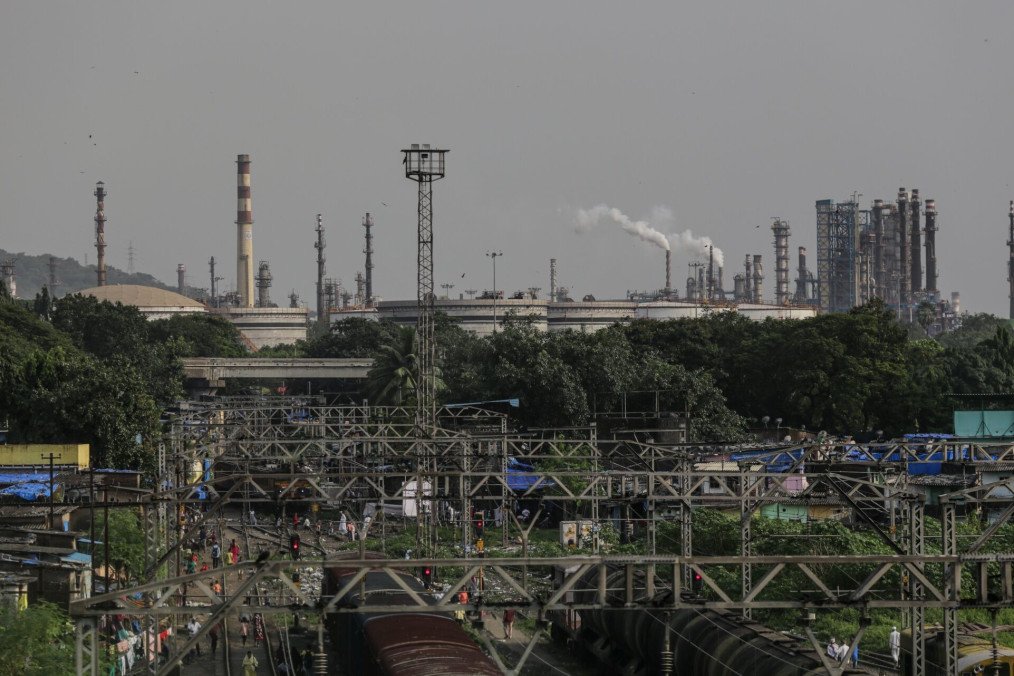
Indian refiners are poised to lift purchases of Russian crude in the coming months as discounts on Urals widen and supplies remain ample, according to a Bloomberg report on October 8.
Urals cargoes loading in November are being offered at $2–$2.50 per barrel below Dated Brent, roughly double the spread seen in July–August when Moscow prioritized domestic customers and tightened exports.
Ship-tracking data indicate an uptick in arrivals this month. Imports of Russian crude to India could average about 1.7 million barrels per day in October—around 6% higher than in September and slightly below the year-earlier pace—Kpler data cited by Bloomberg show.
The prospect of higher intake comes despite tariff pressure from Washington. In August, the US raised duties on most imports from India to as much as 50%, measures the White House linked to New Delhi’s continued purchases of Russian oil. Indian officials have continued talks with the US on a broader trade deal and last month described meetings as “constructive,” even as Washington pressed India to halt Russian oil buys.
Market availability also remains supportive. A government source told Reuters that there is “enough” Russian crude in the market for Indian refiners, with flows buoyed by reduced Russian domestic processing.
Earlier, it was reported that the United States increased tariffs on Indian goods while India maintained it would keep buying Russian oil, with imports around 1.61 million barrels per day accounting for roughly one-third of its supply.
BP (BP) is one of the stocks most watched by Zacks.com visitors lately. So, it might be a good idea to review some of the factors that might affect the near-term performance of the stock.
Over the past month, shares of this oil and gas company have returned -0.7%, compared to the Zacks S&P 500 composite's +4% change. During this period, the Zacks Oil and Gas - Integrated - International industry, which BP falls in, has gained 2%. The key question now is: What could be the stock's future direction?
Although media reports or rumors about a significant change in a company's business prospects usually cause its stock to trend and lead to an immediate price change, there are always certain fundamental factors that ultimately drive the buy-and-hold decision.
Revisions to Earnings Estimates
Rather than focusing on anything else, we at Zacks prioritize evaluating the change in a company's earnings projection. This is because we believe the fair value for its stock is determined by the present value of its future stream of earnings.
We essentially look at how sell-side analysts covering the stock are revising their earnings estimates to reflect the impact of the latest business trends. And if earnings estimates go up for a company, the fair value for its stock goes up. A higher fair value than the current market price drives investors' interest in buying the stock, leading to its price moving higher. This is why empirical research shows a strong correlation between trends in earnings estimate revisions and near-term stock price movements.
BP is expected to post earnings of $0.70 per share for the current quarter, representing a year-over-year change of -15.7%. Over the last 30 days, the Zacks Consensus Estimate remained unchanged.
For the current fiscal year, the consensus earnings estimate of $2.69 points to a change of -17.5% from the prior year. Over the last 30 days, this estimate has changed +1.8%.
For the next fiscal year, the consensus earnings estimate of $2.73 indicates a change of +1.6% from what BP is expected to report a year ago. Over the past month, the estimate has changed +0.7%.
With an impressive externally audited track record, our proprietary stock rating tool -- the Zacks Rank -- is a more conclusive indicator of a stock's near-term price performance, as it effectively harnesses the power of earnings estimate revisions. The size of the recent change in the consensus estimate, along with three other factors related to earnings estimates, has resulted in a Zacks Rank #3 (Hold) for BP.

BELGRADE: The United States has introduced sanctions against Serbia’s main oil supplier, which is controlled by Russia, the company said on Thursday. Serbia’s president said this could have “unforeseeable” consequences for the Balkan country.
He said the sanctions will have “extremely dire consequences” in many aspects: “This is something that will affect every citizen.”
Vucic said Serbia will continue talks with both American and Russian officials, adding that people shouldn’t panic and the government is prepared for the situation.
“Trust your state. We will go through this together,” he said.
Gazprom Neft also owns Serbia’s only oil refinery.
NIS said Thursday it had failed to secure another postponement of the US sanctions, which could jeopardize its efforts to secure oil and gas deliveries in a longer term.
“The special license from the US Department of the Treasury, which enables unhindered operational business, has not yet been extended,” NIS said in a statement. It added that it has stored enough supplies to keep the operation moving for customers for a longer while.
It also said problems could occur at NIS gasoline stations with payments made by foreign bank cards but added that cash payments would be accepted.
The US Treasury’s Office of Foreign Assets Control originally placed sanctions on Russia’s oil sector on Jan. 10 and gave Gazprom Neft a deadline to exit ownership of NIS, which it didn’t do.
US officials have not commented.
Although formally seeking European Union membership, Serbia has refused to join Western sanctions against Russia over its invasion in Ukraine, in part because of the crucial Russian gas deliveries.
The pro-Russian President Vucic is facing one of the biggest threats to more than a decade of his increasingly autocratic rule. Protests have been held by university students and others following the collapse almost a year ago of a concrete canopy at a railway station in the country’s north that killed 16 people.
Many in Serbia believe rampant corruption and nepotism among state officials led to sloppy work on the building reconstruction, which was part of a wider railroad project with Chinese state companies.
Gold's rally has turned heads this year, but silver and platinum are leading a broader rush into hard assets.
Spot silver is hovering around $49 per ounce, up 69% year to date after touching its record high of $49.57 on Wednesday.
Meanwhile, spot platinum is trading near $1,660 per ounce, up a staggering 83% year-to-date and around 13-year highs.
The rush into silver reflects how the white metal — alongside assets like bitcoin — is now seen as "easy-access global inflation havens," wrote Thierry Wizman, a global foreign exchange and rates strategist at Macquarie Group, on Wednesday.
Gold's performance — while impressive — slightly trails silver and platinum.
Spot gold prices are up 54% this year, having smashed through the $4,000 per ounce level to a record high on Wednesday. The yellow metal was trading around $4,037 per ounce at 1:50 a.m. ET on Thursday.
A shift from speculation to structural demand
The synchronized rally across gold, silver, and platinum isn't just about inflation hedging or interest rate expectations — it reflects something deeper, wrote Ole Hansen, the head of commodity strategy at Saxo Bank, on Wednesday.
The powerful gains "point to a broader trend of a rotation into 'tangible stores of value' across the precious metals complex," Hansen wrote.
"In an increasingly fragmented world, the West's weaponization of markets, payment systems, and reserve assets has eroded confidence in traditional safe havens such as the US dollar and Treasuries," Hansen added, highlighting the West's sanctions against Russia for its full-scale invasion of Ukraine in 2022.
That erosion of trust, Hansen argues, is driving both institutional and sovereign investors to seek security outside the traditional financial system.
The shift has fueled an unprecedented wave of gold buying by global central banks — a signal that the appetite for real, unencumbered assets is now structural, not speculative.
"The result is a market no longer dominated by short-term speculative money reacting to real-rate moves, but by a persistent structural bid for security," Hansen wrote.
'Risk-free' does not mean 'trust-free'
Beyond long-term structural flows, geopolitics have added fresh fuel to gold's ascent this year.

FILE - Anglo American CEO Duncan Wanblad speaks during the Investing in African Mining Indaba 2023 conference in Cape Town, South Africa, February 6, 2023. [File photo: Reuters/Shelley Christians]
South African mining veteran Duncan Wanblad on Wednesday lamented the country’s foregone investment in mining, as gold prices surged past $4,000 an ounce — a record high driven by expectations of lower interest rates and safe-haven demand.
Addressing the Johannesburg Mining Indaba conference, Anglo American Plc CEO Duncan Wanblad, whose company exited South Africa’s gold mining sector in 2009, said the country’s mining potential was under-explored “due to unsupportive policy for exploration in the last 20-odd years”.
“That’s a very important part of a mining life cycle. The data will show you that it takes about 17 years from the time that you find the deposit until the time that you get it permitted and ramped up into full production,” Wanblad said.
“It’s a generation of mines that have been foregone,” he added.
On Wednesday, the gold price vaulted above $4,000 an ounce, a new record in a rally driven by expectations of lower interest rates and safe-haven demand, just as mining executives gathered at the Johannesburg conference to discuss the industry’s prospects.
The record revived memories of a visit 26 years ago by South African mining executive Bobby Godsell to Washington and London to lobby the IMF and Britain against a gold sell-off, in a desperate bid to stop prices falling further below $260 an ounce.
At the time, South Africa was a top three gold producer in the world, its output averaging 400 metric tons annually. Its output has fallen from 1,000 metric tons in 1970, when the country was the leading global producer, to 90 metric tons last year.
Today, South Africa’s old, deep shafts are more expensive to run, compared to rivals in Africa, Australia, Canada and South America.
Added to this, South African mining executives have said infrastructure challenges, policy uncertainty and labour unrest are holding back investment into exploration and mine development in the country.
Top South African gold miners Gold Fields (GFIJ.J), opens new tab, founded by Cecil Rhodes in 1887, Harmony Gold and Anglo’s former gold unit, which became AngloGold Ashanti in 2004, have all acquired assets elsewhere in Africa, Australia and the Americas.
Source: Reuters

Gold has soared by 53% to a new record above $4,000 an ounce as investors seek a haven from mounting geopolitical and economic risks.
Spot gold rose to $4,036 in Asian trading yesterday, extending a rally that has more than doubled the price over the past three years.
Analysts attribute the surge to a confluence of crises: Russia’s war in Ukraine, fighting in Gaza between Israel and Hamas that has killed thousands and drawn in Iran and Yemen, and maritime trade disruptions. Concerns over US President Donald Trump’s tariffs, the strength of the dollar, lingering inflation, Federal Reserve independence and sluggish European growth have added to the anxiety.
The rally accelerated after the US government shutdown, now in its second week, delayed key economic data releases. In September alone, gold jumped 12%, lifting silver, platinum and palladium.
Reuters quotes Dan Smith of Commodity Market Analytics as saying: “The rally is unbelievable, telling us that something bad is happening and that we should be nervous.”
Central banks have been another key driver. They are expected to buy 1,000 tonnes of gold in 2025, the fourth consecutive year of heavy purchases as they diversify away from US dollar holdings, consultancy Metals Focus said.
Investment flows into exchange-traded funds (ETFs) backed by bullion have also surged, with a record $64bn invested so far this year, according to the World Gold Council.
Some analysts warn the market is overbought, but see few catalysts to reverse the trend. Goldman Sachs has raised its price forecast to $4,900 an ounce by December 2026.
[Image: Michael Steinberg: https://www.pexels.com/photo/gold-bars-366551/]
https://dailyfriend.co.za/2025/10/09/gold-price-reaches-new-record-amid-global-jitters/
London’s metal traders might want to hold on to their hard hats.
Citi has turned more bullish on both copper and tin, arguing that the market is starting to look beyond short-term demand worries and towards a tighter supply picture.
In its latest Metal Matters note, the bank lifts its near-term copper forecast to $11,000 a tonne, up from $10,500, and sees the red metal averaging $12,000 by the middle of 2026.
That outlook is supported by what Citi calls “growing confidence” that prices can break through cyclical headwinds as the longer-term demand story reasserts itself.
A combination of energy transition spending, recovering industrial activity and slowing mine supply could, it says, bring copper to $12,000 sooner than expected.
Tin, the smaller cousin in the industrial metals family, gets an equally upbeat assessment.
Citi now targets $40,000 a tonne, also by 2026, citing the same blend of structural and cyclical supports. Demand from electronics and renewables continues to rise, while new supply remains thin on the ground.
For London-listed miners such as Anglo American PLC (LSE:AAL), Antofagasta PLC (LSE:ANTO) and Glencore PLC (LSE:GLEN) (all heavily exposed to copper) the shift in tone will be welcome after a subdued summer for base metals.
A sustained move higher in copper prices would feed directly into stronger earnings and cash flow, especially for those with low-cost Latin American production.
Tin’s rebound could also provide a tailwind for smaller producers and traders on the London Metal Exchange, which has struggled with low liquidity since 2022’s market turmoil.
Citi’s call adds to a growing sense that industrial metals are on firmer footing as the global economy steadies and the supply side tightens.
Whether that translates into a full-blown rally remains to be seen, but the bank’s message is clear: both copper and tin look poised for a stronger finish to the decade.
https://ima-api.org/copper-and-tin-take-centre-stage-in-banks-bullish-metals-outlook/
The global copper market is going from surplus to shortage, according to the latest International Copper Study Group (ICSG) report. The 178,000-ton surplus projected for 2025 could flip to a 150,000-ton deficit as supply struggles to keep pace with demand.
“Lower than previously anticipated refined copper production will be constrained by the lower availability of copper concentrate,” ICSG noted.
The mine output is forecast to rise by 2.3% in 2026 as new capacity comes online in countries such as Mongolia and Russia. Yet the rebound won’t offset disruptions in key producers such as Chile, Indonesia, and the Democratic Republic of Congo. In addition, demand growth from Asia and the energy transition sectors will remain robust, further tightening the market.
Copper’s rally, however, has been quieter than the fireworks in gold or silver. While investors have poured into precious metals amid macroeconomic turmoil, copper has been grinding higher due to supply constraints and a softer U.S. dollar.
Morgan Stanley highlighted in a note on Wednesday that a softening dollar and supply disruptions at major mines, such as Ivanhoe’s (OTC:IVPAF) Kamoa-Kakula, Codelco’s El Teniente, and Freeport-McMoRan’s (NYSE:FCX) Grasberg, are supporting higher prices.
The Grasberg tragedy, which halted output and left several workers dead, sent Freeport-McMoRan shares tumbling more than 15% in a single day. Analysts say these disruptions, combined with delayed mine expansions, could reduce 2026 supply forecasts by hundreds of thousands of tons. Morgan Stanley expects copper prices to average $4.83/lb in 2026, roughly in line with current levels but “well above the year-to-date average.”
Given the market dynamic, the bank has upgraded Southern Copper Corp. (NYSE:SCCO) to Equal Weight with a $132 per share mid-2026 price target. The bank noted copper exposure and the dividend upside.
Still, promising copper mines are few and far between. After years of underinvestment, exploration budgets are at multi-decade lows, and permitting delays are lengthening project timelines. The International Energy Agency warned that without discoveries, annual copper output could fall below 20 million tons, while demand is expected to approach 33 million tons.
Although lucrative, major sector consolidations, such as the $53 billion merger between Anglo American (OTCQX:NGLOY) and Teck Resources (NYSE:TECK), may not be the ultimate solution. The 175,000 surge in additional output by 2030 might be an exception, rather than the rule.
“Newly enlarged miners aren’t guaranteed to boost production,” consultancy Wood Mackenzie warned per Reuters, noting that companies often focus on high-return assets rather than expanding total volume.
Price Action: SCCO stock was trading higher by 2.17% to $135.40 premarket at last check Thursday. FCX was up 3.13%.

The Association of Mining and Exploration Companies (AMEC) Chief Executive Warren Pearce says the latest investments to keep Glencore’s (LSE:GLEN) Mount Isa copper smelter and Townsville copper refinery operational is the “right decision”.
“This investment ensures Australia retains critical processing capability at a time when global demand for our minerals is at a premium,” Pearce says.
As Mining.com.au reported, the Australia Federal and Queensland governments signed a heads of agreement with Glencore for a $600 million support package to keep the smelter and refinery running for the next three years.
The funding will be provided in three payments, contingent on completing a transformational study, alongside other review points, protecting more than 600 direct jobs and a further 500 jobs.
Pearce adds that the government’s backing for the smelter gives confidence to explorers and junior to mid-tier mines across the region.
“Knowing there’s a viable processing pathway in place helps justify new exploration investment and keeps the pipeline of projects alive,” he says.
All things critical
According to the Department of Industry, Science and Resources’ (DISR) latest Resources and Energy Quarterly, Australia is ranked the second in the world for its copper resources and the fifth largest refined exporter.
In 2024, the nation produced 210,000 tonnes of copper at its largest mine. In the first half of 2025, Australian mined copper production reached 363,000 tonnes, representing an 8.9% decrease year-on-year.
Despite this, copper output is forecast to grow on average by 2.8% year-on-year from 2024-25 to reach 760,000 tonnes by 2026-27, as reported by DISR.
This increase is driven by expansion at existing mines and ramp up at new mines.
Global copper demand is forecast to rise to meet requirements for clean energy technologies, data centres, and electricity infrastructure. Copper demand is expected to lag demand as new mines are slow to develop and trade barriers interrupt scrap flows.
https://mining.com.au/multi-million-dollar-mount-isa-investment-ensures-processing-capability-amec/
Coking Coal Market:
The quoted price for low-sulphur coking coal in Linfen is 1,600 yuan/mt. The quoted price for low-sulphur coking coal in Tangshan is 1,450 yuan/mt.
Regarding the fundamentals of raw materials, most coal mines are operating steadily, with a few undergoing maintenance shutdowns. Overall production has only slightly decreased, having a limited impact on the market. Downstream coke and steel enterprises show moderate purchasing enthusiasm, and the supply-demand imbalance is not immediately apparent, still providing support for coking coal prices. The post-holiday performance of the coking coal market has been average, with slight corrections in the prices of some high-priced coal types, while most coal prices remain stable, and the cost support for coke remains intact.
Coke Market:
The nationwide average price for first-grade metallurgical coke - coke dry quenching is 1,790 yuan/mt. The nationwide average price for quasi-first-grade metallurgical coke - coke dry quenching is 1,650 yuan/mt. The nationwide average price for first-grade metallurgical coke - wet quenching is 1,440 yuan/mt. The nationwide average price for quasi-first-grade metallurgical coke - wet quenching is 1,350 yuan/mt.
During the National Day holiday, the coke market held up well. On October 1st, mainstream steel mills in Shandong accepted the first round of coke price increases, officially implementing the first round of price hikes, with wet-quenched coke rising by 50 yuan/mt and dry-quenched coke by 55 yuan/mt. In terms of market fundamentals, coke production and supply remained normal during the National Day holiday. Due to increases in both coking coal and coke prices, coking costs rose, squeezing coke producers' profits and curbing the expansion of coke supply. Additionally, downstream purchasing enthusiasm was strong during the holiday, with most coke producers selling their products immediately upon production, keeping their coke inventories at low levels. Only in a few regions did logistics face disruptions due to the holiday and rainy weather, affecting shipments. Looking ahead, coke producers' enthusiasm for production remains moderate, and coke supply is relatively stable. Most steel mills have coke inventories at safe levels, and their willingness to restock after the holiday is average. In summary, the short-term coke market is expected to remain stable, with significant difficulties anticipated for further coke price increases. [SMM Steel]
https://news.metal.com/newscontent/103560479/[SMM-Survey]-Daily-Coking-Coal-Briefing:-October-9-2025
Swiss-headquartered miner Ferrexpo, whose main interests are in Ukrainian iron ore assets, has announced its production results for the third quarter and the first nine months of 2025.
In the third quarter of this year, the company’s total commercial production moved up by 3.3 percent compared to the previous quarter to 1.51 million mt and down by 28.0 percent compared to the second quarter. In particular, the company’s output of pellets totaled 638,963, decreasing by 22.3 percent quarter on quarter.
In the first nine months, Ferrexpo’s total commercial production totaled 5.06 million mt, up by 0.9 percent, while its pellet output was 2.8 million mt, down by 38.5 percent, both year on year.
According to the producer’s report, due to the ongoing suspension of VAT refunds and the resulting reduction in financial liquidity, Ferrexpo has been forced to downscale operations from two pelletizing lines to just one.
Lucio Genovese, interim executive chair, said, “The third quarter of 2025 was the first quarter that we experienced the full impact of the Ukrainian tax authorities’ decisions to suspend the refunds of VAT to our Ukrainian subsidiaries. Despite the continued curtailment in pelletizing capacity to just one line, we achieved total production of 1.5 million mt for the quarter. Strong demand from Chinese customers for our high-grade low-alumina concentrates allowed us to increase production by 36 percent quarter on quarter, and almost fourfold for the year to date compared to the same period last year.”


